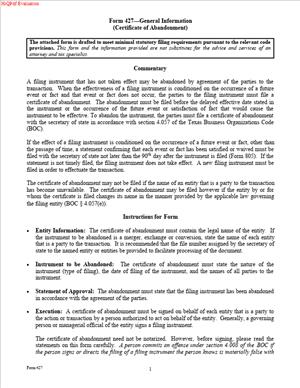
Form 427 – Certificate of Abandonment
Fill out nowJurisdiction: Country: United States | Province or State: Texas
What is a Form 427 – Certificate of Abandonment?
Form 427 is a filing you submit to the Texas Secretary of State to stop a previously filed formation or business transaction from taking effect. In plain terms, you use it to cancel a filing that has a delayed or conditional effective date before that filing becomes effective. After the Secretary of State accepts Form 427, the earlier filing will not go live.
Who typically uses this form?
Governing persons and authorized signers for Texas filing entities and foreign filing entities. That includes corporate officers, managers, or members of an LLC, general partners of a limited partnership, governing persons of a nonprofit, and organizers who filed a certificate of formation with a future effective date. It also includes authorized representatives of multiple entities involved in a pending transaction, such as a merger or conversion that has not yet taken effect.
Why would you need this form?
Business plans change. Deals fall through. Boards change direction. Financing gets delayed. Diligence reveals new risks. You might have queued a filing to become effective on a future date to allow time for closings or internal approvals. If the transaction no longer makes sense, you can file a certificate of abandonment to prevent that queued filing from taking effect.
Typical usage scenarios
- You filed a certificate of merger with a future effective date to coordinate with a closing. The parties later decide not to proceed. You file Form 427 to abandon the merger before the effective date.
- You filed a certificate of conversion for your LLC to convert into a corporation effective next month. Investor terms change, so you pause the conversion. You file Form 427 to cancel the pending conversion.
- You filed a certificate of formation with a January 1 effective date to match your fiscal year. Strategy shifts in December. You file Form 427 so the entity does not form on January 1.
- You filed an application for registration as a foreign entity with a delayed effective date tied to a lease start. The lease does not finalize. You file Form 427 to stop the registration from taking effect.
- You filed a filing instrument conditioned on a future event or approval. The condition fails. You file Form 427 to confirm that the pending filing will not become effective.
The form is a safety valve. It lets you stop a filing that you already submitted but scheduled to become effective later. It is not a tool to undo something that has already taken effect. If the original filing is already effective, you will need a different filing, such as a termination, withdrawal, or a new transaction, to reverse or unwind the change.
When Would You Use a Form 427 – Certificate of Abandonment?
Use Form 427 when you have a filed instrument on record with the Texas Secretary of State that has a delayed or conditional effective date, and you decide not to go forward. The most common users are business owners, managers, corporate officers, general counsel, deal counsel, or paralegals handling entity management.
For example, assume you filed a certificate of merger to consolidate two Texas LLCs effective on the first day of the next quarter. The boards approve, and the instrument is filed with a delayed effective date. During final diligence, a significant liability surfaces. You and the other entity decide to halt the merger. Because the merger is not yet effective, you can file Form 427 to abandon it. The State will accept the abandonment if timely, and the merger will not take effect on the scheduled date.
Or consider a certificate of conversion. You are converting a Texas LLC to a Texas corporation to align with venture financing. You file the conversion with a delayed effective date to line up with a funding round. The round gets pushed. You should not let the conversion take effect without financing in place. You can file Form 427 to abandon the conversion. Later, when you are ready, you can file a new conversion.
Organizers also use Form 427 for certificates of formation filed with a future effective date. Many companies pick a future date for tax or operational reasons. If circumstances change before that date, file an abandonment so the formation does not occur. This avoids forming an entity that you would then need to terminate.
Foreign entities use Form 427 when they file an application for registration with a delayed effective date tied to a facility opening, contract commencement, or hiring milestone. If that trigger falls away, file the abandonment to avoid triggering franchise tax nexus or registered agent obligations in Texas prematurely.
You can also use the form when a filing instrument states that its effectiveness is conditioned on approval by a regulator, shareholder vote, or closing deliverables, and the condition fails. Filing the abandonment clarifies the public record and prevents confusion.
One crucial timing point: You must file Form 427 and have it accepted before the scheduled effective time of the original filing. If you miss that window and the original filing becomes effective, abandonment is no longer available. You will need to evaluate a termination, rescission transaction, or other corrective steps. If your earlier filing had no delayed or conditional effective date and already took effect on submission, Form 427 is not the right tool.
Legal Characteristics of the Form 427 – Certificate of Abandonment
Form 427 is a statutory filing that is legally binding when accepted for filing by the Texas Secretary of State. It derives its effect from Texas law, which allows a filer to abandon a filing instrument before it becomes effective if the instrument specified a delayed effective date or was conditioned on a future event. Once the Secretary of State files the certificate of abandonment, the earlier filing instrument does not take effect. In practical terms, the State treats the pending filing as canceled.
What ensures enforceability?
Three elements matter:
- Timing. The certificate of abandonment must be filed before the effective date and time of the underlying filing. If the underlying instrument has already become effective, abandonment is not available.
- Authority. The abandonment must be authorized in the manner required by law and, if applicable, by the plan or by the governing documents of the entity. For example, if a board approved a merger and the plan of merger specifies how abandonment may occur, you must follow that method. If the plan is silent, the same level of authorization used to approve the original filing is a reliable benchmark. The person signing Form 427 must have authority to bind the filing entity or entities.
- Specificity. The certificate must clearly identify the filing being abandoned. That includes the exact name of the entity or entities, the title of the filing instrument (for example, certificate of merger, certificate of formation, certificate of conversion, application for registration), the date the instrument was filed, and the Texas file number. The certificate must include an express statement that the identified filing is abandoned before it takes effect.
Once filed, the legal effect is simple: the original pending filing has no legal effect on or after its scheduled effective date. It does not amend the public record; it prevents the scheduled change from occurring. If third parties were relying on the pending change, they must be notified through normal business communications, because the public record will reflect that the change never took effect.
General legal considerations
- You cannot partially abandon a filing. The certificate applies to the entire filing instrument identified. If your deal requires a different structure, you must file a new instrument.
- If your original instrument had conditions for effectiveness, and those conditions failed, filing Form 427 is still recommended. It creates a clear public record and avoids any dispute about whether the filing might have become effective.
- The certificate of abandonment does not address contractual obligations you may have with counterparties. Review letters of intent, merger agreements, conversion plans, and term sheets. You may have notice, break fee, or expense provisions to honor.
- Consider tax, licensing, and regulatory consequences. If you planned to form or convert for tax reasons, coordinate changes with your advisors. If you planned to register a foreign entity for a license application, confirm whether the agency requires a different path.
- If there are related filings with counties or other jurisdictions, such as assumed name filings or local permits, the abandonment of the state filing does not automatically unwind those. Close the loop with those offices as needed.
- If you realize an error in the certificate of abandonment after filing, a corrective filing may be available. If you realize you did not timely file the abandonment and the original filing is effective, consult on the proper unwind or termination process. Do not rely on Form 427 after effectiveness.
The bottom line: Form 427 is a precise tool with a narrow window. Use it to stop a queued filing. Ensure proper authority and timing. Keep your internal approvals and notices aligned with the filing.
How to Fill Out a Form 427 – Certificate of Abandonment
Follow these steps to complete and file Form 427 correctly.
1) Confirm that abandonment is available.
- Verify that the original filing has not yet become effective. Review the stamped copy of the original filing instrument. Locate the delayed effective date and time, or the condition for effectiveness.
- Note the Texas file number assigned to the original instrument. You will need it for the abandonment.
- Check the plan or agreement (if any) for how abandonment must be authorized. Many plans allow boards, managers, or authorized officers to abandon before effectiveness without owner approval. Follow the plan’s method if it exists.
2) Obtain the required internal approvals.
- Prepare and circulate a short board resolution, manager consent, member consent, or partner consent, as needed. The consent should authorize abandonment of the specific filing by name and file number and authorize a named officer or agent to sign and file Form 427.
- If multiple entities are parties to a pending merger, acquisition, or conversion, confirm that each entity takes the required action. Some transactions require authorization from each party.
- Keep the signed resolutions or consents with your records. You do not need to attach them to the form unless you choose to include explanatory material. The Secretary of State relies on the signer’s authority as stated.
3) Complete the identification section.
- Enter the legal name of the filing entity. Use the exact name as it appears in the original filing with the Secretary of State. If the filing to be abandoned involves multiple entities (such as a merger), list each party as directed on the form. If space is limited, prepare an attachment with the full list and reference it in the form.
- If the entity is foreign, include its home jurisdiction as requested by the form.
4) Identify the filing instrument being abandoned.
- State the title of the filing instrument you wish to abandon, such as “Certificate of Merger,” “Certificate of Conversion,” “Certificate of Formation,” or “Application for Registration.”
- Provide the date the original instrument was filed with the Secretary of State.
- Provide the Texas file number of the original filing. You can find it on the file-stamped copy or in your confirmation letter.
- If the original instrument had a delayed effective date or time, you may include that date and time in the description. This helps the Secretary of State process the abandonment before the effective moment.
5) State the abandonment.
- Insert a clear statement that the identified filing instrument is abandoned before it takes effect. Use direct language. Example: “The filing entity hereby abandons the above-identified filing instrument before it becomes effective.”
- If the plan of merger or plan of conversion specifies the authority for abandonment, you may reference that provision. This is optional but can be helpful where multiple parties are involved.
6) Specify the effective date of the abandonment, if applicable.
- Unless you specify a delayed effectiveness for the abandonment itself, the abandonment will take effect when filed by the Secretary of State.
- If you choose to specify a delayed effective date and time for the abandonment, ensure it occurs before the effective date and time of the underlying filing. Do not cut it close. Delays increase risk.
7) Add the organizational action statement, if requested.
- If the form prompts you to indicate how abandonment was authorized, describe it briefly. Example: “Abandonment authorized by the board of directors in accordance with the plan of merger.” Or: “Abandonment authorized by the manager per the operating agreement.”
- Keep the statement concise and consistent with your internal consents.
8) Provide contact information.
- List a name, mailing address, email, and phone number for the person the Secretary of State can contact with questions and for return of evidence of filing. This can be internal legal, your outside counsel, or a paralegal.
- If you want expedited processing, indicate that in your cover letter or as instructed by the filing channel you use. Be prepared to pay the expedite fee in addition to the filing fee.
9) Sign the form.
- The signer must have authority. For a corporation, an officer signs. For an LLC, a manager or authorized member signs. For a limited partnership, a general partner signs. For a nonprofit, a duly authorized officer or director signs. For a multi-entity transaction, an authorized signer for each required party signs as the form directs.
- Sign and date the form. Print the signer’s name and title. If signing on behalf of an entity, include the entity name and the capacity. Example: “ABC Holdings, LLC, a Texas limited liability company, by Jane Smith, Manager.”
- Texas accepts legible electronic signatures submitted through its online system. If filing by paper, sign in ink.
10) Prepare any attachments.
- If you need more room for party names, include an attached schedule that lists all parties and their jurisdictions exactly as they appear in the original filing.
- If you are abandoning multiple related filing instruments, file a separate Form 427 for each instrument. Do not stack multiple instruments into one certificate unless the form and instructions allow it.
11) Pay the state filing fee.
- Include the required filing fee. If filing online, pay by card or electronic payment. If mailing or delivering, include a check or money order payable as instructed on the form. If requesting expedited handling, include the expedite fee.
12) File the form.
- File online for the fastest processing, or submit by mail or in person. Ensure the Secretary of State receives and files the abandonment before the original filing’s effective time.
- If timing is tight, use expedited processing and a same-day delivery method. Consider calling ahead to confirm cut-off times for same-day filing.
13) Track confirmation and update stakeholders.
- Keep the file-stamped copy or the electronic confirmation in your records. Verify that the State’s record reflects the abandonment.
- Notify internal stakeholders, counter-parties, lenders, and advisors that the pending filing will not take effect. Cancel any closing or operational steps tied to the abandoned filing.
- If you plan to pursue a different structure, prepare and file new instruments as needed. Treat them as new transactions.
Common pitfalls to avoid
- Missing the deadline. If the original filing becomes effective, abandonment is no longer available. Build a calendar reminder well before the effective time.
- Incomplete identification. Omitting the file number or misnaming the original filing can cause delays. Cross-check your data against the file-stamped copy.
- Insufficient authority. Ensure the signer has clear authority. When in doubt, get a written consent and keep it in your file.
- Delaying the abandonment effective time. Unless you have a good reason, let the abandonment take effect on filing. This reduces risk.
- Assuming abandonment fixes related filings. If you filed related documents in other jurisdictions, handle those separately. The Texas certificate of abandonment applies to the Texas filing instrument you identify.
If you follow these steps, you can complete and file Form 427 with confidence. You will prevent an unwanted formation, registration, merger, conversion, or other filing from taking effect, and you will keep your public record clean and accurate.
Legal Terms You Might Encounter
- When you complete Form 427 – Certificate of Abandonment, you see terms that carry specific meaning. Understanding them helps you decide if the form fits your situation and how to complete it correctly.
- A filing instrument is the document you previously filed with the state that you now want to abandon. It might be a certificate of formation, a certificate of merger, a conversion filing, or an amendment. On Form 427, you identify that prior filing instrument so the state can locate and cancel it before it takes effect.
- The effective date is when a filed document becomes legally operative. Some filings take effect when filed. Others include a future date or a condition. Form 427 works only if the prior filing has not taken effect yet. You use the form to stop that future effectiveness.
- Delayed effectiveness is when your prior filing specifies a future date or a condition that must occur first. For example, you might have set a merger to become effective next month. With Form 427, you can abandon that merger before the date arrives or before the condition occurs.
- Governing authority refers to the people or body that controls the entity’s decisions under its governing documents and law. For a corporation, this often means the board of directors. For an LLC, it can be members or managers. Form 427 must be authorized by the same level of approval required to approve the original filing instrument or by the plan itself if it allows abandonment.
- A plan of merger or a plan of conversion is a written agreement describing how entities will merge or convert. It often includes who can abandon the transaction and how. If your prior filing is based on a plan, you follow the plan’s abandonment rules and document that approval before signing Form 427.
- An organizer, director, manager, or authorized officer is the person allowed to sign on behalf of the entity. The right signer depends on the entity type and the approval received. Form 427 requires a person with proper authority to sign or certify the abandonment.
- The SOS file number is the unique number the state assigned to the prior filing instrument. It helps the state find the exact record to cancel. You enter this number on Form 427 along with the entity name and the date of the prior filing.
- Abandonment means you voluntarily cancel a filing instrument before it becomes effective. It stops the filing from taking legal effect as if it never took effect. Form 427 formalizes that cancellation with the state.
- Consent or approval is the internal authorization needed to take action. If the original filing required member, shareholder, or board approval, the abandonment likely requires similar approval unless your plan allows a different process. You should document that approval and be ready to certify it when you sign Form 427.
- Conditional effectiveness means your filing becomes effective only if a specific event occurs. For instance, a merger could be effective on the later of the two dates or upon receipt of a license. If the condition has not occurred yet, Form 427 lets you abandon the filing before the condition is met.
FAQs
Do you need Form 427 if your filing already took effect?
No. Form 427 is only for filings that are not yet effective. If a filing has already taken effect, you cannot abandon it. You must undo it using a different process, such as a termination, new amendment, or another corrective filing. That path depends on what the effective filing did, and it may require new approvals.
Can you use Form 427 to cancel a certificate of formation before the entity starts?
Yes, as long as the certificate of formation was filed with a delayed effective date or condition and that date or condition has not occurred. If the entity already came into existence, Form 427 will not work. You would need to dissolve or terminate the entity, which is a different filing and process.
Who can sign Form 427?
A person with authority under your governing documents and state law. That could be a director, officer, manager, member, general partner, or organizer, depending on the entity type and the filing being abandoned. If a plan of merger or conversion gives a specific party the power to abandon, have that party sign.
Do you need the same level of approval to abandon as you needed to approve the original filing?
Usually yes, unless your plan or governing documents say otherwise. If shareholders, members, or partners voted on the original filing, expect to obtain comparable authorization to abandon. Document the approval in minutes or a written consent. You certify it when you sign Form 427.
Can you get a refund of the fee you paid for the original filing if you abandon it?
Generally, no. The fee covers the processing of the original filing, even if you later abandon it. Treat the abandonment filing fee as a separate cost. You should plan for both the original filing fee and a new fee to file the abandonment.
How quickly does a certificate of abandonment take effect?
Once accepted by the state, the abandonment takes effect according to the state’s record, usually upon filing. If you are facing a near-deadline for a delayed effective date, file as soon as possible. If timing is tight, submit promptly and monitor acceptance so the original filing does not slip into effect.
Can you abandon only part of a filing, like one entity in a multi-entity merger?
No. Form 427 abandons the entire filing instrument identified in the form. If the original transaction involved multiple entities or steps, you may need a new approach if you want to alter only one part. Consider whether a new amendment filing is more appropriate for a partial change.
Will abandonment affect related filings, like name reservations or assumed names?
Abandonment cancels only the identified filing instrument. It does not cancel other, separate filings. If you need to change or cancel related filings, make separate filings for those items. Review your records for dependencies so your public record stays consistent.
Can you file Form 427 electronically?
Yes, you can typically file electronically or by paper. Choose a method that fits your timeline and your need for speed. Confirm the current filing options and any extra fee for expedited handling before you submit.
What happens if the condition in a conditional effective filing occurs on the same day you try to abandon?
The sequence matters. If the condition occurs and the filing becomes effective before your abandonment is filed, you are too late. File the abandonment before the condition is satisfied or before the delayed effective date arrives.
Checklist: Before, During, and After the Form 427 – Certificate of Abandonment
Before signing
- Identify the exact filing you want to abandon. Note the entity name, SOS file number, and the date it was filed.
- Confirm the filing has not yet taken effect. Check the effective date or any stated condition.
- Gather internal approvals. Prepare board minutes, member consents, partner approvals, or organizer statements that authorize abandonment.
- If the filing is based on a plan of merger or conversion, review the plan’s abandonment clause. Confirm who can authorize and sign.
- Confirm signer authority. Identify the officer, manager, member, partner, or organizer who will execute the form.
- Have a copy of the prior filing instrument and your approval documents handy. You may need specific details for the form.
- Verify fees and payment method. Budget for the abandonment fee and any expedited fee.
- Confirm your contact information and a return email or mailing address for acknowledgments.
- Align stakeholders. Notify lenders, investors, and other parties who expected the original filing to take effect.
During signing
- Verify the exact legal name of the entity as it appears on the state’s records.
- Enter the correct SOS file number for the filing you are abandoning. Avoid reusing a formation file number if you are abandoning a different related filing.
- Provide the correct date of the original filing instrument. Check your filing acknowledgment to avoid typos.
- Confirm the statement of abandonment clearly applies to the entire filing instrument.
- Certify the approval. If the form requires a representation of authorization, ensure it matches your internal records.
- Ensure the signer’s title matches their authority (e.g., President, Manager, Managing Member, General Partner, Organizer).
- Review the effective date section. Confirm you are still within the window to abandon.
- Check for required attachments, if any. For complex transactions, include any supplemental explanation if the form allows it.
- Proofread all entries. Small errors can delay processing or misdirect the abandonment.
After signing
- File the form with the state. Choose electronic filing for speed or mail for a paper record.
- Pay the fee using an accepted payment method. Include any required cover sheet if you file by mail or fax.
- Track acceptance. Watch for the state’s acknowledgment that the abandonment is filed.
- Confirm the original filing is no longer pending or scheduled to take effect. Verify status in the public record.
- Notify stakeholders that the filing was abandoned. Include investors, lenders, counterparties, and service providers.
- Update internal records. Keep a copy of Form 427, your approval documents, and the state’s acknowledgment in your minute book or company record book.
- Review related filings. If you need to adjust names, qualifications, or licenses, file those changes separately.
- Reassess timelines. If you plan to refile a revised transaction, adjust your approvals, closing documents, and effective dates accordingly.
Common Mistakes to Avoid
- Filing after the effective date has passed. If the original filing has already taken effect, Form 427 will not help. Don’t forget to check the effective date and any conditions before you submit, or you may need a more complex fix.
- Using the wrong SOS file number. Abandonment only applies to the specific filing instrument you identify. If you list the formation file number instead of a later amendment or merger file number, the wrong record remains pending, and the filing you meant to stop may go effective.
- Skipping internal approvals. If you do not obtain the required board, member, or partner approval, the abandonment can be challenged internally. Don’t forget to match the approval level used for the original filing or follow the plan’s abandonment clause.
- Letting the wrong person sign. If the signer lacks authority, the state can reject the filing, or it may raise enforceability questions. Don’t forget to confirm the signer’s role and title match the authority granted in your documents.
- Assuming abandonment cancels everything. Abandonment cancels only the identified filing instrument. Don’t forget to handle related filings, contracts, or notices. Misalignment can cause name conflicts, licensing issues, or stakeholder confusion.
What to Do After Filling Out the Form
- File the form promptly. If your original filing has a near-term effective date or condition, speed matters. Submit electronically if timing is tight, or use the fastest paper method you can manage.
- Verify acceptance. Watch for confirmation from the state that your certificate of abandonment is filed. Keep that acknowledgment with your records. This proof helps you show that the original filing never took effect.
- Confirm status in the public record. Search your entity’s record to make sure the abandoned filing no longer shows a pending effective date. If the system still shows it as pending, follow up to resolve the status before the effective date arrives.
- Notify counterparties. Share a short notice with transaction parties, lenders, and investors. Make it clear that the filing was abandoned and will not become effective. This avoids reliance on a transaction that will not occur.
- Align operational changes. If you prepared for the original filing—like new letterhead, bank accounts, or tax registrations—pause those changes. Reverse or hold them until you finalize a new plan.
- Address related filings. If the original filing depended on a name change, a merger, or a conversion, review any related registrations or licenses. File separate amendments or withdrawals if you no longer need them.
- Evaluate next steps. If you still want to move forward with a revised transaction, draft new approvals and filings. Consider a new timeline that avoids last-minute changes. Build in buffers for internal approvals and state processing.
- Store your records. Keep the signed Form 427, internal approvals, and the state acknowledgment in your entity’s record book. Label them clearly so anyone reviewing your records sees the final outcome and the reason the original filing did not take effect.
- Plan communications. If customers, suppliers, or employees expected a merger or conversion, provide a brief update. Set expectations about timing and whether a revised transaction may follow.
- Review obligations. If any contracts or financing agreements were contingent on the original filing, notify the other parties. Confirm whether any milestones or covenants need adjustments in light of the abandonment.
Disclaimer: This guide is provided for informational purposes only and is not intended as legal advice. You should consult a legal professional.