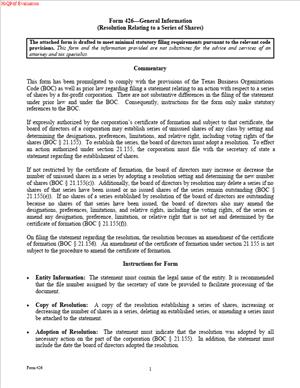
Form 426 – Resolution Relating to a Series of Shares
Fill out nowJurisdiction: Country: United States | Province or State: Texas
What is a Form 426 – Resolution Relating to a Series of Shares?
Form 426 is a filing you submit to the Texas Secretary of State when your board adopts a resolution that creates or changes a “series” of shares within an authorized class of stock. In plain terms, it is the official document that puts your board’s share designations on the public record and folds those terms into your company’s governing documents.
Think of it as Texas’s version of a “certificate of designation.” It captures the board-approved terms for a specific series, like Series A Preferred Stock, including the number of shares and all rights, preferences, and limitations tied to those shares. After acceptance, the series terms become part of your formation records, and investors, lenders, and courts can rely on them.
Who typically uses this form?
Texas for-profit corporations. This includes early-stage companies planning their first preferred financing, growth companies creating new preferred series for later rounds, and established corporations reclassifying or adjusting share structures. You will not use this form if you are an LLC, nonprofit corporation, or limited partnership. It is meant for corporations with authorized stock.
You would need this form if your certificate of formation gives your board the authority to create series and fix their terms. Many Texas corporations include this authority at formation, often called “blank check” preferred. Once the board exercises that authority by resolution, the company must file Form 426 to make the designation effective in the public record. Without the filing, the series is not properly established for corporate law purposes in Texas.
Typical usage scenarios include a venture-backed company creating a Series A Preferred Stock with dividend rights, liquidation preferences, conversion features, and voting rights aligned with a negotiated term sheet. You also use it to increase or decrease the number of shares in an existing series, change the designation or terms of a series if allowed, or eliminate a series when no shares of that series remain outstanding. In each case, your board takes action, and you memorialize that action through Form 426.
Form 426 is not a substitute for a stockholders’ agreement or an amendment to your certificate of formation that changes classes or total authorized shares. It only works when your certificate already authorizes the board to set or change series terms within a class. It is also not a securities filing. It does not replace any notices or compliance steps you may need for your financing.
In short, Form 426 is the official statement of your board’s resolution that creates or adjusts a series of shares. You use it to lock the terms into the state record and make them enforceable against the company and third parties.
When Would You Use a Form 426 – Resolution Relating to a Series of Shares?
You use Form 426 when you need to create or update a series of stock and your board has the authority to do so under your certificate of formation. The most common trigger is a financing round. Your board will designate a series of preferred stock, set the number of shares, and define the rights. Once the board approves the resolution, you file Form 426 to put those terms on record. Investors usually want proof that the designation is on file before or at closing.
You also use Form 426 to fine-tune your capital structure as your business evolves. For example, you might reduce the number of shares in a prior series to free up authorized but unissued shares for a new series. Or you might increase a series if the round size is larger than expected. If your certificate allows it, you might change certain series terms for shares that are not yet outstanding. If no shares of a series are outstanding, you can eliminate that series and return those shares to the class pool.
Founders and general counsel use this form to keep the public record aligned with board decisions. Corporate secretaries use it to maintain a clean minute book and cap table. Outside counsel uses it during closings to ensure all stock designations are legally effective. If you are converting notes that specify a preferred series on conversion, you will file this form to define that series before issuing the shares.
You might also use Form 426 to correct a past designation that did not align with your certificate’s authority. If your certificate authorizes a series but the original resolution omitted a key term, your board can adopt a corrective resolution and file an updated statement. If the change would affect outstanding shares, you will first confirm what approvals are required and whether your certificate permits the board to make the change without stockholder consent.
If you are restructuring or consolidating share classes, Form 426 can support interim steps. You might use it to reclassify a portion of a class into a new series ahead of a merger. If your board needs to rank a series senior to or on parity with existing series, you will include that ranking and any cross-series protections in the resolution you file.
In each case, the timing matters. You want the filing to be effective when the deal terms are final, but before you issue shares under those terms. You can choose to have the filing take effect upon acceptance or on a delayed effective date to align with your closing.
Legal Characteristics of the Form 426 – Resolution Relating to a Series of Shares
Form 426 is legally binding because it records a board resolution that your certificate of formation authorizes. Once filed and effective, the series terms become part of your company’s formation record. That means the company, its stockholders, and third parties are charged with notice of the series’ rights and limitations. Investors and lenders rely on the filing to confirm that the series exists and has the stated terms.
Enforceability depends on a few core elements. First, your certificate of formation must authorize the board to create series and fix their terms. That authority is usually explicit. If you do not have that authority, you cannot use this form to create new series. You would instead amend your certificate to add the authority before filing a series resolution.
Second, the board’s resolution must be properly adopted. You need a quorum, proper notice or unanimous written consent, and a resolution that clearly states the series designation, the number of shares, and all rights, preferences, and limitations. The resolution should also state that the board is acting under authority granted by the certificate. If you are changing a series or eliminating it, the resolution must meet the prerequisites, such as no shares being outstanding for an elimination.
Third, the filing itself must include the required statements. It must identify the corporation, set out the resolution text, and include any statements about outstanding shares that the change requires. It must be signed by an authorized officer. You can choose an immediate or delayed effective date, but if you pick a delay, you must follow the timing rules for delayed effectiveness.
There are general legal considerations to keep in mind. You cannot exceed the total authorized shares of the class. If you are increasing a series, ensure you have enough authorized but unissued shares available in that class. If you are changing series terms that would affect existing stockholders, confirm whether additional approvals are required outside the board. The series terms cannot be inconsistent with your certificate or with any binding agreements the company has with stockholders.
The filing is a public record. Treat the resolution text as a document that investors and competitors may read. Use clear, precise language. Avoid relying on external documents for key economics unless you attach them or incorporate them clearly into the resolution. If you reference conversion formulas, define the inputs or attach a schedule with examples.
The form does not replace your board minutes, stockholder consents, or subscription agreements. It is one piece of a compliant capital formation process. You still need to issue shares under proper approvals and update your cap table and corporate records. If your company uses a transfer agent, provide them with a copy of the filed document to update records.
Finally, be mindful of errors. If the form includes wrong numbers or incomplete terms, you may need to file a corrective or subsequent filing. It is far easier and cheaper to get it right the first time.
How to Fill Out a Form 426 – Resolution Relating to a Series of Shares
1) Confirm you can use this form
Make sure you are a Texas for-profit corporation. Check your certificate of formation. It must authorize your board to create series and fix terms within a class. Review any investor rights agreements or voting agreements. Ensure your planned series is consistent with those agreements. If you need more authorized shares for the class, handle that by certificate amendment before this filing.
2) Assemble the information you will need
Gather the corporation’s legal name exactly as it appears in state records. Get your Texas file number. Identify the class from which the series will be created, such as Preferred Stock. Decide the series name, such as “Series A Preferred Stock.” Decide the number of shares for the series. Draft the full text of the rights, preferences, and limitations. These include dividend rights, liquidation preferences, conversion rights, redemption rights, voting rights, ranking relative to other classes or series, protective provisions, anti-dilution adjustments, and any special covenants. If you are changing or eliminating a series, determine whether any shares of that series are outstanding and gather the counts.
3) Draft and approve the board resolution
Prepare a board resolution that states the authority to act, the series designation, the number of shares, and the full terms. State whether the series ranks senior, on parity, or junior to other classes or series. Include clear definitions. For conversion rights, specify conversion ratios, price, and adjustments. For dividends, state rate, accrual method, and payment priority. For liquidation, define what counts as a liquidation event and the preference amount for redemption, state timing, price, and conditions. Add any protective provisions requiring consent for specified actions. Ensure the resolution also states whether any shares of the series are outstanding if you are changing or eliminating a series. Obtain approval at a board meeting or by unanimous written consent. Keep the minutes or consent with your corporate records.
4) Complete the corporation identification section
Enter the exact legal name and Texas file number on Form 426. Use the name on file. Small differences can delay acceptance. Include a mailing address and contact information for returned evidence of filing.
5) Specify the action the board took
Indicate whether the resolution establishes a new series, increases or decreases the number of shares in an existing series, changes the designation or rights of a series, or eliminates a series. If you are increasing or decreasing shares, state the before and after numbers. If you are changing or eliminating a series, include a statement about outstanding shares as required for that action. If no shares are outstanding, say so clearly.
6) Provide the class and series details
State the class of stock, such as Preferred Stock, that this series belongs to. Provide the exact series name. State the total number of shares the series will have after the action. If your certificate sets a par value, note it if relevant. If the par value is set at the class level, you usually do not repeat it here unless needed to clarify the economics.
7) Insert the full text of the board resolution
Form 426 will require the resolution itself. You can either place the full text in the space provided or attach it as an exhibit if space is limited. Do not summarize key terms. Include every right, preference, and limitation. If you reference schedules for formulas or defined terms, attach them and label them clearly. If you incorporate terms by reference to another document, make sure that document is attached or precisely referenced to avoid ambiguity.
8) Address limitations and conditions
If your certificate conditions certain changes on the absence of outstanding shares, state that fact. If you are changing rights of a series with outstanding shares, confirm in your resolution that the change is limited to terms the board is authorized to modify. If you obtained stockholder approval, say so in the resolution and keep the supporting consents in your minute book.
9) Choose the effective date and time
You can make the filing effective upon acceptance by the state or on a delayed date. A delayed date helps align with a financing closing. If you pick a delay, set a date within the allowed timeframe. You can also specify a time on that date. Coordinate this with your deal timeline to avoid issuing shares before the effective time.
10) Sign the form
An authorized officer should sign. This is usually the secretary, president, or another designated officer. Print the signer’s name and title. Date the signature. By signing, the officer confirms the resolution was duly adopted and the information is accurate.
11) Review for accuracy and internal consistency
Check that the total number of shares of all series in the class does not exceed the class’s authorized shares. Confirm that the ranking statements match prior series. Check cross-references, definitions, and formula inputs. Confirm the series name is consistent throughout. Make sure the stated rights align with your term sheet and stock purchase documents.
12) File the form and pay the fee
File with the Texas Secretary of State. You can submit online, by mail, or in person. A filing fee applies. If your closing needs proof of filing, request expedited processing or a certified copy. Keep the state’s filing acknowledgment with your corporate records.
13) Update your records after acceptance
Update your cap table to add the new series and share counts. Issue stock under board-approved subscription or purchase agreements only after the filing is effective. Deliver the filed designation to your transfer agent if you use one. Update internal equity management systems. If you eliminated a series, adjust your internal records to reflect that those shares returned to the class pool.
14) Communicate with stakeholders
Provide investors and lenders with a copy of the filed document as part of the closing deliverables. If protective provisions require notice to a specific series, send that notice. Ensure directors and officers have the final terms for reference in future approvals.
15) Plan ahead for future changes
If you expect multiple closings, consider reserving extra shares in the series to avoid another filing. If you plan a follow-on series, confirm you have class capacity and board authority. Keep your certificate flexible so the board can adjust series as needed without a separate amendment.
Real-world example
You are closing a Series Seed round. Your certificate authorizes preferred stock in one class with board authority to establish series. Your board adopts a resolution creating “Series Seed Preferred Stock,” sets 2,000,000 shares, and defines a 1x non-participating liquidation preference, non-cumulative dividends, standard weighted-average anti-dilution, and specific voting rights. You file Form 426 with the resolution text attached. You pick a delayed effective date of the closing date at 10:00 a.m. Central. Once the filing is effective, you issue the shares at closing. Your cap table and stock certificates reflect the new series.
Another example: You have an old “Series X Preferred” from a prior recapitalization. No shares are outstanding. You eliminate the series to clean up your charter and free those shares. Your board adopts a resolution eliminating the series. You file Form 426 stating that no shares are outstanding and that the series is removed. The shares return to the preferred class as authorized but unissued.
With careful preparation, clean drafting, and a complete filing, Form 426 is straightforward. It gives you a clear, enforceable record of your series terms so you can raise capital, structure rights, and manage your equity confidently.
Legal Terms You Might Encounter
- Series of shares means a subset within a class of stock. You use this form to formally create that subset and define its rights.
- Designation is the name of the series you create, such as “Series A Preferred.” The designation must be unique within your company.
- Preferences, limitations, and relative rights are the core features of the series. This includes dividends, voting, conversion, redemption, and liquidation terms you list in the resolution.
- Par value is the stated value per share, if any. You include it for the series if your governing documents require it.
- Authorized shares are the total shares your formation documents allow for a class. Issued shares are the ones you actually allocate. Your new series cannot exceed the remaining authorized shares.
- Dividend rights describe if dividends are cumulative or noncumulative and the rate or method. If you want dividends to accrue, you must say so in the resolution.
- Liquidation preference sets the payout order and amount if the company winds up. You state the preference amount and whether it is participating or nonparticipating.
- Conversion rights let holders swap this series into another security, often common stock. You must state the conversion ratio, timing, and any anti-dilution adjustments.
- Redemption rights allow the company or holders to buy back or require the repurchase of shares. State when redemption can occur and the price formula.
- Voting rights define whether this series votes with common stock, votes separately, or has special vetoes. Spell out any class or series voting required for changes.
- Rank describes how this series sits relative to other series. You should state if it is senior, on parity, or junior to other shares for dividends and liquidation.
- Board resolution is the official action that creates the series. This form files that resolution with the state to make it effective and public.
- Delayed effective date allows you to choose a future date or time for effectiveness. You can request a delayed date on the form if permitted.
- Restatement means consolidating all current share terms into one clean document later. You do not restate here; you only file the specific resolution creating the series.
FAQs
Do you need Form 426 to create a new preferred series?
Yes, if your formation documents authorize the board to fix series terms. You use this form to file the board’s resolution that sets the series name, share count, and rights.
Do you need shareholder approval before filing?
Often no, if your formation documents grant “blank check” authority to the board. If they do not, you must amend those documents first, which may require a shareholder vote.
Can you include more than one series in a single filing?
You can if the board adopts one resolution covering multiple series. Still, you reduce confusion by filing separate resolutions for each series.
Do you have to include the full text of the resolution?
Yes. Include the exact text the board adopted, with the series designation, share number, and all rights. Do not summarize or paraphrase.
Can you pick a future effective date?
Yes. You can request a delayed effective date and time. Your series rights begin on that effective date, not before.
Do you need to list par value?
List it if your charter uses par value. If your shares are no‑par, state they are no‑par. Be consistent with your formation documents.
What if the number of shares in the series exceeds the available authorized shares?
You cannot do that. You must increase authorized shares first through an amendment before you create the series.
Who signs the form?
An authorized officer signs. Use your legal name and title as shown in your corporate records. Ensure the signer had authority on the board approval date.
Can you change a series after filing?
Yes, through a new board action and a new filing. You may also need a holder’s consent if the change would adversely affect existing rights.
When can you issue shares of the new series?
Only after the filing is effective. Update your cap table and issue certificates or book‑entry records on or after the effective date.
Checklist: Before, During, and After the Form 426 – Resolution Relating to a Series of Shares
Before signing: Gather information and documents
Governing documents:
- Certificate of formation and any amendments.
- Bylaws and any shareholder agreements that affect share rights.
Board authority:
- Confirm the board has the power to set series terms without a shareholder vote.
- Confirm quorum and approval requirements for the board meeting.
Board action records:
- Draft the full resolution text establishing the series.
- Prepare minutes or unanimous written consent.
- Note the meeting or consent date for the form.
Capital structure data:
- Current authorized shares by class.
- Shares issued and outstanding for each class and series.
- Available shares remaining to allocate to the new series.
Series design and economics:
- Series designation (unique name).
- Number of shares in the series.
- Par value or no‑par status, consistent with your charter.
- Dividend terms (rate, cumulative or not, priority).
- Liquidation preference and participation features.
- Conversion rights and formulas, including anti‑dilution.
- Redemption rights and price mechanics.
- Voting rights, including any special or protective votes.
- Rank relative to other existing or future series.
- Any preemptive or subscription rights, if offered.
Filing details:
- Legal entity name exactly as on record.
- State file number.
- Desired effective date and time, if delayed.
- Signer’s name and title.
- Contact information for the return of evidence and questions.
- Payment method for the filing fee.
During signing: Verify the critical sections
- Entity identity matches the record, including punctuation.
- The resolution text on the form matches what the board adopted, verbatim.
- The series designation is unique and consistent throughout.
- The number of shares in the series does not exceed the available authorized shares.
- Par value or no‑par language aligns with your charter.
- Dividend, conversion, redemption, voting, and liquidation terms are complete and consistent.
- Rank language clearly states senior, parity, or junior status.
- Cross‑references and formulas compute correctly and use defined terms.
- The board approval date is correct.
- The effective date is correct and not retroactive.
- The signer’s name, title, and signature are present and legible.
- All attachments are labeled and included if the resolution text exceeds the space.
- Contact information is accurate for acknowledgment and inquiries.
After signing: Filing, notifying, and storing
- Submit the signed form and fee to the state filing office using an accepted method.
- Request expedited processing if timing is critical, if available.
- Track the filing until you receive evidence of filing or rejection.
- If rejected, fix the specific issue and resubmit promptly.
- Store the filed document and evidence in your minute book and digital records.
- Update your cap table, stock ledger, and internal equity schedules.
- The series shares only on or after the effective date.
- Update subscription agreements, investor notices, and offering documents.
- If you use a transfer agent, provide the filed document and instructions.
- Align bylaws or shareholder agreements if they reference or limit series rights.
- Note any covenants in financing agreements affected by the new series.
- Calendar any dividend, redemption, or conversion dates tied to the new series.
Common Mistakes to Avoid Form 426 – Resolution Relating to a Series of Shares
Filing without board authority:
- Consequence: The filing may be rejected, or the series could be challenged.
- Don’t forget to confirm your charter grants the board “blank check” power.
Exceeding authorized shares:
- Consequence: The filing or issuance fails, causing delays and investor friction.
- Don’t forget to verify the remaining authorized shares before setting the series size.
Incomplete or vague rights:
- Consequence: Ambiguity on dividends, conversion, or liquidation can trigger disputes.
- Don’t forget to define every material term in the resolution text.
Confusing a corporation’s series with an LLC’s series:
- Consequence: Using the wrong framework leads to invalid filings or misaligned records.
- Don’t forget this form is for corporate share series, not LLC series.
Backdating effectiveness:
- Consequence: It can invalidate issuances and breach contracts or compliance timelines.
- Don’t forget the effective date can only be on filing or a valid future date.
Reusing a series name:
- Consequence: Internal confusion and potential ledger errors.
- Don’t forget to select a unique designation for each new series.
Misaligned par value:
- Consequence: Accounting issues and inconsistent corporate records.
- Don’t forget to match par or no‑par language to your charter.
What to Do After Filling Out the Form 426 – Resolution Relating to a Series of Shares
1) File the document
- Submit the signed form with the fee to the state filing office.
- Select a delivery method that meets your timing needs.
- Keep proof of delivery and payment.
2) Monitor processing
- Watch for acceptance or a notice of deficiency.
- If accepted, save the file‑stamped copy and any acknowledgment.
- If rejected, correct the noted issues and resubmit.
3) Update your corporate records
- Insert the filed resolution into your minute book and board records.
- Update bylaws or policies if they reference classes and series.
- Synchronize your capitalization table and stock ledger with the new series.
4) Coordinate investor documentation
- Align term sheets, purchase agreements, and disclosure materials with the series terms.
- Circulate the designation and rights summary to your finance and legal teams.
- Confirm any closing conditions tied to the filing’s effective date.
5) Start compliant issuance
- Do not issue shares before the effective date.
- Prepare certificates or book‑entry records reflecting the correct designation and rights.
- Record issuances with dates, consideration, and holder details.
6) Align with financing and compliance obligations
- Check credit agreements for covenants about preferred stock or dividends.
- Confirm compliance with any notice or consent requirements in existing contracts.
- Track any state or federal compliance steps related to the offering.
7) Set up ongoing administration
- Calendar dividend and redemption dates, if any.
- Prepare procedures for conversions and notices to holders.
- Assign a point person to manage holder communications and recordkeeping.
8) Plan for future changes
- If you need to modify rights later, plan a new board action and filing.
- If you need more authorized shares, prepare a charter amendment first.
- If a series is retired or eliminated, adopt a board resolution and file the required statement.
9) Keep everything consistent
- Ensure the resolution, filed document, and investor agreements match.
- Use the same definition of terms across all documents.
- Audit the cap table after any issuance, conversion, or redemption under the series.
Disclaimer: This guide is provided for informational purposes only and is not intended as legal advice. You should consult a legal professional.