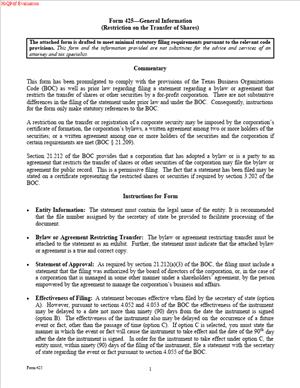
Form 425 – Restriction on the Transfer of Shares
Fill out nowJurisdiction: Country: United States | Province or State: Texas
What is a Form 425 – Restriction on the Transfer of Shares?
Form 425 is a Texas Secretary of State filing you use to place, update, or remove legal limits on the transfer of corporate shares. In simple terms, it is the formal, on-record statement that certain shares in your Texas corporation cannot be transferred freely. It tells the world that sales or transfers of those shares must follow specific rules that your company has adopted.
You use this form for a Texas corporation. It is not for an LLC, partnership, or nonprofit. If you run a for-profit corporation, a professional corporation, or a closely held corporation organized in Texas, this form is for you. It supports the internal rules you already have in your charter, bylaws, or shareholder agreements. It does not replace those documents. It puts the restriction into the public record and makes your rule set easier to enforce against future buyers.
You typically need this form when you want to control who owns your company and how ownership changes hands. You may want to keep shares in a family or founder group. You may want the first right to buy back shares from a departing employee. You may need to ensure only licensed professionals hold stock in a professional corporation. You may want to preserve S corporation eligibility by limiting who can own shares. You may also want to protect a control group agreement after a financing round.
Typical usage scenarios
You adopt a right of first refusal for all common stock. Before a shareholder sells to an outside party, the company gets the first chance to buy at the same price. You add a consent right. No transfer happens without board approval. You impose a buy-sell mechanism. If a shareholder dies or divorces, the company can buy back shares using a set price formula. You add vesting and repurchase rights for employee shares. If a holder leaves early, the company can repurchase unvested shares at cost. You place ownership limits that keep your firm compliant with professional licensing rules. You add restrictions to a new preferred class created in a recapitalization. In each case, Form 425 is the instrument you file with the state to reflect these rules.
Who typically uses this form inside the company?
You, as the founder or CEO, when you want to lock down ownership. Your corporate secretary, when you formalize a legend and transfer process for certificates. Your general counsel or outside counsel, when you align public filings with internal agreements. Your board, when it approves restrictions as part of a financing or succession plan. Investors may also ask you to file the form to ensure clarity and enforceability.
When you complete and file Form 425, you put third parties on notice that a restriction exists. That matters. People who try to buy your stock can no longer claim they did not know about your rules. When your restriction is also noted on share certificates or in electronic statements for uncertificated shares, your restriction is far more likely to be enforced as written. This helps you prevent unauthorized transfers and avoid disputes later.
When Would You Use a Form 425 – Restriction on the Transfer of Shares?
You use Form 425 whenever you want your share transfer restrictions to be on file with the state and visible to the public. This is common at two points. First, early in the company’s life, often right after formation or the first equity issuances. Second, later, after a new investor, a change to your capital structure, or a succession plan requires tighter rules.
You use it when you convert employee equity promises into actual stock. Employees may receive shares subject to vesting or repurchase. You can file Form 425 to state that repurchase rights and transfer limits apply. This reduces confusion when employees leave or sell. It also supports clean cap table management during future diligence.
You use it if you are a professional corporation. If your industry limits ownership to licensed professionals, you need to state and enforce that. This form helps you give clear public notice that only qualified owners may hold stock, and that any non-compliant transfer is void or subject to mandatory redemption.
You use it when you create a new class or series of shares with distinct rights. For example, you authorize a Series A Preferred class with transfer rules tied to investor consent. You can designate the specific class in the form and describe the restrictions that apply only to that class. This avoids applying investor rules to common stockholders by mistake.
You use it when you add a right of first refusal as part of a buy-sell agreement. This is common in family businesses, physician groups, and founder-led companies. You want to keep shares in friendly hands. You may want time to match a buyer’s price. You may need to maintain voting blocks to preserve control. The form allows you to state these limits clearly.
You use it if you must change or remove a restriction already on file. For instance, you might relax a board consent requirement to improve liquidity before a financing. Or you might expand a transfer exception to allow transfers to family trusts. You can file an update to keep the public record aligned with your current governance.
You also use it if you issue uncertificated shares. Many modern corporations do. Uncertificated shares require that you send an information statement to holders in place of a physical certificate. That statement must include a reference to any transfer restriction. Filing Form 425 supports that disclosure and aligns your records with what you send to holders and to your transfer agent.
Typical users include business owners, corporate secretaries, general counsel, outside counsel, and investor counsel. Lenders and buyers look for this filing during due diligence. Filing it helps satisfy diligence and shortens negotiations. It shows you maintain control of your capitalization and prevent cap table surprises.
Legal Characteristics of the Form 425 – Restriction on the Transfer of Shares
Form 425 is a legally binding filing instrument for a Texas corporation. It places a restriction on the transfer of shares into the public record. The restriction itself must be valid under Texas law and your governing documents. The filing makes your restriction more visible and reinforces enforceability against transferees who purchase after the filing.
Enforceability comes from several factors working together. First, your corporation must properly adopt the restriction. That means your board and, when required, your shareholders approve it under your bylaws and charter. If a restriction materially affects a class of shares, you may need a class vote. If your charter or an existing agreement requires a supermajority, you must meet it. Second, you must provide notice to shareholders and transferees. For certificated shares, you place a conspicuous legend on the stock certificate. For uncertificated shares, you include the legend language in the information statement you deliver to holders. Third, you record the restriction with the state by filing Form 425. That filing gives public notice and aligns your records with your internal governance.
Restrictions must be reasonable and clear. You may require board or shareholder consent. You may impose a right of first refusal. You may restrict transfer to certain permitted transferees, like family or affiliated entities. You may require a minimum transfer size or prohibit pledges without consent. You may create buyback rights tied to employment termination. But you cannot impose a restriction that is vague, hidden, or impossible to satisfy. You cannot trap shares forever without a legitimate purpose. You cannot violate other mandatory rules or anti-fraud principles.
The restriction must not conflict with your charter, bylaws, or shareholder agreements. If there is a conflict, you face a risk of non-enforcement or claims of breach. Align your documents and use consistent definitions. Define key terms like transfer, permitted transferee, fair market value, and change in control. State clear timelines, consent standards, and notice mechanics.
For existing shares, you need authority to impose new restrictions. If your charter already authorizes restrictions, you can implement them with proper approvals. If not, you may need shareholder consent for each affected holder or an amendment that authorizes the restriction. If you try to restrict already-issued shares without authority or consent, the restriction may not bind those holders. Future issuances can be made subject to new restrictions if you disclose them at issuance.
The filing becomes effective when the Secretary of State files it, unless you specify a later effective date. A delayed effective date allows you to coordinate with a closing or another event. Once effective, the restriction applies as you have stated. If you later modify it, you must file an update and refresh legends and holder notices.
You should also coordinate with your transfer agent. Your agent will refuse transfers that do not meet the stated conditions. Provide the agent with the final filed form, the exact legend language, and the internal approval certificates. This avoids accidental transfers that violate your restriction.
Finally, consider investor and tax consequences. Some investors resist tight transfer restrictions if they limit liquidity too much. Some restrictions affect valuation methods in buy-sell formulas. If you rely on S corporation status, ensure your restrictions keep out ineligible owners and prevent a second class of stock. Clear drafting helps you avoid unintended consequences.
How to Fill Out a Form 425 – Restriction on the Transfer of Shares
1) Confirm the entity and the need.
Make sure you are a Texas corporation. This form does not apply to LLCs or nonprofits. Decide whether you are adopting a new restriction, amending an existing restriction, or removing one.
2) Gather basic entity details.
Have your exact legal name as on file with the state. Get your Texas file number. Confirm your principal office address. Identify the class or series of shares affected. Confirm whether shares are certificated or uncertificated.
3) Draft the operative restriction text.
Write the rule in clear, plain language. State what transfers are restricted. State the conditions for approval or exceptions. Examples include:
- Consent requirement: “No transfer of any shares may occur without prior written consent of the Board.”
- Right of first refusal: “Before any holder sells shares to a third party, the Company may purchase all such shares at the offered price within 30 days.”
- Permitted transfers: “Transfers to a spouse, lineal descendants, or a revocable trust for the benefit of the holder are permitted, subject to the legend.”
- Professional ownership: “Only licensed professionals in good standing may hold shares. Any transfer to a non-licensed person is void.”
- Repurchase on termination: “Upon termination of service, the Company may repurchase unvested shares at cost and vested shares at fair market value.”
Keep sentences short. Define timelines, pricing methods, and notice delivery. Identify who has discretion to consent and any standards for that discretion.
4) Specify the scope.
State whether the restriction applies to all shares, a specific class, a specific series, or specific certificate numbers. If a new class is involved, match the class name to your charter. If only certain holders are affected, identify those holders by name or by grant date.
5) Add the legend language.
Provide the exact text that must appear on stock certificates. Also state that the same text will be included in information statements for uncertificated shares. Use clear notice phrasing, for example: “The transfer of the shares represented hereby is restricted by a restriction on transfer on file with the Texas Secretary of State and by the Company’s governing documents. Copies are available upon request.”
6) State the adoption authority.
Insert a paragraph that confirms proper approval. Identify the body that approved the restriction and the date. For example: “The Board of Directors approved this restriction on May 14, 2025. The shareholders approved this restriction on May 20, 2025.” If a class vote was required and obtained, say so. If approvals occurred by written consent, state that.
7) Address existing shares.
If the restriction affects shares already issued, state that each affected holder has consented in writing, or that the charter authorized the board to impose the restriction at issuance. Attach consents if the form allows or keep them in the minute book and reference them in the text.
8) Choose the effective date.
You may make the filing effective on the date of filing. You may select a delayed effective date to align with a closing. If you use a delayed date, state the exact date. Do not exceed the permitted delay window. Plan your legends and notices to match the effective date.
9) Prepare exhibits if needed.
If the restriction text is lengthy, attach it as Exhibit A. If multiple classes or series are involved, attach a schedule that lists the classes and the matching restrictions. Reference each exhibit in the main form. Use clear exhibit labels and page numbers.
10) Complete the contact and delivery details.
Provide the name, phone, mailing address, and email of the person the state should contact about the filing. This speeds up resolution if there is a question. Provide a return delivery address for the filed copy.
11) Sign the form.
An authorized corporate officer must sign. Common signers include the president, CEO, secretary, or another duly authorized officer. Print the signer’s name and title. Date the signature. If someone signs as attorney-in-fact, include the power of attorney in your records and make a clear note on the form if space allows.
12) Review for alignment.
Confirm that the restriction matches your charter, bylaws, resolutions, and any shareholder or investor agreements. Check definitions. Confirm timelines. Confirm pricing formulas. Make sure no clause conflicts with prior rights, especially investor protective provisions.
13) Prepare certificate legends and notices.
If you issue certificated shares, update the certificate template with the exact legend text. If you use uncertificated shares, update the information statement template. Plan delivery of updated statements to all holders affected by the filing. Keep evidence of delivery.
14) Coordinate with your transfer agent and cap table.
Provide the filed form and internal approvals to your transfer agent. Instruct the agent to refuse non-compliant transfers. Update your cap table software to flag the restriction. Include required conditions in any future transfer workflows.
15) File the form with the Secretary of State.
Submit the completed form for filing. If you select a delayed effective date, confirm it is stated correctly. Retain a file-stamped copy in your corporate records once accepted. Keep it with the minutes that show board and shareholder approvals.
16) Communicate with stakeholders.
Send a notice to shareholders explaining the restriction in plain language. Include the legend and the date the rule takes effect. Provide a copy on request. Update investor data rooms with the filed form, minutes, and any exhibits.
17) Avoid common mistakes.
Do not use vague terms like “unreasonable transfer.” State exact steps and timelines. Do not forget to identify the affected class or series. Do not attempt to bind existing holders without consent or authority. Do not omit the legend on certificates or the notice for uncertificated shares. Do not conflict with buy-sell or investor agreements. Do not forget to update your transfer agent.
18) Plan for future changes.
If you intend to relax the restriction later, include a clear amendment mechanism. State who can approve changes and how. Keep your cap table clean by requiring every new issuance to acknowledge the restriction in the subscription or grant documents.
By following these steps, you create a clear, enforceable restriction and a clean public record. You align your internal governance, your share legends, and your transfer processes. You protect, control, manage compliance needs, and reduce the risk of transfer disputes.
Legal Terms You Might Encounter
- Restriction on the transfer of shares means any rule that limits how a shareholder can sell or assign shares. You use Form 425 to put that rule on the public record. You describe who is affected and what the rule requires.
- A legend is a short notice placed on a share certificate. It tells buyers that a restriction exists. If you use uncertificated shares, you provide the same notice in an information statement. Form 425 does not replace the legend. The form supports the legend by giving public notice.
- Class and series identify the exact shares affected. For example, you might restrict only Class A or a particular series. On Form 425, you state each class or series covered. That clarity prevents disputes about scope.
- Certificate of formation is your charter document. It can contain transfer restrictions. If your restriction lives in the certificate, you note that on the form. If the restriction lives elsewhere, you cite that source instead.
- Bylaws are internal rules adopted by the board and shareholders. Some transfer restrictions are placed in the bylaws. If your restriction comes from the bylaws, you identify that on Form 425 and summarize the rule.
- Shareholder agreement is a contract among shareholders, sometimes called a buy-sell. It can set rights like first refusal or mandatory buyback. When the restriction comes from such an agreement, Form 425 lets you summarize it without exposing confidential terms.
- Right of first refusal requires a selling shareholder to offer shares to the company or other holders before selling to outsiders. If your restriction is a right of first refusal, state that on the form. Also, describe who can buy, at what price, and the response period.
- Consent requirement means a sale needs approval by the board or a specified group. If your restriction requires consent, the form should say who grants consent. Also note the standard used, such as sole discretion or reasonable grounds.
- Option to purchase on transfer gives the company or other holders a right to buy when a triggering event occurs. Triggers can include death, disability, termination, or bankruptcy. If you use this kind of restriction, state the trigger and the pricing method on the form.
- Delayed effective date is a date you choose for the filing to take effect later than the signing. Many filings allow a short delay. You can choose an immediate effect or a later date. Form 425 gives you that option. Align the date with your internal approvals.
- Authorized officer is the person who signs for the corporation. That person certifies the accuracy of the filing. On Form 425, an officer or authorized agent signs. Use a title that matches your records.
FAQs
Do you need to file Form 425 if your certificate of formation already includes the restriction?
You may not need a separate filing if the restriction is already in the filed certificate. The public record already shows the restriction. If the restriction is in bylaws or a shareholder agreement, filing Form 425 provides public notice. That notice helps future buyers and reduces disputes.
Do you attach the full agreement to Form 425?
You typically do not attach full agreements. You provide a clear statement of the restriction in the form. Focus on the type of restriction, who is bound, the shares covered, and key mechanics. Avoid confidential details that are not needed for notice. Keep the summary accurate and specific.
Do you need shareholder or board approval before filing?
You must adopt the restriction properly under your governing documents. If bylaws or an agreement require approvals, complete them first. The form does not create the restriction by itself. It records a restriction that already exists. Align the filing date with your approval date.
Do uncertificated shares still need a legend?
Uncertificated shares use an information statement in place of a certificate legend. You must give the holder written notice of the restriction. Filing Form 425 does not replace that notice. It adds public notice. Keep your holder notices and legends consistent with the form.
Do you have to refile when you issue new shares?
You do not refile if new shares are already covered by the same restriction. You must keep legends or information statements on those shares. Refile only if the scope, terms, or covered classes change. If you add or remove a class, consider filing an amendment.
Do you need to wait for approval of the filing before enforcing the restriction?
You enforce the restriction based on your governing documents and agreements. Filing gives public notice and a filing date. Once filed, third parties have constructive notice. You should wait for confirmation before relying on the public record. Internally, enforce based on the adopted terms.
Do you include pricing formulas and full triggers in the form?
Include enough detail for a clear notice. State the type of restriction, triggers, and pricing approach. For example, say “right of first refusal at bona fide offer price,” or “company call at formula value.” You can keep more granular details in the agreement. Make sure the summary and agreement match.
Do you need to file a new form to remove or change a restriction?
Yes. If you change, narrow, or terminate a restriction, file the appropriate update. Keep legends and holder notices aligned with the current rule. Update certificates or information statements as soon as the change is effective. Communicate the change to all affected parties.
Checklist: Before, During, and After the Form 425 – Restriction on the Transfer of Shares
Before signing
- Confirm the exact restriction text in your governing documents.
- Identify the classes and series affected by the restriction.
- Verify the company’s legal name as it appears on record.
- Locate the company’s file number on record.
- Confirm board and shareholder approvals are complete, if required.
- Decide whether to use an immediate or delayed effective date.
- Prepare a clear summary of the restriction for the form.
- Decide whether to reference the certificate, bylaws, or an agreement.
- Draft or confirm the certificate legend or information statement language.
- Choose an authorized officer or agent to sign the form.
- Set internal procedures for enforcing the restriction after filing.
- Budget for the filing fee and method of payment.
During signing
- Check the entity name for exact spelling and punctuation.
- Enter the file number exactly as on record.
- Confirm the entity type matches “corporation” issuing shares.
- State the classes and series covered, with no ambiguity.
- Summarize the restriction clearly and in plain language.
- Identify the source document: certificate, bylaws, or agreement.
- Note any key triggers and pricing approach, if relevant.
- Select an immediate or delayed effective date as needed.
- Ensure the signer’s title matches company records.
- Date the form.
- Include any return contact information the form requests.
- Review for internal consistency before you finalize.
After signing
- Submit the form with the required fee to the filing office.
- Keep a copy of the signed form for your records.
- Track confirmation of filing and the effective date.
- Update the stock ledger to flag restricted shares.
- Place legends on all affected certificates.
- Send information statements for uncertificated shares.
- Notify shareholders about the restriction and how it works.
- Notify your transfer agent or recordkeeper to enforce the rule.
- Update your cap table and internal procedures.
- Train staff on consent, first refusal, and transfer review steps.
- Store approvals, the filed form, and holder notices in a central file.
- Calendar periodic reviews and any sunset or trigger events.
Common Mistakes to Avoid Form 425 – Restriction on the Transfer of Shares
- Don’t forget to define exactly which shares are covered. A vague scope invites disputes. If you omit classes or series, a buyer may claim the shares are free of limits. That can undermine your restriction.
- Don’t describe complex pricing without a clear method. If you use a formula, say so. If you use outside valuation, say how you pick it. Unclear pricing can delay transfers and cause conflicts.
- Don’t file before you adopt the restriction internally. The filing does not create the rule. If approvals are missing, the restriction can be challenged. Complete approvals first, then file.
- Don’t skip legends or information statements. The form gives public notice. It does not replace holder notices. If you omit legends, buyers may claim a lack of notice. That can create liability.
- Don’t forget to align the form with your documents. If the summary conflicts with your bylaws or agreement, you create risk. Align the language. Update the form if you change the rule.
What to Do After Filling Out the Form 425 – Restriction on the Transfer of Shares
- File the signed form with the filing office. Include the fee. Choose your delivery method based on speed and cost. Keep proof of submission and payment. Note the effective date you selected.
- Wait for confirmation from the filing office. Save the acknowledgment. Confirm the stamped effective date. Share the confirmation with your internal team. Update your compliance checklist.
- Implement the restriction in your daily processes. Add or update legends on all affected certificates. Issue information statements for uncertificated shares. Update your stock ledger and cap table. Flag restricted classes and series.
- Publish internal guidance for handling transfer requests. Specify who reviews transfer requests. Set deadlines for right of first refusal and consent windows. Document how you verify compliance. Train staff on the steps.
- Notify shareholders about the restriction and how it works. Send a summary with examples. Include key deadlines and contact points. Keep records of delivery. Answer holder questions promptly.
- Coordinate with your transfer agent or recordkeeper. Provide the field form and your legend language. Give written instructions on the review process. Ensure systems block noncompliant transfers.
- Audit related documents for alignment. Review the certificate of formation, bylaws, and shareholder agreements. Confirm the same rule appears across documents. Fix conflicts immediately. Use a single source for the operative terms.
- Set triggers and calendars. Track events that can trigger calls or buybacks. Examples include departures or death. Calendar consent deadlines and right of first refusal periods. Assign responsibility for monitoring.
- Plan for amendments or termination. If you change the restriction, prepare a new filing. Update legends and information statements at the same time. Notify holders and your transfer agent of the change. Keep prior versions for your records.
- Integrate the restriction into future issuances. When you issue new shares, apply the legend immediately. Provide information statements on issuance. Confirm the shares fall within the scope of the filed form. Update the ledger on the issue date.
- Review enforcement outcomes. After the first few transfer requests, run a post‑mortem. Improve forms, timelines, and approvals as needed. Close gaps in processing. Adjust training across the team.
- Maintain clean records. Keep board and shareholder approvals, the filed form, legends, and notices together. Store valuation reports if you use formula pricing. Protect confidentiality while keeping clear audit trails.
- Monitor for investor relations impact. Explain the business reason for the restriction. Clarify liquidity options and timelines. Set expectations for employees and investors. Avoid surprises at exit events.
- Prepare for diligence events. Buyers and lenders will ask about transfer limits. Keep your filed form and internal documents aligned. Be ready to show compliance. Good records reduce delays and costs.
- Consider how the restriction interacts with exits. Map the rule to planned financing or sale timelines. Check drag-along or tag-along provisions for conflicts. Update your filings if you simplify terms before a deal.
- Close the loop on every transfer. Document requests, approvals, and outcomes. Record any exercise of first refusal or call rights. Update the ledger immediately. Confirm holders receive updated certificates or statements.
- Build a periodic review cycle. Reassess the restriction annually. Confirm it still meets your goals. Update the filing if you modify terms. Train new staff on the current process.
Disclaimer: This guide is provided for informational purposes only and is not intended as legal advice. You should consult a legal professional.