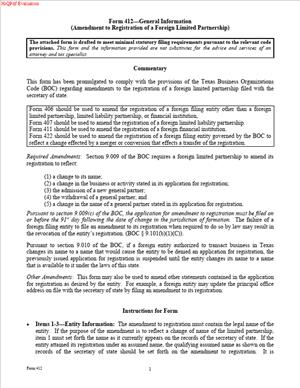
Form 412 – Amended to Registration of a Foreign Limited Partnership
Fill out nowJurisdiction: Country: United States | Province or State: Texas
What is a Form 412 – Amended to Registration of a Foreign Limited Partnership?
Form 412 is the Texas Secretary of State filing you use to update the registration record of a foreign limited partnership that is already authorized to do business in Texas. “Foreign” means your limited partnership was formed outside Texas, whether in another state or another country. When facts in your original Texas registration change, you report those changes with this amendment filing so the state’s public record stays accurate.
You typically use this form if you are a general partner, in-house counsel, outside counsel, a law firm paralegal, or a corporate compliance manager responsible for entity filings. If you work with a filing service or a registered agent provider, they may prepare the form, but an authorized person for the partnership still needs to approve and sign.
You need this form to keep your Texas registration in good standing after key changes occur. Common reasons include a legal name change in your home jurisdiction, adopting an assumed name for Texas, adding or removing general partners, changing your principal office address, or updating other statements in your original application that are no longer correct. Texas law expects your public record to reflect current information. If it does not, you risk rejection of future filings, service issues, and potential administrative action against your registration.
Typical usage scenarios
- Your limited partnership rebrands and changes its legal name in its formation state. You amend your Texas record to show the new name. If the new name is not available in Texas, you adopt an assumed name for use here.
- You add a new general partner or a general partner withdraws. You amend the registration to list the current general partners and their addresses.
- Your principal office relocates to a new address. You update that address so third parties and state agencies can reach you for official matters.
- The partnership’s period of duration or governing structure changes in your home jurisdiction. You align your Texas record with the revised facts.
- You complete a merger that alters your partnership’s name or other key details, and the partnership continues to exist post-merger. You update the Texas record to match the surviving entity’s information.
Think of Form 412 as a precision tool. It updates specific facts on file with the Secretary of State, and it becomes part of the public record the moment it is accepted. Note that some changes are not handled on this form, like changing your registered agent or registered office in Texas. Those require a separate Statement of Change filing. Likewise, if you plan to stop doing business in Texas, you would use a withdrawal filing rather than an amendment.
When Would You Use a Form 412 – Amended to Registration of a Foreign Limited Partnership?
You use this form when any material fact in your original Texas application for registration has changed, and the Texas record must be updated. A classic example is a legal name change in your formation state. If your Delaware limited partnership changes its name as part of a rebrand, you amend your Texas registration to reflect the new name. If that name is already taken in Texas or does not meet Texas naming rules, you state the assumed name you will use in Texas instead.
Many partnerships use the form when their principal office moves. While the registered office and agent in Texas are changed by a different filing, the principal office appears on your registration and should be kept current. If someone needs to send you official correspondence or validate your status, the principal office address on file matters.
Changes to general partners are another trigger. Your registration lists the name and address of each general partner. If a general partner resigns, a new one joins, or an address changes, you file Form 412 to keep the roster accurate. This is not just housekeeping. Lenders, counterparties, and courts rely on those listings to determine who has authority for the partnership.
You also use the form when the partnership’s duration or jurisdictional facts change. If your partnership converts or re-domiciles in a way that keeps it a limited partnership but changes certain formation details, the Texas record should match your current charter. If your operating purpose was stated in the original registration and later changes, you can amend that section to reflect your present activities, as long as they are lawful in Texas.
Typical users include general partners overseeing compliance, general counsel or in-house legal teams, outside counsel retained for corporate work, senior paralegals in law firms, and corporate secretaries or controllers who manage entity records. Smaller firms might lean on a registered agent or filing service for preparation, but you still need an authorized signatory from the partnership to execute the filing.
Do not use this form to change your registered agent or registered office in Texas. That is a separate, specific filing. Do not use it to end your Texas authority. If you are withdrawing from Texas, you file a withdrawal. Finally, if you are attempting to correct a one-off filing error rather than report a substantive change to facts, a correction instrument may be more appropriate. For most ongoing updates to your existing registration, Form 412 is the right path.
Legal Characteristics of the Form 412 – Amended to Registration of a Foreign Limited Partnership
This filing is legally binding because it is the official amendment to your foreign limited partnership’s registration under the Texas Business Organizations Code. When the Secretary of State accepts the form, the amended information becomes part of the public record for your entity. Third parties, courts, and agencies rely on that record to determine who you are, who speaks for you, and how to serve you.
Enforceability rests on three pillars. First, authority: the person who signs must be authorized to act for the partnership, commonly a general partner. Second, accuracy: you certify the truth of the statements. Knowingly filing false information can trigger penalties, including civil liability or criminal exposure. Third, acceptance: the Secretary of State must deem the filing complete and compliant, and the required fee must be paid.
The effective date of your amendment can be immediate upon filing, delayed to a specific date not more than 90 days after filing, or tied to a future event that occurs within 90 days. If you choose a delayed or event-based effective date, be precise. The effective date controls when the public record changes and can affect contracts, notices, and authority questions tied to the information being amended.
A few general legal considerations help you avoid problems:
- Keep your Texas record synchronized with your home jurisdiction. If you change your legal name or general partner roster at home, update Texas promptly so the records match.
- Maintain required name elements. A limited partnership’s name must include “Limited Partnership,” “Limited,” or an accepted abbreviation such as “L.P.” or “Ltd.” If you are an LLLP in your home state and hold yourself out that way in Texas, you must use the correct LLLP indicator.
- Do not attempt to update the registered agent or registered office on this amendment. Use the dedicated change filing. Using the wrong form can delay processing and leave you noncompliant.
- Expect public visibility. Information you provide becomes public. Do not include sensitive personal data beyond what the form requires.
Once filed, the amendment does not cure unrelated compliance gaps. You still must meet tax, licensing, and other regulatory duties to remain in good standing. The Secretary of State can revoke your registration for certain failures, including failure to maintain a registered agent or to keep required information current.
How to Fill Out a Form 412 – Amended to Registration of a Foreign Limited Partnership
Follow these steps to complete and file the amendment correctly:
1) Gather your baseline information
- Your Texas file number for the foreign limited partnership.
- Your current legal name and any Texas assumed name you already use.
- Your formation jurisdiction and original date of Texas registration.
- The precise changes you need to report.
- Names and business addresses for all current general partners, if that section is changing.
- Evidence of a legal name change in your home jurisdiction, if applicable. Some changes may require supporting documentation.
2) Confirm your name and position in Texas
- If your legal name changed, check if the new name is available in Texas and meets naming rules for a limited partnership.
- If the new name is not available or lacks the required LP indicator, plan to adopt an assumed name for Texas in the amendment.
3) Complete the entity identification block
- Enter the limited partnership’s current legal name as it appears in your home jurisdiction.
- Provide the Texas file number assigned by the Secretary of State.
- List your formation jurisdiction (state or country) and, if requested, your principal office address as it will appear going forward.
4) State the nature of the amendment
- The form gives you space to describe each change. Be clear and specific.
- For a name change, state the new legal name exactly and confirm it includes the required LP indicator (for example, “ABC Holdings, L.P.”).
- For an assumed name adoption in Texas, list the assumed name exactly as you will use it here.
- For a principal office change, provide the full new address, including street, city, state, and ZIP or postal code.
- For changes to general partners, identify any departing general partners and list all current general partners with full names and business addresses. If the form asks for only changes, still ensure the record ends up complete and accurate.
5) Address any purpose or duration updates
- If your original registration included a specific purpose and it has changed, restate the purpose in its current form. Keep it lawful and clear.
- If the partnership’s duration or similar jurisdictional facts changed at home, mirror those updates in this amendment.
6) Do not attempt a registered agent or office change here
- Texas handles registered agent and registered office changes through a separate Statement of Change filing. If you try to make that change on Form 412, it will not take effect and may delay processing. File the agent/office change on the correct instrument.
7) Select your effective date
- You can make the amendment effective upon filing, on a specified future date within 90 days, or upon a future event that occurs within 90 days.
- If using a future date, write the exact date and, if needed, the time.
- If using an event-based effective date, describe the event with enough detail that it is objectively verifiable.
8) Add supplemental provisions or schedules, as needed
- If you need more space to list general partners, attach an additional page labeled “Schedule of General Partners” and reference it in the amendment section.
- For complex changes, use a supplemental page to set out the full text of the amended information.
- Keep attachments clear and consistent with the main form.
9) Review signature authority and sign
- The form must be signed by a person authorized to act for the partnership. A general partner typically signs.
- Print the signer’s name and title under the signature and add the date of signing.
- Texas does not require notarization for this filing.
- If filing electronically, follow the signature format required for e-filing. Electronic signatures are accepted.
10) Calculate the filing fee and choose your filing method
- A state filing fee applies. Prepare payment by the accepted methods for your chosen filing channel.
- You can file online, by mail, or in person. Fax filing is often available when paying by approved methods.
- If you need faster processing, request expedited service and include the additional fee. Processing times vary by method and volume.
11) Submit and retain proof
- When you file, request a file-stamped copy for your records. If you attach schedules, keep a full copy of the final packet submitted.
- Monitor for acceptance. If the Secretary of State identifies issues, respond promptly to avoid rejection.
12) Update downstream records
- After acceptance, update your internal records, contracts, bank accounts, insurance, and licenses to reflect any name or general partner changes.
- If you adopted an assumed name for Texas, ensure your invoices, website, and customer communications reflect that name consistently.
- Notify key counterparties and agencies so that service of process, notices, and payments reach you without delay.
Practical tips to avoid common mistakes
- Use the exact legal name on file in your home jurisdiction, including commas, periods, and the LP indicator.
- Do not list a registered agent address where the form asks for your principal office. Those are different addresses.
- If you changed general partners, be sure the list on file reflects the current full roster, not just the changes. Many readers treat the record as definitive.
- Keep sentences in your amendment statement simple and direct. Ambiguity causes processing delays.
- If you choose a delayed effective date, confirm it aligns with any contracts or closings that depend on the new information.
If you file thoughtfully and keep the record synchronized with your home jurisdiction, Form 412 is straightforward. You identify the change, present it clearly, sign with authority, and submit the required fee. Once accepted, the public record updates, and you can continue operating in Texas with confidence that your filings are current.
Legal Terms You Might Encounter
- Foreign limited partnership. This means your limited partnership was formed under the laws of another state or country but does business in Texas. Form 412 amends the Texas registration on file for that foreign entity. You are not forming a new partnership. You are updating the Texas record to match your current facts.
- Amended registration. An amendment updates the information you previously filed when you first registered to do business in Texas. Use Form 412 to report changes like a new name, a new registered agent, a new registered office, a different principal office, or updated general partner details.
- Jurisdiction of formation. This is the home state or country where your limited partnership was originally formed. If the home jurisdiction recognizes a name change or merger that affects your partnership’s name or structure, you will reflect that change on Form 412 so that Texas records match.
- Principal office. This is the location where you direct, control, and coordinate the partnership’s activities. It is usually the headquarters or main business office, and it may be outside Texas. Form 412 lets you update this address if it changes.
- Registered agent. This is the individual or company authorized to receive legal papers for your partnership in Texas. If you appoint a new registered agent, Form 412 will capture that change. The agent must consent to serve, and the registered office must be a physical street address in Texas.
- Registered office. This is the Texas street address where your registered agent is available during normal business hours. It cannot be a P.O. Box. If you move the registered office, you update it through Form 412.
- General partner. A general partner manages the partnership and has the authority to act for it. If you add, remove, or change a general partner, you disclose that change in the amendment. You will list the name and address of each current general partner as required by the form.
- Entity name and name availability. Your legal name is the exact name on file in your home jurisdiction. If that name changes, you update Texas records through Form 412. Texas also requires the name to be available and distinguishable on its records. If not, you may need to adopt an acceptable name for Texas use and reflect it on the form.
- Effective date and delayed effectiveness. You can choose when your amendment takes effect. You may request immediate effectiveness on filing or set a delayed effective date. Texas allows a short delay window. If you choose to delay, list the date and time on Form 412.
- Certificate of existence or evidence of name change. When your home jurisdiction changes your entity name, Texas may require proof from that jurisdiction. If Form 412 or its instructions call for supporting evidence, include the required document so Texas can accept the change.
FAQs
Do you need to file Form 412 if your foreign LP changes its name in its home state?
Yes. Texas must know the current legal name under which you operate. File Form 412 to update the name on Texas records. Check that the new name is available in Texas. If it is not available, you may need to adopt a name you can use in Texas and disclose that on the form.
Do you file Form 412 to change the registered agent or registered office?
Yes. Use Form 412 to appoint a new registered agent or to update the registered office address. The new agent must consent to serve. The registered office must be a Texas street address where the agent is available during business hours.
Do you use Form 412 to add or remove a general partner?
Yes. Form 412 reports changes to your general partners. List the current general partners and their addresses as required. Make sure names match your partnership records exactly. If you remove a general partner, verify that your partnership agreement and home jurisdiction records reflect that change.
Do you need to include proof of a name change from your home jurisdiction?
If your name changed in your home jurisdiction, be ready to include proof with your amendment if required by the form. Follow the current form instructions on acceptable documents. Submitting proper evidence helps avoid rejection or delays.
Can you pick a future effective date for your amendment?
Yes. You can request a delayed effective date on Form 412. The delay must fall within the period allowed. If you do not request a delay, the amendment takes effect when filed by the Secretary of State.
Who can sign Form 412 for a foreign limited partnership?
A general partner with authority should sign. The signer should print their name and capacity and sign by hand if filing on paper. If you file electronically, follow the signature rules in the filing system.
Do you need to update any parties besides the Secretary of State after filing?
Yes. Notify your registered agent, banks, insurers, landlords, licensing boards, and key vendors. Update tax agencies and any agencies that regulate your industry. Update websites, invoices, and contracts so third parties rely on the correct information.
What if you discover a typo after filing the amendment?
If you make a minor error, you generally correct it through a correction filing, not another amendment. Review the correction process and submit the appropriate document. Do not leave errors uncorrected, as they can affect service of process and compliance.
Checklist: Before, During, and After the Form 412 – Amended to Registration of a Foreign Limited Partnership
Before signing
- Confirm your Texas file number and the exact foreign LP name as recorded in your home jurisdiction.
- Decide exactly what you are amending: name, registered agent, registered office, principal office, or general partner details.
- Verify name availability in Texas if your legal name changed.
- Obtain consent from the new registered agent, including the Texas street address for the registered office.
- Compile each current general partner’s full legal name and business or residence address.
- Gather supporting documents required by the form (for example, evidence of a name change from your home jurisdiction).
- Choose the effective date. Decide whether to request a delayed effective date.
- Confirm who will sign. Ensure the signer is a general partner with authority.
- Prepare payment for the filing fee and any copy or certificate fees.
- Identify a return contact with phone and email for filing questions.
- Plan your filing method and delivery (online, mail, or in person).
During signing
- Check the entity name for exact spelling, punctuation, and suffix (such as LP or L.P.).
- Confirm the home jurisdiction is correct and current.
- Verify the registered agent’s name and the registered office street address in Texas.
- Confirm the principal office address, even if it is outside Texas.
- Review the list of general partners for completeness and accuracy.
- If you chose delayed effectiveness, confirm that the date and time comply with the allowed window.
- Include the registered agent’s consent language as required by the form.
- Ensure the signature block shows the signer’s name and title as general partner.
- Review attachments to ensure they match what you stated in the form.
- Proofread one last time. A second set of eyes helps prevent rejection.
After signing
- File the form with the Secretary of State using your chosen method and pay the fee.
- Request a copy-stamped filing or a certified copy if you need it for your records.
- Calendar follow-up dates: expected processing time, delayed effective date, and any internal deadlines.
- If filing by mail, track delivery and keep proof of sending.
- When the filing posts, confirm the public record reflects the updated information.
- Notify your registered agent and share a copy of the filed amendment.
- Update licenses, permits, tax registrations, and industry accounts with the new details.
- Update banks, insurers, landlords, and contract counterparties.
- Refresh your website, letterhead, invoices, and marketing materials with the current information.
- Store the filed form, any certificates, and supporting documents in your records book.
Common Mistakes to Avoid Form 412 – Amended to Registration of a Foreign Limited Partnership
Using a name that does not match your home jurisdiction record.
- Consequence: The Secretary of State may reject the filing, or your records will not match. Always pull the exact legal name from your home jurisdiction’s current record before you draft the amendment.
Forgetting the registered agent’s consent or listing a P.O. Box as the registered office.
- Consequence: Rejection or delay. Texas requires a registered agent that consents to serve and a physical Texas street address for the registered office. Don’t forget to confirm business-hour availability.
Leaving out a current general partner or listing outdated partner information.
- Consequence: Inaccurate public records and potential service of process issues. Verify the current roster and addresses. Align your partnership agreement and internal records before filing.
Requesting a delayed effective date outside the allowed window.
- Consequence: The filing may default to immediate effectiveness or be rejected. Set a valid date and time within the permitted period. If you need a different timing, file closer to your target date.
Amending when you actually need a correction filing.
- Consequence: The wrong filing type may not fix the error. Use an amendment for real changes after registration. Use a correction filing to correct a mistake in a previously filed document.
What to Do After Filling Out the Form 412 – Amended to Registration of a Foreign Limited Partnership
- File the form and pay the fee. Submit the completed Form 412 to the Secretary of State using your preferred method. Include payment for the filing fee and any requested copies or certificates. If you requested a delayed effective date, confirm it appears correctly on the submission.
- Monitor status and confirm effectiveness. Track your filing until the Secretary of State accepts it. Once accepted, review the acknowledgment or copy-stamped form. Confirm the effective date. If you receive a rejection, correct the issues and resubmit promptly.
- Distribute updated information. Send the filed amendment to your registered agent. Share the update with internal leadership, finance, and compliance teams. If general partners change, circulate a revised contact sheet so everyone uses current information.
- Update licenses and registrations. Notify tax authorities, licensing boards, and any agency that regulates your activities. Some agencies require prompt notice of name or management changes. Update your vendor accounts, payment processors, and banking records.
- Refresh external materials. Update your website, contract templates, proposals, and marketing materials. Replace outdated letterhead and invoice footers. Ensure your principal office and registered agent information are correct on public-facing pages.
- Adjust your calendar and records. Note renewal dates for registrations and permits tied to your name or agent information. Store the filed Form 412, supporting documents, and any certificates in your entity records. Keep a copy with your minute book and another in secure digital storage.
- Plan for the next change. If you anticipate further changes—such as moving offices or adding a general partner—prepare the information you will need for a future amendment. Keeping a running list of changes helps you file quickly and accurately.
- Verify downstream contract impacts. Review key contracts for notice clauses that require notifying counterparties of name or management changes. Send formal notices as required to avoid breaches or missed deadlines.
- Coordinate with your home jurisdiction. If the change started in your home jurisdiction, ensure both records align. Keep proof of any home-jurisdiction filings with your Texas amendment in the same file for easy reference.
- Revisit internal authority and signatures. If general partners changed, update banking resolutions, signature cards, and approval matrices. Make sure only current general partners sign agreements on behalf of the partnership.
Disclaimer: This guide is provided for informational purposes only and is not intended as legal advice. You should consult a legal professional.