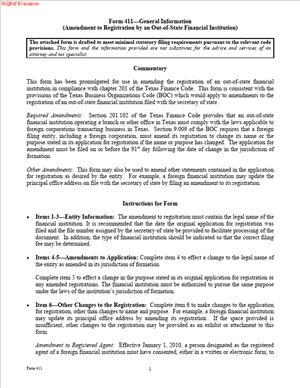
Form 411 – Amended to Registration by an Out-of-state Financial Institution
Fill out nowJurisdiction: Country: United States | Province or State: Texas
What is a Form 411 – Amended to Registration by an Out-of-state Financial Institution?
Form 411 is the Texas filing you use to amend a previously approved registration for an out-of-state financial institution. If your institution is chartered outside Texas and already registered to do business in Texas, this is the form you file when key facts change. It keeps your Texas public record accurate. It also preserves your authority to transact in the state without disruption.
This is not an initial registration. It is a post-approval amendment. Think of it as an update to your certificate of authority record. You use it to notify Texas of changes that affect your registration details, legal identity, or contact points for service of process.
Who typically uses this form?
Banks, savings banks, savings associations, trust companies, and credit unions with a home state charter outside Texas use it. The filer is often your corporate secretary, general counsel, or compliance officer. Your registered agent or outside corporate services provider may also prepare or submit it. If your institution maintains Texas branches or conducts activities requiring registration, this form likely applies to you once facts change.
Why would you need this form?
Because your Texas registration must reflect your true legal status and contact information at all times, if you change names, merge, convert charters, move your principal office, or appoint a new registered agent, Texas expects a prompt amendment. Filing the amendment helps you avoid lapses in authority. It also ensures courts and regulators can reach you through a valid Texas registered agent.
Typical usage scenarios include a name change due to a merger, a home-office relocation, a switch in registered agent, or a charter conversion. If your institution converts from a savings bank to a state bank, or from a federal to a state charter, that change needs to appear on the Texas record. If your legal name is no longer available in Texas or no longer compliant, you may adopt an assumed name for Texas use and report that on the amendment. If your institution establishes or closes a Texas office listed in your registration, you use the amendment to update that schedule as well.
In short, Form 411 is the official way to update the facts that define your legal presence in Texas. It aligns your Texas file with your current charter, identity, and service-of-process details. Once accepted, the amended record becomes your operative registration in the state.
When Would You Use a Form 411 – Amended to Registration by an Out-of-state Financial Institution?
You use this form as soon as a covered change becomes effective for your institution. Do not wait for your next internal compliance cycle. Texas expects a timely update once your underlying records change. You want a clean, accurate file so you can continue business without interruption.
You should file Form 411 when your institution changes its legal name. Name changes often follow mergers, conversions, or brand repositions. If your home-state chartering authority has approved a new legal name, mirror that change on your Texas registration. If the new name conflicts with an existing Texas entity name, you may need to adopt and report an assumed name to use in Texas.
You should file when you change your registered agent or registered office address in Texas. The registered agent is your official recipient for legal notices and lawsuits. If the agent resigns, moves, or you appoint a new one, update the record. Failing to update can cause missed service and default judgments.
You should file when your principal office or home-office address changes. Your principal office is a key point of contact. Texas uses it for certain notices. It should match your current internal records and regulator filings.
You should file when your institution converts charter types or regulators. Conversions can include state-to-federal or federal-to-state changes, or changes between bank and trust charters. If your home-state chartering authority changes, Texas needs to know which authority now supervises your institution and under what charter.
You should file when you merge with another institution, and the survivor is already registered in Texas. If the survivor’s name, charter, or principal office changes, the amendment captures those facts. If the survivor was not previously registered but now wishes to operate in Texas, that is an initial registration, not an amendment.
You should file when the information you previously listed about Texas locations requires an update. For example, you open or close a Texas office that your registration lists. Keep that schedule current to avoid confusion in regulatory exams or customer communications.
Typical users include bank compliance teams, the corporate secretary’s office, in-house counsel, and operations managers responsible for corporate records. If you engage a service company to handle filings, they often prepare the amendment from your instructions. The registered agent may also remind you to update the record if the mail begins to bounce or the agent’s details have changed.
Legal Characteristics of the Form 411 – Amended to Registration by an Out-of-state Financial Institution
This filing is legally binding because it amends a public record that grants you authority to transact in Texas. Your initial registration gives the state a basis to recognize your institution. An accepted amendment updates that authority and the conditions under which you operate. It becomes part of the official record maintained by the filing office.
Enforceability stems from two things. First, you submit the amendment to the proper state office with the required filing fee and signatures. Second, the office reviews it for statutory compliance and then files it. Once filed, the document is evidence of your current registration facts. Courts and counterparties rely on those facts, including your registered agent designation, for service of process and legal notices.
General legal considerations include name availability and name compliance. Texas applies name-distinctiveness and restricted-words rules. If your new legal name conflicts or fails to include a required organizational term, you may need an assumed name for Texas. The amendment lets you report that. You should also maintain the agent’s written consent. Texas does not usually require you to file that consent with the amendment, but you should keep it in your records in case of inquiry.
Another legal consideration is evidence of the underlying change. For a legal name change, Texas may require proof, such as a certified certificate or other official evidence from your home state. For a conversion or merger, you may need to attach a certified statement or certificate showing the effective change. The filing office needs enough information to confirm that your new facts are valid under your home-state law.
Timing matters. While Texas law often allows delayed effectiveness for many filings, you want continuity. If you delay the amendment, your public record may show stale data. That can affect service, compliance exams, and contractual deliverables that require you to keep registrations accurate. File promptly after your change becomes effective in your home jurisdiction.
Finally, failure to amend can carry consequences. You may lose good standing for registration purposes. You may face administrative actions for failing to maintain a registered agent or an accurate address. You could receive default judgments if legal papers go to an old agent or address you no longer monitor. Keep your registration current to reduce these risks.
How to Fill Out a Form 411 – Amended to Registration by an Out-of-state Financial Institution
1) Gather your baseline details.
- Confirm the exact legal name of your institution as it currently appears on file in Texas. This is your starting point for the amendment.
- Locate your Texas file number. You received it when your initial registration was accepted. It appears on your filed certificate and on state correspondence.
- Identify your home jurisdiction and chartering authority. Have your charter number or other identifying detail ready if the form requests it.
- If the amendment involves a name change, obtain certified evidence of the change from your home state.
2) Decide what you are amending.
- Most amendments fall into predictable categories: legal name, assumed name for Texas use, principal office address, registered agent and registered office, charter type or home-state regulator, and Texas office schedule.
- If more than one category changes at the same time, you can include them in one amendment. Keep your explanations clear. The reviewer should see what changed and when it became effective.
3) Complete the identification block.
- Enter the current Texas-registered name of your institution exactly as it appears on file. Use consistent punctuation and spacing.
- Provide your Texas file number. This speeds review and reduces misidentification.
- State your home jurisdiction. If the form requests the chartering authority, identify it as of the date of the change.
4) Describe the amendment to the legal name.
- If you are changing your legal name, supply the new full legal name exactly as recognized in your home jurisdiction.
- Confirm that the new name complies with Texas naming rules. If the name is not available or not compliant in Texas, adopt an assumed name for Texas use. Provide the assumed name on the form where asked or in an attachment.
- If required, attach certified evidence of the name change from your home jurisdiction. Label attachments clearly. Reference them in the body of the form.
5) Address assumed name issues.
- If you must operate under an assumed name in Texas, include the assumed name in the amendment. State that the institution will transact business in Texas under that name.
- Ensure the assumed name obeys Texas rules. It must be distinguishable and not deceptive. It should include organizational words where required for your charter type.
- Keep your assumed name records in sync across your internal documents, marketing, and branch signage in Texas.
6) Update your principal office and mailing addresses.
- If your principal office changed, enter the new street address. Do not use a P.O. Box for a principal office unless the form allows it. Include a mailing address if different.
- Use addresses where you will reliably receive notices. Align with your other regulatory filings to avoid confusion.
7) Update the registered agent and registered office.
- If you are changing the registered agent, enter the full legal name of the new agent. Verify the agent’s consent before filing. Maintain written consent in your records.
- Provide the registered office address in Texas. This must be a physical street address where the agent can accept service during business hours. A P.O. Box is not acceptable for the registered office.
- If the agent remains the same but the registered office moves, report the new address. Confirm that the agent staffs the new location for service.
8) Report a charter conversion or change in chartering authority.
- If your institution converted to a different charter type, state the new charter type and the effective date.
- If your chartering authority changed, identify the new authority and confirm the institution remains validly chartered and in good standing in its home jurisdiction.
- If the form requires supporting evidence, attach a certified certificate or statement from the home authority.
9) Update Texas office information if required.
- If your registration lists specific Texas offices, update that schedule. Add or remove locations with full addresses and effective dates.
- If an office is closing, state the closure date. If opening, state the opening date. Keep the list current for examination and public record purposes.
10) Set the effective date of the amendment.
- You may request immediate effectiveness upon filing. This is common when changes are already effective in your home jurisdiction.
- If you prefer a delayed effective date, you can request one within the allowed window. Use a specific date. Do not exceed the maximum delay allowed by Texas filing rules.
11) Add statements required for compliance.
- Many amendments include standard statements. Examples include the institution remaining duly organized and authorized in its home jurisdiction, and the amendment complying with home-state law.
- If the form includes a declaration about agent consent or assumed name adoption, complete it accurately.
12) Prepare signatures.
- The amendment should be signed by an authorized officer of your institution. Typical signers include the president, a vice president, the secretary, or other authorized executive.
- Print the signer’s name and title. Use a signature format consistent with your internal authority matrix.
- Texas amendments of this type do not typically require notarization. If you include sworn attachments from your home jurisdiction, follow the requirements of that jurisdiction.
13) Calculate and provide the filing fee.
- A filing fee applies to amendments. Have an approved payment method ready. If filing online, you will pay electronically. If filing by mail or in person, include the correct fee and remittance.
- If you need faster processing, request expedited service if available. Include the additional fee when applicable.
14) Choose your submission method.
- You can submit online, by mail, or in person. Online filing often provides faster confirmation. Mail and in-person filings are acceptable if you prefer paper.
- If submitting by mail, use the correct mailing address for business filings. Include a cover note with your contact details for questions. Do not send original home-jurisdiction charters unless certified copies are required.
- Keep copies of everything you submit, including payment confirmation.
15) Provide a return email or mailing address for correspondence.
- The filing office will send evidence of filing to the contact you list. Use an email inbox monitored by your compliance team.
- If the filing office needs clarification, they will reach out using these details. Respond quickly to avoid rejection or delays.
16) Review for accuracy before filing.
- Verify that names, dates, addresses, and file numbers match your internal and home-jurisdiction records.
- Check that attachments are legible and certified where required. Confirm that your registered agent and their address are correct and staffed during business hours.
17) After filing, update your internal and external records.
- Once accepted, update your regulatory, tax, banking, loan, vendor, and customer records to reflect the amended details.
- Update signage, website disclosures, and branch materials if names or locations changed. Notify your registered agent of any future changes in advance.
18) Maintain proof of filing and related consents.
- Keep a copy of the filed amendment and the state’s evidence of filing with your corporate records.
- Retain agent consent and home-state certificates behind the amendment. Auditors and examiners may request this file.
Practical tips
- Align the effective date of your Texas amendment with the effective date of your home-state change. That reduces confusion about which name or charter applied on a given day.
- If you are not ready to use your new legal name in Texas due to conflicts, adopt an assumed name in the amendment. Then plan a later transition when the legal name becomes available.
- Keep a tickler for registered agent renewals and address validations. Many compliance issues start with stale registered agent information.
Common mistakes to avoid
- Reporting the new legal name without checking Texas name compliance. If Texas rejects the name, the filing stalls. Use an assumed name if needed.
- Forgetting to obtain and keep the registered agent consent. You should be able to produce it on request.
- Omitting certified evidence of a name change or conversion when the form or staff requests it. Provide clear, certified documentation to support material changes.
- Leaving the Texas file number blank. That increases the chance of misrouting or delays.
If you approach the amendment step-by-step, the process is straightforward. Gather your records, identify what changed, prepare clear attachments, and sign with proper authority. File promptly, keep proof, and sync your internal systems. That keeps your Texas registration accurate and your operations smooth.
Legal Terms You Might Encounter
- Foreign or out-of-state financial institution. This means your bank, trust company, credit union, or similar entity was formed outside Texas. Form 411 amends your existing authority to do business in Texas.
- Amended registration. This is the filing that updates your existing Texas registration. You use Form 411 to report changes since your original filing.
- Chartering jurisdiction. This is the state or federal authority that issued your charter. If your home state or federal regulator changes, you report it on Form 411.
- Registered agent and registered office. The registered agent receives legal papers for your institution. The registered office is that agent’s Texas street address. If either changes, you update it on Form 411.
- Principal office. This is your main business office, usually your headquarters. If your principal office address changes, you must amend your registration with Form 411.
- Governing persons. These are directors, managers, or similar decision makers. Some changes to governing persons may need disclosure. Use Form 411 to align your Texas record with your current leadership details if required.
- Assumed name. This is a name you use that is different from your legal name. If your legal name changes, you amend it on Form 411. If you only add or drop an assumed name, follow the state’s assumed name process and align Form 411 if the form requires it.
- Certificate of existence or similar proof. This is an official document from your home jurisdiction showing your entity exists and is active. If you change your legal name or domicile, you may need to attach proof. Check the form’s attachment rules before filing.
- Merger, conversion, or reorganization. These are structural changes that can affect your name, type, or jurisdiction. If you merged, converted charters, or reorganized, use Form 411 to reflect the new facts.
- Effective date or delayed effectiveness. This is when the amendment takes legal effect. You can request a future date within the permitted window. If you leave it blank, the amendment usually takes effect when filed.
FAQs
Do you need to file Form 411 if you only changed your mailing or principal office address?
Yes. Keep your principal office address current on the state record. File Form 411 to update that address. If your registered office changed, update that too on the same form.
Do you need to file if the registered agent changed?
Yes. List the new registered agent and the Texas street address for the registered office. Make sure the agent has consented. Mismatched agent details can cause rejection.
Do you need to attach proof if your legal name changed?
Often yes. Name changes usually need proof from your home jurisdiction. Attach a certificate or similar evidence as the form requires. Ensure the name matches across all documents.
Do you need to amend if you converted charters or moved your domicile?
Yes. A charter conversion or a move to a new home state is a material change. Use Form 411 to update your type, name, and chartering jurisdiction. Attach proof of the change if required.
Do you need board approval before signing?
Follow your internal governance rules. The signer must be an authorized officer or representative. Many institutions use a corporate secretary, general counsel, or senior officer to sign.
Do you have to pay a fee for each change listed on the form?
No. You pay a single fee for the amendment filing, even if you report multiple changes. Confirm the current fee before submitting.
Do you want a specific effective date?
You can request delayed effectiveness. Choose a date within the state’s allowed period. If you do not select a date, the filing usually becomes effective when accepted.
Checklist: Before, During, and After the Form 411 – Amended to Registration by an Out-of-state Financial Institution
Before signing
- Legal name of your institution as it appears on current records.
- Any new legal name, if changed.
- Home jurisdiction and chartering authority details.
- Date of original Texas registration and file number, if available.
- Principal office street address and mailing address.
- Registered agent name and Texas registered office street address.
- Type of institution (bank, trust company, credit union, etc.).
- Summary of changes since the last filing.
- Supporting documents for a name change, merger, or conversion.
- Internal authorization to sign (board resolution or officer delegation).
- Contact person for filing questions, with phone and email.
- Payment method for the filing fee.
During signing
- Verify that the legal name and any new legal name match all attachments.
- Confirm the home jurisdiction and charter details are correct.
- Check the registered agent name and Texas street address for accuracy.
- Confirm the principal office address is current.
- Describe the amendments clearly and completely.
- Select an effective date if you want delayed effectiveness.
- Ensure the signer’s name, title, and capacity are correct.
- Review for blanks in required fields.
- Check that attachments reference the same entity name and date.
- Confirm the form page count and attachment list.
After signing
- File the form with the required fee.
- Keep proof of submission and payment.
- Track the filing status until acceptance.
- If rejected, correct the issues and refile promptly.
- Once accepted, save the stamped copy in your records.
- Update your internal databases and compliance systems.
- Notify branches, vendors, and partners of any name or address changes.
- Update banking forms, letterhead, website, and disclosures.
- Confirm your registered agent record is correct in all places.
- Calendar any future updates or renewals tied to this record.
Common Mistakes to Avoid Form 411 – Amended to Registration by an Out-of-state Financial Institution
Leaving out proof for a legal name change.
- Consequence: The filing may be rejected. Don’t forget to attach a certificate or other required proof.
Listing a registered agent who has not consented.
- Consequence: The filing can be rejected, or service can fail. Don’t forget to confirm consent and the Texas street address.
Using an assumed name instead of the legal name.
- Consequence: Records will not match. Don’t forget to list the legal name and handle assumed names through the correct process.
Selecting the wrong effective date.
- Consequence: Misaligned contracts and notices. Don’t forget to choose a date within the allowed window, or leave it blank for immediate effectiveness.
Describing the amendment too vaguely.
- Consequence: Delays and requests for clarification. Don’t forget to state what changed, when it changed, and why it matters to your registration.
What to Do After Filling Out the Form 411 – Amended to Registration by an Out-of-state Financial Institution
- File the signed Form 411 and pay the fee. Use the delivery method your institution prefers. Keep a copy of everything you submit.
- Monitor the filing. Track status until you receive confirmation. If the filing office requests corrections, respond quickly with a clean, updated form.
- Record the acceptance. Save the file-stamped copy and any receipt. Store them where your exam, audit, or legal team can find them fast.
- Update operational items. Align your principal office address on all materials. Confirm your registered agent and registered office details match everywhere.
- Communicate changes. Notify branches, departments, and vendors. If your name changed, update signage, disclosures, customer agreements, and forms. Send notices to key counterparties.
- Align regulatory records. If your home jurisdiction changed or you converted charters, update related records with the proper authorities. Keep copies of those updates with your amendment file.
- Refresh internal governance. Log the filing in board minutes or corporate records. Update officer signatory lists if they were part of the change.
- Review downstream filings. Some licenses, permits, or collateral filings rely on your legal name and address. Update those records to prevent conflicts.
- Set reminders. Calendar the effective date and any follow-up tasks. Add a review date to confirm all systems reflect the changes.
- Plan for future changes. If another change occurs, file a new amendment promptly. Keep your Texas registration current to avoid penalties or service issues.
Disclaimer: This guide is provided for informational purposes only and is not intended as legal advice. You should consult a legal professional.