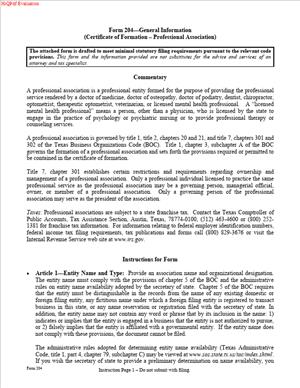
Form 204 – Certificate of Formation for a Professional Association
Fill out nowJurisdiction: Country: United States | Province or State: Texas
What is a Form 204 – Certificate of Formation for a Professional Association?
Form 204 creates a Texas professional association. It is the state filing that brings the entity into legal existence. You submit it to the Secretary of State. When accepted, your practice can operate as a professional association, or “P.A.”
A professional association is a specific Texas entity for licensed professions. It functions much like a corporation but is restricted to professional services. Only licensed professionals can own and govern it, with a few limited exceptions set by law or board rules. You use it when your practice needs a corporate-style structure that still respects licensing rules.
Typical users include doctors, dentists, lawyers, accountants, architects, engineers, veterinarians, and other licensed professionals. Health care groups often prefer a P.A. due to board rules and tradition. Law and accounting firms also use P.A.s to separate the practice from the individual owners’ business liabilities, while keeping professional accountability intact.
You may need Form 204 when you start a new professional practice in Texas. You also use it if you convert a sole proprietorship or general partnership into a professional association. Some firms choose a P.A. over a PLLC or PC due to ownership rules, naming preferences, or insurance and governance norms in their field. The form establishes your entity’s name, purpose, registered agent, and initial directors. It also sets enforceable limits on who may own and manage the entity.
In practice, filing Form 204 is the first legal step. It sets the framework. After approval, you adopt bylaws, elect officers, issue ownership interests, and start operations. Lenders, landlords, and insurers often ask for a filed certificate. It proves that your practice exists and is in good standing to transact business in Texas.
When Would You Use a Form 204 – Certificate of Formation for a Professional Association?
Use Form 204 when you plan to render a professional service through a Texas entity. Your service must require a Texas professional license. The entity must restrict ownership and control to licensed professionals in that field, with limited exceptions.
You would file this form when launching a new medical clinic as a P.A. You need it if you and a partner dentist intend to open a group practice with shared staff and facilities. You also use it if you convert an existing solo law practice into a P.A. for branding, liability protection, or succession planning. Some firms use a P.A. because their malpractice carriers or industry peers expect that entity type.
You also file Form 204 as part of a larger reorganization. For example, you might form a P.A. to receive assets from a dissolving general partnership. Or you might combine several solo practitioners under one entity for contracting and payroll. In each case, the P.A. structure ensures that only duly licensed professionals govern the practice. It also allows clearer separation between practice obligations and personal assets, except for personal malpractice.
Typical users include clinicians opening a multi-physician office, law firm founders, CPA partners moving into an entity, or architects building a design studio. Landlords and vendors may ask for a filed certificate before signing leases or master service agreements. Banks will often require it before opening a business account or extending a line of credit. Filing Form 204 clears those hurdles.
Sometimes a state licensing board rule points you to a P.A. rather than a PLLC or PC. In that case, Form 204 is the correct path. If you are unsure, check your profession’s ownership and control rules. The form is not for general businesses. It is only for professional services that require licensure in Texas.
Legal Characteristics of the Form 204 – Certificate of Formation for a Professional Association
Form 204 is a statutory formation document. It is legally binding because state law makes it the official act that creates the association. When the Secretary of State files it, the professional association exists as a separate legal entity. From that moment, the entity can enter into contracts, hire employees, and hold property in its name.
Enforceability flows from compliance with Texas law. The certificate must include a proper entity name with the required professional designator. It must name a Texas registered agent and registered office. It must state a lawful professional purpose. It must also align with ownership and management rules for your profession. If it misses a key element, the Secretary of State can reject the filing. If it includes prohibited terms or an overbroad purpose, it can cause delays or later legal issues.
A P.A. offers limited liability for business debts and contracts. However, it does not shield you from your own malpractice. Each professional remains responsible for their professional acts. The entity can limit some vicarious liability for other professionals’ acts, consistent with the law. Insurance and risk management still matter for malpractice exposure.
Name rules also have legal force. Your name must include “Professional Association” or “P.A.” It must be distinguishable from other entities on record. Certain words need extra approvals. If your name is misleading or unapproved, the filing can fail or later be challenged.
Your certificate becomes a public record. Third parties rely on it for your entity’s key facts. Courts and agencies use it to confirm your existence, purpose, and authority. The registered agent information controls where lawsuits and official notices get delivered. Incorrect agent details can cause missed notices and default judgments. Keep that information current with separate change filings as needed.
The effective date matters. You can choose immediate effectiveness upon filing. You may also choose a delayed date or an event within 90 days. Contracts and leases may depend on your chosen effective date. Draft the date to match your operational and tax plans.
Finally, professional compliance overlays everything. Owners, directors, and officers generally must hold the required licenses. Transfers to non-licensees are restricted. Loss of a license triggers mandatory redemption or transfer limits. Your certificate and bylaws should reflect these guardrails. They make the entity’s restrictions enforceable among owners and with regulators.
How to Fill Out a Form 204 – Certificate of Formation for a Professional Association
Follow these steps to complete Form 204 accurately and avoid delays.
Step 1: Confirm the P.A. structure fits your profession
- Verify your profession qualifies for a professional association.
- Confirm that owners, directors, and officers will be duly licensed.
- Ensure your intended professional service aligns with Texas rules.
- If your group spans multiple professions, check if the law allows that mix. Most P.A.s are limited to a single profession.
Step 2: Choose a compliant entity name
- Include “Professional Association” or “P.A.” at the end of the name.
- Avoid restricted or misleading terms.
- Select a name distinguishable from existing Texas entities.
- Decide on a backup name in case your first choice is not available.
- Example: “Riverbend Pediatrics, P.A.” or “Hidalgo Dental Group, Professional Association.”
Step 3: Get a registered agent and office in Texas
- Designate a Texas resident or a qualified organization as agent.
- List a physical street address in Texas as the registered office.
- Do not use a P.O. Box for the registered office.
- Obtain the agent’s consent before you file. The form requires that you confirm this consent.
Step 4: Draft a clear professional purpose
- State a single professional service. Keep it specific and narrow.
- Do not write “any lawful purpose.” That will be rejected.
- Example: “The association will practice dentistry and provide dental services.”
- If allowed, ancillary services support that purpose; you can state that as well.
Step 5: Identify initial directors
- List the initial board of directors. At least one director is required.
- Each director should be a licensed professional in the stated field.
- Include each director’s name and mailing address.
- Confirm they are eligible under your profession’s rules.
Step 6: Address ownership and membership details
- A P.A. is owned by members who are licensed professionals.
- Indicate, in the certificate or supplemental provisions, that all members will be duly licensed.
- If the form requests initial members, list their names and addresses.
- If not required, you can state membership restrictions in supplemental provisions.
Step 7: Prepare supplemental provisions
Use the “Supplemental Provisions/Information” section to tailor governance and compliance:
- Ownership restrictions: Only licensed professionals may own membership interests.
- Transfer limitations: Prohibit transfers to non-licensees. Include board approval requirements.
- Mandatory redemption: Require redemption upon death, disability, or license loss.
- Management rules: State quorum, voting thresholds, and director qualifications.
- Indemnification: Permit indemnification of directors and officers, as allowed by law.
- Limitation of liability: Limit personal liability of directors to the extent allowed.
- Action by written consent: Allow board or member action without a meeting.
- Emergency provisions: Outline authority during emergencies if needed.
- Dissolution triggers: Address events that may require winding up the association.
These provisions protect your license compliance and succession plan. They also prevent ownership drifting to non-licensees. Align them with your bylaws.
Step 8: Select the filing’s effective date
- Choose immediate effectiveness upon filing, or set a future date.
- A delayed date can be up to 90 days from signing.
- You may also use a future event within 90 days. Describe the event clearly.
- Match the effective date to lease start dates, payroll, and insurance plans.
Step 9: Name at least one organizer
- Identify the organizer who will sign the certificate.
- The organizer can be any adult individual. They need not be an owner.
- Include the organizer’s name and address.
- Only one organizer is required. More can sign if you prefer.
Step 10: Review and finalize
- Check the name, purpose, and designator.
- Confirm the registered agent and office are correct and consented.
- Verify each director’s licensing and address.
- Ensure supplemental provisions match your professional rules.
- Confirm the effective date clause.
Step 11: Sign the certificate
- The organizer signs and dates the form.
- No notarization is required for the certificate of formation.
- Use a legible signature and printed name.
Step 12: File with the Secretary of State
- Submit the signed form with the state filing fee.
- You can file online, by mail, or by other accepted methods.
- Request a file-stamped copy for your records.
- You may also order certified copies for banks and licensing boards.
Step 13: Hold your organizational meeting
After filing and acceptance:
- Adopt bylaws tailored to a professional association.
- Elect the board (if not already fixed) and appoint officers.
- Approve membership issuances and ownership records.
- Approve banking resolutions and authorized signers.
- Approve any buy-sell agreement consistent with your supplemental provisions.
Step 14: Complete initial compliance items
- Obtain an EIN from the IRS.
- Open a business bank account in the P.A.’s name.
- Register with your professional licensing board, if required.
- Set up malpractice coverage according to your profession’s standards.
- File any required beneficial ownership report, if applicable.
- Confirm local permits, assumed name filings, and tax registrations as needed.
Parties involved in the form
- The professional association: The new entity created by the filing.
- Organizer: The person who signs and files the certificate.
- Registered agent: The Texas contact for official and legal notices.
- Initial directors: The licensed professionals who govern the P.A.
- Members: The licensed owners of the P.A. They hold membership interests.
- Officers: The individuals appointed by the board to manage daily operations.
Key clauses you will include or consider
- Name and type clause: Confirms the P.A. designator.
- Purpose clause: Limits the entity to the specific professional service.
- Registered agent clause: Appoints the agent and office.
- Directors’ clause: Lists initial directors and their addresses.
- Membership restrictions: Limits ownership to license holders.
- Transfer and redemption: Handles changes in ownership and disqualifications.
- Indemnification and liability limits: Protects directors and officers within legal bounds.
- Effective date clause: States when the filing becomes effective.
Signatures and execution notes
- The organizer signs the certificate.
- The registered agent’s written consent is required but not filed with the certificate.
- Directors and members do not sign the certificate unless they also act as organizers.
- Keep signature authority consistent with your organizational meeting minutes.
Schedules and attachments
- Use supplemental pages if you need more space for directors or provisions.
- Attach any addendum for detailed transfer restrictions or redemption terms.
- Keep attachments clear and labeled as supplemental provisions or schedules.
- Ensure attachments do not conflict with the main form’s text.
Practical examples to guide your entries
- Dental practice: “SmileWorks, P.A.” Purpose: “To practice dentistry.” Directors: Two licensed dentists. Supplemental provisions: Ownership only by dentists; mandatory redemption if a dentist loses licensure.
- Law firm: “Valley Litigation Group, P.A.” Purpose: “To engage in the practice of law.” Directors: Three licensed attorneys. Supplemental provisions: Ownership only by attorneys; action by written consent; indemnification clause.
Common mistakes to avoid
- Using “LLC” or “Inc.” instead of “P.A.” or “Professional Association.”
- Writing “any lawful purpose” rather than a specific professional service.
- Naming a non-Texas registered office or a P.O. Box.
- Listing directors who are not licensed in the stated profession.
- Omitting transfer limits that prevent ownership by non-licensees.
- Setting a delayed effective date beyond the allowed period.
- Filing without the registered agent’s consent.
If you plan carefully, the form is straightforward. Keep your purpose narrow, your ownership restricted to licensees, and your governance clear. That approach speeds approval and reduces future compliance issues.
Legal Terms You Might Encounter
- Professional association. This is the specific entity type created by Form 204. It exists to provide professional services that require a state license. Only licensed individuals in the same profession can own and control it.
- Professional service. This is the work your association will offer. It must match a single regulated profession, such as medicine or engineering. Your purpose clause on Form 204 must reflect this scope.
- Certificate of formation. This is the legal document that creates your association. Form 204 serves as that certificate. Once accepted, it becomes your association’s birth record.
- Organizer. This is the person who prepares and signs Form 204. The organizer does not have to be an owner. The organizer’s role ends after filing unless otherwise designated.
- Governing persons. These are the individuals who manage the association. They may be directors, managers, or members based on your chosen structure. Form 204 asks you to identify the initial governing persons.
- Registered agent. This is the person or company authorized to receive legal papers for the association. The agent must agree to serve. Form 204 requires the agent’s name and consent.
- Registered office. This is the physical address where the registered agent will accept legal papers. It must be a street address in the state, not a P.O. Box. Form 204 lists this as the registered office.
- Effective date. This is when your association legally starts. You can choose the date on Form 204. You may select the date of filing or a later date.
- Duration. This states how long your association will exist. Most filers choose perpetual duration. You can specify a limited term in Form 204 if needed.
- Supplemental provisions. These are extra rules you add to govern the association. You can address ownership limits, voting, or transfer restrictions. Form 204 includes space for these provisions.
FAQs
Do you need to be licensed to form a professional association?
Yes. Owners and governing persons must hold the professional license tied to the association’s services. The purpose on Form 204 must align with that profession. If your profession requires a firm permit, secure that as well.
Do you need to list all owners in Form 204?
You must list governing persons as required by the form. You do not always list all owners. If an owner also serves as a governing person, list that person. Keep internal records for all owners and their licenses.
Do you need a registered agent before filing?
Yes. You must name a registered agent and provide a registered office address. The agent must consent to serve. Do not file until you have confirmed consent and a valid street address in the state.
Do you need to attach proof of licensure?
Form 204 does not always require attachments. However, your licensing board or state rules may require you to maintain proof. Keep copies of active licenses for all owners and governing persons. Be ready to provide them if requested.
Do you need to notarize Form 204?
No. Form 204 does not require notarization. The organizer signs the form. Ensure the signature block matches the form’s instructions.
Do you have to wait to conduct business until approval?
Yes. Do not hold out as an association until approval. Wait for acknowledgment from the filing office. After approval, complete any profession-specific registrations before offering services.
Do you file Form 204 online or by mail?
You can usually file electronically or by mail. Choose whichever method best fits your timeline and record-keeping needs. Keep a copy of everything you submit, including payment confirmation.
Do you need internal governing documents in addition to Form 204?
Yes. Form 204 creates the entity. You should also adopt bylaws or similar governing rules. These documents address ownership, management, decision-making, and transfers. They also help you meet professional ethics and compliance rules.
Checklist: Before, During, and After the Form 204 – Certificate of Formation for a Professional Association
Before signing
- Confirm your profession qualifies for a professional association.
- Verify that all owners and governing persons hold active licenses.
- Set your association’s name and confirm it meets naming rules.
- Choose your management structure and governing persons.
- Select a registered agent and obtain written consent.
- Confirm a physically registered office address in the state.
- Decide on the effective date and duration.
- Draft any supplemental provisions you want included.
- Prepare internal governing documents for adoption after filing.
- Confirm any profession-specific firm permits or approvals you must obtain.
- Gather full legal names and addresses for governing persons.
- Confirm business mailing address for non-legal correspondence.
During signing
- Check that the exact legal name matches your selection.
- Verify that the professional purpose is limited to one profession.
- Confirm that the registered agent’s name and street address are correct.
- Recheck the agent’s consent and that the office is not a P.O. Box.
- Ensure governing persons’ names and addresses are complete.
- Review supplemental provisions for clarity and legal consistency.
- Confirm effective date choice: on filing or a future date.
- Make sure the organizer’s name and address are accurate.
- Sign the form legibly and date it, following the form’s signature block.
After signing
- Make a final review for typos, omissions, or mismatched addresses.
- File the form with the state filing office by your chosen method.
- Pay the required filing fee with an accepted payment method.
- Save a complete copy of the signed form and payment record.
- Track your submission and wait for acknowledgment or approval.
- Once approved, store the filed certificate with your corporate records.
- Adopt bylaws or comparable governing rules at your first meeting.
- Record initial resolutions and officer appointments if applicable.
- Update your licensing board with entity details if required.
- Apply for any firm permits required for your profession.
- Open a business bank account with your filed certificate and ID.
- Set up compliance reminders for license renewals and annual filings.
Common Mistakes to Avoid
- Listing a purpose that is too broad. If you describe multiple professions, the filing can be rejected. Keep the purpose limited to the single licensed profession you actually practice. Don’t forget to align the purpose with your licenses.
- Using an invalid registered office. A P.O. Box or out-of-state address will not work. If you use an invalid address, you can miss legal notices and risk default judgments. Always provide a physical street address in the state.
- Failing to confirm agent consent. If the registered agent has not agreed to serve, the filing can be delayed or rejected. Get clear, documented consent. Don’t assume consent based on a past relationship.
- Omitting governing persons. If the form requires governing persons and you leave them out, the filing can fail. Double-check names, addresses, and license status. Keep your internal records consistent with the filing.
- Ignoring supplemental provisions. Skipping ownership or transfer limits can create compliance gaps. This can conflict with professional rules and put licenses at risk. Add the provisions you need now to prevent disputes later.
What to Do After Filling Out the Form
- File the certificate. Submit the signed Form 204 to the filing office. Use your chosen method and keep proof of payment and submission. If you selected a delayed effective date, note it in your calendar.
- Wait for acknowledgment. Do not hold out as an association until approval. If the filing office requests corrections, respond quickly and resubmit.
- Organize your records. Once approved, store the filed certificate, acknowledgment, and receipt in your records book. Keep a digital backup. Maintain a list of governing persons and their licenses.
- Adopt governing documents. Approve bylaws or comparable rules at your first organizational meeting. Record minutes. Appoint officers if your structure calls for them. Authorize banking and signing authority.
- Complete professional requirements. Update your licensing board if required. Obtain any firm permits or certificates that apply to your profession. Confirm malpractice coverage meets your profession’s standards.
- Set up compliance routines. Calendar license renewal dates for all owners and governing persons. Calendar annual or periodic state filings. Review insurance limits each year and update as needed.
- Open accounts and systems. Open a business bank account using your filed certificate and entity records. Set up bookkeeping, billing, and document retention. Keep license copies and renewal proofs organized.
- Monitor ownership rules. Ensure all owners and governing persons remain properly licensed. If a license lapses, update roles promptly to stay compliant.
- Plan for changes. If you change the registered agent, office, name, or governing persons, file an amendment or update as required. Update internal records to match. Keep the association’s public information current.
- Train your team. Educate staff on signing authority, client intake, and compliance workflows. Build controls for conflicts, trust accounting, and client records if applicable to your profession.
- Prepare for audits. Keep a compliance file with licenses, meeting minutes, permits, and insurance certificates. Update it after each renewal or change. Quick access reduces stress during reviews.
- Review annually. Each year, review your purpose, ownership, and management. Confirm they still match Form 204 and your professional rules. If not, plan a timely amendment and board or member approval.
Disclaimer: This guide is provided for informational purposes only and is not intended as legal advice. You should consult a legal professional.