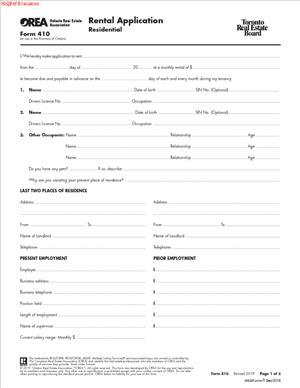
OREA Form 410 – Rental Application – Residential
Fill out nowJurisdiction: Canada | Province: Ontario
What is a Form 410 – Rental Application – Residential?
Form 410 is a standard rental application commonly used in Ontario to present a clear snapshot of a prospective tenant’s identity, income, and rental history, along with the applicant’s consent to verification through credit and reference checks. It is used for various residential properties—houses, condos, townhomes, basement suites, and purpose-built apartments—and helps landlords compare applicants consistently when there is more than one interested party.
The form is not a lease and does not reserve the unit. It is a preliminary screening tool. If your application is accepted, you will typically sign:
- An agreement to lease (also called an offer to lease), which is binding and outlines the rent, term, inclusions, and conditions;
- The Ontario standard lease, which becomes the formal tenancy agreement.
Only those later documents create the tenancy and set out your binding obligations. Think of Form 410 as your renter profile that initiates formal consideration.
Landlords, property managers, or listing brokerages use the application to assess whether you will likely pay rent on time, take reasonable care of the unit, and comply with house or building rules. The form typically requests your full legal name and contact details, date of birth (to match credit records), government ID type, current and prior addresses, employment and income information, references, vehicle and parking needs, desired move-in date, and occupant details. It may include space for a guarantor if needed to support your application (common for students, newcomers, or applicants with limited credit history).
The form accommodates varied applicant profiles—salaried employees, contract workers, self-employed individuals, retirees on fixed income, students, newcomers, and those without extensive credit history. When multiple adults will be responsible for rent, each adult customarily completes and signs their own application to authorize individual checks. If an adult will live in the unit but not be a tenant, they are usually listed as an occupant rather than a co-applicant.
Form 410 also helps align expectations. You can note the preferred commencement date, number of occupants, pet information, parking or locker needs, and any timing considerations for move-in. Early clarity lets the landlord confirm whether the unit and building rules are compatible with your situation, reducing surprises when drafting the lease. Provide only what the form requests; the objective is to verify suitability while minimizing the collection of sensitive data.
After submission, the landlord or their agent typically compares your application with others for the same unit. With your consent, they may contact employers and prior landlords, review your credit report, and verify references. They also check whether your requested timing and term align with their plans (for example, a fixed one-year term beginning on a specific date). If they decide to proceed, they issue an agreement to lease for signature; the Ontario standard lease follows. Throughout, Form 410 remains non-binding and functions strictly as the screening document that feeds accurate information into the binding lease documents.
When Would You Use a Form 410 – Rental Application – Residential?
You use Form 410 once a landlord or listing agent is ready to evaluate you for a unit—typically after a viewing (in person or virtual) or after initial screening questions. In competitive markets, timing matters; submitting a complete application with clear supporting documents helps ensure your file is reviewed promptly alongside others.
Applicants use the form to demonstrate their qualifications. Salaried tenants can list their employer, role, start date, and attach recent pay stubs or a letter of employment. Self-employed applicants may provide a brief description of their business, how long they’ve operated, and proof such as tax summaries or bank statements showing income deposits. Students or newcomers may add a guarantor, who typically submits a parallel application. When roommates apply together, each adult completes a separate application so the landlord can assess individual backgrounds and the household’s combined capacity to pay.
Landlords and property managers use the form to gather consent for verification and to standardize comparisons among applicants. Some may invite applications prior to open houses to pre-screen; others accept them only after viewings. In either case, Form 410 is the conventional instrument for formal vetting.
There are situations where the form is helpful but not strictly required. If you have completed an initial pre-screen questionnaire, the landlord may still require a full Form 410 to complete their file. By contrast, lease renewals or mid-term rent adjustments generally do not use Form 410. Assignments or sublets typically follow different procedures and forms, including required consents.
If your application includes a guarantor—a common approach for those with limited credit or short employment history—the guarantor provides their own identity, income, and credit details and agrees to pay if you do not. You must still complete your own application accurately; the guarantor supplements your file rather than replacing it.
Use Form 410 for new tenancies. It is not designed for rent increases, minor mid-term changes, or adding an occupant to an existing lease unless specifically requested as part of a screening process. For new applications, it collects the details relevant to an initial qualification decision.
Legal Characteristics of the Form 410 – Rental Application – Residential
Form 410 is a screening and authorization document, not a lease. Submitting it does not create a tenancy, guarantee acceptance, or bind either party to proceed. Its legal relevance lies in your consents and declarations: you authorize credit and reference checks and affirm the accuracy of your information. Landlords rely on these statements, and material misrepresentation can lead to rejection or issues later, including potential termination proceedings if significant inaccuracies are discovered after tenancy begins.
If accepted, you typically sign an agreement to lease that sets out rent, term, inclusions (utilities, parking, locker), and any conditions. Afterward, the Ontario standard lease is executed, which governs the tenancy and must comply with Ontario law. Clauses conflicting with mandatory rules may be unenforceable. Form 410 does not replace either document; it supplies accurate, verified inputs for drafting them.
Fees and deposits are regulated. In Ontario, landlords and brokerages cannot charge application fees. You should not pay to submit an application or to cover a credit check. A rent deposit is requested only after an offer to lease has been accepted. Usually this equals one rental period (for monthly tenancies, one month’s rent) and is applied to the last month’s rent, not damages. Damage deposits are not permitted. Key or fob deposits can be requested but must be refundable and limited to actual replacement cost. If you transfer a deposit after acceptance, obtain written instructions and a receipt specifying what the deposit is for.
Privacy and human rights obligations apply throughout. Landlords must collect and use personal information only for legitimate screening and tenancy management purposes, and they should disclose in the application how your data will be collected, used, shared, retained, and secured. Your Social Insurance Number is not required for a credit check; adequate identification with your name, date of birth, and current address is generally sufficient. You can mask unnecessary identifiers on ID copies if instructions allow.
Human rights rules limit factors used for approval or rejection. Landlords can assess income, credit history, rental history, and references, but they cannot discriminate on protected grounds (for example, family status or disability). Service animals are not pets. Landlords may ask about the number of occupants to ensure suitability and occupancy compliance, but the inquiry must remain neutral. Where accommodation is required for protected grounds, landlords should consider reasonable accommodation up to undue hardship.
When you sign the consent, you permit contact with current and prior landlords, employers, or HR departments, and listed references, and you authorize a credit report. Even if you attach your own credit report, the landlord may obtain a fresh report with your authorization. They should not use your information for unrelated purposes or share it beyond those involved in screening and tenancy administration. Application materials are commonly retained for a reasonable period for regulatory or dispute-related reasons; they should be stored securely and disposed of appropriately when no longer needed.
Payment methods are also regulated. You cannot be required to provide post-dated cheques, pre-authorized debits, or a specific electronic method as a condition of tenancy, although you may voluntarily agree to convenient payment arrangements. If interest is payable on a last month’s rent deposit, the landlord must account for it as required by applicable guidelines. These details typically appear in the lease rather than the application, but understanding them helps you evaluate requests made after acceptance.
You may withdraw your application prior to acceptance if you decide not to proceed. If a landlord accepts your application, the agreement to lease formalizes the terms. Review that document to ensure it reflects what you proposed or agreed during discussions (rent, term, inclusions, conditions). If discrepancies arise, resolve them before signing; the executed lease governs once in force.
How to Fill Out a Form 410 – Rental Application – Residential
1) Identify the property.
- Enter the full street address, unit number, and city as listed; add a building name or legal description in notes if commonly used.
- Include advertised rent, term, parking/locker details, and your preferred move-in date (note flexibility if applicable).
2) Provide your personal details.
- Use your full legal name, matching government photo ID, plus a reliable phone and email.
- Include date of birth for credit matching and the type of ID provided; do not include your Social Insurance Number.
3) List all occupants.
- Indicate the total number of adults and children; name each occupant and, if requested, note children’s ages.
- Clarify pet details (species/size) and distinguish service animals from pets where applicable.
4) Add your current address and landlord.
- Provide your current address (with unit and postal code), move-in date, and brief reason for moving.
- List your current landlord or property manager’s name and contact details; if owner-occupied, say so and add a suitable reference.
5) Add your rental history.
- Cover the requested period (commonly two to five years) with prior addresses and dates.
- Provide landlord contacts; if unavailable, note why and offer an alternative reference (e.g., superintendent).
6) Provide employment and income.
- List your employer, role, employment status (full-time, part-time, contract), start date, and, if applicable, contract end date.
- Include a verification contact (HR/supervisor), your gross income and pay frequency, and note typical variable compensation if relied upon.
7) Include other income if relevant.
- Add pensions, support payments, scholarships, benefits, or investment income with amounts/frequency.
- Attach reasonable proof (benefit or award statements) without over-disclosure.
8) Add vehicles if parking is requested.
- For each vehicle, list make, model, year, and plate (or note “pending”).
- Indicate if you require EV charging or accessible parking.
9) Provide banking details.
- Name your primary bank and branch or transit number if requested; omit full account numbers.
10) List references.
- Provide two reliable non-family references (supervisors, colleagues, professors, clients) with contact information.
- Notify references so they respond promptly.
11) Note any conditions or requests.
- State practical needs (e.g., two parking spots, storage locker) and timing constraints (e.g., weekend move-in).
- Keep requests specific and reasonable.
12) Review the privacy and consent clauses.
- Read the authorization allowing credit and reference checks, and note who is authorized to conduct them.
- Confirm how your data will be used and retained; ask questions before signing if unsure.
13) Sign and date.
- Sign and print your name clearly; unsigned applications cannot be processed.
- Each co-applicant and any guarantor must sign their own sections or separate forms.
14) Add schedules if you need more space.
- Attach a “Schedule A to Form 410” for overflow (include property address/date); reference relevant sections.
- Initial added pages for clarity and continuity.
15) Attach supporting documents.
- Include recent pay stubs or a letter of employment; self-employed applicants should add concise financial proof (tax summaries, invoices, bank deposit history).
- Provide a recent credit report if available (landlord may still obtain one with consent), reference letters if helpful, and a clear copy of photo ID with unnecessary identifiers masked if permitted.
16) Submit the package.
- Follow submission instructions (email, portal, separate files vs. combined PDF) and use clear file names.
- Keep copies; do not pay an application fee; only provide a rent deposit after acceptance, and get a receipt stating its purpose.
Tip: After acceptance, ensure the agreement to lease andthe Ontario standard lease match the terms you proposed or discussed.
Legal Terms You Might Encounter
- Applicant: The person completing the form to be considered for tenancy. The applicant provides identity, address history, and income details and signs consents for verification.
- Co-applicant: Another adult who will be jointly responsible for rent and obligations. Each co-applicant usually completes a separate application; the household’s combined income may be considered alongside individual credit profiles.
- Occupant: Someone who will live in the unit but is not a tenant. Occupants are listed for safety and compliance; they do not assume legal responsibility for rent unless added as tenants.
- Guarantor (co-signer): A person who promises to pay if the tenant does not. Guarantors provide their own identity, income, and credit details and usually sign a separate guarantor agreement at the lease stage.
- Consent and authorization: Clauses allowing the landlord or agent to verify employment, contact prior landlords and references, and obtain a credit report for screening.
- Credit report: A summary of credit history and current obligations used to assess payment reliability. You may attach a recent copy; the landlord may also obtain one with your consent.
- Employment verification: Confirmation of job status and income, often through HR, a supervisor, or an approved verification service. Letters on letterhead and recent pay stubs can support verification.
- Deposit: In Ontario, commonly, the last month’s rent deposit is requested after acceptance. Damage deposits are not permitted. Key/fob deposits must be refundable and limited to replacement cost.
- Agreement to lease (offer to lease): The binding document issued after acceptance that sets rent, term, and inclusions, preceding the Ontario standard lease.
- Term and commencement date: The duration of the tenancy and the start date. Proposals can be noted on your application to align expectations.
- Privacy notice: An explanation of how your personal information will be collected, used, shared, stored, and disposed of for screening and tenancy administration.
FAQs
Do you need a separate application for each adult?
Yes. Each adult who will be responsible for rent should complete and sign their own application so screening can occur individually and consents are properly captured. Adults living in the unit who are not responsible for rent should be listed as occupants.
Do you have to attach proof of income?
Strongly recommended. Clear, recent proof—pay stubs, a letter of employment, tax summaries or bank deposits for self-employed applicants—speeds verification and reduces back-and-forth. Without proof, screening may be delayed or declined.
Do you need a guarantor if your income is limited or you’re new to credit?
Not always, but a guarantor can strengthen your file if you are a student, newcomer, or recently employed. Guarantors generally must have stable income, good credit, and be willing to provide documents and sign a guarantor agreement.
Do you list time living with family, residence abroad, or owning a home?
Yes. Provide a complete address history for the requested period, even when you did not pay rent. For family living or homeownership, note the status and provide an alternative reference (e.g., supervisor or community leader). For time abroad, include reachable references.
Do you need your employer’s direct contact if privacy rules are strict?
Provide the designated verification method (HR, third-party service) and attach a letter of employment plus recent pay stubs if direct confirmation is restricted. Include brief instructions for the landlord on how verification works.
Do you include variable or cash income?
Yes, if you rely on it to pay rent. Provide a reasonable average and objective proof (invoices, bank statements). If income is seasonal, explain the cycle and how you manage expenses (savings, secondary income).
Do you sign if you’re still comparing units?
You may submit applications for consideration, but should not sign a binding agreement to lease or the standard lease until you’re ready. If you withdraw, notify the landlord or agent promptly.
Do you provide pet and parking details at the application stage?
Yes. Early disclosure confirms compatibility with property and building rules and prevents last-minute conflicts when drafting the lease.
Checklist: Before, During, and After the Form 410 – Rental Application – Residential
Before signing
- Valid photo ID and matching legal name; reliable phone and email.
- Address history with landlord contacts; alternate references if a prior landlord is unavailable.
- Employment details and proof of income; concise financial package if self-employed.
- Additional income statements if relevant.
- Two non-family references with phone and email; notify them in advance.
- Vehicle details if requesting parking; specify if you need EV charging or accessibility.
- Co-applicant/guarantor information; ensure each person completes and signs their own application.
- Special requests (storage, extra parking) noted clearly.
During signing
- Confirm property address, unit, rent, term, and preferred start date.
- List all adults as applicants/co-applicants and minors as occupants.
- Ensure income figures match your documents; avoid estimates.
- Double-check landlord/reference contact details.
- Read and understand consent and privacy clauses before signing.
- Add any conditions or notes precisely and sparingly.
- Sign and date; ensure all co-applicants and any guarantor have signed their sections.
After signing
- Save a clean PDF of the form and attachments; use clear file names.
- Submit as instructed and confirm receipt if you don’t get an acknowledgment.
- Alert references and employer/HR to expect verification requests.
- Calendar expected review windows and follow-up dates.
- Store sensitive data securely; minimize printed copies.
- Provide updates promptly if circumstances change (new job, updated income).
Common Mistakes to Avoid Form 410 – Rental Application – Residential
- Leaving gaps in address or employment history: Briefly explain study, travel, caregiving, or job-search periods.
- Overstating or guessing income: Use exact, supportable figures and explain variable income with a reasonable average.
- Using one form for multiple adults: Each adult must complete and sign their own application and consent.
- Missing signatures or consents: Incomplete authorizations halt screening and can cost you the unit.
- Oversharing sensitive data: Do not include full bank numbers or your Social Insurance Number; mask unnecessary ID details if allowed.
What to Do After Filling Out the Form 410 – Rental Application – Residential
- Submit your application exactly as instructed by the landlord, property manager, or listing brokerage. Use consistent, descriptive file names and include a short, professional cover note with the property address, preferred move-in date, and any key conditions (such as parking). If you receive no acknowledgment within the stated timeframe or a reasonable period, follow up politely to confirm receipt and legibility.
- Prepare for verification. Let your employer/HR, references, and prior landlords know to expect emails or calls and encourage timely responses. If a verifier cannot reach a contact, promptly provide an alternate reference. For non-standard files (self-employment, international income), add a brief summary that highlights the documents proving stability.
- If details change after submission (e.g., you accept a new role), send a dated addendum or updated page referencing the property and original submission date, plus proof (updated letter of employment). Keeping your file current avoids confusion and supports faster decisions.
- Upon acceptance, you will receive an agreement to lease (offer to lease). Review it carefully: rent, term, inclusions (utilities, parking, locker), conditions, and commencement date should match your application and discussions. Resolve discrepancies before signing. Transfer the last month’s rent deposit only after acceptance and per written instructions, and obtain a receipt stating the purpose (applied to last month’s rent). If a refundable key/fob deposit is requested, confirm that it is limited to the replacement cost.
- If you are not selected, you may ask how long your application will be retained. If you prefer removal, you can request it. Consider any feedback to strengthen future applications—clearer proof of income, better references, or earlier disclosure of special requests can all help.
- If you’ve applied to multiple units, manage the process actively. Withdraw promptly from units you are no longer pursuing, keep documents organized, and respond quickly to each landlord or agent. Clear communication demonstrates professionalism and reduces miscommunication. Above all, ensure the lease you ultimately sign reflects the terms that matter to you; the application starts the conversation, while the lease governs your tenancy.
Disclaimer: This guide is provided for informational purposes only and is not intended as legal advice. You should consult a legal professional.