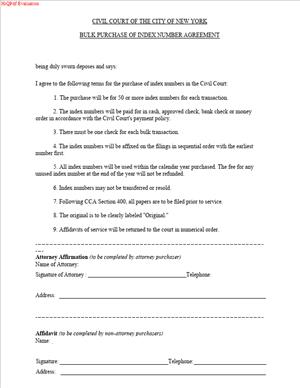
CIV-AD-79 – Bulk Purchase of Index Number Agreement
Fill out nowJurisdiction: Country: United States | Province or State: New York
What is a CIV-AD-79 – Bulk Purchase of Index Number Agreement?
The CIV-AD-79 is the Civil Court of the City of New York’s administrative agreement that authorizes eligible, high-volume filers to pre-purchase a block of civil court index numbers for later assignment. An index number is the unique identifier that opens a civil case; without one, your filing does not officially commence. Under this agreement, you obtain a defined quantity or range of numbers in advance, safeguard them internally, and assign each number to a specific case when you file that matter with the court. The court approves your participation, sets program terms, and then issues numbers subject to ongoing compliance.
This arrangement is particularly useful for organizations that file frequently and at scale—landlord-tenant practices, creditors’ rights firms, collection agencies, property managers, insurance carriers pursuing subrogation, and municipal or quasi-governmental units with continuing enforcement workloads. These filers often open multiple cases per week across one or more boroughs. Buying numbers in bulk reduces friction at intake, shortens cycle times for new matters, standardizes billing, and enables predictable internal controls. Your team can prepare pleadings and intake packets with the index information ready, minimizing last-minute errors at submission.
The agreement marries convenience with responsibility. Instead of purchasing a number for each new case at the counter or online, you prepay for a block, manage that inventory, and then log every assignment. Centralized payment and logging smooth coordination with runners, outside vendors, and client service teams while improving auditability. Because your internal process generates fewer touchpoints, you reduce opportunities for mis-keyed numbers or misapplied payments. Properly handled, the block functions like a controlled inventory: each number entered as stock is tracked while unused, and is permanently tied to one case at assignment.
Organizational accountability is built into the framework. You identify a custodian who controls the unused numbers and maintains the assignment log. You list authorized users—staff or vendors permitted to handle numbers under the custodian’s oversight—and you provide administrative and billing contacts to receive confirmations, invoices, and compliance notices. This clarity lets the court communicate efficiently and audit quickly if a discrepancy arises. It also ensures you have a defined escalation path when issues occur, such as suspected loss, theft, or misassignment.
Bulk purchasing is most effective for recurring case types commonly filed in Civil Court and, when applicable, its Housing Part. Typical examples include nonpayment and holdover proceedings, consumer credit actions, and insurance subrogation matters. Small Claims filings generally use their own process and are not the target of this program. If your practice involves only occasional filings or varied, one-off matters, a bulk arrangement may not be necessary and can even be counterproductive if numbers expire unused. Your goal is to match quantity to near-term demand so you avoid waste while still gaining speed and consistency.
The agreement is not simply an order form; it is a binding commitment to follow court rules on security, segregation by county, accurate recordkeeping, and reconciliation. The court can monitor your usage and require periodic reports. If you mishandle numbers, fail to maintain logs, or permit unlisted users to apply numbers, the court may suspend or revoke privileges and reject filings that rely on invalid or expired numbers. Conversely, a well-run bulk program sharpens operational discipline, improves cash forecasting, and produces dependable audit trails for both your internal stakeholders and the court.
In practice, the CIV-AD-79 helps larger teams synchronize billing and filing calendars, align staff coverage with predictable filing waves, and build standardized checklists that new team members can follow with minimal ramp-up. It harmonizes intake tasks across matter types that share similar opening steps. Because each county administers its own series, you also learn to manage county-specific inventories with clear labels and access rules. Over time, the process becomes an operational backbone: you set reorder thresholds, run weekly reconciliations, train for incident reporting, and document how vendor interactions are supervised.
Finally, the agreement encourages disciplined access control. Whether your inventory is printed, digital, or both, you must guard it from unauthorized use. The custodian’s log is your first line of defense. It shows who assigned which number, when, and to what case; it also provides the complete audit chain for periodic reconciliation. If discrepancies appear—such as a gap in the sequence or a number reserved but not filed—you can investigate quickly, report promptly, and remediate before the issue affects court intake. When managed with care, the CIV-AD-79 transforms a routine administrative step into a reliable, scalable process that supports a high-volume practice.
When Would You Use a CIV-AD-79 – Bulk Purchase of Index Number Agreement?
Use a CIV-AD-79 when your volume and cadence make per-case purchases inefficient. Indicators include steady weekly filings, a dedicated intake or docketing team, or reliance on runners who spend significant time at the clerk’s office. When filings are predictable, the administrative savings—fewer payment transactions, faster matter opening, better workload planning—often outweigh the upfront setup and the ongoing compliance tasks of logging and reconciliation.
Landlord-tenant practices benefit when monthly cycles of nonpayment and holdover cases create regular filing spikes. Creditors’ rights work, consumer debt matters, and no-fault insurance litigation likewise gain from predictable case initiation that aligns with client placement schedules or renewals. If you need to avoid bottlenecks during busy periods, a pre-purchased pool of numbers prevents last-minute scrambles and gives managers confidence that filings can proceed even if a clerk’s line is long or a payment system experiences delays.
From an accounting perspective, bulk buying consolidates payments and makes fee reconciliation straightforward. Instead of processing dozens of small transactions, finance can match one payment to one block, monitor drawdown, and forecast reorder points. Your compliance team can monitor usage, aging, and log completeness in a single view. If your filings ebb and flow seasonally, you can time block issuance to coincide with expected peaks, reducing the risk of unused numbers aging toward expiration.
Conversely, if your caseload is sporadic or you open only a handful of Civil Court matters per quarter, the block may not be justified. You risk holding numbers that creep toward expiration without being used, and fees for unused numbers are typically non-refundable. If your practice is geographically dispersed with minimal volume in certain counties, avoid setting up bulk arrangements in those low-volume locations. Because each county maintains its own series and program administration, cross-county usage is not permitted; misapplied numbers will cause rejections and delay case initiation.
Multi-borough practices should plan county by county. Evaluate whether your filings in each county are sufficient to support separate setups, logs, custodians, and user lists. Start with the county where volume is reliably highest, refine your internal controls, and expand outward after the first block proves stable. This phased approach helps you discover workflow gaps and training needs on a smaller scale before rolling out across multiple counties. It also prevents waste by avoiding blocks in counties where demand is uncertain.
In short, adopt a CIV-AD-79 when you need speed, predictability, and centralized control. Avoid it when irregular volume or low demand would force you to carry idle, aging inventory. When uncertain, project your next quarter’s caseload per county, confirm the applicable expiration practices, and buy only what you can confidently assign within that window. Tuning quantity to real usage lets you capture the operational benefits without paying for numbers you do not need.
Legal Characteristics of the CIV-AD-79 – Bulk Purchase of Index Number Agreement
The CIV-AD-79 is a binding administrative agreement with the Civil Court of the City of New York. By signing, you accept the court’s terms regarding payment, security, authorized access, and reporting, in exchange for the privilege of purchasing index numbers in bulk. The agreement becomes effective when the court accepts your submission and, if required, when payment clears, and a block is issued. From that moment, your duties are enforceable, and misuse can trigger corrective action.
The court’s authority to regulate filings and collect fees underpins enforceability. If you breach the terms—by letting unlisted staff use numbers, failing to maintain secure custody, skipping reconciliation, mixing counties, or mishandling expiration—the court may suspend or revoke your privileges. Suspensions can be temporary and conditional on remediation; revocations can be longer or permanent for serious or repeated violations. The court may also reject filings that use invalid, expired, or mismatched numbers, delaying or halting case openings.
Core terms typically include non-transferability and security. Non-transferability means numbers issued to your organization cannot be sold, loaned, or shared with other entities or related affiliates not named in the agreement. Security requirements obligate you to protect both physical lists and digital repositories. The custodian is accountable for procedures such as locked storage, access restrictions, audit trails, and user training. If your organization uses a case management system, configure role-based permissions so only authorized users can view or assign numbers.
Accurate and timely recordkeeping is central. You must maintain an assignment log capturing, ata minimum, index number, case title, filing date, assigned attorney or filer, and relevant internal identifiers. The court can request reconciliation; you must then show that each number is either assigned to a filed matter or remains unused and secure. Gaps, duplicates, or inconsistencies may prompt audits and can pause new block issuance until issues are resolved. An effective log is contemporaneous, searchable, and exportable.
Financial terms cover accepted payment methods, timing, and the usual absence of refunds for unused or expired numbers. Plan block sizes around realistic, near-term demand. If a payment is returned or rejected, issuance may be canceled and privileges suspended until corrected. Keep proof of payment with your agreement records for audit purposes. Finance teams should monitor usage trends so reorders occur before inventory hits zero, but not so early that aging accelerates.
Each county’s program is distinct. A block issued in one county cannot be used in another, and county-specific terms apply only to that county’s filings. If you maintain multiple county agreements, keep separate logs, custodian assignments, and authorized user lists for each. Mixing numbers across counties invites intake rejection and compliance action. If your organization relocates, changes names, restructures, or modifies contact details, you must update each county’s records promptly.
Your responsibilities extend to agents and vendors. If permitted, a runner or filing vendor may be listed as an authorized user with a clearly defined scope. Even then, your organization remains fully accountable for compliance. Maintain written instructions, train vendor personnel who handle numbers, limit access to what is strictly necessary, and perform periodic spot checks. Treat vendors as an extension of your team: monitor their conduct and document any incident and corrective measures.
Agreements often include requirements for incident reporting and corrective steps. If a number is lost, stolen, or assigned to the wrong case, you must notify the clerk immediately, annotate your log, and follow the court’s instructions for cancellation or curative action. Swift reporting reduces the risk of duplication, fraud, or conflicting case records and demonstrates good-faith compliance. Recurrent discrepancies or delays in reporting can escalate oversight or trigger suspension.
Termination and renewal may be governed by administrative practice in the civil court of New York City. Some arrangements continue until modified or terminated; others require periodic updates to authorized user lists or contact details. Treat the agreement as a living document: monitor court notices, align internal procedures when rules evolve, and refresh your user lists and custodian designations as staffing changes. Proactive maintenance keeps privileges uninterrupted and minimizes the likelihood of intake disruptions.
How to Fill Out a CIV-AD-79 – Bulk Purchase of Index Number Agreement
1) Identify the purchaser.
- Enter the full legal name of your organization. If you use a DBA, include both the legal name and the DBA to prevent billing or audit confusion.
- Provide complete address, main phone, and a monitored email (ideally a shared inbox) for official communications.
- If a law firm, name the responsible attorney and include any requested attorney identifiers.
2) Choose the county.
- Select the Civil Court county (Bronx, Kings, New York, Queens, or Richmond) where you will file and use the numbers.
- Use a separate agreement for each county you intend to serve; approval is county-specific.
- Start with the county where your filing volume is highest and expand later as procedures stabilize.
3) Name your contacts.
- List a primary administrative contact who manages day-to-day processes and can respond quickly to court inquiries.
- Provide a billing contact who handles invoices, payments, and reconciliation; note any internal PO requirements.
- Designate a custodian for security and logs, plus a backup custodian to ensure continuity.
4) List authorized users.
- Identify staff who may handle or assign numbers; include titles, direct lines, and work emails.
- If vendor access is permitted and you intend to use a runner or filing service, list them and define their scope (e.g., pickup/delivery only).
- Attach a separate schedule if the list is long; label it by county and effective date.
5) Request a quantity.
- Specify the number of index numbers you need. As a starting point, request what you expect to use in one to two months.
- If timing fields exist, align issuance with upcoming filing waves to minimize aging risk.
- Acknowledge any expiration window and size your order conservatively.
6) Accept the terms.
- Review and initial key clauses on non-transferability, security, and reconciliation.
- Confirm you understand vendor oversight, incident reporting, and audit provisions, and that your internal process matches those requirements.
- Brief internal teams on consequences for misuse and establish escalation paths.
7) Acknowledge recordkeeping.
- Commit to maintaining a contemporaneous assignment log with number, case title, filing date, assigned filer/attorney, court part (if any), and internal matter number.
- Confirm you can produce the log on request and that your system can export the required fields.
- Decide whether the log will be centralized with the custodian or maintained in a controlled, shared system.
8) Confirm payment method.
- Indicate your payment method per county instructions; verify accepted options beforehand.
- Complete internal approvals (e.g., PO issuance) so payment is timely and block issuance is not delayed.
- Make payment payable as instructed and retain proof with your agreement file.
9) Add certifications.
- Answer compliance questions accurately, including any use of third-party filers or runners and limits on their roles.
- Certify the accuracy of your addresses, contacts, and authorized users, and plan to update promptly when changes occur.
- Ensure the signer has authority to bind your organization to the agreement’s terms.
10) Sign and date.
- Have an authorized officer, partner, or attorney sign; print name, title, and date.
- Provide direct contact information for the signatory to expedite any follow-up questions.
- Use the signature format required by the county (wet ink or accepted electronic signatures).
11) Attach schedules.
- If needed, attach a clearly labeled authorized-user schedule for the specific county.
- Include any required authorization letters or identity documents. A brief cover page listing attachments speeds intake review.
- Check legibility and consistency across attachments and date them.
12) Submit the agreement.
- File with the correct Civil Court office for the county per its submission instructions.
- Keep a complete copy of everything submitted, including payment proof, and note the submission date and method.
- Track status and follow up if confirmation is not received within your expected timeframe.
13) Use and track the numbers.
- On issuance, record the block range (start and end) and store it securely. For physical lists, use locked storage; for digital lists, limit access and maintain audit trails.
- Assign a number only when opening a case and immediately update the log to reflect the assignment.
- If reserving a number for a pending filing, mark the reservation with a short hold timeline and release it if the filing stalls.
14) Maintain compliance.
- Update the court promptly when addresses, contacts, custodians, or authorized users change, and keep proof of each update.
- Remove access immediately when personnel change roles or depart; retrieve any physical lists or devices containing numbers.
- Report lost, stolen, or misapplied numbers right away and document the incident and corrective measures.
15) Reconcile and renew.
- Reconcile regularly by matching each number to a filed matter or confirming it remains unused and secure; weekly is common for high-volume operations.
- Monitor inventory against your reorder threshold and request replenishment early enough to avoid interruptions.
- Prioritize assignment of aging numbers when appropriate and document any closures or cancellations consistent with court direction.
Legal Terms You Might Encounter
- Index number: A unique identifier that opens a civil case. Once assigned, it becomes part of the public record and cannot be reused.
- Bulk purchaser: The contracting entity responsible for payment, security, compliance, and oversight of staff and vendors who handle numbers.
- Authorized user: A person or vendor you list who may access or apply numbers. Listing does not shift liability; it clarifies permitted handlers.
- Custodian: The individual responsible for securing unused numbers, maintaining the log, and supervising authorized users; a backup custodian ensures continuity.
- Assignment: The one-time act of linking a number to a new case at filing; after assignment, the number cannot be reclaimed or reassigned.
- Reconciliation: The periodic verification that every number is either assigned with complete details or accounted for as unused and secure.
- Non-transferability: The restriction against selling, sharing, or gifting numbers beyond the approved entity and listed users, even within corporate families.
- Suspension or revocation: The court’s power to pause or terminate bulk privileges for misuse, poor recordkeeping, or other breaches.
- Expiration: The administrative cutoff after which an unused number may not be valid; manage orders to use numbers within that window.
- Refund policy: Payments for unused or expired numbers are typically non-refundable; purchase conservatively and adjust based on real usage.
FAQs
Do you need a pending case to buy a block?
No. You purchase numbers in advance and assign them only when opening a new case. Do not attach bulk numbers to already-indexed matters or to filings outside your approved Civil Court use.
Do you need a separate setup for each county where you file?
Yes. Each county runs its own series and administration. Using a number from one county in another will likely result in rejection. Keep separate logs, custodians, and authorized user lists per county.
Must you list your filing vendor or runner as an authorized user?
If permitted, the vendor will handle numbers, list them, and define their scope. Your organization remains responsible for misuse. If vendor listing is not allowed, restrict assignment authority to internal staff and give vendors only what they need to deliver.
How many numbers should you request initially?
Start with one to two months of anticipated filings. Track usage weekly and set a reorder threshold that accounts for court processing time while avoiding overstock that could age toward expiration.
What should you do if a number is lost, stolen, or used on the wrong case?
Notify the clerk immediately, record the incident in your log, and follow instructions for cancellation or correction. Prompt reporting limits disruption and demonstrates compliance.
Can you get a refund for unused or expired numbers?
Generally no. Avoid waste by purchasing conservatively, monitoring aging, and prioritizing assignment of older numbers when feasible.
Do you need to update the agreement after a move or staffing change?
Yes. Notify the court promptly of changes to addresses, contacts, custodians, or authorized users so that notices reach the right people and only approved personnel have access.
Can you use bulk numbers for all civil case types?
Use numbers only for the permitted case types and parts under your setup. Maintain separate workflows if different divisions have unique requirements to prevent misapplication.
Checklist: Before, During, and After the CIV-AD-79 – Bulk Purchase of Index Number Agreement
Before signing
- Verify legal name, DBA (if any), address, and contacts match official records.
- Select a custodian and backup; decide on storage (physical, digital, or both) and access controls.
- Compile authorized users with roles and contact details; apply least-privilege principles.
- Estimate monthly volume per county, set a conservative initial quantity, and define a reorder threshold.
- Confirm payment method, internal approvals, and signatory authority.
- Draft brief internal procedures for assignment, reconciliation, incidents, and vendor oversight.
During signing
- Confirm the correct county and consistent organizational details across all fields.
- Double-check administrative, billing, and custodian contacts.
- Review and attach any extended authorized-user schedule with the county and the effective date.
- Confirm quantity requested and acknowledge expiration and non-transferability terms.
- Ensure reconciliation, audit, and incident clauses align with your controls; adjust processes if needed.
- Sign, date, print name and title, and file a clean copy for internal use.
After signing
- Submit per instructions; record submission details and track status.
- Upon approval, log the exact block range and restrict access appropriately.
- Implement the assignment log on day one and begin recording immediately.
- Brief intake, billing, and runners on county-specific separation and assignment rules.
- Calendar reconciliation checkpoints and a replenishment review before reaching your threshold.
- Monitor real usage and refine quantity and cadence for future orders.
Common Mistakes to Avoid CIV-AD-79 – Bulk Purchase of Index Number Agreement
Mixing counties in a single log or inventory.
- Consequence: filing rejections and possible suspension. Maintain distinct, clearly labeled inventories per county and train staff accordingly.
Allowing unlisted staff or vendors to handle numbers.
- Consequence: breach of terms. Update authorized user lists before granting access and remove access immediately when roles change.
Over-ordering and letting numbers expire.
- Consequence: wasted, non-refundable fees. Size orders to realistic demand and prioritize assignment of older numbers when appropriate.
Failing to report lost or misapplied numbers promptly.
- Consequence: delays, rejections, or administrative action. Encourage immediate, no-blame reporting and document corrective steps.
Assigning numbers before approval or without recording them.
- Consequence: intake rejection and reconciliation gaps. Wait for written confirmation of your block and log every assignment in real time.
What to Do After Filling Out the Form CIV-AD-79 – Bulk Purchase of Index Number Agreement
- File the agreement and track acknowledgment.
Record submission date, receiving office, and reference numbers. Follow up if confirmation is delayed.
- Record your block range upon approval.
Enter start and end numbers in your inventory; limit access to custodians and listed users, and provide read-only visibility to finance and audit as needed.
- Implement internal workflows.
Train staff on assignment timing, logging, incident reporting, and reconciliation cadence. Provide a concise, quick reference tailored to county-specific rules.
- Begin controlled assignment.
Assign numbers only at case opening and immediately update your log with case title, date, filer, and internal matter number.
- Reconcile regularly and manage replenishment.
Match numbers to cases at a set cadence (weekly for high volume), monitor inventory against your reorder threshold, and start replenishment early.
- Manage amendments.
Update the court promptly when addresses, contacts, custodians, or user lists change; file proof internally and adjust system permissions the same day.
- Share procedures widely, not number lists.
Secure the inventory; avoid emailing lists unless necessary and protected. Prefer access-controlled systems with audit trails.
- Prepare for audits.
Maintain the agreement, block confirmations, payment proofs, assignment logs, reconciliation reports, and incident files in a central, controlled repository. Conduct periodic self-audits.
- Close out and renew.
As numbers near depletion or expiration, reconcile final usage, document any cancellations per court instruction, and size your next block based on recent trends to maintain continuity without waste.
Disclaimer: This guide is provided for informational purposes only and is not intended as legal advice. You should consult a legal professional.