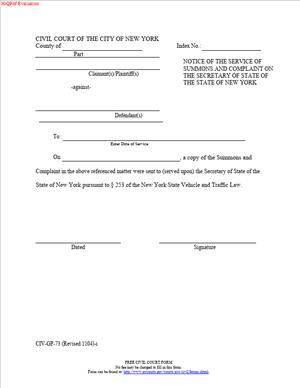
CIV-GP-73 – Notice of Service of Summons and Complaint on the Secretary of State of the State of New York
Fill out nowJurisdiction: Country: United States | Province or State: New York
CIV-GP-73 – Notice of Service of Summons and Complaint on the Secretary of State of the State of New York is a Civil Court of the City of New York form. It notifies a defendant that the summons and complaint were served through the Secretary of State. It concerns notice of a lawsuit, not the merits of the underlying dispute.
You may encounter this document when a business entity is a defendant, particularly in paperwork connected with a default judgment request. Original service, additional notice, and proof of mailing serve distinct purposes.
If you prepare the form, accurately identify the case, defendant, and earlier service event. If you receive it, understand that someone claims the lawsuit papers have already been served. The notice alone does not establish liability, confirm valid service, or show that judgment has been entered.
What is CIV-GP-73 – Notice of Service of Summons and Complaint on the Secretary of State of the State of New York?
Clear definition
This form gives notice of an earlier service of the summons and complaint on the Secretary of State. The summons identifies the lawsuit and calls for a response; the complaint describes the plaintiff’s allegations and requested relief.
For certain business defendants, an authorized service procedure involves delivering papers to the Secretary of State. That office is not being sued simply because it receives them.
The notice connects the service event to the defendant and case. It differs from an affidavit of service, which records delivery or mailing facts in a sworn statement. It is neither a settlement agreement nor an admission of liability.
Who typically uses this form?
A plaintiff or someone handling the plaintiff’s paperwork may prepare the notice using existing case papers and service records. Self-represented plaintiffs may encounter it while assembling a default judgment application.
A business owner, officer, employee, or mail recipient may receive it. Handling correspondence does not automatically make that person an individual defendant; the case caption identifies whom the lawsuit names.
Different people may prepare, sign, mail, and file related papers. The preparer should not assume personal knowledge of events performed by someone else.
Why might you need this form?
Original service and later notification can fulfill different procedural requirements. In a default judgment request against a corporation, the court may examine whether additional notice was sent and whether the mailing is adequately documented.
The form helps connect that notice to a specific lawsuit. Its usefulness depends on accurate underlying records: completing a notice cannot establish that an unsupported service event occurred.
Typical real-life scenarios
- You sued a corporation over an unpaid invoice, served it through the Secretary of State, and are reviewing additional-notice requirements before seeking default relief.
- You receive business mail referring to an unfamiliar lawsuit and need to locate the summons, complaint, and court record.
- You inherited a case file containing several receipts and must distinguish original service from later mailings.
- Your defendant is an LLC rather than a corporation, requiring you to check whether the same procedure applies.
- A notice returns undelivered, creating an issue to evaluate without automatically resolving the validity of original service.
When would you use CIV-GP-73 – Notice of Service of Summons and Complaint on the Secretary of State of the State of New York?
Use this notice only in a procedural setting that fits its purpose: reporting completed service of the summons and complaint through the Secretary of State. It is not a request for future service.
A common context is preparation for a default judgment request involving a corporate defendant. Additional notice and mailing proof may matter separately from the original service record.
Before choosing the form, check:
- Entity type: Corporations, LLCs, partnerships, and individuals are not interchangeable.
- Service method: Service through the Secretary of State differs from personal delivery to an authorized business representative.
- Court: This form belongs to the Civil Court of the City of New York. Similar forms from other courts are not necessarily interchangeable.
- Timing: Original service, notice mailing, and the court application may have separate timing requirements.
- Address: The appropriate address depends on the governing procedure and circumstances, not merely on what appears in a convenient record.
The notice may arrive before any judgment exists. It does not establish that the defendant has lost every opportunity to participate, and its receipt should not be assumed to restart a response period.
Legal characteristics of CIV-GP-73 – Notice of Service of Summons and Complaint on the Secretary of State of the State of New York
The notice has a procedural function. Its significance depends on applicable requirements and the surrounding facts, not simply on using the correct form number.
The caption connects it to the action through the court, county, parties, and index number. Exact business identity matters: a storefront name or related company may not identify the defendant named in the complaint.
Dates must describe the correct events. The original service date is not necessarily the preparation date, confirmation date, or mailing date.
Accurate contents and proper delivery are separate questions. A completed form may still involve an insufficient mailing. A mailing receipt, meanwhile, does not establish that every statement or enclosure was correct.
Supporting records may include the original service record, completed notice, enclosure copies, and mailing proof. A returned envelope should also be preserved because its address and return explanation may matter.
Court acceptance does not necessarily establish valid service. A filed document can remain subject to later review or challenge.
The notice does not prove the claim, establish damages, amend a defendant’s name, or cure every defect in earlier service.
Is it legally binding?
“Legally binding” is not the most useful description. This is neither a contract exchanging promises nor an order directing payment. It is a procedural document that may help demonstrate compliance with an additional-notification requirement.
Its effect depends on accurate information, proper delivery, timing, and supporting proof. Completion alone does not establish compliance.
A signer must distinguish personal knowledge from information obtained through records. A separate sworn mailing statement has a different evidentiary role from the notice.
For recipients, the broader lawsuit determines response obligations and available objections. The court ultimately evaluates whether applicable procedural requirements have been satisfied.
How to fill out CIV-GP-73 – Notice of Service of Summons and Complaint on the Secretary of State of the State of New York
Step 1 – Confirm the document’s purpose
Read the title and printed text. Confirm that the form reports completed service through the Secretary of State, rather than requesting service, proving a later mailing, or applying for judgment.
Step 2 – Gather the existing case records
Collect the summons, complaint, case information, service record, relevant addresses, and applicable instructions. Resolve missing information before signing or sending the notice.
Step 3 – Identify the court and county
Copy court information from the existing case papers. Use the county associated with the action, not your residential county unless they are the same.
Step 4 – Reproduce the party names
Match the case caption, preserving entity endings and identifying details. Do not substitute an owner or trading name. Investigate inconsistent records rather than silently creating a different caption.
Step 5 – Enter the index number
Copy every identifying component, including the year where shown. A business registration number, invoice number, or Secretary of State transaction reference is not the court’s index number.
Step 6 – Identify the notice recipient
Complete applicable recipient and address fields using the governing notice requirements. Distinguish the defendant from a person handling its mail. Determine what each available address represents before selecting one.
Step 7 – Verify the original service event
Check that the service record concerns the same entity and lawsuit. A business filing, payment confirmation, or service request does not necessarily document completed service.
Step 8 – Enter the service date where requested
Use the recorded date of the event requested. Do not substitute today’s date or a confirmation-download date. Resolve conflicting records rather than estimating.
Step 9 – Read the completed notice language
Read the printed wording together with your entries. Confirm that it accurately describes the case and earlier service. Avoid adding payment demands, allegations, or arguments.
Step 10 – Complete identifying and signature fields
Complete the fields appearing on your copy and accurately identify your role. Do not sign for someone else or claim to have performed service unless that is true.
Step 11 – Separate notice from mailing proof
Identify any separate proof required for the later mailing. Signing the notice does not establish who mailed it, when, where, or how. The mailing record must reflect the actual event.
Step 12 – Check accompanying documents
Review applicable instructions for required enclosures. Match the packet’s contents to those requirements; do not assume every procedure requires an identical set of papers.
Step 13 – Review dates and document consistency
Compare the notice with supporting records, focusing on names, index number, dates, addresses, and signatures. Never describe a planned mailing as already completed.
Step 14 – Preserve the completed version and event records
Save the final notice and actual enclosure packet. Retain mailing evidence, returned envelopes, and filing confirmations so preparation, delivery, and submission remain separately documented.
Legal terms you might encounter in CIV-GP-73 – Notice of Service of Summons and Complaint on the Secretary of State of the State of New York
- Secretary of State: The state official through whose office service may be authorized for certain business entities. Receiving papers does not make that official a defendant.
- Service of process: Formal delivery of lawsuit papers through a legally recognized method. Preparing papers or paying a fee is not necessarily completed service.
- Summons: The paper identifying the lawsuit and calling on the defendant to respond. Its case information should correspond with the notice.
- Complaint: The document stating the plaintiff’s claims and requested relief. The notice neither replaces it nor adds allegations.
- Plaintiff and defendant: The plaintiff brings the action; the defendant is the person or entity sued. A mail recipient does not become a defendant merely by receiving correspondence.
- Caption: The identifying block naming the court and parties. It should remain consistent with the existing case papers.
- Index number: The court-assigned case identifier, distinct from mailing tracking numbers and service transaction references.
- Additional notice: A further notification following original service, potentially subject to its own timing, delivery, and proof requirements.
- Affidavit of service: A sworn statement describing service facts. Unlike the notice, it provides evidence concerning delivery or mailing.
- Default judgment: A judgment sought following a defendant’s failure to respond or appear as required. This notice alone neither establishes entitlement to judgment nor proves damages.
FAQs
Which date belongs in this form if my records show several different dates?
Match the wording beside the field to the record documenting that event. For original service, use the supported service date—not the filing date, payment date, or date you downloaded a receipt.
If records conflict, investigate before completing the field. Keep any later mailing date separate. The notice does not create a new effective date for the lawsuit.
What should I enter if the business name differs from the name on the complaint?
Compare the caption, service record, and business-identification information. Determine whether the difference is formatting or indicates another legal entity.
Do not quietly rename a party through this notice. A suspected error in the complaint requires separate attention. A contact person or department may help route mail but does not replace the defendant’s name.
Who can sign this form, and what authority should you confirm?
Follow the signature block and accompanying instructions. Typing the document does not automatically make someone the proper signer.
If acting for an entity or another person, confirm your authority and capacity; a job title alone does not necessarily authorize court representation. A person signing separate mailing proof must be able to truthfully attest to the facts stated.
Do you need to attach another copy of the summons and complaint?
Check the applicable notice procedure and requirements for the intended court request. The title alone does not determine enclosure requirements.
If copies are required, verify that they are the appropriate papers, not an unserved draft or an accidentally substituted amendment. Retain the actual enclosure packet. Tracking information generally does not identify everything inside an envelope.
Which address should you use when the business has several addresses?
First determine whether the field requests the recipient’s address, a signer’s contact information, or something else. For the recipient, follow the applicable procedure.
Compare available addresses and document their sources. A storefront, principal office, and correspondence address may differ. Verify unit numbers and postal codes; do not assume the original service information resolves the later mailing-address question.
Does filing acceptance mean this form proves that service was valid?
No. Acceptance generally confirms that the document entered the court record, not that a judge approved service, mailing, or entitlement to judgment.
An electronic transmission confirmation may also precede acceptance or rejection. Preserve both status messages and underlying evidence. If correction is requested, read the stated reason rather than assuming the entire case has been rejected.
What should you do if you discover an error after sending this document?
Identify the error and determine which mailed or filed versions contain it. Preserve the version actually sent and its supporting records.
Then determine the appropriate correction process for the affected step. Do not overwrite the original and obscure the history. A corrected notice does not automatically repair defective service or eliminate the consequences of an earlier mailing.
What changes in the public record when you file this document?
Filing may add the notice and supporting papers to the accessible case history. It does not itself amend the complaint, change business registration information, or establish that judgment exists.
Review attachments for unnecessary sensitive information. Follow applicable privacy and redaction requirements while retaining required information. Private research notes need not automatically become part of the submission.
Checklist: Before, During, and After CIV-GP-73 – Notice of Service of Summons and Complaint on the Secretary of State of the State of New York
Before
- Confirm the court, entity type, and procedural purpose.
- Gather the summons, complaint, case information, and original service evidence.
- Identify the particular defendant covered by the notice.
- Verify address, timing, mailing, and enclosure requirements.
- Determine who may sign and who will handle mailing.
- Resolve inconsistent names, dates, or case numbers.
During
- Match the caption and index number to the case.
- Enter dates according to the events requested.
- Distinguish the defendant from mailing contacts and signers.
- Report only supported, completed events.
- Complete applicable signature and contact fields.
- Check enclosures, legibility, page order, and missing information.
After
- Save the signed notice and exact outgoing packet.
- Record the completed mailing’s date, destination, method, and mailer.
- Preserve receipts, tracking records, and returned correspondence.
- Check court acceptance or rejection when filing is required.
- Maintain separate timeline entries for mailing and filing.
- Track subsequent deadlines without assuming this notice restarts them.
Common mistakes to avoid with CIV-GP-73 – Notice of Service of Summons and Complaint on the Secretary of State of the State of New York
- Treating the notice as original service. The document reports an earlier event; it does not replace the underlying service record or automatically cure defects.
- Using a transaction date as the service date. Identify what each receipt timestamp records before copying it.
- Substituting a familiar business name. Compare legal identity across the caption and service evidence, especially where related companies share an address.
- Assuming a correct address guarantees sufficient mailing. Method, timing, contents, and proof may each require separate verification.
- Signing mailing proof too early. Do not certify an event before it occurs. The statement must match the completed mailing and signer’s knowledge.
- Keeping tracking information but not enclosures. Retain an exact packet copy so you can establish what was sent.
- Confusing upload confirmation with acceptance. Check subsequent filing status and address any rejection or correction request.
- Adding unnecessary private records. Extra material can expose sensitive information without supporting the procedural issue. Keep research files separate from required submissions.
What to do after filling out CIV-GP-73 – Notice of Service of Summons and Complaint on the Secretary of State of the State of New York
Treat the notice as one component of the case record. Labels such as “draft,” “signed,” “mailed,” and “filed” help distinguish completed steps from planned actions.
Step 1: Create a final reference copy.
Save a readable copy, including signatures and handwritten entries. Open the saved file to verify that every page is present. Keep editable drafts separate.
Step 2: Assemble the actual outgoing packet.
Include the required enclosures and compare them with your intended contents. Check each packet independently when multiple defendants or addresses are involved.
Step 3: Confirm the delivery arrangements.
Verify the recipient, destination, and required method. Give the mailer clear instructions about the packet and the details that must be recorded.
Step 4: Record the completed mailing.
Preserve the actual date, address, method, and receipt information. Complete required proof of what happened, not from an earlier plan that may have changed.
Step 5: Determine what belongs in the court submission.
Check whether the notice, mailing proof, or supporting papers must be filed now or with a later application. Mailing and court filing are separate actions.
Step 6: Use the available filing method when filing is required.
Confirm the permitted submission channel and formatting requirements for your case. Retain the electronic transmission confirmation or available paper-filing acknowledgment.
Step 7: Verify the submission outcome.
Check acceptance or rejection and read any explanation fully. Record missing signatures, unreadable pages, or identification issues requiring correction.
Step 8: Preserve problems as well as successful events.
Keep returned envelopes, failed-delivery records, and rejection notices. A later successful attempt does not make the earlier history irrelevant.
Step 9: Update your internal case documents.
Revise your timeline, document index, and task list. Identify where supporting evidence is stored. These organizational changes do not amend filed papers or the court docket.
Step 10: Identify the next unresolved procedural task.
Review remaining responses, appearances, or applications using the governing procedure and actual case history. Do not calculate deadlines solely from the notice’s preparation date.
An accessible, accurate record should show the sequence clearly: original service, notice preparation, mailing, and any court submission. Preserve unresolved discrepancies rather than allowing them to disappear from later review.
Disclaimer: This guide is provided for informational purposes only and is not intended as legal advice. You should consult a legal professional.