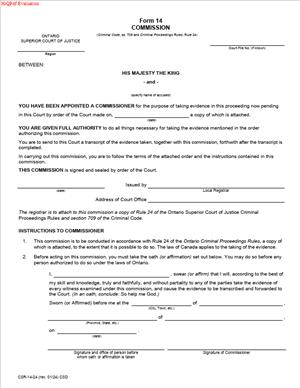
Form 14 (CSR-14-24) – Commission
Fill out nowJurisdiction: Country: Canada | Province or State: Ontario
What is a Form 14 (CSR-14-24) – Commission?
Form 14 (CSR-14-24) — Commission is a court order used in Ontario criminal cases to authorize someone (a “commissioner”) to take evidence outside the courtroom. You use it when a witness cannot attend court in person, or when the court needs evidence gathered in a structured, reliable way at another place or time. The form sets out who the commissioner is, what evidence they will take, how they will take it, who may attend, and how the record will come back to the court.
Think of this form as the court’s written instruction manual for collecting testimony or exhibits away from the courtroom. It allows the court to preserve important evidence while maintaining fair trial standards. The commissioner acts under the authority of the order. They administer the oath or affirmation, manage the process, ensure a record is made, and return the transcript and exhibits to the court.
Who typically uses this form?
Crown counsel use it to secure evidence from witnesses who are away, ill, or otherwise unavailable. Defence counsel use it to preserve exculpatory evidence or to examine a vulnerable defence witness in a practical setting. A self‑represented accused may use it in the same way. The commissioner may be a lawyer, notary, registrar, or another person the court trusts to perform the task. In all cases, the court signs the form and defines the commissioner’s powers.
You might need this form if a material witness is out of province, outside Canada, hospitalized, incarcerated elsewhere, or subject to safety limits. You also may need it to organize a remote examination, to manage an interpreter, or to handle sensitive exhibits with chain‑of‑custody controls. The form helps the court avoid delays, loss of evidence, or unfairness caused by unavailability.
Typical use scenarios
- A civilian witness who moved abroad and cannot return for trial dates.
- A medically fragile witness who cannot travel but can be examined at a care facility.
- An expert located in another province who must testify on narrow technical issues.
- A police officer or military witness on deployment, but available by remote connection.
- A vulnerable witness who needs a controlled environment with support.
- A detained witness is in another institution where local attendance is impractical.
In each case, the form specifies the date window, the location or video platform, the people allowed to attend, how exhibits will be handled, and when and how the transcript will be filed. It also sets out how objections will be recorded so the trial judge can rule on them later.
When Would You Use a Form 14 (CSR-14-24) – Commission?
You use this form when live, in‑court testimony is not practical or would cause unfair prejudice to either side. For example, a key eyewitness may now live in another country. They are willing to testify but cannot afford the travel or have immigration hurdles. A commission allows you to examine them under oath and create a reliable record without bringing them to Ontario.
You also use a commission when timing is urgent. Suppose a witness is scheduled for surgery and may not be competent to testify later. You can preserve their evidence now, under supervised conditions, so the trial can proceed fairly. Courts often grant commissions to prevent evidence from being lost due to illness, age, or impending travel.
Sometimes the location drives the need for a commission. A forensic scientist may be working in a lab across the country. The parties only need a short examination on a narrow point. A commission saves time and public expense while keeping the process rigorous. In other cases, an incarcerated witness in another jurisdiction cannot be transported in time. A commission lets you take their evidence where they are, under secure protocols.
A commission is also useful when you need special arrangements. If a witness requires an interpreter, the form can direct how to swear in the interpreter, how to manage simultaneous interpretation, and how to mark translated documents as exhibits. If the case involves sensitive material, the form can set privacy conditions, including limited attendance and sealed returns to the court.
Typical users include Crown attorneys, defence counsel, and self‑represented accused. Victims and civilian witnesses may be involved through their participation in the examination. Institutions such as hospitals, correctional facilities, and labs may also coordinate logistics when the commission occurs on their premises. The presiding judge remains in control. The judge signs the form and sets the framework so the evidence meets trial standards.
In short, you use a commission when it balances necessity and fairness. You still get oath‑bound testimony, cross‑examination, and a proper record. You just move those functions to a different setting, under court control, to avoid losing important evidence.
Legal Characteristics of the Form 14 (CSR-14-24) – Commission
The form is a court order. Once a judge signs it, it is legally binding on the parties and on the commissioner named in it. It creates clear authority for the commissioner to administer oaths or affirmations, conduct the examination, manage exhibits, and produce an official record for the court. It also creates obligations. Parties must comply with the directions on attendance, disclosure, timing, and the return of materials.
Enforceability comes from the court’s jurisdiction over the case and the order’s clarity. The form identifies the file, the parties, and the scope of the commission. It directs the commissioner on the method of recording (audio, video, or certified transcript), the handling of exhibits, and the immediate return of the record. It typically provides that objections be made on the record, with the trial judge to decide them later. That protects the right to a fair trial and the right to cross‑examine.
When the commission is held within Ontario, compliance is straightforward. If the commission occurs outside Ontario, the order still governs the parties and the commissioner. Practical enforcement over non‑parties may depend on local law. In those cases, you address consent, logistics, and local support in advance. The form can set terms to align the process with the receiving location’s requirements. Even then, the key point stands: the result is a court‑controlled evidentiary record for use at trial or another hearing.
The resulting evidence is not automatically admissible for every purpose. The trial judge controls admissibility, use, and weight. The commission record usually comes back as a transcript and any marked exhibits, certified by the commissioner. The judge can receive the evidence as if given in court, limit it, or order further steps. That protects against unfairness and ensures compliance with evidentiary rules.
There are also important fairness considerations built into the form. The order should confirm that both sides can participate, examine, and cross‑examine. It should address interpreters. It should set privacy safeguards where needed, such as in‑camera attendance or non‑publication directions. It should ensure secure transmission and storage of the record to maintain the chain of custody. The form can also address expenses and who pays the commissioner’s fees. All of this supports reliability and integrity.
In sum, a signed Form 14 commission is binding and enforceable. It empowers the commissioner, secures process fairness, and protects the evidentiary record. The trial judge still decides if, how, and to what extent the commissioned evidence will be used.
How to Fill Out a Form 14 (CSR-14-24) – Commission
Completing this form is about clarity and logistics. You are asking the court to let evidence be taken outside the courtroom in a controlled way. The form must tell the commissioner and the parties exactly what to do. Follow these steps.
Step 1: Set up the case caption and identifiers
At the top, enter the court file number exactly as it appears on the court record. Use the proper style of cause, usually “R. v. [Accused’s surname].” Identify the court location (judicial region and courthouse). Insert the date the order will be signed, leaving it blank if you are submitting a draft for the judge to complete.
In a short preamble, note that the court heard a motion or application to issue a commission. State whether it was on consent or contested. This is why the court is authorizing the commission.
Step 2: Identify the commissioner
Name the commissioner with full legal name, professional status, and contact details. Include mailing address, phone, and email. If relevant, include the commissioner’s licensing or appointment status (for example, lawyer, notary, court reporter, or registrar). If the commission will occur in a specialized setting (such as a hospital or correctional facility), note that the commissioner has permission to access the location, or state that the institution will facilitate access.
State that the commissioner is authorized to administer oaths or affirmations. Confirm authority to manage interpreters and to mark and safeguard exhibits. Limiting the commissioner’s role can help. The commissioner does not rule on evidentiary objections; they record them for the trial judge.
Step 3: Define the scope and purpose
Say plainly what the commission will cover. Identify the witness or witnesses by name. If more than one witness is involved, you can list them in a schedule. If the scope is narrow, describe it (for example, “evidence limited to chain‑of‑custody issues for Exhibit 12”). If the witness is vulnerable or requires accommodations, describe what you need the commissioner to implement (for example, breaks, a support person, or privacy measures).
Define whether the commission is to preserve evidence for trial, to complete a continuation of an interrupted examination, or to examine a witness who cannot attend for a specific reason. If timing is urgent, note the reason. A short, practical statement helps the judge see why the commission is necessary and proportionate.
Step 4: Set dates, times, location, and format
Specify a time window within which the commissioner must complete the examination. Include time zones if the witness or commissioner is in another region. State the location, including full address, or specify that the examination will occur by videoconference. If remote, name the platform and who will host it.
Set daily start and end times if needed. Include flexibility for breaks or for the witness’s health or work schedule. Address what happens if the witness cannot complete the examination in one sitting. The order can allow the commissioner to adjourn and continue within the time window.
Step 5: Attendance and participation
List who may attend. Include Crown counsel, defence counsel, the accused (with remote attendance if needed), the court reporter or videographer, the interpreter, and any support persons permitted for vulnerable witnesses. If the accused cannot attend the location, authorize virtual attendance so cross‑examination rights are protected.
Give the parties equal rights to examine, cross‑examine, and re‑examine. Direct the commissioner to keep a clear record of who is examining at each stage. If a self‑represented accused is involved, set any needed limits to prevent harassment while preserving the right to cross‑examine. State whether the public may attend, or if the commission occurs in private, to protect sensitive information.
Step 6: Interpreters and oaths
If an interpreter is needed, state that the interpreter must swear or affirm an interpreter’s oath before the examination begins. Identify the language and dialect. If documents require translation, direct how to handle translated versions and how to mark them. Direct the commissioner to obtain the witness’s oath or affirmation before testimony begins. If the witness requires a specific form of oath or accommodation, include it.
Step 7: Recording, transcript, and exhibits
State the method of recording: audio recording, video recording, certified transcript, or a combination. Name the person or service responsible for creating the record. Direct that the record must be full, clear, and continuous, and that off‑the‑record discussions be minimized and noted when they occur.
Direct the commissioner on exhibit handling. Require exhibit labels that match the court’s numbering or a clear separate scheme (for example, “Commission Exhibit C‑1, C‑2…”). Order the commissioner to maintain the chain of custody, to safeguard originals, and to package and seal exhibits for return if the evidence includes digital files, direct secure transfer (for example, encrypted media). If sensitive material is involved, authorize sealing until the trial judge orders otherwise.
Step 8: Objections and rulings
Direct that any objections during the examination must be stated on the record with brief grounds. The commissioner should not decide contested objections. Instead, the commissioner records the objection, marks any disputed material separately, and continues. The trial judge will later decide admissibility and use. If a question risks serious prejudice or breach of a legal restriction, authorize the commissioner to pause and contact the court for directions.
Step 9: Confidentiality, privacy, and publication limits
If needed, include a direction that the commission proceed in private with limited attendance. If publication bans or identity protections are in place in the proceeding, confirm they apply to the commission. Instruct the commissioner to alert all attendees to these limits before the examination begins. Direct that any public‑facing or online platform settings be configured to prevent unauthorized access or recording.
Step 10: Fees, expenses, and logistics
State who will arrange and pay the commissioner’s fees, the court reporter’s costs, and technology or facility charges. If cost‑sharing applies, specify it. Provide for payment of reasonable witness expenses if applicable. Identify who will deliver exhibits and materials to the commissioner, and when. Direct the parties to cooperate on scheduling and on supplying any agreed documents for use at the examination.
Step 11: Return of the commission, delivery, and timelines
Set a clear deadline for the commissioner to return the completed package to the court. The package usually includes:
- A certificate of the commissioner confirming the oath, the dates and times, the attendees, and the method of recording.
- The transcript or audio/video record is certified as complete.
- All exhibits are sealed and indexed.
- Any log of objections, with references to transcript pages or time stamps.
Direct delivery to the courthouse address and to the trial judge or the criminal intake office, as appropriate. State who receives copies. If the record is sealed or subject to a ban, confirm that only the court may unseal it or authorize copies.
Step 12: Ancillary directions and problem‑solving
Anticipate foreseeable issues. If the witness is in a secure facility, authorize search and security procedures. If the witness may need breaks or medical support, direct the commissioner to accommodate them. If time zones create hardship, allow start times that are reasonable for all. If network instability is likely in a remote commission, direct fallback options (such as telephone audio with local audio recording backup).
Authorize the commissioner to amend logistics as needed to complete the examination, as long as fairness and the order’s core terms stay intact. Require the commissioner to note any changes on the record.
Step 13: Signatures and formal conclusion
End the form with the judge’s signature block, including the judge’s name, title, and the date of signature. Include the place of signature. Insert approval lines “as to form and content” for counsel where appropriate. If the order was made on consent, you can note that above the signature lines. If not, just include the judge’s signature and the date.
If you used schedules, list them. Common schedules include:
- Schedule A: Witness list and contact details.
- Schedule B: Instructions to the commissioner.
- Schedule C: Exhibit list template and labelling scheme.
- Schedule D: Logistics plan (location map, remote platform details, security contacts).
Make sure each schedule is referenced in the body of the order. Keep schedules concise and practical.
Step 14: Final checks before submission
Check names, dates, file numbers, and spelling. Verify the commissioner’s contact information and willingness to act during the stated time window. Confirm that all privacy and publication directions match any existing orders in the case. Confirm that the accused’s attendance is addressed, especially if custody or distance prevents in‑person attendance. Ensure the return timeline works with the court’s schedule.
Finally, provide the draft form to the court with your supporting materials. If the other side consents, include that note. If not, be ready to explain why the commission is necessary, fair, and workable. Once the judge signs, send a copy to the commissioner and all attendees. Then coordinate dates and carry out the plan set by the order.
By following these steps, you give the court and the commissioner a clear roadmap. You protect the parties’ rights, collect reliable evidence, and keep the case moving. The finished record returns to the court ready for the trial judge to use, subject to any rulings on admissibility.
Legal Terms You Might Encounter
- Commission. This is the court’s written authority to take a witness’s evidence outside the courtroom. Form 14 (CSR-14-24) records that authority. It sets out who will take the evidence, where, how, and by when.
- Commissioner. This is the person the court appoints to take the evidence. The commissioner administers the oath, runs the examination, manages exhibits, and certifies the record. You must name this person in Form 14 and confirm they can act.
- Witness (Examinee). This is the person whose evidence will be taken on commission. You must identify the witness correctly in the form. Use the full legal name and any known aliases that appear in your case.
- Oath or Affirmation. This is the promise the witness makes to tell the truth. The commissioner administers it at the start. Form 14 authorizes the commissioner to do this and confirms the evidence is sworn or affirmed.
- Transcript. This is the verbatim written record of the witness’s evidence. The commission must state how the evidence will be recorded. The transcript forms part of the return sent back to the court.
- Exhibit. This is a document or item introduced during the examination. Each exhibit must be marked and tracked. Form 14 can set rules for exhibits, including copies, numbering, and custody.
- Return of the Commission. This is the sealed package the commissioner sends back to the court. It includes the transcript, exhibits, and a certificate. Form 14 sets the deadline and the address for the return.
- Certificate of Commissioner. This is the commissioner’s signed statement confirming what they did and how the examination ran. It confirms identity, oath, attendance, and recording method. You need this for the evidence to be usable.
- Mode of Examination. This is how the evidence will be taken: in person, by video, or by phone if allowed. Form 14 must authorize any remote option. If you need a video, include it in the terms.
- Service. This is how you deliver the issued commission to others. You must give a copy to all parties and the commissioner. Form 14 names the parties and is the document you serve.
FAQs
Do you need the other side’s consent to use a commission?
No, but consent helps. If there is no consent, you seek court approval. The court will weigh fairness, timing, and the witness’s circumstances. Form 14 is used after approval is granted. It records the court’s directions for how the commission will run.
Can one commission cover more than one witness?
Usually, no. A commission typically names one witness. If you need to examine multiple witnesses, use separate forms unless the court allows a combined approach. Read your draft carefully. Do not add new names without permission.
Who can act as the commissioner?
Choose someone who can administer oaths and manage the record. The person must be independent and available. They must not be a party or a witness in the case. Confirm they can take evidence at the chosen location and by the chosen method. Get their full details for the form.
Can you conduct the commission by video?
Yes, if the court authorizes it. If you want a video commission, include that request before the form is issued. Form 14 should list the platform, recording plan, and any backup plan. Make sure the commissioner can manage identity checks and exhibits on video.
Do you have to attend the commission?
You or your counsel should attend. The other side can attend and cross-examine. Attendance can be in person or by video if the form allows it. The commissioner should not proceed if parties were not notified according to the terms.
What if the witness refuses to answer or the process breaks down?
The commissioner notes the refusal and the reasons. They continue if possible. You may need to pause and seek further directions. Keep a clean record of every step. Use the process in the form to reschedule or vary the terms if needed.
How are exhibits handled during a remote commission?
Plan exhibit handling before the examination. Use a consistent numbering system and a secure share method. The commissioner controls marking and the master set. The return of the commission must include the exhibits or copies as directed in the form.
How long is the commission valid?
It is valid until the deadline set in the form. That deadline covers completion of the examination and delivery of the return. If you will miss the date, seek an extension early. Do not proceed after expiry without new directions.
Who pays for the commission?
The party seeking the commission usually pays the upfront costs. These include the commissioner’s fees, room or platform fees, and transcript costs. The court can later decide who bears the costs as part of the case outcome.
Can you amend a commission after it is issued?
Yes, but only with court approval or as the form allows. If details change—like the date, the mode of appearance, or the commissioner—you should seek a variation. Use a clear draft that shows the change you need and why.
Checklist: Before, During, and After the Form 14 (CSR-14-24) – Commission
Before signing
- Confirm witness details. Full legal name, contact, location, and availability.
- Confirm commissioner details. Name, address, authority to act, and conflicts.
- Choose the mode in person or video, with a tested recording plan.
- Book logistics. Location or platform, date, time, and time zone.
- Interpreter plan. Language, dialect, and interpreter qualifications, if needed.
- Transcript plan. Court reporter engaged, or audio/video capture confirmed.
- Exhibit plan. Master set, numbering, and secure sharing process.
- Identification plan. Government ID to be shown, captured, and recorded.
- Attendance list. Parties, counsel, and support staff with contact details.
- Return instructions. Court office address, deadline, and packaging.
- Service plan. Who you will serve, how, and when.
- Costs. Commissioner fees, transcript rates, and payment method.
- Draft terms. Any limits on scope, time caps, or breaks.
During signing
- Verify names. Parties, witnesses, and the commissioner are spelled correctly.
- Verify authority. The form states the commissioner’s powers and mode.
- Verify location and time. Include time zone and backup plan.
- Verify notice terms. How and when each party will be notified.
- Verify recording method. Transcript, audio, video, or combination.
- Verify exhibit handling. Numbering, custody, and return.
- Verify interpreter terms. Identity, oath, and role boundaries.
- Verify return deadline. Date, address, and sealing instructions.
- Verify cross-examination rights. Attendance and questioning allowed.
- Verify signature blocks. Judge’s signature and court seal as required.
After signing
- File the form for issuance. Follow the court office’s steps and timelines.
- Get the issued copy. Confirm seal, signature, and all pages attached.
- Serve issued form. Deliver to all parties and the commissioner.
- Confirm logistics. Send final notice with date, time, and connection details.
- Prepare materials. Witness outline, exhibits, and undertakings.
- Conduct the examination. Keep a clear record and manage objections.
- Secure the return. Confirm transcript, exhibits, and certificate included.
- Track delivery. Use a reliable method to return the sealed package.
- File confirmations. Keep proof of service and delivery receipts.
- Store copies. Keep working copies of the transcript and exhibits securely.
- Calendar deadlines. Note any next steps for trial use of the evidence.
Common Mistakes to Avoid
Leaving out the commissioner’s powers.
- If the form does not grant clear powers, the commissioner may halt the examination. Don’t forget to authorize the oath, recording, exhibits, and remote attendance if needed.
Naming the wrong person or location.
- Errors in names or addresses can void service or cause missed appearances. Use exact legal names and confirm the address and time zone in writing.
Skipping exhibit instructions.
- Without a plan, exhibits get lost or misnumbered. The court may refuse the evidence. Don’t forget to set numbering, custody, and return rules in the form.
Ignoring the return deadline.
- Late returns can make the evidence unusable. They can also delay your hearing. Don’t forget to set a practical deadline and track it closely.
Missing service or notice.
- If others did not get proper notice, the commission may be set aside. Don’t forget to serve the issued form and confirm attendance details in advance.
What to Do After Filling Out the Form
- File for issuance. Submit the completed Form 14 to the court office for issuance. Ask for enough certified copies for all recipients.
- Confirm the issue details. Check the seal, signature, and any endorsements. Make sure attachments are included and legible.
- Serve the issued form. Deliver a copy to all parties and to the commissioner. Include the scheduled date, time, and connection details.
- Finalize logistics. Book the room or platform. Test audio, video, and recording. Secure an interpreter if needed.
- Prepare a witness package. Include the notice, the issued form, and any agreed exhibits. Provide instructions for presenting ID at the start.
- Conduct the examination. The commissioner verifies identity, administers the oath, and records the evidence. Counsel examines and cross-examines as allowed.
- Mark and secure exhibits. The commissioner controls marking and the master set. Keep duplicates for working use.
- Complete the certificate. The commissioner signs the certificate that confirms the process and attendance.
- Assemble the return. Include the transcript, exhibits, and the certificate. Seal the package and label it with the case details.
- Deliver the return to the court. Use a reliable courier or secure electronic method if allowed. Keep proof of delivery.
- Notify parties. Confirm that the return was delivered and when the court can release copies.
- Review the transcript. Check names, dates, and exhibit references. Flag any corrections or clarifications you will request.
- Plan for trial use. Note any required motions, notices, or rulings before using the evidence at trial.
- Seek variations if needed. If something changed or went wrong, request a variation or further directions without delay.
- Store working copies. Keep the transcript and exhibits secure. Limit access and maintain a chain of custody.
Disclaimer: This guide is provided for informational purposes only and is not intended as legal advice. You should consult a legal professional.