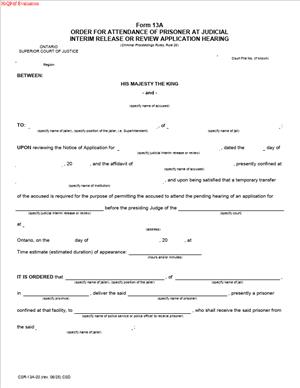
Form 13A (CSR-13A-20) – Order for Attendance of Prisoner at Judicial Interim Release or Review Application Hearing
Fill out nowJurisdiction: Country: Canada | Province: Ontario
What is a Form 13A (CSR-13A-20) – Order for Attendance of Prisoner at Judicial Interim Release or Review Application Hearing?
Form 13A is a court order used in the Superior Court of Justice. It directs the person in charge of a correctional institution, police holding facility, or another custodian to produce an accused in custody for a specific bail-related hearing. The hearing may be a judicial interim release hearing or a review application hearing. In plain terms, it tells the jail or police to bring the person to court, or make them attend by video, at a set date and time.
You use this form when an accused is in custody, and the court needs them present. The order ensures the person appears before a judge for the bail decision or review. Without it, the institution has no clear directive to move the accused. The form removes delay and confusion. It sets out where, when, and how the person must attend. It also gives the authority to return the person after the hearing.
Who typically uses this form?
Defence counsel often prepares it for a judge to sign. Duty counsel or a self-represented accused may also prepare a draft. The Crown may prepare it in some cases, such as on consent or for a Crown-initiated review. Court staff may assist with formatting, but the judge issues the order. The sheriff may be the executing authority if transport is required. The superintendent or officer in charge receives and acts on it.
You would need this form if you have a bail matter in the Superior Court and your client is in custody. If your hearing requires the accused in person or by video, you need a production order. Form 13A is tailored for bail and bail reviews. It is not a general production order for trial evidence. It is focused on attendance for judicial interim release or review under the Criminal Proceedings Rules of the Superior Court of Justice.
Typical usage scenarios
You filed a bail review after a justice of the peace denied bail. The Superior Court sets a hearing. Your client is in a provincial jail. You prepare Form 13A so the jail brings your client for the review. Or you have a s. 522 bail hearing in the Superior Court for a serious charge. The accused is in a police cell or detention centre. You need the order to move them to court for the hearing. Another common scenario is a remote appearance. The court directs attendance by video. Form 13A orders the institution to set up a video link at a set time.
The form carries a clear purpose. It implements the court’s authority to require attendance. It helps you protect your client’s right to a timely bail hearing and to be present and heard. It also gives custody staff clear instructions so the process runs on time.
When Would You Use a Form 13A (CSR-13A-20) – Order for Attendance of Prisoner at Judicial Interim Release or Review Application Hearing?
Use Form 13A when the Superior Court has scheduled a bail-related hearing and the accused is in custody. If the matter is a bail review under the Criminal Code, the hearing takes place in the Superior Court, and the accused must attend unless the court excuses attendance. Form 13A provides the formal order needed to have the accused brought before the court. Informal arrangements are not enough; the correctional institution needs a signed court order before it can arrange production.
Defence counsel may use this form when seeking a bail review based on new evidence or a change in circumstances. For example, if the accused is being held at a provincial correctional facility and the court sets a hearing date for the following week, counsel may prepare Form 13A so the facility can produce the accused at the correct date and time. Duty counsel may also prepare the form when assisting a self-represented accused, especially if the judge requests a draft order for signature.
The Crown may also use Form 13A when responding to a defence bail review application or when the court requires a production order in advance of the hearing. The form can set out the agreed attendance arrangements, including whether the accused will appear in person or by video. Once signed, the institution has the authority and information needed to coordinate secure attendance.
Form 13A may also be used for remote hearings. Some correctional facilities need advance notice to book a video suite, arrange supervision, and connect to the correct platform. The form identifies the hearing date, time, method of attendance, and any return-to-custody instructions. If the judge requires in-person attendance, the form can state that clearly. It may also include special instructions, such as medical needs, interpreter arrangements, or other logistical requirements.
In short, Form 13A is used when an accused person is in custody and must attend a Superior Court bail hearing or bail review. It is typically prepared by defence counsel, duty counsel, the Crown, or a self-represented accused. Court staff, sheriffs, and correctional institutions rely on the signed form to arrange transportation, video attendance, security, and return to custody.
Legal Characteristics of the Form 13A (CSR-13A-20) – Order for Attendance of Prisoner at Judicial Interim Release or Review Application Hearing
Form 13A is a binding court order once signed by a judge. It directs public officials to produce an accused in custody for a scheduled hearing. It is grounded in the court’s authority over its proceedings and the statutory bail regime. The court has jurisdiction to control attendance for matters before it. The order ensures the accused’s appearance, whether in person or by a permitted remote method.
What ensures enforceability?
First, the judicial signature and the court file number tie the order to a live proceeding. Second, it identifies the institution and the custodian bound by the order. Third, it states clear instructions for time, place, and mode of attendance. Fourth, it may include a direction to the sheriff. This makes it operational. The sheriff coordinates transport and security. Non-compliance can be addressed by the court through sanctions and further directions.
The order supports procedural fairness and timely access to bail proceedings. The law expects bail hearings and reviews without unreasonable delay. The accused has a right to participate meaningfully. Attendance is central to that right. The order also protects the institution. Staff acts with legal authority to move the prisoner. They can rely on the court’s direction for transport, video arrangements, and return to custody.
There are general legal considerations. Use the correct court file style and number. Ensure the named institution is the one actually holding the accused. If the accused will be moved before the hearing, include alternative directions. For video, include the platform and connection plan. For in-person appearances, allow enough time for transport. Ensure you coordinate with the Crown and the court. Include any special conditions. These may include medical needs, mental health concerns, or security alerts.
Privacy and accuracy matter. Use the accused’s full legal name. Include date of birth or other identifier if the form permits. Keep details of what is needed for identification and logistics. Do not include surplus narrative or evidence. The order is not the place to argue merits. It is a practical directive to ensure attendance.
How to Fill Out a Form 13A (CSR-13A-20) – Order for Attendance of Prisoner at Judicial Interim Release or Review Application Hearing
Follow these steps. Draft the order clearly and completely. Keep sentences short and specific. Confirm all logistics before you finalize the draft.
1) Identify the court and location
- Insert “Superior Court of Justice.”
- Add the court location (city and courthouse address line if requested).
- This ensures the institution knows where the hearing is set.
2) Insert the court file number and style of cause
- Use the exact Superior Court file number.
- Style of cause is “R. v. [Accused’s full name].”
- Match the spelling used on the indictment or review materials.
3) State the type of hearing
- Check or state “Judicial Interim Release Hearing” if it is a bail hearing in the Superior Court.
- Check or state “Review Application Hearing” if it is a bail review.
- If unsure, confirm with the court office before drafting.
4) Provide the accused’s identifying details
- Full legal name as it appears on charging documents.
- Date of birth, if the form allows, for accurate identification.
- Include any institutional identifier if requested (e.g., inmate number).
5) Name the custodial institution
- Use the formal name of the correctional facility or police holding facility.
- Add the address if the form provides space. If not, include it in a schedule.
- If the accused is in transit or may move, add an alternate direction. Example: “If [Facility A] is not the custodian on the hearing date, the person in charge of the facility then holding the accused shall produce them.”
6) Specify the date, time, and courtroom
- Insert the exact date and start time set by the court.
- Add the courtroom number or virtual courtroom designation.
- If the matter is time-sensitive, add “or as soon after that time as the matter may be heard.”
7) Choose in-person or remote attendance
- If in-person, state: “Produce the accused at [Courthouse, Courtroom] for in-person attendance.”
- If remote, state the platform and connection plan. Example: “Produce the accused for video appearance via [platform] at [time]. The institution shall connect to [details].”
- If the judge has directed in-person attendance, record that direction.
8) Direct transport and return
- Include a clear return clause. Example: “The sheriff or person in charge shall return the accused to [Facility] forthwith upon adjournment, unless otherwise ordered.”
- If multiple dates are set (e.g., continuation), you can add: “This order applies to any continuation date set on the record, unless varied.”
9) Address security and special arrangements
- If there are known risks, include minimal, necessary directions. Example: “Enhanced restraints as per institutional policy.”
- For medical or accessibility needs, add a practical note. Example: “Ensure access to prescribed medication during transport and at court.”
- If an interpreter is required, say so and identify the language. The court will arrange the interpreter, but the institution must facilitate attendance.
10) Include authority for the sheriff
- If your region uses sheriff transport, include: “The sheriff is directed and authorized to take custody of the accused for transport and return.”
- This helps avoid gaps in responsibility between police and corrections.
11) Add any remote hearing technical details
- Provide dial-in, bridge, or meeting ID details if used by the court.
- State a test time if the court requests it. Example: “Test connection at [time] on the hearing date.”
- Keep details factual and concise.
12) Execution details
- Date the order at the city where the court sits.
- Present the order to the presiding judge for signature.
- Do not sign in the “Judge” line yourself. The judge will sign and, where used, the court will affix the seal.
13) Service and distribution
- Serve the signed order on:
- The person in charge of the named institution.
- The sheriff (if transport is involved).
- The Crown.
- Defence counsel or the accused (for records).
- Use the service method the institution requires (fax, email, or courier). Confirm receipt. Keep proof.
14) Proof of service and follow-up
- Prepare an affidavit or confirmation of service if the court requires it.
- Call the institution to confirm logistics the day before the hearing.
- On the hearing day, be available early. If there is a connection issue, notify the court and the institution at once.
Practical drafting tips
- Use the court’s current Form 13A template. Keep formatting consistent.
- Avoid unnecessary narrative. The order is operational, not argumentative.
- Ensure dates and times are correct and reflect the court’s schedule.
- If the accused has another court matter the same day, alert the court. Ask the judge to include coordination language if needed.
- For remote appearances, verify the time zone and platform well in advance. Some institutions require notice of at least 24–48 hours.
- If your client needs private counsel-client communication during the hearing, arrange a method. Note it briefly if the institution must facilitate a breakout or private phone line.
- If the judge endorses special attendance terms on the record, mirror those terms in the order.
Common errors to avoid
- Naming the wrong institution or leaving it blank. Confirm custody location on the day you draft.
- Omitting the courtroom or virtual courtroom information.
- Forgetting a return direction. Always say where the accused goes after the hearing.
- Using an Ontario Court of Justice file number instead of the Superior Court file number for the review.
- Failing to serve the sheriff or facility in time. Late service can cause missed appearances.
Example scenario for context
- You filed a bail review. The Superior Court sets it for next Thursday at 10:00 a.m. in Courtroom 4. Your client is held at a provincial correctional centre. The judge prefers a video appearance. You draft Form 13A with the court file number and style of cause. You direct the institution to produce the accused by video at 9:45 a.m. You include the platform and meeting ID. You authorize the sheriff for coordination. You include the return direction. The judge signs it. You serve the institution and the sheriff on the same day and confirm receipt. On Wednesday, you call to test the connection. On Thursday, your client appears on time.
Another scenario
- You have a s. 522 bail hearing in the Superior Court. The judge requires in-person attendance. Your client is in a police holding facility. You draft Form 13A ordering production at the courthouse at 9:00 a.m. You direct the sheriff to take custody and return the accused to the facility after the hearing. You flag a medical need for insulin access. The judge signs the order. The sheriff arranges transport. The hearing proceeds.
If the order needs changes after signing:
- If the date or mode of appearance changes, seek a revised order. Prepare an amended Form 13A with the new details. Ask the court to sign it. Serve it promptly. Do not rely on verbal changes with the institution.
Final check before filing and service:
- Confirm the hearing type is correct (judicial interim release vs review).
- Confirm the accused’s current location.
- Confirm the judge’s direction on the mode of attendance.
- Confirm the courtroom and time.
- Confirm you included transport and return directions.
- Confirm service details and contacts for the institution and sheriff.
By completing these steps, you give the institution a clear, lawful directive. You also protect your client’s right to appear. You reduce the risk of delay or missed attendance. The court can then proceed with the bail issue on the scheduled date.
Legal Terms You Might Encounter
- Judicial interim release: This is the formal term for bail. The hearing decides if a person in custody can be released while the case continues. Form 13A ensures the person is physically or virtually present for that hearing so the judge can make a decision.
- Review application: This is a request to change an earlier release or detention order. It is brought to a higher court when you want a different result from the earlier bail decision. Form 13A is used to have the person in custody brought to the review hearing.
- Order for attendance: This is the core of Form 13A. It directs the correctional institution to produce the person in custody at a set date, time, and location, or by video if allowed. It also tells the institution to return the person after the hearing unless a release order is made.
- Superintendent: This is the official in charge of the correctional institution where the person is held. The order is addressed to this person. They must follow the order and arrange transport or a video appearance.
- In custody (remand): This means the person is being held in jail before trial or while waiting for a hearing. If the person is on remand, they cannot leave the institution unless an order like Form 13A authorizes their attendance at court.
- Style of cause: This is the case title at the top of court documents (for example, “R. v. [Accused’s Name]”). It must match the title already used in the case. Form 13A will be rejected or ignored if the title is wrong or inconsistent.
- Court file number: This is the unique number assigned to the case by the court. It appears on every filing. It connects the order to the right case, and the institution uses it to confirm the order is valid for that person.
- Warrant of committal: This is the document that authorizes the institution to hold the person. Form 13A does not replace that warrant. It temporarily authorizes transport or a virtual connection so the person can attend the hearing.
- Escort and return directions: These are instructions in the order that tell the institution how to transport the person and what to do afterward. The order usually says to return the person to custody immediately after the hearing, unless the court orders release.
- In-person vs. video appearance: The order can direct the person to attend in person or by video. If video is allowed, the order should say so. The institution uses this information to arrange technology or transport.
- Service: This means delivering a copy of the signed order to the people who must act on it, such as the institution. Proof of service helps prevent last-minute problems if someone claims they never received the order.
- Registrar or trial coordinator: Court staff who manage scheduling and issue signed orders. You work with them to get the judge’s signature and to pick up a stamped copy that you can serve on the institution.
FAQs
Do you need Form 13A for every in-custody bail hearing?
Not always. Some routine appearances are covered by existing remand procedures. Form 13A is used when you need a clear, enforceable direction to produce a person for a judicial interim release hearing or a review application in the Superior Court. If you are unsure, ask the court office whether an order is required for your hearing date.
Do you file Form 13A before you have a hearing date?
No. You need a scheduled date and time first. The order must include the hearing date, time, and location, or the arrangement for video. Secure the hearing with the court. Then complete the form, get it signed by a judge, and serve the issued order on the institution.
Can you reuse a Form 13A if the hearing is adjourned?
No. Do not alter an issued order. If the date changes, prepare and seek a new order with the new date and time. Then serve the newly issued order to the institution. This reduces confusion and prevents no-shows.
Do you need the person to attend in person or by video?
That depends on the court’s direction and the availability of technology. If video is allowed and you want to use it, request that arrangement while setting the hearing. Then state “by video” clearly in the order. If it must be in person, the order should say so to trigger transport.
Who prepares and signs Form 13A?
The party that needs the person in custody at the hearing usually prepares the draft. That is often a defence for a review application, or the Crown if they are seeking a review. A judge signs the order. Court staff then issues a stamped copy. Only the issued order should be served on the institution.
How far in advance should you file and serve the order?
As early as you can after the hearing is scheduled. Institutions need lead time to arrange transport or video. Aim to have the signed, issued order served several business days before the hearing. Then confirm receipt the day before.
What if the person is moved to a different institution after you serve the order?
Confirm the person’s location a few days before the hearing. If they have moved, prepare a new order with the correct institution or provide the issued order to the new institution with the court staff’s guidance. Do not rely on the old order reaching the right place in time.
Can Form 13A cover more than one day?
Yes, if the court approves. If you expect a multi-day hearing, ask for an order that covers the entire period and notes daily attendance or “until the hearing is concluded.” The wording should be clear so the institution knows whether to return the person each day or to keep them available.
Do you need to serve other parties besides the institution?
Serve the institution. As a practical step, also send a copy to opposing counsel and court staff involved in scheduling. This keeps everyone aligned, reduces surprises, and helps avoid lost time on the hearing day.
Checklist: Before, During, and After the Form 13A
Before signing
- Confirm the exact hearing type: judicial interim release or review application.
- Get a scheduled date, time, courtroom, and appearance mode (in person or video).
- Verify the court file number and style of cause as already used in the case.
- Confirm the accused’s full legal name and date of birth.
- Identify the current institution holding the person and, if available, their correctional or identification number.
- Check whether any special arrangements are needed: interpreter, medical needs, or security considerations.
- Decide on attendance mode. If video, confirm the institution can support it at the scheduled time.
- Coordinate logistics with court staff, including any identifier needed for a video link.
- Prepare clear return directions (for example, return to the same institution after the hearing unless released).
- Gather contact details for the institution’s administration so you can confirm receipt later.
- Have a plan for service: who will serve the issued order, how, and by when.
- Confirm if a multi-day order is needed. If yes, note all dates.
During signing
- Verify the style of the cause exactly matches the case record.
- Check the court file number digit by digit.
- Confirm the accused’s name spelling and date of birth.
- Ensure the institution’s full name and location are correct.
- State the hearing date, start time, and courtroom clearly. Avoid “TBA” or blank fields.
- Specify attendance mode: in person or by video. Do not leave this ambiguous.
- Include clear return directions after the hearing.
- Confirm any date range if the hearing spans multiple days.
- Ensure the judge’s name line, signature line, and date of signature are included.
- Check that there are no handwritten edits that could cause confusion.
- Keep a clean copy ready for the court to sign and issue.
After signing
- Obtain the issued order from court staff (signed and stamped).
- Make certified or court-stamped copies as instructed by the court office.
- Serve the issued order on the institution promptly using the agreed method.
- Send a courtesy copy to opposing counsel and relevant court staff.
- Keep proof of service and note the date, time, and method.
- Call the institution to confirm they received the order and can comply.
- Confirm the person’s location the day before the hearing.
- Bring extra stamped copies to court on the hearing day.
- If the hearing is adjourned, prepare a new order for the new date and repeat service.
- File and store the final order and proof-of-service documents in your file.
Common Mistakes to Avoid
Naming the wrong institution.
- Don’t guess. Confirm where the person is held before you finalize the order. If the order goes to the wrong place, the person may not be produced, and the hearing can be delayed.
Leaving the appearance mode unclear.
- Don’t forget to specify “in person” or “by video.” Without this, transport or connection may not be arranged, risking a no-show.
Using an unsigned draft.
- Never serve a draft. Only serve the issued version signed by the judge and stamped by the court. A draft will not be acted on by the institution.
Changing an order after it’s issued.
- Do not handwrite new dates or times on an issued order. If anything changes, seek a new order. Altered documents cause confusion and may be ignored.
Entering the wrong file number or the wrong style of cause.
- Double-check every digit and letter. If they are wrong, court staff may refuse to issue the order, or the institution may not act on it.
What to Do After Filling Out the Form
- Get the hearing scheduled. Secure the date, time, courtroom, and appearance mode with court staff. Make sure the court can accommodate video if requested.
- Finalize the draft order. Insert the correct style of cause, file number, accused details, institution, hearing details, attendance mode, and return directions. If multi-day, list each date or request attendance “until the hearing is concluded” as appropriate.
- Present the draft to the court. Submit the draft to the criminal office or trial coordinator so a judge can review and sign it. Ask when the issued order will be ready.
- Pick up the issued order. Once signed and stamped, get copies as needed. Confirm that the filed date and the judge’s signature are clear and legible.
- Serve the institution. Deliver the issued order promptly to the institution. Use a reliable method that provides confirmation. Include necessary details for the video, if applicable.
- Notify other participants. Send a copy to opposing counsel and the court staff managing your hearing. This ensures everyone knows the person will attend and how.
- Confirm execution. Contact the institution to confirm receipt and arrangements. Reconfirm the person’s location and the transport or video link details the day before the hearing.
- Bring copies to court. Carry extra stamped copies to the hearing. If anyone questions service or attendance, you can show the order and proof of service.
- If the hearing is adjourned, do not alter the existing order. Prepare a new order with the new date and time. Seek signature and issuance again. Serve it as before and confirm receipt.
- Store records. Keep the issued order and proof of service in your file. Record who received it, when, and how. Note any confirmation calls and names of contacts.
- Suppose the person was not produced. Advise the court promptly. Have your proof of service ready. The judge may give directions to resolve the issue or set a new date with a new order.
- After a release order, if the court grants release, the institution will follow the release paperwork. The attendance order’s return directions no longer apply. Keep the release documents with your file records.
These steps keep logistics tight and reduce the risk of delays. Clear details, timely service, and confirmation calls are the best ways to ensure the person in custody attends as ordered.
Disclaimer: This guide is provided for informational purposes only and is not intended as legal advice. You should consult a legal professional.