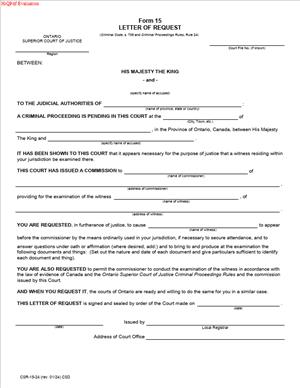
Form 11 (CSR-11-21) – Order Releasing Exhibits for Scientific Testing
Request DocumentJurisdiction: Country: Canada | Province or State: Ontario
What is a Form 11 (CSR-11-21) – Order Releasing Exhibits for Scientific Testing?
Form 11 (CSR-11-21) is a court order used in criminal cases. It authorizes the temporary release of one or more court exhibits for scientific testing. An exhibit is any item filed or marked as evidence. That can include drugs, firearms, clothing, swabs, hard drives, and many other items. Once an item becomes an exhibit, it sits under court control. You cannot remove it without a judge’s order. This form is that order.
You use this form when you need testing that has not yet been done or needs to be repeated. It sets the conditions of release. It names the custodian who holds the item. It identifies the person or lab who will receive it. It sets how long the item can be out. It states how the item travels, how it will be tested, and how it returns. It can also limit what testing may occur. It can require you to share results with the other party. It can require chain‑of‑custody steps.
Who typically uses this form?
Defence counsel often uses it for independent testing. Crown counsel also uses it to send items for specialized testing. A self-represented accused may use it with the court’s approval. Police property officers and exhibit clerks follow it to release the item. Lab scientists rely on it to understand the court’s conditions.
You would need this form if a test result is key to your case. For example, you may want a private DNA lab to retest a swab. You may want a chemist to confirm drug purity. You may want a firearm expert to check toolmarks. You may want a digital expert to image a phone in a different way. You may want a toxicology review for sentencing. You may want to test a substance that the first lab did not test.
Typical usage scenario
The parties identify the exhibits to test. The moving party drafts the order and seeks consent. If consent is possible, the order can go in on consent. If not, you schedule a motion before a judge. The judge hears submissions on scope, timing, and safeguards. The judge then signs the order with detailed conditions. The exhibit custodian releases the items to the named scientist under those terms. The lab completes testing. The items are returned by a deadline, with documentation.
Form 11 (CSR-11-21) belongs to the Criminal Proceedings Rules of the Superior Court of Justice. It fits within the rules on motions and orders. It gives the Court a clear way to control exhibits while allowing necessary science.
When Would You Use a Form 11 (CSR-11-21) – Order Releasing Exhibits for Scientific Testing?
Use this form when an exhibit in court or police custody must be released for scientific examination or testing. The request may arise before or during trial, for sentencing purposes, or in limited post-conviction proceedings. The resulting order establishes who may receive the exhibit and how it must be transported, examined, protected, documented, and returned.
Before trial, the defence may request independent testing to assess or challenge the prosecution’s evidence. This could involve additional analysis of a DNA mixture, testing for gunshot residue on clothing, forensic examination of a digital device, or analysis of a suspected controlled substance. The court may consider the relevance of the proposed testing, whether sufficient material is available, the risk of altering the exhibit, and whether the work can be completed without unfairly disrupting the trial schedule.
Scientific testing may also become necessary during trial. A witness may identify an issue that was not previously examined, or an exhibit may reveal a feature requiring expert analysis. When the results could materially affect the proceeding, the court may authorize testing subject to expedited deadlines. The order may permit experts for both sides to attend or observe and may establish procedures for documenting the examination and sharing the results.
An exhibit may also require testing after a finding of guilt when the results could be relevant to sentencing. Depending on the case, testing may address the composition or purity of a controlled substance, the operability or classification of a firearm, or another scientifically verifiable characteristic of the evidence. In limited circumstances, testing may also be sought in connection with an appeal, miscarriage-of-justice review, or another post-conviction process.
Typical applicants include defence counsel, Crown counsel, and self-represented accused persons. Police or court exhibit custodians generally manage the authorized release and return, while qualified laboratory personnel perform the examination. Although victims and third parties do not normally submit the form, their privacy or property interests may be affected when an exhibit contains biological material, personal information, or digital data. The order may include terms limiting access, copying, disclosure, retention, and secondary use.
Special safeguards are important when testing may consume, damage, or permanently alter the exhibit. The court may require the sample to be divided, a reserve portion to be preserved, or non-destructive methods to be attempted first. The order may also require advance notice before destructive testing, photographs or video of the procedure, detailed laboratory notes, and complete chain-of-custody records.
Additional controls may apply to restricted or dangerous exhibits, including firearms, ammunition, explosives, controlled substances, or hazardous materials. The order may require police transportation, examination at an approved facility, supervised access, secure storage, and restrictions on private possession. These terms help ensure that the testing is conducted safely, lawfully, and without compromising the evidence.
The proposed order should also address timing. If a trial, sentencing hearing, or other court date is approaching, it may establish deadlines for transferring, testing, reporting on, and returning the exhibit. It may also require interim updates or prompt disclosure of the results to the parties. Clear terms allow the court to accommodate necessary scientific testing while protecting the exhibit’s integrity and the fairness of the proceeding.
Legal Characteristics of the Form 11 (CSR-11-21) – Order Releasing Exhibits for Scientific Testing
This form creates a binding court order. It binds the parties, the exhibit custodian, and anyone named in the order. It is legally binding because the Court controls exhibits filed in its proceedings. Once an item becomes an exhibit, only the Court decides how it moves. The order reflects that control. A signed order carries the Court’s authority. Failure to follow it can draw sanctions. The Court can enforce it through its contempt powers. It can also vary or revoke it if needed.
Enforceability comes from clear terms. The order identifies the articles to be released. It names the custodian and the recipient. It sets the testing purpose and scope. It sets return deadlines. It sets chain‑of‑custody and packaging rules. It sets who pays the costs. It sets data sharing requirements. It sets confidentiality terms. The clerk enters the order on the court record. The judge signs it. The seal and file number link the order to the case. Service on the custodian and parties ensures notice. These steps make the order actionable.
Several legal considerations guide the Court. Relevance is primary. The Court looks at whether the proposed testing can assist with a live issue. Fairness is next. The order should not unfairly prejudice either side. The Court will often allow observers, photos, or shared reporting to ensure fairness. Timing matters. The Court will not derail a trial without good reason. Proportionality also matters. The Court weighs the expense, delay, and complexity against the likely value. Integrity of the exhibits is crucial. The order guards against contamination or loss. Privacy and privilege also play a role. If a device holds personal data, the order can limit the scope or require filters. If an item may hold solicitor‑client communications, the order can set review protocols. Safety and compliance are also assessed. The Court ensures that the handling of dangerous or restricted items meets legal and safety standards.
Consent helps. If both sides consent and the order protects the exhibit, the Court often grants it. If there is no consent, the moving party must show why the testing is necessary and how risks will be managed. The Court retains full discretion. It can modify the draft order to address concerns. It can add undertakings from experts. It can require notice before any destructive step. It can require the presence of both parties for key stages.
How to Fill Out a Form 11 (CSR-11-21) – Order Releasing Exhibits for Scientific Testing
Plan before you draft. Confirm the exact exhibits. Check who holds them. Often, the police or the court exhibit office is the custodian. Get a short letter or email from your proposed lab. It should confirm readiness, accreditation, contact details, and timelines. Identify whether testing is destructive. If it is, plan sample‑splitting and reserves. Speak with the other side about consent. Consent speeds approval.
Now, complete the form step by step.
1) Style of cause and file number
Enter the case title exactly as it appears on the indictment or information. Use “R. v. [Accused’s Last Name].” Insert the Superior Court file number. Confirm the location of the court. Accuracy here ties the order to the right record.
2) Court location and hearing details
State the courthouse city. Add the date the judge will sign or the date of the motion. If the order follows a hearing, include “on hearing the submissions of…” and list who appeared. If on consent, say “on consent of the parties.”
3) Judge and role titles
Insert the presiding judge’s name and title if known at drafting. Leave blank if unknown. The clerk can fill it in when the judge signs.
4) Parties and counsel
List those who sought the order. Identify counsel for each party. If you are self‑represented, state that. Include contact information for service if required by local practice.
5) Recitals and authority
Add brief recitals to set the context. For example:
“THIS COURT ORDERS that certain exhibits be released for scientific testing on the conditions set out below.”
Keep recitals short and factual. Do not argue the merits in the order. The order is not your factum.
6) Identification of exhibits
Describe each exhibit with precision. Include the exhibit number, description, and any unique identifiers. For example:
“Exhibit 12: Black Samsung mobile phone, IMEI ending 1234, in tamper bag #A001.”
If there are many items, attach Schedule A. In Schedule A, list each item on its own line. Match the descriptions to the exhibit log. Avoid vague terms like “the phone.” Precision prevents mistakes.
7) Current custodian
State who holds the exhibit now. That can be “the Officer in Charge of Exhibits, [Police Service].” It can be “the Clerk of the Superior Court, [Location] Exhibit Office.” This tells the order’s target who must act.
8) Destination lab and recipient
Name the lab or expert who will receive the items. Include full contact details. Add a responsible person’s name and title. For example:
“To: [Expert Name], Forensic Scientist, [Lab Name], [Address], [Phone], [Email].”
Attach Schedule B with lab details and a point of contact. Specify delivery hours and any intake requirements.
9) Purpose and scope of testing
State the testing you seek in plain terms. Limit it to what is necessary. Examples:
“To perform STR DNA profiling and comparison with known samples.”
“To conduct chemical analysis to identify and quantify controlled substances.”
“To create a forensic image of the device and conduct keyword searches limited to [date range/topics].”
If there is a privacy impact, limit the scope by date, file path, keywords, or data type. If further testing may be needed, say so, but require notice and consent or further order.
10) Handling and chain‑of‑custody conditions
Set clear handling rules. For example:
- The custodian will release each item in sealed, tamper‑evident packaging. Each seal number will be recorded.
- The recipient will sign a chain‑of‑custody form on receipt and on return.
- The item will remain in locked, access‑controlled storage when not under active examination.
- All movements will be logged with date, time, and person.
You can attach a sample chain‑of‑custody form as Schedule C. Keep the steps simple and auditable.
11) Transport arrangements
Specify who will transport the items and how. Options include in‑person pickup by the expert, police courier, or bonded courier. Set packaging, tracking, and insurance. For example:
“Transport by bonded courier with tracking and adult signature. Insurance to declared value of $[amount].”
For firearms, ammunition, drugs, or other restricted items, the police are required to transport and supervise. State that the recipient must comply with all safety and storage rules.
12) Non‑destructive first, destructive only if needed
If sample consumption is a risk, write it in. For example:
“Testing will be non‑destructive where possible. If destructive testing is necessary, the expert will first create and preserve a representative reserve. The expert will give 5 days’ written notice to both parties before destructive steps.”
Set minimum reserve amounts if relevant. If the sample is small, require high‑resolution photos and videos before and after.
13) Observation and documentation
State whether observers may attend key stages. This can be “by agreement” or “on request with 48 hours’ notice.” Always require documentation:
“The expert will take photographs of the item before, during, and after testing, showing seal integrity, sample condition, and any markings.”
Require a short lab report with methods, findings, and uncertainty, even for screening tests.
14) Time limits and return
Set a clear return date. For example:
“The exhibits will be returned to the custodian on or before [date], unless extended by consent or further order.”
Add a reporting schedule:
“The expert will provide a progress update by [date], and a final report within [days] of completing testing.”
If the trial is near, set firm dates. Late returns can disrupt trial logistics.
15) Access to results
State who receives results. A common term is:
“The expert will provide a copy of any report, notes, images, and underlying data to both parties at the same time.”
For digital work, specify deliverables:
“Provide forensic image hash values, process logs, and search results limited to the approved scope.”
If privileged data may surface, add a privilege screen protocol. For example, use a separate reviewer or filter terms. Keep it brief in the order and attach details in a schedule.
16) Costs
Say who pays. Options include the moving party, cost‑sharing, or costs in the cause. Clarity avoids disputes:
“The moving party will pay all reasonable costs of transport, testing, and return.”
17) Security and indemnity (if required)
If the exhibit is valuable or risky, it requires security. For example:
“Before release, the moving party will post security of $[amount], refundable on safe return.”
Add an indemnity clause if appropriate.
18) Contingencies and breach
Add a simple clause for problems:
“If an issue arises that prevents compliance, the recipient will notify both parties and the custodian immediately. No further steps will be taken without written consent of the parties or further order.”
State consequences of missed deadlines:
“If the return date is missed, the custodian may seek directions on short notice.”
19) Variations and further directions
Keep a narrow door open:
“Any party may seek further directions on notice to the others.”
This allows quick course corrections without rewriting the order.
20) Signatures and issuance
Leave space for the judge’s signature and the date. Add “Signature of Judge” and the court seal block. The clerk will issue the order. Serve a filed copy on the custodian, the lab, and all parties. Keep proof of service.
21) Schedules
Use schedules to reduce clutter and avoid errors.
- Schedule A: List of exhibits with full identifiers.
- Schedule B: Lab and expert details, including delivery instructions.
- Schedule C: Chain‑of‑custody form and packaging instructions.
- Schedule D: Testing protocol summary and any limits or keywords.
Refer to each schedule in the body of the order. Example: “as set out in Schedule A.”
Practical drafting tips help the Court and the custodian. Use precise item descriptions. Avoid jargon not needed for identification. Keep conditions clear and measurable. Replace “as appropriate” with specific steps. If you say “non‑destructive,” define what that means in context. If timing is tight, build in reminders and a consequence. If you propose observers, set a cap on numbers and roles. If you limit the digital scope, define the search parameters. If you need a reserve sample, set a minimum mass or volume.
Filing and scheduling follow local practice. File the draft order with your motion record or with a consent filing. Provide the judge with a clean, editable copy. Bring your lab letter. Bring the exhibit list. Bring a short plan for transport and security. Be ready to explain why the testing matters and why your safeguards are enough. If consent is partial, highlight the agreed parts and the live issues. The Court can adopt the agreed terms and decide the rest.
Finally, execution needs follow‑through. Send the signed order to the custodian and the lab the same day. Confirm transport. Track the chain of custody at every handoff. Calendar the return date and check in with the lab well before. On return, inspect seals and document condition. File any required reports and share them promptly. If anything goes off plan, seek directions early. The Court’s priority is the integrity of the exhibits and a fair process. Your job is to meet that standard with clear steps and timely updates.
Legal Terms You Might Encounter
When you use Form 11 (CSR-11-21) – Order Releasing Exhibits for Scientific Testing, you will see common court terms. Understanding them helps you draft clear, practical terms in order.
- “Exhibit” means a physical or digital item filed with the court as evidence. In this form, you identify each exhibit by its court exhibit number, description, and current holder. Make sure your description matches the court’s exhibit list.
- “Custody” means physical control over the exhibit. The form sets out who will take custody for testing. You should state how custody transfers and who receives it. This prevents disputes and gaps.
- “Chain of custody” is the documented trail showing who handled the exhibit, when, and why. The order should require a custody log at release, during transport, at the lab, and on return. This preserves evidentiary integrity.
- “Scientific testing” means forensic or technical analysis performed by qualified personnel. The order should name the test types and any limits. Use precise language, such as DNA profiling, fingerprint analysis, or material composition testing.
- “Non-destructive testing” means testing that leaves the exhibit intact. If you need this, say so. If any part of the testing may alter the exhibit, address it directly in the order.
- “Destructive testing” means analysis that consumes or changes the exhibit. If you seek destructive testing, the order should authorize it, define the scope, and require sampling plans, photographs, or retention of subsamples when feasible.
- “Accredited laboratory” refers to a lab that meets recognized forensic standards. The order should name the lab, its location, and any accreditation status known to you. You can also require experienced personnel and documented methods.
- “Conditions of release” are the rules the lab and courier must follow. This can include sealed packaging, temperature controls, restricted access, documentation, and insurance. The form supports detailed conditions to protect the exhibit.
- “Return date” is the deadline to bring the exhibit back to the court or the current holder. Include a firm date or a date tied to a clear event. Build in time for shipping and reporting.
- “On consent” means all affected parties agree to the order. If you have consent, say so. If not, the order may result from a contested motion. In either case, the form captures the final court direction.
- “Sealing order” means the court has restricted public access to an item or document. If a sealing order covers your exhibit or the test results, reference it. Add handling instructions that respect the seal.
- “Confidential information” includes personal data, health data, and sensitive case details. The order can limit who may view and share information. It can also set secure transmission and storage requirements.
- “Notice” means formal communication to parties or affected non-parties. The form may note who was notified and how. Clear notice supports fairness and reduces later challenges.
- “Registrar or clerk” refers to the court office holding the exhibit or managing records. Your order will often direct the clerk to release the exhibit and keep a copy of the custody record.
- “Judge’s endorsement” is the judge’s signature and any written directions. This validates the order. Confirm that the endorsement matches the form’s terms.
These terms guide the core structure of Form 11 (CSR-11-21). Use them to write tight, verifiable conditions that protect evidence and timelines.
FAQs
Do you need the other party’s consent to use this form?
No, not always. You can seek the order without consent. If you have consent, say so in the form. Attach any signed consents if available. The court still decides whether to grant the order.
Do you need to name the exact laboratory in the order?
Yes, you should. Identify the lab by name and location. Add the lab’s contact person if known. State how the exhibit will be delivered and received. This prevents confusion and delays.
Do you have to allow the other party to observe testing?
Not in every case. Still, you should address the observation if the testing is significant. The order can allow observation, remote viewing, or later disclosure of methods and results. If observation is not possible, set out why and add safeguards.
Do you need permission for destructive testing?
Yes. Ask for explicit permission if testing will alter or consume any part of the exhibit. Define the scope, the sampling plan, and retention of any remaining material. Add photographs or measurements before testing.
Do you have to return the exhibit to the court after testing?
Usually yes. The order should direct the return location and date. It should also require a written chain-of-custody log. If return is not feasible, explain why and propose an alternative.
Do you have to address sealed or sensitive items?
Yes. If an exhibit is sealed or restricted, include handling instructions that respect the limits. Set out who may access the item. Require secure packaging and storage. State how to transmit results securely.
Do you need to serve the order on non-parties holding the item?
Often yes. If a police service, agency, or third party holds the exhibit, serve them. The form can be released by that holder. Include contact details and a pickup process.
Do you need to file the lab report with the court?
Not in every case. The order can require disclosure to parties or filing with the court. Clarify what must be filed, by whom, and when. Include privacy limits if needed.
Checklist: Before, During, and After the Form 11 (CSR-11-21) – Order Releasing Exhibits for Scientific Testing
Before signing
- Confirm the case title, court file number, and court location.
- Get the exhibit list from the record holder. Verify exhibit numbers and descriptions.
- Identify each exhibit precisely. Include make, model, serial number, and unique marks.
- Photograph the exhibits if appropriate. Keep images for identification.
- Decide the exact tests you seek. Write them in clear, technical terms.
- Confirm whether testing is destructive or non-destructive.
- Choose the laboratory. Confirm capacity, timelines, and chain-of-custody procedures.
- Get the lab’s intake requirements. Include packaging, labeling, and contact details.
- Select a courier or transport method. Confirm handling conditions and insurance.
- Draft conditions of release. Include custody logs, access limits, and storage rules.
- Set a realistic return date. Built-in shipping, testing, and reporting time.
- Address sealing orders or privacy limits. Add secure transmission and storage rules.
- Consider observation or documentation. Plan for photographs, notes, and video if needed.
- Decide who pays for testing and transport. State payment responsibility.
- Collect consents if available. Keep signed copies for filing.
- Prepare a draft order with specific directions for the clerk and the lab.
- Plan for contingencies. Add steps for damage, loss, or test failure.
- Confirm availability for scheduling and pickup with all parties.
During signing
- Verify the style of the cause and file number on the form.
- Confirm every exhibit number matches the official exhibit list.
- Ensure the lab name, address, and contact details are accurate.
- Check that testing descriptions are specific and complete.
- Confirm that the destructive testing authority, if requested, is clearly stated.
- Ensure conditions of release, address packaging, transport, and custody logs.
- Verify who will pick up and deliver the exhibits. Include names or roles.
- Confirm the return deadline and return location.
- Add obligations to share results or methods, if required.
- Include directions for sealed or sensitive materials.
- State who may access the exhibits and results at the lab.
- Confirm notice and service directions for all parties and holders.
- Review the cost and responsibility sections. Avoid ambiguity.
- Ensure the judge’s endorsement matches the form’s text.
- Check dates, signatures, and the court seal before you leave.
After signing
- Obtain a sealed copy of the signed order for your records.
- Serve the order on all parties and any exhibit holder.
- Confirm receipt with the lab and the holder. Save confirmations.
- Arrange pickup and delivery under the order’s conditions.
- Create a chain-of-custody log. Start it at release from the holder.
- Package and label the exhibits as directed. Photograph the packaging.
- Track the shipment and delivery. Keep tracking records.
- Confirm the lab’s intake, storage, and access controls in writing.
- Calendar the return date and any reporting deadlines.
- Receive and review lab reports. Check that testing matched the order.
- Arrange the return of exhibits by the deadline. Log every handoff.
- File any required proof of return or status update with the court.
- Serve results or summaries if the order requires it.
- Securely store all records. Keep custody logs, receipts, and reports together.
- Note any needed amendments. Seek a variation if timelines change.
Common Mistakes to Avoid
- Vague exhibit descriptions. Don’t forget to match the court’s exhibit number and add clear identifiers. Consequence: delays, misdelivery, or handling the wrong item.
- Missing authority for destructive testing. Don’t assume permission. State it explicitly and define the scope. Consequence: testing halted or evidence excluded.
- No return plan or deadline. Don’t leave timing open. Set a firm return date and location. Consequence: late returns and enforcement issues.
- Failing to name the lab and transport details. Don’t write “a lab to be determined.” Identify the lab and courier. Consequence: release refused or stalled.
- Ignoring sealing or privacy limits. Don’t overlook access restrictions. Add secure handling rules. Consequence: breaches, complaints, or sanctions.
What to Do After Filling Out the Form
- File the completed form with the court office. Request that it be placed before a judge. Bring any supporting materials you plan to rely on.
- Serve the filed form and any motion materials on the other parties. If a third party holds the exhibit, serve them too. Keep proof of service.
- Attend as required for the hearing or review. Be ready to explain the testing plan. Bring consent letters if you have them.
- Obtain the signed and sealed order. Check that all directions you need are included. Verify the judge’s endorsement.
- Coordinate release with the exhibit holder. Share the order and pickup details. Confirm a specific date and time for release.
- Prepare packaging and transport. Follow all handling conditions in the order. Label the package with case and exhibit details.
- Start the chain-of-custody log at pickup. Record names, locations, dates, and times. Continue the log at every transfer.
- Deliver the exhibit to the laboratory. Get a written receipt. Confirm that the lab understands the order’s limits.
- Monitor progress and timelines. Ask for confirmation when testing starts and ends. Address any delays quickly.
- Receive the report and materials. Verify that the lab followed the scope. Check that any destructive work matched the order.
- Arrange for return by the deadline. Transport under the same custody rules. Get a receipt from the court or holder.
- File any required proof of return. Serve results or summaries if the order requires. Update the court if timelines have changed.
- If you need more time or a changed scope, seek a variation. File a short request to amend the order. Explain why the change is necessary.
- Store all records securely. Keep the order, notices, custody logs, shipping records, and lab reports. You may need them later.
- If a dispute arises, document everything. Keep emails and delivery records. Clear documentation resolves most issues.
Disclaimer: This guide is provided for informational purposes only and is not intended as legal advice. You should consult a legal professional.