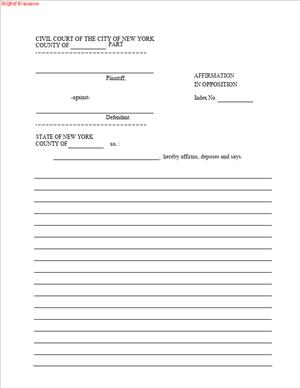
CIV-GP-122 – Affirmation in Opposition
Fill out nowJurisdiction: Country: United States | Province or State: New York
What is a CIV-GP-122 – Affirmation in Opposition?
The CIV-GP-122 is a standard form used in the Civil Court of the City of New York. You use it to oppose a motion or an order to show cause. It is a sworn written statement that presents facts, explains your position, and asks the court to deny the other side’s request. It belongs to the motion practice tools used in New York City Civil Court cases.
An “affirmation” is a sworn statement made under penalty of perjury. In New York practice, an affirmation is typically signed by an attorney or a person allowed to affirm. If you are self-represented and not authorized to affirm, you usually submit an affidavit instead. The court provides both versions for that reason. This form is the attorney version.
You file this form when the other side has asked the court for relief by motion. Common examples include motions for summary judgment, to dismiss the case, to compel discovery, or to strike a pleading. You also use it when responding to an order to show cause that sets deadlines and a return date. The affirmation presents the facts and law that support your opposition. You attach exhibits, like contracts, emails, account statements, or prior orders, to prove your points.
Who typically uses this form?
Attorneys who represent individuals, small businesses, landlords in money claims, tenants in money claims, consumers, debt buyers, creditors, insurers, and other civil litigants. The Civil Court handles money disputes up to a set jurisdictional limit. It covers consumer credit, property damage, breach of contract, and other civil matters. In these cases, attorneys often oppose motions using this form.
You would need this form when the court has set a date for the motion to be heard. The notice of motion or the order to show cause will include that date. It may also include deadlines for your opposition. Your written opposition must reach the court and the other side before that deadline. This form provides the structure for your opposition. You identify the motion, state the facts, present your legal arguments, and ask the court to deny the relief.
Typical usage scenarios
The plaintiff moves for summary judgment in a credit card case. You represent the defendant. You draft a CIV-GP-122 to explain gaps in the plaintiff’s proof. You attach billing records, your client’s affidavit, and prior discovery responses. You argue that material facts remain in dispute. You ask the court to deny the motion or, at a minimum, to allow more discovery. You sign the affirmation and file it, with exhibits and proof of service, by the deadline.
You can also use this form to oppose a motion to dismiss for lack of service. You would set out the service facts based on your investigation. You attach process server records, photos, or affidavits. You explain why the service met the legal standard or why the issues require a hearing. The structure is the same in each case. Facts first, then law, then a clear ask.
When Would You Use a CIV-GP-122 – Affirmation in Opposition?
Use this form any time you are opposing a noticed motion or an order to show cause in a Civil Court case. The key trigger is a return date set by the court. When you receive the motion papers, read the notice carefully. It tells you when and where the motion will be heard. It may also state when your opposition is due. Orders to show cause usually set specific opposition deadlines. Follow those dates strictly.
If you represent a consumer sued for a credit card balance, you may face a summary judgment motion. The plaintiff will attach account statements and an affidavit. You should use this form to challenge that proof. You might show that the records are incomplete or not from a custodian with knowledge. You might point out inconsistent account numbers. You may attach your client’s affidavit denying the account. The affirmation ties those facts together and asks the court to deny the motion.
If you represent a small business in a contract dispute, the other side may move to dismiss for lack of personal jurisdiction. Use this form to show contacts with New York, a signed agreement, or forum selection. Attach the contract and communications. Explain the factual background and why the court has jurisdiction. Ask the court to deny dismissal and keep the case on track.
If the plaintiff moves to strike your answer for failing to provide discovery, respond with this form. Explain what you served, when, and what remains. Attach your responses and emails. Offer to provide specific items by a date certain. Ask the court to deny sanctions and set a realistic schedule.
If a defendant moves to vacate a default judgment by order to show cause, you oppose with this form. Address service history and prejudice. Challenge the claimed excuse or merit if the record supports it. Attach the affidavit of service and prior orders. Ask the court to deny the vacatur if appropriate.
Attorneys also use this form to oppose motions to consolidate, sever, amend pleadings, or change venue. The core approach remains consistent. State the procedural posture. Lay out the facts. Apply the law. Ask clearly for the relief you want: denial, modification, or another fair outcome.
Legal Characteristics of the CIV-GP-122 – Affirmation in Opposition
This form is not a contract. It does not bind the other side by agreement. It is a sworn submission to the court that carries weight because of its form and content. When properly executed and filed, your affirmation becomes part of the motion record. The judge reads it along with the moving papers and reply papers. The court may rely on your sworn factual assertions and the exhibits you submit.
It is legally effective because it is a sworn statement made under penalty of perjury. The signature block uses the required affirmation language. You affirm that the contents are true based on your personal knowledge, your file, or a review of records. If you attach exhibits, you identify and authenticate them. You explain how you obtained them and how they relate to the facts in dispute. You also state the relief you seek. This clarity helps the judge issue a decision that addresses your arguments.
Enforceability comes from proper procedure. Use the exact case caption and docket or index number. Identify the court, county, judge, and part if assigned. Reference the specific motion you oppose by title and date. Include the return date and, if used, the motion sequence number. Serve your papers on time and in the proper manner. File them with the court before the deadline. Include a separate affidavit of service signed by a nonparty who mailed or delivered the papers. If the case is in the e-filing system, file and serve through that system as required.
Your affirmation should rest on admissible facts or authenticated records. Avoid speculation. If you lack personal knowledge, say so and explain the basis for your statements. Cite the exhibits you attach by letter or number. Identify pages within exhibits when you can. The court expects clear, organized support for your points. Conclusory statements without proof carry less weight.
Be mindful of confidentiality and redaction. Do not include full Social Security numbers, full account numbers, or other sensitive data. Redact to the last four digits where needed. If you must submit sensitive material, use the proper method to protect it. Keep your submission professional, concise, and focused on what the court must decide.
Finally, know the limits of an opposition. If you seek your own affirmative relief, you may need a cross-motion. Do not try to obtain new relief inside an opposition without the proper notice. If you only want the motion denied or modified, an opposition is the right vehicle. If you need more time to gather facts, ask for it within your affirmation and explain why. The court can grant additional time when justified.
How to Fill Out a CIV-GP-122 – Affirmation in Opposition
Follow these steps to complete the form and submit it correctly.
1) Gather the key papers.
Collect the summons and complaint, answer, prior orders, and the motion papers you are opposing. Gather your discovery responses, emails, contracts, and records that you will attach. Decide which exhibits you need. Mark them with tabs labeled A, B, C, and so on. Prepare clean, legible copies. Redact sensitive data as needed.
2) Set up the caption.
At the top, identify the court as the Civil Court of the City of New York. Add the county where the case is pending. Use the exact party names from the original caption. List the docket or index number. If a judge and part are assigned, include them. Accuracy here avoids filing issues.
3) Title the document.
Center the title: “Affirmation in Opposition.” If there is a motion sequence number, include it beneath the title. If you are opposing an order to show cause, note that in the introductory paragraph rather than changing the title.
4) Identify the motion and relief opposed.
In the opening paragraph, state what you are opposing. Example: “I submit this affirmation in opposition to plaintiff’s motion for summary judgment noticed for return on [date].” If an order to show cause sets the date, say so. Briefly list the relief the other side seeks and what you ask the court to do instead.
5) Introduce yourself and your role.
State your name, your status as an attorney admitted in New York, and who you represent. Explain how you know the facts. For example: “I am the attorney for the defendant. I am fully familiar with the facts based on my file, discovery, and discussions with my client.”
6) State the procedural background.
In a short section, outline the case history that matters to this motion. Note when the action began, what pleadings were filed, and relevant prior orders. Keep this tight. The goal is to give the judge context in a few paragraphs.
7) Present the material facts with cites to exhibits.
Lay out the facts that matter to the issues raised by the motion. Use separate, numbered paragraphs. Keep each paragraph focused on one point. After each important fact, cite the supporting exhibit and page. Example: “Defendant disputed the charges on March 5, 20XX (Exhibit B at 2).”
8) Organize your legal arguments with clear headings.
Create short argument headings that match the relief sought by the motion. Write one section per issue. Apply the facts to the legal standards that control the motion. Avoid block quotes. Be direct. If the plaintiff’s proof is insufficient, explain why and point to the holes with record citations. If the motion is premature, explain what discovery you still need and why it matters.
9) Address any reply points you can foresee.
Identify weaknesses the other side might raise in reply. Neutralize them now. For example, if they may say an affidavit of sale is enough, explain what is missing from that affidavit. Stick to the record. Do not attack opposing counsel. Keep your tone professional.
10) Ask for specific relief in a concise conclusion.
End with a short request. Example: “For these reasons, the Court should deny plaintiff’s motion in its entirety.” If you seek alternative relief, state it. Example: “Alternatively, the Court should deny the motion without prejudice and set a discovery schedule.” If you need more time, ask for it and state what you will obtain with that time.
11) Attach and label your exhibits.
Attach exhibits after the signature page. Label them A, B, C, and so on. Create a short cover page for each exhibit that states what it is. Example: “Exhibit A: Contract dated May 10, 20XX.” Ensure each exhibit is legible. Avoid duplicates. Highlight key portions or provide pinpoint references in your text.
12) Insert the affirmation language and sign.
Use the required affirmation statement. Example: “I affirm under penalties of perjury that the foregoing is true.” Add the date and the city or county where you sign. Sign your name. Print your name, firm, address, phone, and email below the signature. Because this is an affirmation, you do not need a notary if you are authorized to affirm.
13) Prepare a proof of service.
Have a person who is not a party and is at least 18 years old serve the papers. Service can be by mail unless the court or case requires another method. The server must sign an affidavit of service describing how and when service was made and on whom. Attach that affidavit to your filing or file it separately as required.
14) File your opposition on time.
File your affirmation, exhibits, and proof of service with the court before the deadline. If the case is in the e-filing system, upload the documents there. If the case is not e-filed, file it in person or by mail as allowed. Keep a stamped copy or confirmation receipt for your records.
15) Follow any page limits or part rules.
Some parts impose page limits or require courtesy copies. If a judge requires hard copies, deliver them on time with exhibit tabs. If you need an adjournment, request it as early as possible and confirm any new schedule in writing.
16) Prepare for oral argument or submission.
Check the notice to see if the motion is on submission or for argument. If the court will hear the argument, prepare a short outline. Focus on your best two or three points. Bring spare copies of key exhibits. If the court decides on submission, monitor the docket for the decision.
Practical drafting tips
- Keep paragraphs short and focused. Judges appreciate clarity.
- Use accurate dates, names, and amounts. Consistency builds credibility.
- Do not overstate facts. If a point is uncertain, say so plainly.
- Avoid personal attacks. Address arguments, not attorneys.
- Proofread for typos, incorrect exhibit letters, and caption errors.
- Ensure your exhibits match your citations and are in order.
- Redact sensitive data before you file and serve.
Common pitfalls to avoid
- Missing the opposition deadline. Late papers may be rejected or ignored.
- Failing to authenticate exhibits. Identify what each exhibit is and how you got it.
- Ignoring the relief actually requested by the motion. Address each requested item.
- Asking for new relief without a cross-motion. Use the right vehicle for your goals.
- Submitting conclusory statements without record support. Show, do not just tell.
Real-world example
You represent a defendant in a store credit account case. The plaintiff moves for summary judgment with monthly statements and a generic affidavit. Your affirmation explains that the affidavit lacks a foundation to admit the records. You point out missing cardmember agreement pages and inconsistent balances. You attach your client’s affidavit denying receipt of several charges and your discovery demands. You ask the court to deny the motion or allow discovery on account ownership and assignment. You file and serve the papers five days before the return date. The court denies the motion without prejudice and sets a discovery schedule.
Use this process in any Civil Court motion where you oppose relief. The CIV-GP-122 gives you a clean, accepted format to present your client’s position. Keep it factual, organized, and timely. That is how you help the court reach a fair decision.
Legal Terms You Might Encounter
- Affirmation: An affirmation is a signed statement of facts. It is made under penalty of perjury. On CIV-GP-122, you affirm that your facts are true. You do not need a notary when you affirm.
- Affidavit: An affidavit is a sworn statement before a notary. This form is an affirmation, not an affidavit. If you are an attorney, you typically use the affirmation on CIV-GP-122. Do not add a notary block to this form.
- Movant: The movant is the party that made the motion. You use this form to oppose the movant’s request. Name the movant clearly in your caption and body.
- Opposing Party: This is the party you are challenging in your affirmation. It may be the movant or another party seeking relief. Identify each opposing party by name, not “they.”
- Caption: The caption is the case header. It lists the court, parties, and index number. Your CIV-GP-122 must match the caption on the motion papers exactly.
- Index Number or Docket Number: This is the case number assigned by the court. You place it at the top of your CIV-GP-122. If it is wrong or missing, the clerk may reject your filing.
- Return Date: The return date is when the court reviews the motion. Your opposition must be filed and served before this date. Put the return date in your affirmation so the court sees your timing.
- Relief Requested: Relief is what the movant wants the court to do. Your affirmation explains why the requested relief should be denied or modified. Address each item of relief directly.
- Exhibits: Exhibits are documents that support your facts. Label each exhibit and reference it by letter in your affirmation. Attach only clear, relevant pages.
- Proof of Service: This is evidence that you served your papers on other parties. It is often an affidavit of service from the server. Your CIV-GP-122 needs proper service to be considered.
FAQs
Do you need to notarize CIV-GP-122?
No. CIV-GP-122 is an affirmation. You sign under penalty of perjury, not before a notary. Use the signature block on the form. Do not attach a separate notary page.
Do you use this form if you represent yourself?
Yes, you can. A self-represented litigant can submit an affirmation in opposition using this form. Follow the form’s language. Sign and date the affirmation. Make sure your contact details are complete.
Do you have to attach the motion papers again?
No. You do not need to reattach the entire motion. Attach only exhibits that support your opposition. Include the key pages you rely on, like contracts or notices. Label each exhibit clearly.
Do you need to serve the other party?
Yes. You must serve your opposition on all parties. Follow the service method required by the court. Prepare a proof of service. File that proof with your affirmation.
Do you have to file before the return date?
Yes. File and serve your opposition before the return date. The court may set an earlier deadline. If you miss the deadline, the court may ignore your papers. Ask the clerk about timing if unsure.
Do you need a memorandum of law with this form?
Not always. CIV-GP-122 can stand alone. If the issues are complex, you can attach a short memorandum. Keep it clear and focused. Refer to your exhibits and facts.
Do you list every fact you know?
No. Include only facts relevant to the motion. Stick to firsthand knowledge when possible. Avoid speculation. Support key points with exhibits or prior court filings.
Do you need to attend the motion date after filing?
Check your notice of motion. Some motions are decided on the papers. Others require an appearance. If an appearance is set, bring your filed opposition and exhibits. Arrive early and be prepared.
Checklist: Before, During, and After the CIV-GP-122 – Affirmation in Opposition
Before signing
- Gather the motion papers you are opposing.
- Confirm the index or docket number.
- Confirm the correct case caption and judge or part.
- Note the return date and any service deadlines.
- Outline your key facts in chronological order.
- List each point you will oppose and why.
- Collect exhibits that support your facts.
- Mark each exhibit with a clear label and brief description.
- Confirm the correct names and addresses for service.
- Check the service method rules for motion papers.
- Prepare a proof of service form for later use.
During signing
- Verify the caption matches the motion exactly.
- Enter the correct index or docket number.
- State your role: party or attorney for a party.
- Identify the motion you oppose by title and date.
- List the relief requested by the movant in brief.
- Answer each point raised in the motion.
- Refer to exhibits by letter in the text.
- Include the return date for clarity.
- Use the affirmation language on the form.
- Sign and date the affirmation where indicated.
- Print your name, address, phone, and email clearly.
- Check that all pages are numbered.
- Review for typos, missing names, or wrong dates.
After signing
- Make a complete set for filing with the court.
- Make a complete set for each party you must serve.
- Keep a clean set for your records and the hearing.
- Serve all parties by the allowed method.
- Obtain a signed proof of service from the server.
- File your CIV-GP-122 and exhibits with the court.
- File the proof of service with your opposition.
- Confirm filing acceptance with the clerk or system.
- Calendar the return date and any appearance.
- Bring your filed copies and exhibits to court.
- Monitor the case for any court decision or next steps.
Common Mistakes to Avoid CIV-GP-122 – Affirmation in Opposition
- Don’t forget the index or docket number. Without it, the clerk may not match your papers to the case. Your opposition may be ignored.
- Don’t use the wrong caption. A mismatched caption can delay filing. The court may reject your submission.
- Don’t skip service. If you do not serve all parties, the court may refuse to consider your opposition. The motion may be granted by default.
- Don’t miss the deadline. Late papers risk being rejected. The court may decide the motion without your input.
- Don’t attach unlabeled exhibits. Unlabeled or blurry documents weaken your argument. The court may not find the proof you cite.
What to Do After Filling Out the Form CIV-GP-122 – Affirmation in Opposition
- File your CIV-GP-122 promptly. Do not wait until the return date. Use the court’s accepted filing method. Include all exhibits and the proof of service.
- Serve all parties who appeared in the case. Use the required service method for motion papers. Complete a proof of service for each party or address. Keep the originals for filing.
- Confirm the court has your papers. Check the docket if available. If there is an error, correct it quickly. Re-file any rejected pages without delay.
- Prepare for the motion date. Bring your filed set and your exhibits. Outline your main points in a one-page note for yourself. Focus on the relief at issue.
- Watch for a reply from the movant. The movant may submit a reply before the return date. Read it carefully. Be ready to address any new points at the appearance, if allowed.
- Consider amendments only if needed. If you spot a clear error, correct it before service and filing. If already filed, you may submit a corrected affirmation with an explanation. Keep changes narrow and necessary.
- Distribute copies to your client or team. Make sure everyone has the final version. Note any deadlines for follow-up or compliance.
- Track the result. The court may decide on the papers or after the appearance. When the decision is issued, review the order. Calendar any deadlines from that order.
- If the motion is granted in part, plan the next steps. Comply with any directives. If you need further relief, prepare the proper papers. Keep your file complete and organized.
- If the motion is denied, preserve your win. Save the order and your opposition for future use. You may need them if the issue arises again.
- Maintain your record. Store your CIV-GP-122, exhibits, and proofs of service. Keep a clear index of what you filed. This protects you if questions come up later.
Disclaimer: This guide is provided for informational purposes only and is not intended as legal advice. You should consult a legal professional.