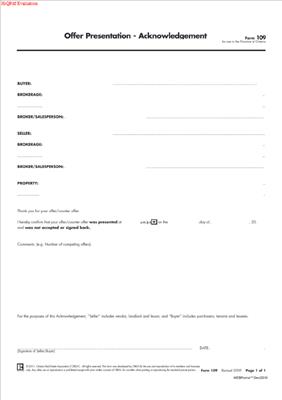
OREA Form 109 – Offer Presentation – Acknowledgement
Fill out nowJurisdiction: Country: Canada | Province/State: Ontario
What is an OREA Form 109 – Offer Presentation – Acknowledgement?
This form records that an offer was handled properly. It confirms whether an offer was presented to the seller, and when. It also records who presented it and to whom. It protects you by creating a clear paper trail. It does not sell the property or change the deal terms. It is an administrative acknowledgment tied to a specific offer.
You typically see this form in residential and commercial deals. It applies to both purchases and leases. Real estate registrants use it every day in Ontario. It is a standard way to show that an offer reached the seller. It can also confirm when the seller chose not to see an offer. The form lives in the brokerage file. You can also give a copy to the cooperating brokerage on request.
Who uses this form?
Sellers and their listing brokerage use it most. The listing salesperson or broker presents the offer and completes the form. The seller signs to confirm what happened. The buyer’s brokerage may request a copy as proof. Landlords and tenants can use it in leasing transactions. Builders and developers use it in new construction sales. It works the same way in each case. It tracks the handling of each offer with dates, times, and names.
Why would you need this form?
You need it to reduce risk. Disputes often arise about the offer presentation. A buyer may claim their offer was ignored. A seller may claim they never saw an offer. This form settles those claims quickly. It shows whether the offer was presented or not, and why. It supports compliance with Ontario rules on offer handling. It also helps you manage multiple offers. You can track every offer that came in and when it was dealt with.
Common situations show how useful it is. A buyer’s agent sends an offer at 6:45 p.m. The seller set a review time of 8:00 p.m. You present the offer at 8:05 p.m. You both sign the acknowledgment. Now there is a record of that event. Or consider a pre‑emptive offer during a “no pre‑emptive” period. The seller had given written direction not to review early offers. In that case, you would not present the early offer. The acknowledgment lets you record that the offer was not presented. You also record the reason. This avoids confusion and protects all parties.
The form is short. It asks for basic details. You identify the property and the parties. You state if the offer was presented. You include the date, time, and method of presentation. You note who was present or consulted. You then sign and date the form. Simple, clear, and reliable.
If you are the listing agent, this form is part of your file. If you are the seller, it confirms you saw specific offers. If you are a buyer’s agent, it gives you formal proof. If you are a buyer, it reassures you that your offer reached the seller. Everyone benefits from the clarity.
When Would You Use an OREA Form 109 – Offer Presentation – Acknowledgement?
You use this form whenever a real estate offer is received and handled. The most common moment is right after you present the offer to the seller. You can complete it immediately after the presentation. That ensures the date and time are exact. The seller can sign while the facts are fresh.
You also use it when an offer is not presented. That may happen when the seller has given clear written directions. For example, the seller has set an offer date and will not review early offers. An offer arrives early. You do not present it. You still complete an acknowledgment. You record that the offer was not presented and the reason. This protects your compliance record.
Multiple offer nights are a prime use case. You receive five offers. You present them in an orderly sequence. You complete an acknowledgment for each offer. You record the presentation time for each. You can also note the presentation method. You might say “video call” or “in person.” This gives a precise record if disputes arise later.
You also use it in lease transactions. A landlord may receive several lease offers in a tight market. You present each to the landlord. You complete an acknowledgment for each offer. The same rules apply. The form tracks timing and handling. That supports fair process and clean records.
Virtual presentations are another use case. Many presentations happen by phone or video call. You still need proof of presentation. The acknowledgment captures that context. You confirm the method, date, and time. You obtain signatures electronically. You then store the form as you would for any in‑person meeting.
Withdrawn offers also come up. A buyer may withdraw an offer before presentation. You can note that outcome. You record that the offer was withdrawn and not presented. This closes the loop. It shows you followed the seller’s direction for handling offers.
The typical users are sellers and their listing brokerage. Buyers and their brokerage often request confirmation. Landlords, tenants, builders, and commercial clients use it as well. Use the form any time you need to show what happened to a specific offer. It is the simplest way to document proper handling.
Legal Characteristics of the OREA Form 109 – Offer Presentation – Acknowledgement
This form is not an agreement of purchase and sale. It does not bind anyone to buy or sell. It does not change price, terms, or conditions. It is a factual record signed by the people involved. It confirms the status of an offer at a point in time. It is legally significant as evidence. It can be used to prove that an offer was handled properly.
The form supports compliance with Ontario real estate rules. Registrants must deliver offers and convey them to clients. They must keep proper records. This form helps you meet those duties. It shows you presented the offer to the seller. Or it shows you did not present it because of the seller’s written direction. It can also confirm that the seller chose not to view an offer. In each case, the form backs up your file.
What ensures the enforceability of its contents?
Accuracy and signatures do. You identify the property and parties. You record a clear date and time. You explain whether the offer was presented. You capture signatures from the right people. You keep a copy with the deal file. You can share a copy with the cooperating brokerage when asked. This creates a reliable audit trail. Courts, regulators, and brokerages value clear records like this.
Is it binding?
It is binding in a narrow sense. It binds the signer to the statements they made. If those statements are false, the signer faces risk. Misstatements can have serious consequences. Factual errors can damage a client’s interests. Treat it like any other signed record. Check details before you sign. If you make a mistake, correct it in writing at once.
General legal considerations apply. Keep client information confidential. Do not disclose price or terms to other bidders through this form. The acknowledgment should not share confidential offer content. It only confirms presentation status and timing. Provide the form only to authorized parties. Follow your brokerage policies on record retention. Electronic signatures are acceptable. Use a reliable system for e‑signing. Keep a clean copy in the file.
This form does not replace the seller’s written direction on offer handling. If the seller sets a review date or declines pre‑emptive offers, get that direction in writing. Then use this acknowledgment to record each offer handled under that direction. The two records work together. One sets the rules. The other records the events.
The form also supports fairness in multiple offers. It shows that each offer was handled the same way. It helps avoid claims of bias or favoritism. If a buyer questions the process, you can show an exact timeline. That transparency builds trust and reduces complaints.
How to Fill Out an OREA Form 109 – Offer Presentation – Acknowledgement
1) Gather the key details first.
- Collect the property address, including the unit number if any.
- Have the full legal names of all sellers on hand.
- Know the buyer’s name and the buyer’s brokerage.
- Confirm the date and time the offer was received.
- Confirm the date and time the offer was presented, if applicable.
- Have the listing brokerage name and your name as the listing salesperson.
2) Identify the property.
- Enter the municipal address in full.
- Include city, postal code, and unit number where applicable.
- Add a brief legal description if requested on the form.
- If the form allows, include the MLS number for clarity.
3) Identify the offer.
- Enter the buyer’s full name or buyer entity name.
- Add the buyer’s brokerage name and salesperson, if known.
- If multiple offers exist, include a simple identifier.
- You can use the date and time received as the identifier.
4) Confirm the status of the presentation.
- State clearly if the offer was presented to the seller.
- If presented, record the exact date and time.
- Note the presentation method, such as in person or video call.
- If not presented, state the reason in plain language.
5) Refer to the seller’s written direction if relevant.
- If the seller sets a review date, note that direction.
- If early offers were not to be reviewed, state that.
- Keep the seller’s direction document with your file.
- Do not attach it to the acknowledgment unless your policy allows.
6) Name the participants in the presentation.
- List the seller(s) present, and any co‑decision makers.
- List the listing salesperson or broker who presented.
- If a manager attended, include their name.
- If the buyer’s agent attended, include that if the form provides space.
7) Record receipt and presentation times accurately.
- Use the local date and time in Ontario.
- If multiple offers were presented, complete one form per offer.
- Do not combine several offers on one acknowledgment.
- Keep times consistent with your message logs and emails.
8) Keep confidentiality front and center.
- Do not include offer price or terms on this form.
- The form is not a summary of offer details.
- It is a record of presentation status and timing only.
- If the buyer asks for proof, provide the acknowledgment only.
9) Add any required notes with care.
- If the offer was withdrawn, say so and add the time.
- If the seller declined to view, record that and why.
- If the presentation happened in stages, note the sequence.
- Keep the notes factual and neutral.
10) Get the right signatures.
- Have the seller sign and date the acknowledgment.
- Have the listing salesperson or broker sign and date it.
- If the brokerage requires a manager’s signature, add it.
- Use electronic signatures if allowed by your brokerage.
11) Check for completeness before you send or file.
- Confirm names, dates, times, and spellings.
- Make sure the property address is exact.
- Ensure the presentation status matches the facts.
- Confirm all required signatures are on the form.
12) Distribute and store the document.
- Give a copy to the seller for their records.
- Provide a copy to the cooperating brokerage on request.
- Save a clean, final copy in the brokerage file.
- Follow your brokerage policy for record retention.
13) Handle multiple offers with separate acknowledgments.
- Create one acknowledgment for each offer.
- Complete and sign each immediately after presentation.
- Keep them in time order for a clean timeline.
- This streamlines any later review or inquiry.
14) Handle not‑presented offers correctly.
- Complete an acknowledgment even if you did not present.
- State the reason, such as the seller’s prior written direction.
- Include the date and time you received the offer.
- Sign and file as you would for presented offers.
15) Align with your communication trail.
- Keep emails and messages that show receipt and scheduling.
- Match those timestamps to the acknowledgment.
- This creates a tight, defensible record.
- It also helps with future training and process improvement.
16) Use attachments only if your policy permits.
- You may attach a copy of the seller’s directions on offer handling.
- You may also attach a short cover note for context.
- Do not attach confidential offer documents.
- Keep the acknowledgment limited to process facts.
17) Correct errors promptly.
- If you spot an error, prepare a corrected acknowledgment.
- Cross‑reference the original by date and property.
- Explain the correction in a short note.
- Have the parties re‑sign if material details changed.
18) Apply the same process in lease deals.
- Identify the landlord, tenant, and the premises.
- Record presentation status and timing as usual.
- Use the same signature and filing steps.
- Keep the lease file complete and consistent.
19) Prepare for questions from the cooperating brokerage.
- Be ready to provide the signed acknowledgment on request.
- Do not share confidential offer terms.
- Stick to presentation status and timing.
- Refer questions on content to your client’s decision.
20) Close the file with a clear checklist.
- Ensure every offer has a matching acknowledgment.
- Confirm each is signed and dated.
- Ensure all not‑presented offers are recorded with reasons.
- Archive the documents per your brokerage policy.
Real‑world examples
You set an offer date for a Friday at 6:00 p.m. Ten offers arrive. You present them in order, starting at 6:15 p.m. After each presentation, you complete and sign an acknowledgment. The seller also signs. Two buyers ask for proof of presentation. You send them their signed acknowledgments. Everyone has clarity.
Another example: An early offer arrives on Wednesday morning. The seller has already directed you not to review early offers. You do not present the offer. You still complete an acknowledgment. You record that it was not presented and state the prior direction. You sign and file it. If the buyer’s agent later asks for proof, you provide the acknowledgment. The record is clean and compliant.
One further example: A buyer withdraws an offer at 4:00 p.m., before the review time. You record the withdrawal in the acknowledgment. You note that it was not presented due to withdrawal. You sign and file it. The sequence is clear if anyone asks later.
If you hold to this process, you reduce risk. You also build trust with clients and other brokerages. The form is short. Filling it out well takes minutes. The value lasts for years.
Legal Terms You Might Encounter
- Offer means a written proposal to buy the property. You use this form to record how that offer was presented to you.
- Offer presentation refers to the meeting or communication where the offer is conveyed and explained. This form captures who attended, how it happened, and when.
- Irrevocable period is the time a buyer keeps the offer open. You note the presentation time here to prove the offer was conveyed in time. Registered offer means an offer the listing brokerage has recorded as received. You acknowledge that all registered offers were conveyed to you.
- Multiple offers mean more than one buyer submitted offers at the same time. The form confirms that you knew about competing offers. Seller’s direction is your instruction on how to handle offers. You record if you allowed or declined attendance by a buyer’s representative.
- Pre-emptive offer is an early offer before a planned offer date. You still complete this form to document how that early offer was handled. Listing brokerage is the brokerage representing you as the seller. Its representative presents offers and signs their portion. Co-operating brokerage is the brokerage representing the buyer. The form shows whether that representative attended the presentation.
- Acknowledgement is your signed confirmation that an offer was presented. You are not accepting or rejecting terms by signing this form. Confidentiality means the form does not disclose price or conditions. It only documents the process and your instructions around the presentation.
- Multiple representation occurs if one brokerage represents both sides. If that applies, you confirm that the offer was still presented properly.
FAQs
Do you need to complete this form for every offer?
Yes, complete one each time an offer is presented to you. It creates a clear record of the presentation method and timing. If new offers arrive later, complete a new form for each.
Do you sign this form before or after the offer presentation?
Complete and sign it immediately after the presentation. Capture the date, time, and attendance while details are fresh. That helps avoid gaps or disputes later.
Do you, as the seller, have to let the buyer’s representative attend?
You decide whether to allow attendance. Your choice should be consistent with your written instructions. The form documents your direction and what actually occurred.
Do buyers sign this form?
No, buyers do not usually sign this form. It is typically signed by you and the listing representative. The form focuses on the seller’s acknowledgement of the process.
Do you include the number of competing offers on this form?
You record whether multiple offers existed. You may also note relevant presentation details. The form does not disclose confidential terms of any offer.
Do you use this form when there is a pre-emptive offer?
Yes. If you receive an early offer before a scheduled date, use this form. It records how the offer was presented and whether attendance was allowed.
Do you need to fill out a new form if a revised offer arrives?
Complete a new form if there is a new presentation event. That includes a substantially revised offer that is presented again. Keep all versions in your deal file.
Do you share this form with anyone outside the deal team?
You keep it in your transaction records. Provide copies only to parties who need them for the file. Avoid sharing confidential information unnecessarily.
Checklist: Before, During, and After the OREA Form 109 – Offer Presentation – Acknowledgement
Before signing
- Confirm the correct property address and legal names of all sellers.
- Gather your written instructions on the offer presentation and attendance.
- Have a record of registered offers and the times they arrived.
- Identify whether multiple offers exist at the time of presentation.
- Prepare contact details for the listing representative who presented.
- Note whether a buyer’s representative requested to attend.
- Collect any earlier acknowledgements if prior presentations occurred.
- Decide in advance whether to allow attendance by buyer’s representatives.
- Confirm who has the authority to sign for each seller.
- If using electronic signatures, test access and identity verification.
During signing
- Verify the property address, seller names, and date on the form.
- Check the presentation method: in person, phone, video, or email.
- Confirm whether the buyer’s representative attended, as directed.
- Record the exact presentation time, matching your communication logs.
- Indicate whether multiple offers existed at the time.
- Ensure the listing representative’s details are accurate and legible.
- Review any seller instructions recited on the form for accuracy.
- Initial any changes on the form before signing.
- Confirm that the acknowledgement does not reveal offer terms.
- Sign and date the form. Ensure all sellers sign in the proper spots.
After signing
- Save a legible copy in your deal file, digital or physical.
- Provide a copy to your listing representative for brokerage records.
- If you receive new offers, complete new forms for each presentation.
- Keep an organized log of all presentation acknowledgements.
- Store the form securely with restricted access to authorized people.
- If a mistake is found, correct it promptly and initial the change.
- Retain the form for the entire retention period set by your brokerage.
- If a dispute arises, use the form to show the presentation process.
Common Mistakes to Avoid OREA Form 109 – Offer Presentation – Acknowledgement
Leaving the presentation time or date blank
- Consequence: You may face disputes over whether the offer was conveyed on time.
- Don’t forget to record the exact time and date for each presentation.
Misstating whether multiple offers existed
- Consequence: You risk credibility issues and process complaints.
- Don’t guess. Confirm the status with your representative before signing.
Revealing offer terms on this process form
- Consequence: You could breach confidentiality and invite challenges.
- Don’t write price, conditions, or buyer names on the form.
Failing to reflect your direction on attendance
- Consequence: The form may not match your instructions if challenged later.
- Don’t leave this unclear. Check the attendance box that matches your choice.
Collecting incomplete signatures from all sellers
- Consequence: The acknowledgement may be invalid or questioned.
- Don’t overlook co-owners. Ensure every named seller signs and dates.
Using one form for multiple separate presentations
- Consequence: Timelines and facts blur, weakening your records.
- Don’t combine events. Complete a new form for each presentation.
What to Do After Filling Out the Form OREA Form 109 – Offer Presentation – Acknowledgement
- File it in your transaction record promptly. Use your brokerage’s naming rules.
- Share a copy with your listing representative and anyone managing compliance.
- Keep the form paired with your communication log and offer receipt records.
- If another offer is presented later, complete a new acknowledgement.
- If your presentation instructions change, put them in writing. Attach to the file.
- If you correct an error, mark the correction, initial, and date it. Save both versions.
- Maintain a clear timeline across all acknowledgements. Note the order of events.
- If the deal collapses, keep the form in the file. It still documents the process.
- When the transaction closes, retain the form for the full retention period.
- If a concern arises, rely on the form to show what happened and when.
Disclaimer: This guide is provided for informational purposes only and is not intended as legal advice. You should consult a legal professional.