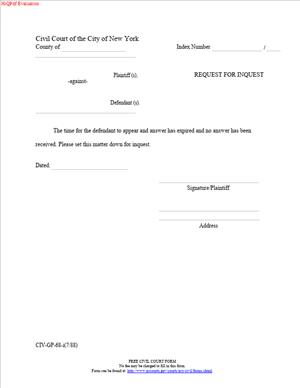
CIV-GP-68-i- Request for Inquest
Fill out nowJurisdiction: Country: United States | Province or State: New York
What is a CIV-GP-68-i- Request for Inquest?
A Request for Inquest asks the Civil Court of the City of New York to schedule an inquest. An inquest is a short hearing where the judge decides your damages after liability has already been resolved. Liability is resolved when the defendant defaults or when the court rules for you on liability. At the inquest, you prove your damages with documents and testimony. The judge then enters a money judgment.
You use this form in the General Civil Part of the Civil Court. The Civil Court can award money up to the court’s monetary limit. You cannot use this form for Housing Court cases. You also cannot use it in Small Claims or Commercial Claims, which have their own procedures.
Who typically uses this form?
Plaintiffs and their attorneys use it after a default or a liability ruling. Self-represented plaintiffs often use it in simple debt or contract cases. Small businesses use it to collect unpaid invoices. Insurers and subrogation plaintiffs use it in property damage matters. Individuals use it in motor vehicle and personal injury cases where the defendant defaulted.
You need this form when you have cleared the liability step but still need a hearing on damages. If the defendant never answered your complaint, you ask for a default judgment. When your damages are fixed by a contract or a sum certain, the clerk may enter judgment without a hearing. If your damages are not fixed, the court schedules an inquest. This form is how you get the inquest date.
Typical usage scenarios
The most common is a pure default. You served the summons and complaint. The defendant did not answer or appear. You prove proper service and default, and you request an inquest to prove your damages. Another path is when the defendant’s answer was stricken. This can happen for discovery failures or court order violations. Liability is then deemed admitted. You request an inquest to prove your damages. A third path is a partial summary judgment on liability. The judge decides the defendant is liable but reserves damages. You request an inquest to finish the case. A fourth path is a default at trial. The defendant failed to appear on the trial date. The court directs an inquest. You complete this form to calendar it.
In each scenario, you are not relitigating fault. You focus only on the amount of money you can prove. That is the limited purpose of the inquest.
When Would You Use a CIV-GP-68-i- Request for Inquest?
You use it after the court has a basis to enter judgment for you on liability. The timing depends on how you reached that point. If the defendant defaulted by not answering the complaint, you first show proper service and default. If the court agrees, the next step is damages. This form asks the court to set the hearing.
If the court struck the defendant’s answer, the case shifts to damages only. You file this form to ask for an inquest date. You attach the order striking the answer. You also attach your evidence of damages. This keeps the court calendar efficient and signals you are ready to proceed.
If you won summary judgment on liability, the same logic applies. You already have a court order saying the defendant is liable. You cannot get a final judgment until damages are set. You file the Request for Inquest to schedule that hearing. You submit your proof of damages along with the request.
If the defendant defaulted on the trial date, the judge may direct an inquest “forthwith” or later. If directed later, you file this form to calendar it. You attach the note or order showing the trial default. You also include your readiness to present damages.
Typical users include self-represented plaintiffs in contract and consumer debt cases. Small businesses use it when customers ignore lawsuits. Landlords with non-housing civil claims use it for unpaid use and occupancy outside summary proceedings. Medical providers use it for unpaid services when damages require proof. Drivers and pedestrians use it in auto property damage and personal injury defaults. Subrogating insurers use it after paying their insureds and suing the wrongdoer.
Real examples help. You run a design firm. Your client did not pay a $9,500 invoice. You sued in Civil Court. The defendant never answered. Your invoice sets a fixed sum, but you also seek late fees and interest. The clerk may still need an inquest to confirm the running totals. You file this form to calendar the inquest.
Another example: You were rear-ended. You sued for bodily injury and lost wages. The defendant did not answer. Your medical expenses and lost wages require proof. The court will not guess. You request an inquest. You bring medical bills, proof of treatment, and wage records to the hearing.
One more example: The court struck the defendant’s answer for failing to comply with discovery. Liability is now resolved against the defendant. You use this form to convert the case to damages. You attach the court’s order and your damages proof.
Legal Characteristics of the CIV-GP-68-i- Request for Inquest
This form is a procedural request, not a contract. It is not legally binding by itself. You are asking the court to schedule a limited hearing on damages. The binding result comes from the judgment after the inquest. That judgment is enforceable.
What ensures enforceability?
You must have a valid service of the summons and complaint. You must show that the defendant defaulted or that the court resolved liability. You must meet any notice requirements for a default judgment. If the defendant has appeared at any point, you must serve notice of the inquest. You also must comply with rules on military status. If the defendant may be in active military service, special protections apply. The court will not enter a default judgment without a proper affidavit on military status.
Your damages must be proven with competent evidence. Bring itemized bills, contracts, invoices, ledgers, and receipts. Bring repair estimates, photographs, and appraisals for property damage. Bring medical records and bills for injury claims. Bring affidavits from people with direct knowledge. If you seek lost wages, bring W-2s, pay stubs, and employer letters. If you seek interest, show your calculation and the start date. If you seek costs and disbursements, list each with receipts.
The court may reject a request if essential proof is missing. Common problems include no proof of service of the summons and complaint, no affidavit of default, or no military status affidavit. Another common issue is vague damages. You must show how you reach your number. The court cannot award speculative sums.
An inquest is generally held before a judge without a jury. The defendant’s default waives a jury. You must still present admissible evidence. Hearsay may not be enough unless a rule allows it. If you use business records, bring proper certifications or a witness. If you seek medical costs, make sure the records are legible and tied to the incident.
The court also ensures fairness through notice. If the defendant appeared in the case, you must give notice of the inquest date. You must file proof of that service. Notice must follow the required method and timing. If you fail to give notice, the court may vacate any judgment later.
Finally, be consistent with prior orders. If a judge limited the scope of damages or excluded certain items, do not seek them at the inquest. Attach the order so the inquest judge understands the posture. This prevents delay and denial.
How to Fill Out a CIV-GP-68-i- Request for Inquest
Follow these steps to complete and file the form. Use black ink. Print clearly. Keep sentences short and specific. Attach legible copies of all supporting documents.
1) Complete the case caption.
- Write the court: Civil Court of the City of New York.
- Write the county where your case is filed.
- List the Part and Judge if assigned.
- Fill in the index or docket number exactly as on your summons.
- Write the full names of the plaintiff(s) and defendant(s) as on the pleadings.
2) Identify yourself.
- If you are the plaintiff’s attorney, write your name, firm, address, phone, and email.
- If you are self-represented, write your name, address, phone, and email.
- Indicate “Plaintiff” or “Attorney for Plaintiff.”
3) State the basis for the inquest.
- Check or state the reason the liability is resolved.
- Common reasons: defendant defaulted in answering, defaulted at trial, answer stricken, or liability granted by court order.
- If there is a court order, write the date and attach a copy.
- If default in answering, state the date service was complete and the deadline to answer.
4) Confirm service and default.
- Attach the affidavit of service for each defendant served.
- Attach your affidavit or affirmation of default.
- State that the defendant failed to appear or answer.
- If you mailed any additional default notice, state the date and attach proof.
5) Address military status.
- Attach an affidavit stating the defendant’s military status.
- Use information from a reliable source to support the affidavit.
- If the defendant is in active service, note that status and follow the required protections.
6) Describe your claim and damages.
- State the cause of action in one sentence, such as breach of contract, subrogation, or negligence.
- Provide a brief, clear description of the loss.
- Itemize your damages by category.
- For each category, list the amount and attach proof.
- Examples: principal due, interest through a date, late fees, cost of repairs, medical bills, lost wages, and court costs.
7) Show how you calculated interest.
- State the rate if based on contract or law.
- State the start date for interest.
- State the end date used for the calculation.
- Attach a simple interest chart or spreadsheet if helpful.
8) List costs and disbursements.
- Include the index fee, service fees, subpoena fees, and other allowed costs.
- Attach receipts or invoices where possible.
- Add the costs to your total request.
9) Attach supporting evidence.
- Contracts, invoices, statements of account, and ledgers for contract cases.
- Repair estimates, appraisals, and photos for property damage.
- Medical bills and records for injury claims.
- Affidavits from people with knowledge, notarized if required.
- Any prior orders that affect liability or damages.
10) Prepare a proposed judgment, if required.
- Some Parts ask for a proposed judgment with line items.
- Include the plaintiff’s name, defendant’s name, and case number.
- List principal, interest, costs, and the total.
- Leave the signature line for the judge.
11) Address interpreter or accommodation needs.
- If you or a witness needs an interpreter, note the language.
- If you need an accommodation, state the request.
- This helps the court calendar the matter properly.
12) Notice to defendant if needed.
- If the defendant has appeared, you must serve notice of the inquest.
- Prepare a Notice of Inquest with the date, time, and Part once assigned.
- Serve it by the required method and timing.
- File proof of service before the hearing.
13) Sign and date the form.
- If you are an attorney, sign as the attorney for the plaintiff.
- If you are self-represented, sign as plaintiff.
- Print your name below the signature.
- Include the date and your contact information.
14) Notarize attached affidavits.
- Affidavits must be sworn before a notary.
- Affirmations by attorneys may be used if allowed.
- Do not alter notarized documents after signing.
15) Make copies and assemble the packet.
- Keep one full copy for yourself.
- Make copies for the court and for service, if required.
- Arrange the packet in this order: request form, supporting affidavits, proof of service, military affidavit, damages exhibits, prior orders, and proposed judgment.
16) File the Request for Inquest.
- File with the Civil Court clerk in the county of your case.
- You may file in person or by mail.
- If electronic filing is available, follow the posted instructions.
- Pay any required motion or calendar fee if applied by the Part.
17) Track scheduling and appearance.
- The court will assign an inquest date or Part.
- Check the calendar using the court’s notice.
- Appear on time with originals of key exhibits and two extra copies.
- Bring witnesses if needed to lay the foundation for the records.
18) Prepare for the hearing.
- Organize your exhibits with page numbers.
- Create a short outline of your damages proof.
- Start with a liability posture in one sentence.
- Move to damages by category with exhibits to support each item.
- Be ready to answer the judge’s questions.
19) Present your case at the inquest.
- State your name and role.
- Explain how you calculated your damages.
- Offer exhibits one at a time.
- Ask the judge to admit them into evidence.
- Give clear, concise testimony or call necessary witnesses.
20) After the inquest.
- The judge will issue a decision and enter judgment.
- Ask the clerk when to expect the judgment to be entered.
- Once entered, obtain a copy of the judgment.
- You can then enforce the judgment using the court’s procedures.
Practical tips will save time. Keep your numbers consistent across all documents. If your invoices show credits or refunds, reflect them. If your contract has an attorney’s fee clause, prove your fees with time records and rates. If you claim future damages, explain the basis and support it. Do not seek items the court has already denied. If you are unsure whether damages are liquidated, file the request. The court will decide if a hearing is needed.
Common mistakes lead to delays. Missing affidavits of service will stop the process. Unclear totals or math errors cause questions. Unsupported medical bills or repair estimates will not carry the day. Unsupported interest rates will be reduced or denied. Keep the record clean and complete.
Your goal with this form is simple. You ask the court to calendar a focused hearing and to give you a clear path to a money judgment. If you provide a complete packet and appear prepared, the inquest will be efficient.
Legal Terms You Might Encounter
- Inquest: An inquest is a hearing on damages. The court decides how much you should recover. You ask for it with the CIV-GP-68-i- Request for Inquest after liability is set or a default occurs.
- Default: A default happens when the defendant does not answer or appear. Your request for an inquest tells the court you want a damages hearing because of that default.
- Default Judgment: This is a judgment granted when the defendant does not participate. Your request helps the court move the case toward a damages decision and a final judgment.
- Damages: Damages are the amounts you seek. They include money you claim you lost, such as invoices, repairs, or fees. The request for an inquest signals you are ready to prove those amounts.
- Liquidated Damages: These are damages that are fixed or easy to compute, like a balance due on a contract. If your damages are liquidated, the court may review your papers without a live hearing. Your request can support a “paper inquest.”
- Unliquidated Damages: These damages need proof at a hearing, like pain and suffering or disputed repair costs. Your request asks the court to set a date so you can testify and present exhibits.
- Affidavit of Service: This is a sworn statement showing how you served the defendant. The court needs this before an inquest. Your request often relies on this proof to show the defendant was notified.
- Proof of Facts: These are documents or sworn statements that back your claim, like contracts, estimates, and photos. Your request for an inquest should align with this evidence, so the amounts claimed match what you can prove.
- Military Status Statement: Courts cannot enter a default judgment against certain active-duty service members without specific protections. Your inquest request typically assumes you have already addressed military status in your default papers.
- Inquest Calendar: This is the court’s schedule for inquest hearings. Your request asks the clerk to place your case on that calendar or decide it on submissions.
- Ex Parte: Ex parte means “without the other side present.” An inquest after default is usually ex parte. Your request alerts the court that the defendant did not appear, so the court can proceed.
- Notice of Inquest: The court may send notice of the inquest date. You can also mail a courtesy copy to the defendant. Your request triggers that scheduling process.
FAQs
Do you need the CIV-GP-68-i- Request for Inquest if the defendant answered?
No. You use this form when the defendant defaulted, or liability was already decided, but damages still need proof. If the defendant answered and the case is active on the trial calendar, you usually do not use this form for damages.
Do you have to serve the Request for Inquest on the defendant?
The court generally handles notice after your case is on the inquest calendar. Still, send a courtesy copy to the defendant at the last known address. It helps reduce disputes about notice and avoids delays. Keep proof of mailing for your records.
Do you need to appear in person for the inquest?
It depends on the case. If your damages are liquidated and fully supported by papers, the court may decide on submissions. If your damages need testimony, expect to appear. Your request opens that scheduling. Watch for the court’s notice and be ready either way.
Do you need a separate request for each defendant?
If there are multiple defendants and some defaulted while others appeared, note that in your request. The court may schedule an inquest only against the defaulting parties. If all defendants are in default, one request can cover the case. Be clear about who defaulted and what damages you seek from each.
Do you need to list every dollar you seek in the request?
Yes. Be specific. Match your requested amounts to your proof. Include interest, costs, and fees if permitted, and show how you calculated them. Your request signals to the court that your damages are ready for review.
Do you need a military service statement with a request for an inquest?
If you are seeking a default judgment, you will need military status information as part of your default proof. The inquest request assumes your default package is complete. If not, the court can delay or decline scheduling until you supply it.
Do you need to attach all exhibits to the request?
You do not usually attach every exhibit to the request itself. However, your file should already contain proof of service and default documents. Prepare your inquest packet now: contracts, invoices, estimates, photos, records, and your damage calculation. You will use these at the hearing or with your written submission.
Do you have to pay a fee when filing the request?
There can be fees associated with moving a default case to judgment. Confirm what applies to your case and be ready to pay at filing. Keep your receipt. If a fee is required and you do not pay, your request can be rejected.
Checklist: Before, During, and After the CIV-GP-68-i- Request for Inquest
Before signing
- Case caption. Confirm exact names, index number, and the court location.
- Default status. Ensure you have proof that the defendant defaulted, or liability is already decided.
- Proof of service. Have affidavits of service for the summons and complaint, and any prior motions.
- Military status information. Ensure your default proof addresses military service when required.
- Damages list. Prepare a clear breakdown of amounts for each category of damages.
- Interest calculation. Note start date, rate, per diem, and total through a specific date.
- Costs and disbursements. List filing fees, service fees, and other allowable costs.
- Exhibits packet. Gather contracts, invoices, estimates, photos, medicals, or repair bills.
- Witness plan. Identify who can testify about records, work done, or losses.
- Contact details. Confirm your mailing address, phone, and email are current.
- Settlement posture. If settlement talks are active, note timelines to avoid wasted appearances.
During signing
- Correct court part. Confirm the Civil Court county and the correct part for your case type.
- Names and roles. Verify plaintiff and defendant names and which defendants defaulted.
- Relief requested. Ensure the total damages match your evidence.
- Itemization. Double-check each line of damage aligns with your documents.
- Interest in math. Recheck the per diem and totals. Correct any rounding issues.
- Signature. Sign and date. If you are an attorney, include your name, address, and phone.
- Consistency. Make sure amounts match any prior pleadings or demanded relief.
- Attachments reference. If you reference affidavits or exhibits elsewhere, note where they appear in the file.
After signing
- Make copies. Keep a signed original for filing and at least two copies for your records.
- File the form. Submit the CIV-GP-68-i- Request for Inquest with the clerk for your case.
- Pay any fee. If a fee applies, pay and keep the receipt with your case notes.
- Calendar tracking. Note the expected processing time and check the inquest calendar status.
- Courtesy notice. Mail a copy to the defendant or counsel and keep proof of mailing.
- Inquest packet. Assemble your exhibits, affidavits, and a concise damages summary.
- Witness confirmations. Confirm availability and contact details for all witnesses.
- Hearing prep. Draft a short outline of your testimony and the order of your proof.
- Contact updates. If your address changes, notify the court in writing promptly.
- Storage. File stamped copies, receipts, and your inquest packet checklist in a safe place.
Common Mistakes to Avoid CIV-GP-68-i- Request for Inquest
- Requesting an inquest before establishing default or liability. The court cannot schedule damages until liability is resolved. Don’t forget to file and prove default first, or obtain a liability finding.
- Failing to itemize damages. Vague totals cause delays or reduced awards. Don’t forget to list each category with amounts and the documents that support them.
- Miscalculating interest. Wrong dates or rates can hurt credibility and the final number. Don’t forget to show your start date, rate, per diem, and total through a clear date.
- Using names or index numbers that do not match prior papers. Inconsistencies trigger clerk questions and rejections. Don’t forget to copy the caption and index number exactly as filed.
- Not preparing an inquest packet. Showing up without proof forces adjournments or denials. Don’t forget to bring originals, copies, and a simple summary of damages.
- Ignoring multiple-defendant status. If some defendants answered and others defaulted, a blanket request can confuse the record. Don’t forget to state which defendants defaulted and what you seek against each.
What to Do After Filling Out the Form CIV-GP-68-i- Request for Inquest
File the form with the Civil Court clerk for your case. Bring or include the index number on every page. Be ready to pay any required fee. Ask for a stamped copy for your records.
Track scheduling. The court may set an inquest date or ask for additional papers. Check your mail and your case status. If you receive a date, calendar it immediately.
Notify the defendant as a courtesy. Mail a copy of your filed request and any notice of the inquest date. Keep proof of mailing in case the court asks.
Prepare your inquest packet. Organize exhibits in the order you will present them. Use tabs and brief labels. Include:
- A damages summary with totals and calculations.
- Contracts, invoices, and receipts.
- Estimates, photos, and repair or medical records.
- Business records, affidavits, or a witness to lay a foundation.
- Proof of payments, chargebacks, or credits.
- Interest and cost calculations through the hearing date.
Plan your testimony. Write a simple outline. Start with who you are, your role, and why you know the facts. Walk through each damage category. Tie each dollar to a document or a witness.
Coordinate witnesses. Confirm appearance times and locations. Arrange for interpreters or accommodations if needed. Bring current contact details in case of delays.
Decide if the inquest can proceed on papers. If damages are liquidated and your supporting affidavits are strong, prepare a complete written submission. Confirm the court’s preference if you receive instructions.
Bring everything in duplicates. Have one set for the judge and one for your own use. Extra copies help if the court requests a copy for the file.
Arrive early on the hearing date. Check in with the clerk. Keep your exhibits and outline handy. Listen for your case call. When called, state what you seek and proceed methodically.
If you miss the hearing, contact the clerk promptly to learn your options to restore the case to the inquest calendar. Act fast to avoid dismissal.
If the court needs more proof. You may get an adjournment or a direction to submit affidavits. Follow the instructions exactly. Update your calculations to the new date.
If you settle, notify the court right away to avoid unnecessary appearances. If the case resolves, file the appropriate stipulation or other paperwork to close the case.
After the court awards damages, wait for the judgment to be entered. Request a copy for your records. Check that the amounts match your award, including interest and costs.
Serve notice of entry if needed. Mail a copy of the judgment with notice of entry to the defendant. Keep proof of mailing. This can affect any time to challenge or appeal.
Store your file. Keep the judgment, your inquest packet, and all receipts together. Record the date, total, and any interest post-judgment if applicable.
Plan next steps. If you need to correct a clerical error, request a correction promptly. If enforcement is needed, consider your options. Keep notes of all actions taken and communications.
If you must amend your request. Prepare a corrected request and an explanation of the change. File it, serve courtesy copies, and track the new status. Update your damage calculations to the latest date.
Maintain professionalism in all contacts. Clear communication with the clerk helps move your case forward. Precise paperwork reduces adjournments and avoids surprises.
Disclaimer: This guide is provided for informational purposes only and is not intended as legal advice. You should consult a legal professional.