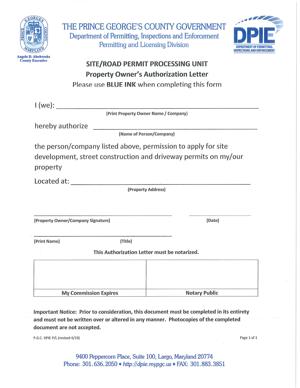
Site/Road Permit Processing Unit – Property Owner’s Authorization Letter
Fill out nowJurisdiction: Country: United States | Province or State: Maryland
What is a Site/Road Permit Processing Unit – Property Owner’s Authorization Letter?
This letter gives formal permission from a property owner to another person or company. It authorizes them to act for the owner on site and road permit matters. It is a short, signed document that confirms owner consent. It identifies the property, the scope of work, and the person or firm you authorize. It allows the permitting office to accept applications and issue permits without the owner being present.
Site and road permits cover work on or near the public right-of-way. They also cover site improvements tied to development. Typical examples include driveways, aprons, sidewalks, curb and gutter, utility trenching, storm drain tie-ins, grading, and traffic control. These activities affect public access and safety. The permitting office must confirm that the owner supports the work. The letter creates a clear record of that consent.
Who typically uses this form?
Homeowners use it when a contractor or expeditor will handle permits. Developers and builders use it when engineers, surveyors, or consultants manage approvals. Commercial landlords use it when tenants improve storefront sidewalks or access points. Homeowners’ associations use it when repairing common-area sidewalks or curbs. Public-facing work often involves multiple parties. The letter confirms who can sign, submit, and accept permit conditions.
You need this form if you are not the titled owner, but you must apply for a permit. The permitting office will not accept many road or site permit applications without owner consent. If you are a tenant, contractor, or consultant, this letter is essential. If you are the owner but delegate tasks to others, this letter streamlines the process. It prevents delays and clarifies authority.
Typical usage scenarios include a driveway apron replacement that crosses the sidewalk. A contractor plans to close a lane to install a new utility line. A developer needs a haul route permit during construction. A restaurant tenant wants to repair a sidewalk planter and add pavers. An HOA plans to replace broken curbs in the subdivision. In each case, the work touches or affects the right-of-way. The permitting office needs the owner’s authorization to process the permit.
The letter is straightforward. It lists the property, the authorized agent, the scope, and the time period. It states that you, the owner, want the agent to act on your behalf for permits. It should include your signature and date. It often includes a notary acknowledgment. The permitting office places the letter in the permit file. Staff may refer to it during reviews, inspections, and issuance.
When Would You Use a Site/Road Permit Processing Unit – Property Owner’s Authorization Letter?
Use this letter whenever someone other than the owner applies for or manages a site or road permit. If a contractor will pull a road cut permit, the letter is needed. If an engineer submits a site plan for review, a letter is needed. If a tenant plans to modify access points, the letter is needed. The permitting office must see that the true owner supports the activity.
Homeowners use the letter when they hire a contractor to fix a driveway apron. The work often crosses the sidewalk or curb. That triggers a right-of-way permit. The contractor will coordinate with the utility companies and traffic control. You want them to handle submittals, fees, and inspections. The letter gives them that authority.
Landlords use the letter when a tenant updates site elements. Storefront improvements can affect sidewalks, ramps, and curbs. If a tenant plans to add a new entrance or replace a curb ramp, they cannot act alone. The landlord signs the authorization, which allows the tenant or their contractor to submit. This protects the owner and keeps the record clear.
Developers use the letter to authorize their civil engineer. The engineer may submit grading, storm drain, and traffic control plans. Those reviews require many cycles and revisions. The letter lets the engineer sign, respond to comments, and accept permit conditions. The engineer can also pick up permits and schedule pre-construction meetings.
Homeowners’ associations use the letter for common-area repairs. The HOA board represents common property. The board authorizes a paving contractor to replace curbs and sidewalks. The letter identifies the subdivision and common parcels. It confirms that the board officer signing has authority.
Lenders, receivers, or property managers may need to use the letter. If they hold legal authority to manage a property, they can sign as the owner’s agent. They must prove their authority with supporting documents. The permitting office will rely on the letter and attachments to verify control.
You also use this letter when a contractor changes. If you switch contractors midstream, the office needs a new authorization. The prior letter should be revoked in writing. The new letter should state the same property and scope. It should name the new firm and update the dates.
In short, use the letter when there is a separation between property ownership and permit management. It keeps the process clean. It reduces questions about who can make binding decisions.
Legal Characteristics of the Site/Road Permit Processing Unit – Property Owner’s Authorization Letter
This letter is a legally significant appointment of an agent. It creates limited authority for permitting tasks. It is not a general power of attorney. It is a targeted authorization tied to a property and scope. It lets the agent sign applications, accept conditions, and receive permits. It supports the permitting office’s duty to verify owner consent.
The letter is binding because the owner signs it with the intent to authorize. It identifies the parties and the property. It states the scope of the authorization. It often includes a notary acknowledgment, which helps confirm identity and intent. The permitting office then relies on it in processing the application. That reliance gives the letter legal weight in the permit record.
Enforceability rests on clarity and proper execution. The owner of record must sign. If the owner is an entity, an authorized officer must sign. The letter should match the deeded owner’s name. The property must be identified by street address and parcel details. The scope should be specific. The time period should be clear. The letter should include contact information. Notarization is recommended. These elements help prevent fraud and confusion.
The letter does not transfer ownership. It does not grant access rights beyond permitting tasks. It does not waive permit requirements. It does not change liability for code compliance. The owner remains responsible for compliance on their property. The contractor remains responsible for their work and safety. The permitting office enforces the code regardless of who signed the application.
The letter can be revoked. You can revoke the authorization at any time in writing. Send the revocation to the permitting office and the agent. The office will place the revocation in the file. They may hold or cancel permits if the authority is unclear. Revocation does not erase prior actions taken under valid authority. It does stop further actions by the former agent.
If the letter is defective, the office may reject the application. Defects include missing signatures, wrong owner names, vague scopes, or expired dates. If someone forged a signature, the office may void the permit. The office may also refer the matter to enforcement. Clear documents protect you from these risks.
Electronic signatures may be accepted if agency rules allow. Some offices still require ink originals for owner authorization. Check submission rules before you sign. If ink originals are required, plan for mailing time. A notary seal can save time by avoiding rejections based on identity concerns.
Finally, the letter becomes a public record in many cases. Do not include confidential data not needed for permitting. Provide only what is necessary to confirm authority and scope. Keep sensitive contract terms in separate agreements, not in the authorization letter.
How to Fill Out a Site/Road Permit Processing Unit – Property Owner’s Authorization Letter
Follow these steps to complete the letter correctly the first time.
1) Confirm the property owner of record.
- Pull the most recent deed or tax bill. Match the legal name exactly.
- If there are multiple owners, list all owners. All must sign.
- If an entity owns the property, use the full legal name.
2) Identify the property precisely.
- Provide the street address.
- Add the tax account or parcel number, if available.
- Include lot, block, and subdivision, if applicable.
- Add a brief legal description if the address is new or unclear.
3) Name the authorized agent.
- Provide the company’s legal name, if a company.
- Provide the individual contact name and title.
- List a phone number and email.
- Add the firm’s role: contractor, engineer, expeditor, or tenant.
4) State the scope of authorization.
- Describe the specific work that needs a site or road permit.
- Examples: driveway apron replacement, sidewalk repair, curb cut, utility trench, storm drain tie-in, grading, traffic control, lane closure, haul route.
- Keep the scope clear and tied to the property.
5) Specify the permit types expected.
- List site development, right-of-way, grading, traffic control, or related permits.
- If unknown, write “site/road permits required for scope described.”
6) Define the time window for authority.
- Set a start date and an end date.
- Use a realistic window that covers review and issuance.
- Example: “Valid for 12 months from the date of signature.”
7) Grant specific actions the agent may take.
- Authorize signing and submitting applications.
- Authorize paying permit and review fees.
- Authorize responding to comments and revising plans.
- Authorize accepting permit conditions and picking up permits.
- Authorize requesting inspections related to the scope.
8) Set limits, if any.
- You may restrict authority to certain permits or plans.
- You may bar the agent from changing the scope without new consent.
- You may state that no work may start without written notice to you.
9) Add acknowledgment of owner responsibility.
- State that you understand permits do not waive code obligations.
- State that you remain responsible for compliance on your property.
10) Include project identifiers.
- If you have an application or tracking number, add it.
- Include the project name used by your team.
11) Address insurance and bonding expectations.
- You may require the agent to maintain insurance and bonds.
- Note that the agent must meet all licensing and bonding rules.
- Keep detailed terms in a separate contract, not in this letter.
12) Prepare attachments (schedules).
- Schedule A: Property information (address, parcel, legal description).
- Schedule B: Scope of work summary and permit types.
- Schedule C: Sketch or site plan showing work area, if available.
- Schedule D: Proof of ownership (recent deed page or tax bill).
- Schedule E: Agent’s contact details and license numbers, if required.
- Schedule F: Corporate authority documents, if an entity owns the property.
13) Handle entity signatures correctly.
- If the owner is a corporation, an officer should sign and state their title.
- If the owner is an LLC, a manager or authorized member should sign.
- If a trust owns the property, a trustee should sign and note their capacity.
- Attach a resolution or operating agreement excerpt if needed.
14) Handle HOA or condo ownership.
- An officer should sign on behalf of the association.
- Attach a board resolution authorizing the work and the signer.
15) Handle multiple owners.
- Include signature blocks for each owner.
- Each owner prints their name and title, if any.
- Each owner dates their signature.
16) Include notary acknowledgment.
- Many permitting offices prefer or require notarization.
- Use a notary block that matches the signature count.
- The notary should verify identity and date.
17) Use original signatures if required.
- Some offices accept scans; others require ink originals.
- If originals are required, mail or deliver the signed letter.
- Keep a copy for your records.
18) Review for consistency.
- Check that the owner’s name matches the deed.
- Confirm the address and parcel number.
- Confirm the agent’s name and contact details.
- Ensure the scope is clear and specific.
19) Submit with your permit application.
- Upload or attach the letter and schedules to the application.
- Label files clearly: “Owner Authorization Letter” and “Schedules.”
- If you already filed, submit the letter as an addendum.
20) Update the letter if the agent changes.
- Revoke the prior letter in writing.
- Issue a new letter naming the new agent.
- Notify the permitting office to update the file.
21) Avoid common mistakes.
- Do not use nicknames or trade names for ownership.
- Do not leave out the parcel or address.
- Do not use vague scopes like “all work.”
- Do not omit dates or signatures.
- Do not skip notarization if it is required.
22) Keep your contract separate.
- The authorization letter is for the permitting office.
- Place payment terms, indemnity, and warranties in your contract.
- Do not add confidential terms to the permit record.
23) Keep a record.
- Save a signed copy and the notary page.
- Save proof of delivery or upload confirmation.
- Track the authorization expiration date.
24) Coordinate with your team.
- Share the letter with your contractor or consultant.
- Make sure they submit it with their applications.
- Confirm that all permit forms match the letter details.
A clean, detailed authorization letter speeds review. It prevents staff from placing your application on hold. It protects you by defining the agent’s authority. It protects the permitting office by confirming consent. It protects the agent by confirming they can sign and accept conditions.
If your project evolves, update the letter. If your ownership changes, issue a new letter. If you pause the project, consider shortening the authorization period. The permitting office needs the current authority in the file.
Treat the letter as part of your project controls. Draft it early. Align it with your contract. Use attachments to keep the letter short and clear. Sign with care, and notarize when possible. This preparation will save time and avoid rejections.
Legal Terms You Might Encounter
- Property owner of record means the person or entity listed in land records as the current owner. Your name must match the deed or recorded instrument. If your ownership changed recently, attach proof, such as a recorded deed or settlement statement, so the letter reflects the true owner.
- Authorized agent is the person or company you empower to act for you on a permit. In this letter, you name that agent and define what they can do. The permit office relies on this grant to accept applications, make revisions, and receive decisions from your agent.
- Permittee is the party responsible for the permit after it is issued. Sometimes the permittee is the contractor; sometimes it is you. The letter should make clear whether your agent will be the permittee or only a submitter on your behalf.
- Right-of-way refers to public land set aside for roads or utilities. Many site or road activities occur within or connect to a right-of-way. Your authorization confirms that you, as the private owner, consent to work that ties your property to the public system.
- Easement is a legal right for others to use a portion of your property for a limited purpose, like drainage or access. If the work falls within an easement area, your letter should acknowledge that use and any restrictions recorded against the easement.
- Scope of work describes the activities your agent may pursue under your authority. Keep it specific. Name the type of permit, the location, and the tasks. This helps reviewers confirm that your consent covers the proposed improvements.
- Indemnification, sometimes called hold harmless, is an agreement to protect the county from claims arising from your project. Your letter may acknowledge this duty, or the permit may impose it. Understand that authorization does not remove your responsibility for damages caused by your project.
- Affidavit is a sworn statement. Some authorization letters include affidavit language or require notarization. When you sign an affidavit, you declare under oath that the information is true. False statements can lead to penalties and permit denial.
- Notarization is a formal acknowledgment of your signature by a notary public. Some offices require notarization to reduce fraud. If notarization is required, sign in front of the notary and include all notary details, such as seal and commission expiration.
- Revocation means you cancel the agent’s authority. Your letter should state how you may revoke it and when the revocation takes effect. You can usually revoke by a written notice filed the same way you filed the original letter.
- Expiration is the date your authorization ends. You can set a date or tie it to the end of a project. If you do not specify, the office may apply a default period. Keep track, because expired authorization can halt permit review.
- Entity authority is proof that a person can sign for a company, trust, or association. If you sign as a manager, trustee, or officer, be ready to provide documents that show your title and signing power. Without these, the office may reject the letter.
- Parcel identifier is a unique number tied to your property, such as a tax account, parcel number, or block and lot. Include the full identifier to avoid confusion with nearby parcels. This links the authorization to the exact site.
FAQs
Do you need to notarize the Property Owner’s Authorization Letter?
Requirements vary by permit type and risk. Some offices accept a standard signature, while others require notarization. To avoid delay, confirm the requirement for your permit category. If notarization is needed, sign in front of a notary, and attach the complete seal and acknowledgment.
Can you authorize a contractor to submit and sign for you?
Yes, if you name the contractor or firm as your authorized agent in the letter. Define what the contractor can do, such as submit applications, sign related forms, receive notices, and pick up permits. If you only want them to submit, say so. Limit the authority by project, location, and duration.
What if there are multiple property owners?
All titled owners usually must authorize the agent. If the deed lists two or more owners, get each owner’s signature. If owners hold title through an entity, a qualified officer or manager may sign for the entity. If an owner cannot sign, attach a power of attorney or court order that shows who can sign on their behalf.
How long is the authorization valid?
You set the term in the letter, or the office applies a default period. Common practice is to tie validity to the permit lifecycle or to a specific end date. If the permit process runs long, you may need to renew or file a new letter. Track the date to avoid lapses that stall review.
Can one authorization cover multiple permits on the same property?
Yes, if your letter clearly lists the permit types and project scope. You can authorize “site development, driveway, and utility connection permits” for one address. If future work is not yet defined, avoid blanket language. Instead, file a new letter when the new scope is ready.
What if the property is owned by an LLC, corporation, or trust?
An officer, manager, or trustee with signing power must sign. Include the signatory’s title and attach supporting proof, such as articles, operating agreement excerpts, or a trustee certificate. If the signer’s authority is not clear, the office may request more documentation before accepting the letter.
Do you need to attach proof of ownership?
It is often helpful and sometimes required. If land records reflect recent changes, attach the recorded deed or settlement statement. For inherited or trust property, attach the trust certificate or related court documents. This speeds verification, especially when the owner’s name differs from the application.
Can you revoke the authorization after filing?
Yes. File a written revocation, signed by the owner of record or authorized officer. State the date of revocation and identify the permits or applications affected. Notify your agent and any contractors at once. If a permit is already issued, you may also need to transfer or close it.
What if the project occurs in a public right-of-way?
Your authorization letter covers work on your private parcel and connections. Separate approvals may still apply for activity within the right-of-way. Make sure your agent understands both tracks. Your letter should not imply you control public land; it should only consent to your project and its tie-ins.
Can you email a scanned copy, or must you file an original?
Many offices accept clear, legible scans. Some require originals for notarized letters. When in doubt, keep the ink-signed original and submit a high-quality scan. Be prepared to supply the original if requested during review or before permit issuance.
Checklist: Before, During, and After the Property Owner’s Authorization Letter
Before signing
- Confirm the exact property address and parcel identifier.
- Verify the current owner of record matches your name and capacity.
- Identify the agent’s full legal name and contact details.
- Define the precise scope of work and permit types covered.
- Decide on the authorization duration and expiration date.
- Confirm whether notarization is required for your permit type.
- Gather proof of ownership, such as a recorded deed or settlement sheet.
- If an entity owns the property, gather proof of signing authority.
- If a power of attorney is used, obtain a signed, valid copy.
- Note any easements or right-of-way tie-ins relevant to the work.
- Collect any active or pending permit numbers to reference.
- Align expectations with your contractor about responsibilities and limits.
During signing
- Use the official form or required format without altering required text.
- Enter the owner’s legal name exactly as it appears in land records.
- Include the agent’s complete legal name, not a nickname or trade name.
- Describe the scope clearly, including location and key activities.
- Add the expiration date or event that ends the authorization.
- For entities, include title, capacity, and entity name after the signature.
- If multiple owners exist, obtain all required signatures.
- Date every signature and initial any corrections.
- If notarization is required, sign in front of the notary and include the seal.
- Attach all supporting documents before you submit.
After signing
- Submit the letter with your permit application, or file it as required.
- Keep a digital copy with clear scans of all pages and attachments.
- Retain the ink-signed original in a safe place.
- Share copies with your agent, contractor, and project manager.
- Update your project file with the date and expiration of authorization.
- Track permit status and respond to reviewer questions through your agent.
- If ownership changes, file a new authorization or revoke the old one.
- If the scope changes materially, issue an updated letter.
- Diary a reminder 30 days before expiration to renew if needed.
- After permit issuance, keep the letter with inspection documents on site.
Common Mistakes to Avoid
- Don’t forget to name the agent precisely. Using a trade name or a first name only can cause rejection. The office needs a clear legal name to match the permit records.
- Don’t mismatch the owner’s name with land records. If your signature block differs from the deed, the office may place your application on hold. Align your legal name and capacity, and attach proof of ownership if needed.
- Don’t leave the scope of work vague. Broad or unclear language can trigger a request for clarification. This delays the review. State the permit types, site address, and core activities.
- Don’t skip required signatures. If multiple owners hold title, each must sign. Missing signatures lead to immediate rejection and resubmittal.
- Don’t overlook expiration or revocation terms. Open-ended letters can expose you to unauthorized actions. Set a sensible end date and know how to revoke authority.
- Don’t assume scanned copies are always enough. Some offices require originals for notarized letters. If you submit a scan, keep the original ready to avoid last-minute delays.
What to Do After Filling Out the Form
- File the authorization with your permit submission. If you already filed the permit, upload or deliver the signed letter to your reviewer. Reference the application or permit number so staff can link it to the correct file.
- Confirm receipt. Ask your agent to verify that the letter is in the record and accepted. If staff request corrections, revise promptly. Keep the revision history in your project file.
- Monitor review milestones. Your agent should manage communications, respond to comments, and schedule any follow-up submissions. Ensure responses stay within your authorized scope. If the scope must expand, issue a new letter or an addendum.
- Coordinate with inspections. Keep a copy of the authorization in the project binder. Inspectors may verify that the agent or permittee matches the permit. If the permit lists a different party than your letter, resolve the inconsistency before inspections begin.
- Amend when needed. Use an updated letter to change agent details, modify scope, extend the expiration date, or add permit types. Mark the document as “Amended Authorization,” include the date, and restate all current terms. Do not rely on email threads as a substitute.
- Revoke when authority should end. File a written revocation that identifies the property, the agent, and the affected permits. State an effective date. Notify your agent, contractor, and any subconsultants the same day. If a permit remains active, coordinate a transfer or closure to avoid work stoppage.
- Update records after ownership changes. If you sell, merge, or transfer the property, your prior authorization does not carry forward. The new owner must issue a fresh letter. Close or transfer any active permits to prevent violations tied to the wrong owner.
- Maintain records. Keep both digital and paper copies of the signed authorization, amendments, proof of ownership, and any revocations. Retain these records for the full permit lifecycle and a reasonable period after final inspection.
- Close out at project completion. When permits pass final inspection, note the date and archive the file. If your authorization remains open-ended, consider issuing a revocation to prevent unintended use.
Disclaimer: This guide is provided for informational purposes only and is not intended as legal advice. You should consult a legal professional.