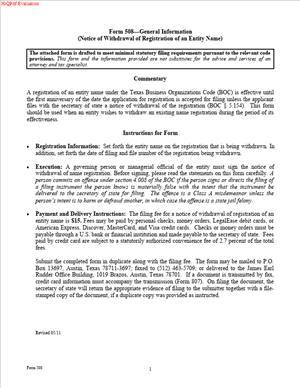
Form 508 – Notice of Withdrawal of Entity Name Registration
Fill out nowJurisdiction: Country: United States | Province or State: Texas
What is a Form 508 – Notice of Withdrawal of Entity Name Registration?
Form 508 is the filing you use to cancel a name registration on file in Texas. A name registration is a one-year protection that a foreign filing entity can place on its legal name. It prevents other entities from filing under a confusingly similar name in Texas during that period. You may have registered your name before opening operations in Texas. You might have used it to hold the name while you evaluated an entry, negotiated a deal, or prepared other filings.
The Notice of Withdrawal ends that protection. It removes the record of your name registration from the state’s database. After withdrawal, your name is no longer protected by that name registration. The state may then accept new filings that use or resemble the withdrawn name, subject to standard name rules.
Who typically uses this form?
Foreign filing entities that previously registered their legal name in Texas. That includes corporations, LLCs, limited partnerships, and similar entities formed outside Texas. In-house counsel, paralegals, outside corporate attorneys, and registered agents often prepare and file it. Senior managers or authorized officers usually sign it.
Why would you need this form?
You file it when you no longer need to hold the name through a name registration. Common reasons include: you are now qualifying to transact business as a foreign entity; you changed your legal name in your home jurisdiction; you merged into another entity; you decided not to enter Texas; or you plan to use a different name via an assumed name filing. Withdrawal clears the record and avoids future renewals.
Typical usage scenarios
A Delaware LLC registered its name in Texas to protect branding during a planned rollout. After several months, the company either qualifies to do business in Texas or postpones the plan. In both cases, the name registration is no longer needed. The company files Form 508 to withdraw. Another example is a foreign corporation that rebrands and has a new legal name. Its prior Texas name registration covers the old name. The corporation files a withdrawal to release that old name. A third example is a holding company that used a name registration to block a name during negotiations. The deal falls through. The company withdraws and stops further obligations tied to that record.
Form 508 is not for domestic Texas entities that never registered their name as a foreign name registration. It is also not the form to abandon an assumed name. Those are different filings. Form 508 addresses only the withdrawal of an entity name registration by a foreign filing entity.
When Would You Use a Form 508 – Notice of Withdrawal of Entity Name Registration?
You use Form 508 when a prior name registration is on file, and you want to cancel it. If you are a business owner or counsel, timing matters. Many filers withdraw right before or at the same time they take another step that makes the registration unnecessary.
One practical example is a foreign LLC that is ready to start business in Texas. It files an application to register as a foreign entity. Once that filing is in place, the name registration provides no added protection. The LLC files Form 508 to avoid redundant records and reduce confusion.
Another example is a foreign corporation that has changed its legal name. Its Texas name registration reflects the old name. The company no longer wishes to hold the old name because the brand has changed. It files a withdrawal so the registry aligns with the new identity plan. If the company wants protection for the new name before it qualifies, it may file a new name registration for that new name. The withdrawal clears the path for that change.
Consider also a private equity buyer that acquires a target with a registered name in Texas. The buyer plans to consolidate names or realign entities. It withdraws the legacy name registration as part of the post-closing clean-up. This prevents overlap and keeps the Texas records consistent with the new structure.
You may also withdraw if you decide not to expand into Texas. An in-house legal team might have registered the name a year ago during strategy planning. The plan changes. There is no reason to renew or let the registration sit. Filing Form 508 ends the record promptly.
Registered agents use this form too. They might file a withdrawal at the direction of the client. This often happens when the client merges with another company. The surviving company might have a different name registration on file. The agent withdraws the now unnecessary record upon direction.
Finally, you may use this form to coordinate names across related entities. Suppose your parent entity holds a name registration that your Texas subsidiary now needs. You may withdraw the parent’s registration so the subsidiary can seek its own protection under the rules. The withdrawal frees the name, subject to the state’s availability standards.
Legal Characteristics of the Form 508 – Notice of Withdrawal of Entity Name Registration
Form 508 is a statutory filing that has legal effect upon acceptance and effectiveness. It is not a contract. It is a notice to the state that you intend to cancel a prior name registration. Once filed, the state updates its records and removes the registration. Your exclusive protection under that registration ends at that time.
The filing is legally binding because the law authorizes both the initial registration and the subsequent withdrawal. The form captures key facts to ensure the correct record is canceled. These include the exact entity name, the entity’s jurisdiction, and the state file number. You certify that you are authorized to act for the entity. The filing office relies on that certification.
Enforceability rests on proper execution and accurate identification. The signature must be from an authorized person. That can be an officer of a corporation, a manager or member of an LLC, a general partner of a limited partnership, or an authorized agent. False statements can carry civil or criminal consequences. The form’s language makes that clear. No notarization is required. The filing office looks for a clear signature, printed name, and title.
The effective date also affects the legal effect. You can choose immediate effectiveness when filed. You can also select a delayed effective date within the allowed window. Use a delayed date to align the withdrawal with related filings. For example, you might delay the withdrawal until the day your foreign registration is approved. That avoids any gap in your name protection during a critical transition.
Withdrawal does not dissolve an entity or cancel authority to do business. It only ends the name registration. It does not affect assumed names, trademarks, service marks, or other rights. It also does not waive any claim you may have under unfair competition law. It simply removes the specific statutory name registration in Texas.
Once the withdrawal takes effect, others may seek to use or protect the name. The state applies its standard name-availability rules. There is no grace period. If you later want protection again, you must file a new qualifying filing. You cannot revive the old registration by request. You must submit a new application that meets current requirements.
The filing office may reject a Form 508 for defects. Common grounds include a missing file number, a wrong entity name, a lack of signature capacity, or an unpaid fee. The office can also reject if the form attempts to do more than withdraw. Keep the filing narrowly focused. Do not bundle unrelated changes in the same document.
How to Fill Out a Form 508 – Notice of Withdrawal of Entity Name Registration
Follow these steps to complete and file Form 508 accurately. Prepare the data first. Then fill out each section with care. Finally, file it using an accepted method and keep proof.
1) Confirm you have an existing name registration.
- Check your records for the Texas file number tied to the name registration.
- Make sure the registration is still active. You can withdraw an active record. If it expired, there is nothing to withdraw.
2) Gather core information.
- Exact legal name of the entity as it appears on the name registration.
- Entity type (corporation, LLC, LP, LLP, etc.).
- Jurisdiction of formation (state or country).
- Texas file number for the name registration. This is essential for matching the correct record.
- Desired effective date. Decide if you want immediate or delayed effectiveness.
3) Obtain the official form.
- Use the state-issued Form 508. Do not substitute a letter.
- Prepare a cover page or letter with a contact person. Include name, phone, and email. This helps resolve any issues.
4) Complete the entity identification section.
- Enter the exact entity name. Match spacing, punctuation, and capitalization.
- Select or state the entity type. Use the type shown on the registration.
- State the entity’s jurisdiction of formation. Use the full state or country name.
5) Provide the Texas file number.
- Enter the file number assigned to the name registration.
- Do not use a number from a different filing. If you also have a foreign registration in Texas, that number is not the same. Use the number from the name registration record.
6) State the withdrawal.
- The form includes a clear statement that the entity withdraws its name registration.
- If the form offers a checkbox or pre-printed statement, confirm it applies to your filing. Do not alter the standard language.
7) Choose the effectiveness of filing.
- Option A: When filed by the state. This is the default and is the fastest.
- Option B: Delayed effective date. Choose a date within the allowed window from the date of filing. Use this to coordinate with other filings, such as a foreign registration approval.
- Option C: Delayed until a future event. If the form allows this, state the event clearly. The event must occur within the allowed window. If uncertain, use a specific delayed date instead.
8) Execution by an authorized person.
- Sign the form. Use blue or black ink if filing by paper.
- Print or type the signer’s name and title. The title should reflect authority. Examples: President, CEO, Manager, Managing Member, General Partner, or Authorized Agent.
- Date the signature.
- Notarization is not required. Do not add a notary block unless instructed.
9) Include any necessary attachments.
- If the signer’s authority is not obvious, attach a brief statement or resolution. This is optional but can prevent rejection.
- If the entity recently changed its name in its home jurisdiction, no proof is required to withdraw. The withdrawal concerns the Texas record only.
10) Provide a return contact and delivery details.
- List a contact person for questions. Include email and phone.
- Provide a return address for the file-stamped copy. Choose mail or electronic return if available.
11) Calculate and include the filing fee.
- A state filing fee applies. Prepare payment in an accepted form.
- If you want expedited processing, include the additional expedite fee and a clear expedite request on your cover page.
- If submitting by mail, include a check or money order payable as instructed on the form. If submitting by fax or online, follow the stated payment method.
12) File the form.
- You can submit by mail, online, fax, or in person, as permitted.
- For mail: send the signed form, payment, and cover page to the filing office’s address shown on the form.
- For fax: include the required payment forms.
- For online: follow the instructions on the state’s electronic filing system.
- For in-person: bring payment in an accepted form and request a file-stamped copy.
13) Track processing and get confirmation.
- Keep your submission proof and payment receipt.
- Look for a file-stamped copy or confirmation notice.
- If you do not receive confirmation within the typical timeframe, contact the filing office with your entity name and file number.
14) Update internal records and calendars.
- Record the effective date of withdrawal.
- Notify your branding, marketing, and compliance teams. Make sure everyone knows the name is no longer protected by the registration.
- If you need continued protection by another path, file the appropriate new application. Coordinate timing to avoid unwanted gaps.
15) Coordinate with related filings.
- If you are qualifying as a foreign entity, align the withdrawal with the approval date of your foreign registration. Use delayed effectiveness if needed.
- If you plan to reserve the name or adopt an assumed name, plan the sequence. Avoid a window where neither protection applies.
- If you are freeing the name for a related entity, confirm that entity’s filing is ready. A short gap may invite conflicts.
Practical tips for accuracy
Match the name exactly. A mismatch can trigger rejection or misapplied withdrawals.
- Use the correct file number. This is the most common mistake. Double-check it against the name registration record.
- Sign with the correct title. If your title changed, use your current title and note the capacity that grants authority.
- Keep copies. File-stamped copies help resolve future questions about timing and effectiveness.
- Avoid drafting edits. Do not change the form’s standard statements. The filing office expects standard language.
Situations where you should not use Form 508
- You want to abandon or change an assumed name filing. Use the proper assumed name document instead.
- You want to cancel a foreign entity’s registration to do business in Texas. Use the correct termination or withdrawal filing for that purpose.
- You want to change your legal name on a current foreign registration. Use the appropriate amendment filing.
- You never had a name registration on file. There is nothing to withdraw.
Consequences to consider
- After withdrawal, the name may become available to others. If you still need protection, do not withdraw until you have a replacement filing in place.
- The state does not hold the name for you after effectiveness. There is no automatic holdover.
- If you change your mind after filing, you cannot undo a processed withdrawal. You must file a new application if you want protection again.
Real-world example
You are counsel for a Delaware corporation that registered its name in Texas last year. You now plan to register to do business in Texas under that same legal name. You prepare Form 508 with immediate effectiveness. You submit it the day your foreign registration is approved. You attached a cover page requesting expedited service for both filings. The name stays protected during the transition. Once your foreign registration is effective, the name registration becomes unnecessary and is withdrawn as planned. Your internal records show no gap and no extra renewals.
Another example
You represent a foreign LLC that rebranded and changed its legal name in its home state. The Texas name registration still reflects the old name. You file Form 508 to withdraw the old record with a delayed date set for two weeks. That timing matches the launch of new brand assets. In the same period, you handle any separate filings needed for the new name. The old name protection ends on the planned date, and there is no conflict with the new branding plan.
Use Form 508 when you are ready to remove the prior name registration. Complete each section cleanly. Sign with proper authority. File with the fee. Keep the confirmation. This minimizes risk and keeps your Texas records accurate.
Legal Terms You Might Encounter
- Entity name registration is the temporary protection of your exact legal name in Texas for a set period. You used it to block others from taking that name while you evaluated next steps. This form lets you withdraw that protection before it expires.
- Foreign filing entity means your company was formed outside Texas. You registered your name in Texas without registering to transact business. You use this form when you no longer need that Texas name hold.
- Withdrawal means you are voluntarily ending your entity name registration. After withdrawal, Texas treats the name as available. You should only file this when you are ready to release the name.
- Registrant refers to the entity that registered the name. You, as the registrant, authorize the withdrawal. Make sure the name and formation details match your original registration.
- Jurisdiction of formation is where your entity was legally formed. List the state or country that issued your formation certificate. Use the same jurisdiction you used in the original name registration.
- Secretary of State file number is the number you received when you registered the name. It ties your withdrawal to the right record. You can find it on your registration acknowledgment.
- Execution means you sign the form with authority. The signer must be an authorized officer, manager, partner, or agent, depending on your entity type. The signature certifies that the information is correct.
- Effective date is when the withdrawal takes effect. If you do not choose an effective date, it becomes effective when filed. If you set a future date, plan your transition around that date.
- Assumed name (often called a “DBA”) is different from an entity name registration. An assumed name does not protect the exact legal name. If you used an assumed name anywhere, that filing does not end when you withdraw the entity name registration.
- Conversion to foreign registration is when you choose to register to transact business in Texas instead of holding only a name. If you decide to operate in Texas, you would file an application to register your entity to transact business rather than withdraw the name. The withdrawal ends only the name registration, not any separate authority to do business.
FAQs
Do you need to withdraw if your name registration is about to expire?
You can let the registration lapse, but your name becomes available at expiration. Withdraw if you want to release the name earlier, avoid confusion, or clear the record before a transaction or rebrand.
Do you need to withdraw if you will register to transact business in Texas?
If you register to transact business using the same legal name, you do not need to keep a name registration. Once you complete your registration to transact business, the name registration no longer serves a purpose. Many entities withdraw the name registration when they submit their foreign registration.
Do you need the Secretary of State file number to withdraw?
Yes. The file number links your withdrawal to the correct name registration. You should not guess. Check your prior acknowledgment or internal records to confirm the number.
Do you have to notarize the withdrawal?
No. The form requires a valid signature by an authorized person, but it does not require notarization. Sign clearly and include the signer’s title.
Can you set a future effective date?
Yes. You can select an effective date, including a specific date after filing. Use this if you need time to update branding, contracts, or internal systems before the name becomes available.
Can you withdraw if you changed your legal name in your home jurisdiction?
Yes. You can still withdraw. Use the Texas-registered name on the form so the record matches the existing registration. You can note your current legal name in your cover materials if needed.
Can you reverse a withdrawal if you change your mind?
No. Once the withdrawal is effective, the Texas name protection ends. If you still need the name, you would file a new name registration, subject to availability at that time.
Do you have to notify anyone after you withdraw?
You should notify internal teams and any third parties who rely on your Texas name status. This can include marketing, sales, procurement, lenders, and counter-parties. Update any materials that referenced the Texas name registration.
Checklist: Before, During, and After the Form 508 – Notice of Withdrawal of Entity Name Registration
Before signing
- Confirm your exact registered entity name as it appears on the Texas record.
- Locate the Secretary of State file number for the name registration.
- Verify your entity’s jurisdiction of formation and organizational type.
- Decide on your effective date strategy: immediate or a specific future date.
- Identify the correct signatory with authority for your entity type.
- Confirm whether you want to hold any assumed names separate from this withdrawal.
- Notify leadership and branding teams about the planned release date.
- Review any contracts that reference the Texas name registration.
- Align the withdrawal with any pending filings, mergers, or rebrands.
During signing
- Check the entity name spelling against the original registration.
- Confirm the file number matches your name registration record.
- Verify that the jurisdiction of formation and entity type are correct.
- If selecting a future effective date, ensure the date is realistic and coordinated.
- Ensure the signer’s name, title, and authority are accurate.
- Review the execution block for any missing required fields.
- Keep your sentences clear and avoid extra statements that cause confusion.
- Sign in ink if filing on paper, or use the proper method if filing electronically.
After signing
- File the form with the Texas Secretary of State using your chosen method.
- If time-sensitive, choose a faster filing method that meets your needs.
- Track filing confirmation and note the effective date in your records.
- Tell your internal teams once the filing is accepted and the name is released.
- Update branding, purchase orders, proposals, and communications that referred to the registration.
- Notify relevant partners who rely on your Texas name status.
- Retire any materials that might suggest you still hold the Texas name.
- Store a copy of the signed form, your proof of submission, and the acceptance notice.
- Calendar any related follow-up tasks, such as re-registration or assumed name updates.
Common Mistakes to Avoid
- Listing the wrong name or file number. Don’t guess at your record. A mismatch can lead to rejection or delays. Use the exact name and the correct file number from your prior acknowledgment.
- Using the wrong effective date. Don’t pick a date that conflicts with live contracts or campaigns. If you release the name too soon, you may face branding confusion or lost opportunities.
- Having an unauthorized signer. Don’t have a person sign without proper authority. The filing can be rejected, or your company could face internal approval issues.
- Mixing up entity name registration and assumed names. Don’t assume this form cancels assumed name filings. Those are separate and may require their own filings to end.
- Withdrawing when you plan to register to transact business under the same name. Don’t release the name before securing your foreign registration. You risk someone else grabbing the name in the gap.
What to Do After Filling Out the Form
File the form promptly
- Submit the signed form to the Texas Secretary of State.
- Select the filing method that aligns with your timing needs.
- If you set a future effective date, file early to avoid tight lead times.
Confirm acceptance
- Watch for confirmation that the filing was accepted.
- Verify the effective date shown in the state’s acknowledgment.
- If anything is off, contact the filing office quickly to clarify.
Coordinate internal changes
- Notify marketing, sales, procurement, and legal teams of the release date.
- Update websites, proposals, and sales materials that referenced the registration.
- Adjust templates, signature blocks, and contract language as needed.
Manage related filings
- If you also hold an assumed name in Texas, review that filing separately.
- If you plan to operate in Texas, plan your registration to transact business.
- If your brand strategy changed, consider whether a new name registration is needed.
Plan for name availability
- Once withdrawn, the name is generally available for others to claim.
- If you need that name again, you would have to register it anew.
- Monitor name availability if you expect to re-enter the market later.
Preserve records
- Keep a copy of the signed form and your proof of submission.
- Keep any acceptance or acknowledgment from the state in your permanent files.
- Note the effective date and document any related approvals.
Address third-party dependencies
- Inform lenders, major customers, and partners if they relied on the Texas name status.
- Update certifications, bids, or proposals that referenced the registration.
- Communicate clearly that the name protection in Texas has ended.
Handle changes or corrections
- If you find an error before acceptance, act quickly to correct it.
- After acceptance, you cannot reverse a withdrawal. You would file a new name registration if needed.
- If a branding or transaction timeline shifts, adjust future filings accordingly.
Maintain a clean compliance timeline
- Align this withdrawal with any pending registrations or renewals.
- Avoid gaps where you intend to hold rights but have released the name.
- Use a checklist and calendar reminders to keep your filings on track.
Disclaimer: This guide is provided for informational purposes only and is not intended as legal advice. You should consult a legal professional.