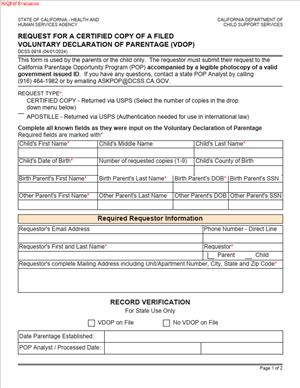
Request for a Certified Copy of a Filed Voluntary Declaration of Parentage (VDOP)
Fill out nowJurisdiction: Country: United States | Province or State: California
What is a Request for a Certified Copy of a Filed Voluntary Declaration of Parentage (VDOP)?
This request is a formal application you submit to get an official, certified copy of a Voluntary Declaration of Parentage (VDOP) that has already been filed. The VDOP is a legal document that two people sign to establish the legal parentage of a child without going to court. Once the VDOP is properly executed and filed with the state, it has the same force and effect as a court judgment of parentage. The certified copy is the version you use as proof in legal and administrative processes.
This form belongs to the California Department of Child Support Services. The department maintains the state’s filed VDOP records and issues certified copies to eligible requestors. The certified copy you receive will bear official certification that makes it suitable for court, agencies, and institutions that need verified records.
Who typically uses this request?
Usually, one of the parents who signed the VDOP, the adult child named in the VDOP, a local child support agency, or a legal representative with proper authorization. You can also use this request if you are a guardian or custodian with court documentation that gives you authority to act for the child or a parent. Courts and certain public agencies may also request certified copies as part of official duties.
Why would you need a certified copy?
Many important processes require you to prove legal parentage. If you need to add a parent to a birth certificate, enroll a child in health insurance, start or respond to a child support case, apply for a child’s passport, obtain Social Security benefits, or resolve a custody or visitation issue, you may be asked for a certified copy of the VDOP. A standard photocopy or a hospital worksheet is not enough. The certified copy confirms the document is genuine, current, and on file with the state.
Typical usage scenarios
- You signed a VDOP at the hospital and now need proof to update the birth record. Vital records staff will request a certified copy.
- You are opening or responding to a child support case. The agency will need a certified copy to confirm parentage.
- You are adding a child to health, dental, or vision plans through your employer. The plan administrator needs proof of parentage.
- You are applying for a U.S. passport for your child. The acceptance facility may require a certified VDOP if a parent’s name is not on the birth certificate or if there are questions about parentage.
- You are seeking custody, visitation, or child support orders in family court. Filing the certified VDOP can save time because parentage is already established.
- You are the child named in the VDOP and are now an adult. You need proof of parentage for financial aid, benefits, or personal records.
The request form is straightforward. You provide identifying details about the child and the parents, your relationship to the child, and your contact information. You also verify your identity and state the number of certified copies you need. When your submission meets eligibility and identity rules, the agency issues a certified copy by mail or as otherwise allowed on the form.
When Would You Use a Request for a Certified Copy of a Filed Voluntary Declaration of Parentage (VDOP)?
You use this request when you need an official, certified proof of a filed VDOP. You do not use it to create or sign a new VDOP. It only applies to declarations that have already been signed and filed with the state.
As a parent, you might use this request soon after childbirth. You signed the VDOP at the hospital and need to take the next step to update the birth certificate. The vital records office will require a certified copy of the filed declaration to add the other parent to the record.
As a parent or guardian, you also use this request when a school district or health plan needs proof of a legal relationship to enroll a child or authorize services. If your name is not printed on the birth certificate, or if the certificate was issued before the VDOP was processed, the certified VDOP can bridge that gap.
If you are working with a local child support agency, the caseworker may ask you to request and supply a certified copy. While agencies can often request copies directly, they may ask a parent to obtain them to speed things up or to support parallel processes like passport applications.
Attorneys and legal representatives use this request when they need court-ready proof of parentage. If you are an attorney for a parent or the child, you use the request with a letter of representation or a signed authorization. Guardians ad litem or conservators use it with their appointment orders.
Adult children named in the VDOP use this request to obtain their own records. If you are over 18, you can request your own certified copy to support benefits, immigration, inheritance, or name change proceedings.
You might also use this request after a move, name change, or loss of records. If your documents were lost, destroyed, or are outdated, request a new certified copy with current certification.
In short, you use this request when you need verifiable proof of parentage that will stand up in court or with agencies. If a regular copy or hospital worksheet will not suffice, the certified copy will.
Legal Characteristics of the Request for a Certified Copy of a Filed Voluntary Declaration of Parentage (VDOP)
The request itself is not a contract and does not create legal rights by itself. It is an administrative application that triggers the agency’s release of an official record. The legal weight comes from the certified copy you receive and from the underlying VDOP.
A properly executed and filed VDOP is legally binding. When both parents sign the declaration with a qualified witness or notary, and the state accepts it for filing, it has the same effect as a court judgment of parentage. That means it establishes legal rights and responsibilities for both parents, including custody, visitation, and support obligations. The declaration can be used in court, at vital records, and with public and private entities that require proof of parentage.
The certified copy’s enforceability rests on two features. First, the certification itself. The copy bears the agency’s seal or certification statement and an authorized signature. This shows it is a true and correct copy of the filed record. Second, the state’s statutory framework recognizes the declaration as equivalent to a parentage judgment once filed. Together, those features make the certified copy reliable evidence in court and in administrative settings.
There are important legal considerations. The VDOP can be rescinded within a short window after signing, unless a court has already issued an order about custody or support. After that window closes, a party may seek to set aside the declaration in court based on limited grounds such as fraud, duress, or material mistake of fact, often with genetic testing evidence and within defined time limits. If a declaration has been rescinded or set aside, it will not carry legal effect. If you suspect a rescission or set-aside, note this in your request and be ready to supply related court documents.
Access to certified copies is limited. The state protects these records due to their sensitivity. Generally, release is permitted to the parents who signed, the adult child, an authorized legal representative, a court, or a local child support agency. Others may need a court order. You must verify your identity. If you are requesting on behalf of someone else, you must show your authority to act, such as a power of attorney, letters of guardianship, or a signed authorization.
If there is an adoption, termination of parental rights, or a protective order that affects disclosure, release may be limited or require a court order. If the birth certificate has been amended under a court order or vital records process, the certified VDOP still shows the original declaration information as filed. It remains proof of the legal act at the time of filing unless set aside. Be aware that a certified VDOP does not, by itself, modify custody or support orders. It proves parentage. Courts still decide parenting plans and support amounts.
When you use a certified copy, ensure the certification is recent enough for your purpose. Some agencies prefer a certification dated within the last 60–90 days, even though older certified copies remain valid. If your recipient requires a recent certification, request a new copy rather than using an older one.
How to Fill Out a Request for a Certified Copy of a Filed Voluntary Declaration of Parentage (VDOP)
Follow these steps to complete the request accurately and avoid delays.
1) Confirm you are eligible to request a copy
- Make sure you are one of the authorized requestors: a parent who signed the VDOP, the adult child named in the VDOP, a local child support agency worker, a court clerk, or a legal representative with proof of authority. If you are a guardian, custodian, or attorney, gather your appointment orders, signed authorization, or retainer letter.
- If you are not an authorized person, you will likely need a court order permitting release. Do not submit the request without that order.
2) Gather key details about the VDOP
- Child’s full name at birth. Include first, middle, and last names as they appeared at birth.
- Child’s date of birth and place of birth. Include the city, county, and hospital or facility, if known.
- Names of both parents who signed the declaration. Use the names as they appeared at the time of signing. If a parent’s name has changed since signing, also note the current name.
- Approximate date the VDOP was signed and where it was signed. The hospital name or county is helpful. If you do not know the exact date, provide a date range.
- Any case numbers. If there is a child support case, include the case or participant number. If there is a court case involving parentage, include that case number.
These details help the agency locate the correct record quickly.
3) Complete the requestor information section
- Print your full legal name. If you have used other names, list those as “also known as” if the form provides space.
- State your relationship to the child. For example: “Mother (signatory),” “Father (signatory),” “Adult child,” “Attorney for [Name],” or “Guardian.”
- Provide current contact information: mailing address, phone number, and email. The certified copy is mailed to the address you provide, so ensure it is reliable and secure.
- If your mailing address differs from the address on your ID, be ready to explain the difference or include proof of address, if requested.
4) Identify the record you are requesting
- Enter the child’s full name, date of birth, city and county of birth, and hospital, if known.
- Enter the parent names as they appear on the VDOP. If you are unsure, use the names at the time of signing and note any known variations.
- Provide the approximate date of signing. If signed at the hospital, list the hospital and discharge date or birth date as a guide.
5) State the number of certified copies and the purpose
- Indicate how many certified copies you need. Order more than one if you will submit copies to multiple agencies. Most do not return documents.
- Briefly state your purpose: “Add parent to birth certificate,” “Child support case,” “Insurance enrollment,” “Passport,” or “Court filing.” This helps the agency verify your need and may guide any special instructions.
6) Address confidentiality and special circumstances
- If there is a protective order, adoption, or pending court action affecting disclosure, note it. Attach the relevant order. This allows the agency to review the request under the correct rules.
- If the VDOP was rescinded or a court set it aside, say so and include documentation. You may still need a certified copy for the record, but the agency must reflect the correct status.
7) Provide identity verification and authority documents
- Include a clear copy of a valid government-issued photo ID. A driver’s license, state ID, or passport is typical. Ensure the copy is legible and not expired.
- If you are an attorney, include a letter of representation signed by the client, your bar number, and your firm’s contact information.
- If you are a guardian, conservator, or custodian, include certified letters of appointment or the court order authorizing you to act.
- If you hold a power of attorney, attach the signed power of attorney document. It should expressly authorize you to obtain confidential records on behalf of the principal.
8) Review any fee and payment instructions
- Some requests may require a fee per certified copy. If a fee is required, use the payment methods accepted on the form. Do not send cash unless the form allows it. If a fee waiver applies through an agency case, note the case information as directed.
- If you are unsure about the fee, confirm the current amount before you submit. Submitting an incorrect fee can delay processing.
9) Choose a delivery method and processing options
- Enter the address where the agency should mail the certified copies. Use a physical mailing address that accepts secure mail. If the form offers alternative delivery options, select one and follow any extra steps.
- If you have a deadline or hearing date, note it. The agency may not guarantee expedited handling, but clear information helps.
10) Sign and date the request
- Read the declaration on the form. Many forms include a statement under penalty of perjury that the information is true and that you are authorized to receive the record.
- Sign with ink (or follow the electronic signature instructions if allowed). Date your signature. Unsigned requests will be returned.
11) Assemble and submit your packet
- Include the completed request form, a copy of your ID, any authorization documents, court orders, and payment (if required).
- Keep copies of everything you send. Note the mailing date and method. If the form allows email or fax submission, follow the instructions precisely and keep your transmission confirmation.
12) Track and receive your certified copy
- Processing times vary. Build in time for review and mailing.
- When your certified copy arrives, check it immediately. Confirm the names, dates, and certification are correct and legible. If there is an error, contact the agency promptly with your request details and a description of the issue.
Practical tips and examples
- If you signed the VDOP at the hospital the day your child was born, but do not remember the exact time, list the birth date and hospital name. That is usually enough to locate the record.
- If your last name changed after marriage, list your current name in the requestor section and your prior name in the parent name section as it appeared at signing.
- If you are the adult child and your ID shows a different last name due to a name change, include your name change order or explain the change in the space provided.
- If you need multiple certified copies for different agencies, order them together. It is faster than submitting repeated requests.
- If a court hearing is scheduled, note the hearing date on the form and attach the hearing notice. Organize your packet so reviewers see your deadline.
What you should not do
- Do not submit the request if you were not a signatory, are not the adult child, and do not have a court order or legal authority. It will be denied.
- Do not send original identity documents unless the form specifically requires originals. Send clear copies.
- Do not alter or write on a certified copy after you receive it. If information needs correction, work through the proper amendment process.
What this request does not do
- It does not create parentage. The VDOP itself does that when filed.
- It does not amend a birth certificate. You use the certified VDOP to request an amendment from vital records.
- It does not modify custody or support orders. Those require a court process.
By completing this request carefully, you can obtain a certified copy that meets court and agency standards. Use accurate names and dates, verify your authority, and include all required documents. This reduces back-and-forth and helps you move your matter forward without delays.
Legal Terms You Might Encounter
- Voluntary Declaration of Parentage (VDOP). This is a legal form where parents state who the legal parents are. You request a certified copy of a filed VDOP to prove parentage for benefits, records, or court matters.
- Certified Copy. A certified copy is a stamped, official reproduction of the filed VDOP. It proves the document is authentic and is often required over a plain photocopy.
- Filing Date. The filing date is when the VDOP was officially accepted into the record. You provide it on the request form if known to help locate the document faster.
- State File Number. This is the unique number assigned to the VDOP record. If you know it, include it on the request form. It speeds up the search.
- Signatory. A signatory is anyone who signed the original VDOP. If you were a signatory, note that on the request form. It helps confirm your right to receive a copy.
- Legal Parentage. Legal parentage means who the law recognizes as a parent. The VDOP establishes legal parentage without a court hearing, and the certified copy is proof.
- Authorized Representative. This is someone allowed to act for you, like an attorney or agent. If you are requesting someone else, you need proof of authorization with the form.
- Rescission. A rescission cancels a VDOP within a short, legally defined window. You cannot rescind using the request form; you only use the form to get a certified copy.
- Set Aside. A set-aside is a court process to challenge a VDOP after the rescission period. The request form does not change or undo a VDOP; it only provides a certified copy.
- Confidential Information. Some VDOP details are protected. The request form asks for enough information to locate the record while keeping private details secure.
FAQs
Do you qualify to request a certified copy if you are not a listed parent?
You may qualify if you are an adult child named on the VDOP or an authorized representative. If you are not a listed parent or the adult child, include a signed authorization or legal document that shows your authority. Without proper authorization, your request may be denied.
Do you need the exact filing date or state file number to submit the request?
No. These details help, but are not required. Provide as much identifying information as you can: child’s full name and date of birth, parents’ names at signing, and the city or county connected to the birth or signing. If you guess on dates, label them as “approximate.”
Do you need to notarize the request form?
Usually, no. Most requests do not require notarization. If you are an authorized representative, some situations may require a notarized authorization or a certified copy of your authority. Check your supporting documents, sign the request clearly, and include a legible copy of your identification.
How many certified copies should you order?
Order as many as you need for your immediate use. Many offices need an original certified copy and will not accept a scan. If you must send copies to multiple places, order extras now to avoid delays later.
How long will it take to receive your certified copy?
Processing times vary. Plan for several weeks from the date the office receives your request. Incomplete forms, missing fees, or unclear identity documents can slow processing. Provide a complete mailing address and check your mail regularly.
What if your name changed after the VDOP was signed?
That is common. On the request form, list the parents’ names exactly as they appeared at signing, if known. Then include your current legal name in the contact section. If you do not remember the exact spelling used at signing, share any variations that might have been used.
Can you correct an error on the VDOP using this request?
No. This form gets you a certified copy of the filed document. If you find an error on the VDOP, request the certified copy first. Then use the proper process to amend, rescind, or seek a set-aside, depending on your situation. The request form itself does not make changes.
Will obtaining a certified copy change child support, custody, or other orders?
No. Getting a certified copy does not create, change, or end any court orders or agency actions. It only provides official proof of the filed VDOP. Use the certified copy as evidence where needed.
Checklist: Before, During, and After the Request
Before signing: Information and documents you need
- Child’s full name at birth and date of birth.
- Parents’ full legal names as they appeared when signing the VDOP.
- Any prior or alternative names used by either parent.
- Approximate filing date and city or county connected to the birth or signing.
- State file number, if you have it.
- Proof of identity for the requester (government-issued photo ID).
- Proof of authority if you are not a listed parent or the adult child (authorization letter, legal appointment, or other documentation).
- Your mailing address where you want the certified copy sent.
- Payment method accepted for the request.
- Use your phone and email for questions about the request.
During signing: Sections to verify
- Requester’s name and relationship to the child match your ID or authority.
- Child’s name and date of birth are accurate and complete.
- Parents’ names at the time of signing are entered exactly as originally used.
- Reason for requesting a certified copy is clearly stated, if the form asks.
- The number of certified copies needed is correct.
- Mailing address is complete, including apartment, unit, or suite number.
- Contact information is current and legible.
- Any authorization or legal documents are attached and referenced on the form.
- Payment information is included, and the amount is correct.
- Signature and date appear in the correct spaces, in ink, and are readable.
After signing: Filing, notifying, storing
- Submit the request using the method allowed by the form (mail, in person, or other options provided on the form).
- If you mail the request, use a trackable service so you know when it arrives.
- Keep copies of the request, your ID, and all attachments for your records.
- Note your submission date and set a reminder to follow up if needed.
- When you receive the certified copy, check the seal, certification language, and details on the face of the document.
- Store certified copies in a secure place. Do not staple or punch holes through seals.
- Send certified copies only to offices that require originals. If scanning is needed, keep the original intact.
- If your request is returned or incomplete, fix the issues quickly and resubmit.
Common Mistakes to Avoid
- Don’t forget to match the names used at signing.
- Entering only current names can cause a “no record found” result. Include names as used when the VDOP was signed, plus any variations.
- Don’t omit proof of authority if you are not a listed parent or the adult child.
- Requests lacking authorization will be denied. Attach a signed authorization or legal appointment.
- Don’t submit unclear identification.
- Blurry ID images or mismatched names delay processing. Provide a clear, current ID that matches the requester’s information.
- Don’t guess on details without saying they are approximate.
- Approximate dates or places are fine if labeled as such. Unlabeled guesses can lead to a misfile or rejection.
- Don’t request “a copy” when you need a “certified copy.”
- An uncertified copy may be rejected by agencies and courts. Check the box for certified copies and specify the number needed.
What to Do After Filling Out the Form
- Submit your request using the method allowed by the form. If you mail it, use a trackable option and keep the receipt. If you file in person, ask for a receipt or confirmation.
- Watch your mail. Processing can take time. If you listed an email or phone number, stay available for questions. If you move before you receive the copy, update your mailing address with the office that is processing your request.
- When you receive the certified copy, review it right away. Confirm the child’s name and birth date, parents’ names, filing date, and the certification seal. If anything looks wrong, contact the office that issued the certified copy and ask about the next steps.
- If you need corrections to the VDOP itself, use the proper process for amendment, rescission, or set-aside. The certified copy request does not change the original record. Gather any supporting documents before you start that process.
- Distribute certified copies only where required. Common recipients include benefits offices, passport or identity record offices, schools, or courts. Before you send a copy, confirm they need a certified original. If yes, mail one certified copy, not a scan.
- Protect your privacy and the child’s privacy. Store certified copies in a secure place. Do not share more copies than necessary. If you must send a copy, use a secure delivery method and confirm the address.
- If your request is returned or denied, read the notice carefully. Fix any issues, such as missing authorization, incomplete identity, or incorrect payment. Then resubmit with the corrections. Keep a copy of the corrected packet.
- If you anticipate needing multiple certified copies over time, note the process and your record details. Future requests will be easier if you have the filing date and state file number on hand.
Disclaimer: This guide is provided for informational purposes only and is not intended as legal advice. You should consult a legal professional.