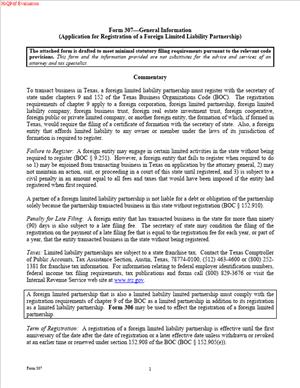
Form 307 – Application for Registration of a Foreign Limited Liability Partnership
Fill out nowJurisdiction: Country: United States | Province or State: Texas
What is a Form 307 – Application for Registration of a Foreign Limited Liability Partnership?
Form 307 is the filing you use to register a foreign limited liability partnership to do business in Texas. “Foreign” means your partnership was formed under the laws of another state or country. You are not forming a new Texas partnership. You are asking Texas to recognize your existing limited liability partnership status and to authorize you to transact business in Texas.
You typically use this form if your firm is already a limited liability partnership under its home jurisdiction. Common users include law firms, accounting practices, engineering groups, consulting partnerships, and other professional or commercial partnerships that elected liability protection for partners. You also use it if your general partnership converted to a limited liability partnership in your home state and now plans to take on Texas work. If you operate as a limited partnership that elected limited liability partnership status in your home jurisdiction, you may also fall within this pathway. The core test is simple: you are a partnership with registered limited liability partnership status outside Texas, and you plan to conduct business in Texas.
You need this form to gain legal authority to transact in Texas while preserving your liability shield. Without registration, you risk penalties and practical limits. You may not be able to maintain lawsuits in Texas courts. You can face fines for transacting without registration. You can also face service of process challenges. Registration creates a public record of your presence and appoints a Texas registered agent for legal notices.
Typical usage scenarios
You open a Texas office. You hire staff in Texas. You sign a long-term services contract in Texas. You begin a major project in Texas, even if your team remains out of state. You pitch to a Texas public agency that asks for evidence of Texas authority. Your bank or landlord requests proof you are registered to do business in Texas. A client’s outside counsel asks for your Texas registration details as part of an engagement or diligence review. Each scenario points to the same step: file Form 307 to register the foreign limited liability partnership.
When filed and accepted, the registration grants you authority in Texas. It also locks in the state’s recognition of your limited liability structure. This helps protect partners from partnership liabilities arising from other partners’ conduct, subject to the limits of applicable law. The registration is time-limited and requires annual renewal. You must update Texas if key details change, such as your name or registered agent. Plan for these lifecycle steps from the outset.
When Would You Use a Form 307 – Application for Registration of a Foreign Limited Liability Partnership?
You use Form 307 the moment your partnership’s business crosses into Texas in a way that counts as “transacting business.” Opening an office or facility in Texas qualifies. Hiring one or more employees who work in Texas qualifies. Regularly performing services in Texas qualifies. A one-time meeting is usually not enough on its own. But a sustained project or ongoing client work in Texas is.
Consider a few practical examples. Your out-of-state law firm opens a Houston office to serve energy clients. You need registration before the lease begins and the staff start work. An engineering partnership wins a multi-year public project in Austin. You register to sign the contract and ensure your partners’ liability protections hold in Texas. A management consulting partnership expands sales coverage into Dallas and begins weekly on-site work. You register to avoid operating without authority. A professional services partnership wants to bid on a Texas public contract. The solicitation requires proof of Texas authority. You file Form 307 before submitting the bid. A midwestern accounting firm onboards several Texas-based clients. Engagement terms and vendor platforms ask for entity numbers and registered agent details. You file to keep the workflow moving and to avoid compliance gaps.
Typical users include managing partners, firm administrators, operations directors, and in-house counsel. Outside corporate secretaries and compliance service providers also handle this filing. If you are the responsible partner for expansion, you should plan the filing timeline alongside your hiring date, lease date, and client deadlines. Filing in advance avoids last-minute delays and avoids signing contracts before authority is in place.
Legal Characteristics of the Form 307 – Application for Registration of a Foreign Limited Liability Partnership
Form 307 is a state filing that carries legal effect when accepted. It is not a private contract. It is a registration that authorizes your foreign limited liability partnership to transact business in Texas. It also places your entity under Texas’s registration and service-of-process framework. Texas recognizes your limited liability partnership status under its statutes and the law of your home jurisdiction. This recognition depends on you maintaining your home status and your Texas registration.
The filing is legally binding because it is a statutory registration. You certify facts under penalty of law. You appoint a registered agent for service of process in Texas. You agree to keep that agent and office current. You also agree to pay the required filing fee, which is based on the number of partners. When the state accepts your filing, your authority begins on the effective date you choose or on the date of filing. The registration then remains active for one year and must be renewed to continue.
Enforceability flows from several factors. You provide a compliant name that meets Texas naming rules for limited liability partnerships. You appoint a Texas registered agent and registered office with a physical street address. You pay the correct fee. You supply correct data about your home jurisdiction and the date your partnership became an LLP under that law. You sign the form by a person with the authority to bind the partnership. If you satisfy these requirements, the filing is accepted and placed on the public record. That record allows courts, agencies, and counterparties to rely on your status and agent details.
There are important legal considerations. If your legal name is not available in Texas or does not contain the required “LLP” or “L.L.P.” indicator, you must adopt a compliant assumed name for Texas use and file the proper assumed name paperwork. If your registered agent resigns or your agent address changes, you must promptly update the record to avoid service-of-process failures. If you fail to renew your registration, your Texas authority lapses. You can face penalties for doing business while unregistered. You may also lose the practical benefits that come with registration, such as the ability to maintain lawsuits in Texas courts until you cure the lapse.
Texas bases the filing fee on the number of partners as of the filing date. The fee is per partner. You should keep accurate partner counts as of the exact date you sign and submit. This fee structure also applies to annual renewal. Budget for this each year. If your partner count changes during the year, the renewal fee will reflect the number of partners on the renewal date. Keep your partnership records current to avoid surprises.
Finally, your registration does not replace other obligations. You may need licenses or permits for your industry. You may need to register for state tax accounts. Those steps sit alongside Form 307. Plan them in parallel with your registration to avoid operational delays.
How to Fill Out a Form 307 – Application for Registration of a Foreign Limited Liability Partnership
Follow these steps to complete and file Form 307 accurately and on time.
1) Confirm you qualify as a foreign LLP.
- Make sure your partnership holds current limited liability partnership status under its home law.
- Verify that you are a partnership, not a corporation or limited liability company.
- Check that your home status is active and not suspended.
2) Choose and confirm your Texas name.
- Begin with your legal partnership name as recognized in your home jurisdiction.
- Texas requires an “LLP” or “L.L.P.” or the full words “Limited Liability Partnership” in the name.
- If your legal name is missing the required indicator, adopt a compliant assumed name for Texas.
- If your legal name is already taken in Texas, choose an available assumed name for Texas use.
- If you use an assumed name in Texas, plan to file the required assumed name certificate.
3) Gather key information before you start the form.
- Legal name of the partnership and any assumed name you plan to use in Texas.
- The home jurisdiction where the partnership was formed.
- Date the partnership was formed and the date it became an LLP under home law.
- Principal office street address (no P.O. box for principal office if the form requests a street address).
- Texas registered agent name, and Texas registered office street address.
- Confirmation that the registered agent has consented to serve.
- Number of partners as of the filing date for fee calculation.
- Contact email and phone number for state communication.
- Desired effective date (on filing or a delayed date within the allowed window).
4) Complete the entity name section.
- Enter the legal name exactly as it appears in your home records.
- If you will transact in Texas under an assumed name, list that assumed name in the space provided.
- Ensure the name includes the required “LLP” or “L.L.P.” indicator.
5) Provide the jurisdiction and formation details.
- State the state or country where the partnership was formed.
- Enter the date of formation of the partnership.
- Enter the date your partnership became a limited liability partnership under home law.
- These dates help validate your foreign LLP status.
6) Enter the principal office address.
- Provide the full street address of your principal office.
- Include city, state, postal code, and country if outside the United States.
- Use a physical address, not a P.O. box, to the extent the form requires it.
7) Appoint your Texas registered agent and office.
- Select whether your agent is an individual resident of Texas or an organization authorized to serve as an agent.
- Enter the full name of the registered agent.
- Enter the registered office street address in Texas. A P.O. box is not acceptable for this address.
- Confirm you obtained the agent’s consent to serve. You will certify this in the form. Keep a written consent in your records.
8) State the number of partners and calculate the fee.
- Count all partners as of the filing date.
- The fee equals $200 for each partner.
- Example: 12 partners equals a $2,400 filing fee.
- Verify your count with your partnership records before you sign.
9) Provide any additional information the form requests.
- Some versions include a field for a federal employer identification number. If included, supply it or mark “not applicable” as instructed.
- If you have a Texas office beyond the registered office, provide that address if requested.
- If the form asks for a purpose, you can state “to transact all lawful business for a limited liability partnership.”
10) Choose the effective date and any delay.
- You can make the filing effective on the date of filing.
- You can select a future date within the allowed delay period if needed.
- Use a delayed date if your lease or the first day of business falls later. This can align fees and renewals with your operational start.
11) Review compliance statements and acknowledgments.
- You are certifying that the partnership is a valid LLP in its home jurisdiction.
- You are certifying that the registered agent consented to serve.
- You are certifying that the information is true and correct at the time of filing.
12) Sign the form.
- A partner or another person authorized by the partnership must sign.
- Print the signer’s name and title (for example, “Managing Partner”).
- Date the signature.
- If filing electronically, follow the signature instructions provided in the filing system.
13) Prepare attachments if needed.
- If there is not enough space for a long name or address, attach an additional page.
- If you are using an assumed name, prepare the assumed name certificate for separate filing.
- Keep copies of any partner resolutions that authorize the filing, even if not submitted.
14) Pay and submit your filing.
- Calculate the total fee based on the partner count.
- Pay the fee by an accepted method such as credit card, check, or money order, depending on how you submit.
- You can file electronically or by mail. Choose the method that fits your timeline.
- If you need a certified copy, request it at submission and pay any extra fee.
15) Track confirmation and record the details.
- After submission, wait for acceptance confirmation.
- Record your Texas file number, the effective date, and the registered agent details.
- Save a stamped copy to your corporate records and your minute book.
16) Plan for annual renewal.
- Registration lasts one year and must be renewed to remain active.
- The renewal fee equals $200 per partner as of the renewal date.
- Set a calendar reminder at least 60 days before expiration.
- Update the partner count and any changed information before you renew.
17) Keep information current between renewals.
- If your registered agent or registered office changes, update your record promptly.
- If your legal name changes in your home jurisdiction, update Texas and adjust your assumed name if needed.
- If you withdraw from Texas, file a withdrawal so the record closes cleanly.
18) Avoid common mistakes.
- Do not submit a name that lacks the required “LLP” or “L.L.P.” indicator.
- Do not list a P.O. box as the registered office.
- Do not miscount partners. Confirm the count on the exact signing date.
- Do not appoint a registered agent who has not consented.
- Do not assume your home registration alone authorizes Texas activity. You need Texas registration.
19) Use practical timing tips.
- If your partner count will drop soon, consider timing your filing to reflect the correct number and manage fees.
- If you are opening multiple Texas locations, register before the first hire or lease starts.
- If your project timeline is short, use electronic filing to accelerate processing.
20) Keep internal governance aligned.
- Adopt a short partner resolution authorizing the filing and naming the signer.
- Record the assumption of the registered agent and any assumed name.
- Update your engagement letters and proposals to reflect your Texas name and agent details where appropriate.
By following these steps, you will complete Form 307 accurately and on time. You will have the authority to transact business in Texas. You will preserve your limited liability partnership protections while operating in the state. Keep clean records, renew each year, and update Texas as your details change. This approach avoids penalties, streamlines client onboarding, and supports smooth operations across state lines.
Legal Terms You Might Encounter
- Foreign limited liability partnership means your partnership was formed outside Texas and elected LLP status in its home jurisdiction. This form registers that same partnership to do business in Texas while keeping its LLP liability shield.
- Limited liability partnership (LLP) is a general partnership that limits partners’ personal liability for many partnership obligations. Form 307 confirms your LLP status, so Texas recognizes the liability protection.
- Jurisdiction of formation is the state or country where your partnership was formed and registered as an LLP. You list this on Form 307 so Texas can confirm your home-state status.
- Registered agent is the person or company you appoint in Texas to receive lawsuits and official notices. Form 307 requires a Texas registered agent who has agreed to serve.
- Registered office is the Texas street address where the registered agent will accept legal papers. Form 307 requires a physical address in Texas. A P.O. Box does not meet this requirement.
- Assumed name is a name you use in Texas if your legal name is unavailable or does not meet Texas naming rules. If your LLP name is taken or conflicts, you state the name you will use in Texas on Form 307 and complete any related assumed name filings.
- Service of process is the delivery of legal documents that start a lawsuit or require action. Your registered agent at the registered office receives service of process after you file Form 307.
- Effective date is when your Texas registration becomes active. On Form 307, you choose immediate effectiveness or a delayed date if you want the registration to start later.
- Principal office is your main business office, which may be outside Texas. You provide this address so the state and public know where to contact your partnership beyond the registered office.
- Amendment is a filing you submit if information on your registration changes, such as your name, registered agent, or registered office. If anything on Form 307 becomes inaccurate, you file an amendment to keep your record current.
FAQs
Do you need to register as a foreign LLP if you only have a few Texas clients?
If you are transacting business in Texas, you register. One client may be enough if you have an ongoing presence, projects, employees, or operations in Texas. If your activity is isolated or occasional, you may not need to register. When in doubt, register to avoid penalties and protect your LLP status.
Do you need a Texas registered agent before filing?
Yes. You must name a Texas registered agent and registered office on Form 307. The agent must consent to serve. Choose an agent who is available during business hours at a Texas street address.
Do you have to use your exact home-state name in Texas?
Use your exact legal name with the required “LLP” or “L.L.P.” ending. If that name is not available in Texas or does not meet naming rules, you must adopt an assumed name for Texas. You then include that Texas name in your filing and update your branding where needed.
Do you need to list every partner on Form 307?
Generally, no. You identify the partnership and its key details, not the personal information of every partner. Keep your internal partnership records up to date in case the state requests proof.
Can you delay the effective date of your registration?
Yes. You can choose a delayed effective date on Form 307. This helps you align the registration with project start dates, contract timelines, or insurance coverage.
How long does a foreign LLP registration last in Texas?
Registration is not permanent. You must renew to maintain your LLP status in Texas. Calendar your renewal deadline when you file, so you do not lose liability protection.
Do you need to attach proof of home-state LLP status?
Be prepared to prove you are currently registered as an LLP in your home jurisdiction. Texas may accept your attestation on the form or may request evidence. Keep a recent proof of status ready in case it is requested.
Can you change your registered agent or office later?
Yes. If your agent or address changes, file an amendment promptly. Do not let your Texas record go stale. A lapse risks missed legal notices and loss of good standing.
Checklist: Before, During, and After the Form 307 – Application for Registration of a Foreign Limited Liability Partnership
Before signing
- Confirm your partnership is registered as an LLP in its home jurisdiction.
- Verify your exact legal name, including the “LLP” or “L.L.P.” suffix.
- Check Texas name availability. Decide on an assumed name if your name conflicts.
- Select a Texas registered agent. Confirm written consent and a Texas street address.
- Gather your principal office address and best business contact email or phone.
- Decide on the effective date: immediate or delayed.
- Note your formation jurisdiction and original formation or LLP registration date.
- Obtain internal approval to register in Texas (partner resolution or consent).
- Prepare payment details for the filing fee.
- Calendar is an annual renewal reminder.
During signing
- Confirm the name on the form matches your legal name exactly, including the LLP ending.
- If using an assumed name in Texas, ensure it appears correctly and consistently.
- Enter the precise jurisdiction of formation and current LLP status.
- List the registered agent’s full legal name. Recheck the Texas street address.
- Confirm the registered office is not a P.O. Box and is located in Texas.
- Verify the principal office address, which may be outside Texas.
- Select the correct effective date box. Enter any future date accurately.
- Review any required statements or acknowledgments for accuracy.
- Ensure the signer is authorized by the partnership to submit the application.
- Check the fee calculation and payment method details before submission.
After signing
- File the form with the Texas Secretary of State using your chosen delivery method.
- Pay the applicable fee and save your proof of payment.
- Wait for the acknowledgment or stamped copy showing the filing date and status.
- Distribute a copy to partners, compliance staff, and your registered agent.
- If using an assumed name, complete any required assumed name filings in Texas.
- Update engagement letters, website, invoices, and signage to reflect the Texas name.
- Register for any required state tax accounts and local permits as applicable.
- Add the renewal deadline to your compliance calendar with reminders.
- Set a process to monitor changes to agent, office, or name and file amendments quickly.
- Store the filed form and acknowledgment in your entity records and cloud backups.
Common Mistakes to Avoid
- Using a name that is not available in Texas — Your filing gets rejected, and your launch is delayed. Don’t forget to check availability and plan an assumed name if needed.
- Listing a P.O. Box as the registered office — Texas requires a physical street address. Don’t risk rejection. Confirm the agent’s Texas street address is correct.
- Forgetting the “LLP” or “L.L.P.” suffix — Texas expects the designator in the legal name. Don’t cause confusion or rejection. Verify the suffix appears everywhere on the form.
- Naming a registered agent who hasn’t consented — If the agent refuses service, you can miss lawsuits. Don’t skip consent. Geta written agreement from the agent before filing.
- Selecting the wrong effective date or missing renewal — A bad date can complicate contracts and insurance. Missing a renewal can jeopardize liability protection. Don’t ignore timelines. Align your effective date and calendar annual renewal reminders.
What to Do After Filling Out the Form
- File the application promptly. Submit Form 307 to the Texas Secretary of State with the fee. Choose immediate effectiveness or a delayed date that fits your rollout.
- Track your filing. Watch for the state’s acknowledgment or stamped copy. If you need a specific start date, confirm it appears on the acknowledgment.
- Share the field document. Send a copy to your registered agent, partners, and your operations or finance lead. Vendors and banks may also ask for it when onboarding you in Texas.
- Update your public-facing materials. Use the exact Texas name, including “LLP” or “L.L.P.” If you adopted an assumed name, update your website, letterhead, invoices, and contracts.
- Complete related filings. If an assumed name is required, complete those filings promptly. Register for state tax accounts and any needed licenses tied to your Texas activities.
- Integrate the registered agent. Confirm the agent’s intake process for legal mail. Provide contact instructions so urgent notices reach the right person inside your firm.
- Calendar renewals and deadlines. Set a renewal reminder several months in advance. Add reminders for annual report due dates that apply to your partnership’s operations.
- Keep records organized. Store the filed form, agent consent, name evidence, and your acknowledgment in your entity records. Keep both digital and physical copies.
- Monitor changes. If your agent, office address, or name changes, file an amendment quickly. Do the same if your home-jurisdiction LLP status changes.
- Plan for exits. If you stop doing business in Texas, file the appropriate withdrawal. Close tax accounts and cancel permits to avoid future fees or notices.
- Align insurance and contracts. Confirm that your insurance endorsements and Texas contracts list your Texas name correctly. Match the effective date of coverage to your filing date.
- Train your team. Tell the client intake, billing, and marketing teams about the Texas registration. Give them the approved Texas name and any assumed name to use.
- Review compliance annually. Check your home-jurisdiction LLP status, Texas registration, agent information, and renewal schedule. Fix gaps before they create risk.
Disclaimer: This guide is provided for informational purposes only and is not intended as legal advice. You should consult a legal professional.