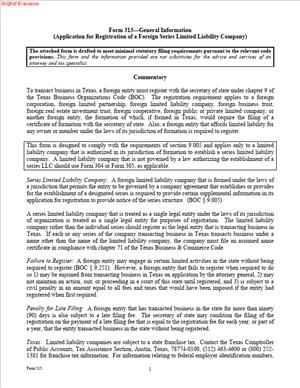
Form 313 – Application for Registration of a Foreign Series Limited Liability Company
Fill out nowJurisdiction: Country: United States | Province or State: Texas
What is a Form 313 – Application for Registration of a Foreign Series Limited Liability Company?
Form 313 lets a foreign series limited liability company register to do business in Texas. “Foreign” means your LLC was formed outside Texas. A “series LLC” means your LLC can establish an internal series with separate assets and liabilities. You use this filing to set up your legal presence with the state. You also tell the state you are a series LLC under your home law.
This is an official filing with the Texas Secretary of State. It creates your authority to transact business in Texas. It also places key facts about your entity on the public record. Those facts include your name, jurisdiction, governing persons, and registered agent.
Who typically uses this form?
Business owners and legal teams for out‑of‑state series LLCs. Real estate investors who use separate series for each property. Funds or holding companies that separate assets by strategy. Franchisors that split markets into series. Professional service groups that silo risk by client or office.
Why would you need this form?
Texas requires registration before you transact business in the state. Registration helps you sign Texas contracts without issue. It helps you open bank accounts, lease offices, and hire staff. It also allows you to bring lawsuits in Texas courts. Without registration, you risk penalties and delays.
You should use Form 313 when you want clarity on liability protection. Texas recognizes the internal shields of a series LLC. But you must show that your home law authorizes series and limits liabilities. This form gathers those facts. It also lets you list series that will operate in Texas, if required.
Typical usage scenarios
A Delaware series LLC buys a warehouse near Dallas. It plans to place the property in a separate series. It files Form 313 before closing and hiring local vendors. A Nevada series LLC opens a Houston sales office. It registers the parent series LLC, then rolls out a Texas marketing push. A Tennessee series LLC plans to manage Texas rental homes through a dedicated series. It registers and designates a Texas registered agent first.
In short, Form 313 is the gate to Texas for your series LLC. You use it to comply with state law and avoid friction in daily operations. It provides the state with the details it needs to recognize your entity and its structure.
When Would You Use a Form 313 – Application for Registration of a Foreign Series Limited Liability Company?
Use this form when your series LLC crosses into Texas business activity. Examples include opening any Texas office or warehouse. Signing long‑term service contracts performed in Texas. Employing Texas staff or contractors on a steady basis. Owning or leasing Texas real estate through the series LLC. Selling products from inventory stored in Texas.
You also use this filing when a particular series will operate in Texas. Many series LLCs operate each line through a named series. If that series will transact business under its own name, Texas may require separate details. This form covers the foreign series LLC and supports recognition of its series structure. It lays the base for any additional series filings, if needed.
Typical users include the business owner or managing member. In larger groups, your general counsel or legal operations team will lead. Your Texas registered agent may assist with address details. Your accountant may flag Texas tax exposure that triggers registration. A real estate broker or landlord may require proof of registration before lease signing. A lender may need the registration before funding a Texas loan.
Timing matters. File before you close a Texas deal or onboard Texas staff. Some contracts require proof of authority at signing. Banks and title companies often ask for the state file number. You avoid rush issues if you file early in the process.
If you test the Texas market without a fixed place of business, you still may need to register. The threshold is “transacting business,” which is fact‑specific. When in doubt, register. It is a simple step that removes risk and delays.
Legal Characteristics of the Form 313 – Application for Registration of a Foreign Series Limited Liability Company
This filing is legally binding because it is an official state record. Acceptance by the Secretary of State grants your authority to operate in Texas. The state issues a file number. That number serves as evidence of your registration and status.
Enforceability rests on accuracy and compliance. You must provide your true legal name from your home jurisdiction. You must identify your home jurisdiction and formation date. You must designate a Texas-registered agent and office. You must name your governing persons. You must confirm your series authority under home law. You should maintain separate records for each series. Those records help uphold the internal liability shields.
The form supports limited liability at two levels. First, it acknowledges your LLC’s general liability shield. Second, it records that your home law permits series with separate liabilities. Texas respects those shields if you maintain the required separations. You should keep distinct assets, accounts, and records for each series. You should document internal allocations and decisions for each series. You should avoid commingling funds across series.
Name rules affect enforceability. Your name must be available and properly formatted. It must include “LLC” or a similar suffix if required by your home law. If the exact name is unavailable in Texas, you must adopt an acceptable alternative name. You then transact business under that alternative name in Texas.
Governing person disclosures also matter. Texas requires the names and addresses of managers or managing members. Provide current information. Use physical addresses, not P.O. boxes, if the form requires it. These details help third parties validate authority.
Registration creates ongoing duties. You must maintain a Texas registered agent and registered office. You must update the state when those details change. You must file updates if your name changes in your home state. You must file any required state reports when due. You also must meet state tax and reporting obligations.
Failure to register can limit your rights in Texas courts. You may also face penalties and back fees. Contracts made before registration remain valid. But you cannot maintain an action in Texas courts until you cure the failure. Timely registration avoids these problems and signals compliance.
This filing does not replace internal governance documents. You still must follow your operating agreement. You must follow your home state’s series requirements. You also must manage each series as a separate business line. The state filing and your internal records work together to protect the shields.
How to Fill Out a Form 313 – Application for Registration of a Foreign Series Limited Liability Company
Follow these steps to complete the form correctly the first time.
1) Confirm you are a “foreign series LLC.”
- Check your certificate of formation or articles. Ensure your home law authorizes series.
- Verify your operating agreement establishes the series framework.
- Confirm that your internal records support separate series liabilities.
2) Decide if you need to register now.
- Review your planned Texas activities. Look for offices, staff, property, or sustained contracts.
- If you will transact business in Texas, move forward with registration.
3) Run a Texas name check.
- Confirm your legal name is distinguishable in Texas records.
- If not available, choose an alternative name for Texas use.
- Ensure the Texas name includes an appropriate “LLC” identifier.
4) Gather core company information.
- Legal name of the foreign series LLC, exactly as formed.
- Home jurisdiction and formation date.
- Business purpose for Texas. You can use a broad lawful purpose.
- Duration, if not perpetual.
- Principal office address. Use a physical address.
- Mailing address, if different.
5) Identify governing persons.
- Determine if you are manager‑managed or member‑managed.
- List each manager or managing member by name and address.
- Use current, complete addresses. Avoid P.O. boxes if the form bars them.
6) Prepare your series statement.
- State that your home law authorizes series limited liability companies.
- Confirm that liabilities of each series are enforceable only against that series.
- Confirm that the company maintains records for each series.
7) List any series that will transact business in Texas.
- Name each series that will operate in Texas, if the form requires it.
- Use the exact series name from your internal records.
- Provide the principal office address for each listed series.
- Ensure each series name connects to the parent LLC name, if your home law requires it.
8) Designate your Texas registered agent and office.
- Select a Texas resident or a company authorized to serve as an agent.
- Provide the registered office street address in Texas. No P.O. boxes.
- Obtain the agent’s written consent to serve. Keep the consent with your records.
- Confirm normal business hours for service of process at that address.
9) Handle name conflicts or modifications.
- If your legal name is not available, state your Texas alternative name on the form.
- If your home law allows a broader name, your Texas name still must comply with Texas rules.
- Use the Texas name consistently in contracts and invoices.
10) Draft your purpose statement for Texas.
- Describe the business you will conduct in Texas in plain terms.
- “Any lawful business” is usually acceptable. Add a brief descriptor if helpful.
11) Attach required documents.
- Obtain a certificate of existence or good standing from your home jurisdiction.
- Ensure the certificate is recent. The state expects a current certificate.
- If the form provides a series schedule or supplement, complete and attach it.
- Match names across all documents without variation.
12) Review liability and records confirmations.
- Confirm you maintain separate accounts for each series.
- Confirm the title to assets is recorded to the correct series.
- Confirm that contracts identify the correct series as the party.
13) Sign the application.
- An authorized manager, member, or officer should sign.
- Type or print the signer’s name and title on the signature block.
- Date the application. The form does not require notarization.
14) Pay the state filing fee.
- Confirm the fee amount before you pay.
- Prepare an acceptable payment method specified by the filing office.
15) File the application with the Texas Secretary of State.
- Submit the completed form and all attachments.
- Keep a copy of everything you file for your records.
16) Track confirmation and next steps.
- Watch for acknowledgment and your Texas file number.
- Share the file number with banks, landlords, and lenders.
- Update your internal compliance calendar to reflect renewal dates.
17) Align contracts and signage.
- Use your Texas name exactly as registered on all Texas contracts.
- If a series signs a contract, identify the series as the party.
- Include the Texas registered office on statutory notices where needed.
18) Maintain good standing.
- Keep your registered agent and office current.
- Update the governing person’s information if it changes.
- File amendments if your legal name or home jurisdiction details change.
- Observe Texas tax and reporting requirements tied to your activities.
Practical examples help lock this down. Say you manage short‑term rentals through Series A. You enter a property management agreement for a Dallas property. The party on that contract should be “Series A of [Parent LLC Name].” After you file Form 313, your authority in Texas is clear. Vendors can verify your status. Insurance carriers can issue Texas endorsements under the correct name.
Consider another scenario. You are a holding company with three investment series. Series B will hire two sales employees in Austin. Payroll requires Texas registration to set up state accounts. You file Form 313 before issuing offer letters. Your HR vendor sets up state accounts without delay.
Watch for common pitfalls. Name mismatches cause rejections. Match your home jurisdiction name letter‑for‑letter. Series names must match your operating agreement. Do not list a series that does not exist in your internal records. Use a Texas street address for the registered office, not a mail drop. Get the registered agent’s consent. Attach a current certificate of existence.
Check the governing persons section with care. If you are manager‑managed, list managers, not all members. If you are member‑managed, list the managing members. Use current addresses. Confirm spelling and middle initials where applicable.
Mind your record‑keeping. Series liability shields depend on separation. Keep separate bank accounts for each series. Sign contracts in the correct series name. Title assets in the name of the owning series. Track liabilities by series in your accounting system.
If you later add a series that will operate in Texas, plan the filing steps. Update your internal resolution by creating the series. Confirm the new series name and purpose. Review whether additional Texas filings are needed for that series. Keep your Texas records aligned with your internal governance.
Finally, organize your compliance file. Include the filed Form 313 and acceptance page. Include the certificate of existence you used. Include the registered agent consent. Include your operating agreement and series schedules. Include a list of governing persons with dates. This file supports smooth audits, financing, and due diligence.
You now have a clear roadmap. Gather accurate information. Complete each section with precision. File early in your expansion timeline. Maintain clean records by series. With this approach, your foreign series LLC will be ready to operate in Texas with confidence.
Legal Terms You Might Encounter
- Foreign entity means your company formed outside Texas. On this form, you identify your home jurisdiction and confirm that you are a foreign series limited liability company.
- Series limited liability company means an LLC that can create separate internal cells called series. On this form, you confirm your company is authorized to establish a series under its formation law.
- Protected series are internal cells with assets and liabilities tracked separately. The form asks you to identify that you are a series LLC and to list the series that will transact business in Texas if required.
- Registered series are series that have a public filing in their home jurisdiction. If your home law allows or requires registration of each series, be ready to name any series doing business in Texas.
- Governing authority means the people who manage the LLC, such as managers or managing members. The form asks if the LLC is manager-managed or member-managed and may request names or titles.
- Registered agent is the person or company in Texas who accepts legal papers on your behalf. The form requires you to name a registered agent and provide a Texas street address for the registered office.
- Registered office is the Texas street address where your registered agent can be found during business hours. The form requires a physical address. A P.O. Box is not sufficient.
- Principal office is your main business office, which can be outside Texas. The form asks for this address to place the company on record.
- Assumed name is the name you use in Texas if your true name is not available or not compliant. The form allows you to adopt an assumed name for use in Texas.
- Certificate of existence (or good standing) is the official document from your home jurisdiction confirming your company exists. The form requires you to attach a recent certificate to support your registration.
- Jurisdiction of formation is the state or country where you formed the LLC. The form requires the jurisdiction and the formation date.
- Effective date is when your Texas registration becomes active. The form lets you choose the filing date or a delayed effective date.
FAQs
Do you have to register each series, or only the parent LLC?
You register the foreign series LLC with this form. If a specific series will transact business in Texas under its own name, you may need to identify that series as part of your filing or make a related filing. Confirm the naming and disclosure for every series that will sign contracts, hold assets, or open accounts in Texas.
Do you need a Texas registered agent?
Yes. You must appoint a Texas-registered agent with a Texas street address. The agent must consent to the appointment. The registered office cannot be a P.O. Box. Many rejections happen when the agent’s consent or street address is missing or incorrect.
Do you need a certificate of existence from your home jurisdiction?
Yes. Include a recent certificate of existence or status from your home jurisdiction. Ensure the certificate is current. Older documents often cause delays or rejections.
Do you have to use your exact name from the home jurisdiction?
Yes. Use your exact legal name as it appears on your home records. If that name is not available in Texas or includes restricted words, you can adopt an assumed name on the form. If you adopt an assumed name, use it consistently in Texas contracts and filings.
Do you list managers or members on the form?
You identify the management structure and, if requested by the form, the governing persons. If you are manager-managed, list the managers. If you are member-managed, list the managing members. Use full legal names and titles.
Do you need a physically registered office address?
Yes. Provide a Texas street address for the registered office. A P.O. Box is not accepted. The address must allow personal delivery during normal business hours.
Do you need to delay the effective date?
Not required. Most filers choose the filing date. You can delay the effective date if you need future alignment with leases, tax periods, or internal approvals. If you select a delayed date, ensure your contracts and tax planning match that date.
Do you need to file again if you add a new series later?
If a new series will transact business in Texas under its own name, expect to make a filing to add or register that series information. Keep a process in place to update the Secretary of State whenever you create, rename, or wind up a series that is active in Texas.
Checklist: Before, During, and After the Form 313 – Application for Registration of a Foreign Series Limited Liability Company
Before signing
- Confirm your company is a series LLC under its home law.
- Identify which series will operate, hold assets, or bank in Texas.
- Run a Texas name availability check for the parent and any series.
- Decide on an assumed name if your legal name is unavailable or restricted.
- Choose a Texas-registered agent and get written consent.
- Gather a Texas street address for the registered office.
- Confirm your principal office address (can be outside Texas).
- Confirm the management structure and the names of managers or managing members.
- Order a current certificate of existence from your home jurisdiction.
- Prepare a list of series that will transact in Texas and their exact names.
- Select your effective date (filing date or delayed date).
- Confirm payment method for the filing fee.
- Set up internal records to track assets, liabilities, and agreements by series.
During signing
- Use the exact legal name of the foreign LLC from your home records.
- If using an assumed name in Texas, enter it exactly as chosen.
- Enter your jurisdiction of formation and formation date accurately.
- Check the box or statement indicating the company is a series LLC.
- Confirm the registered agent’s full name and Texas street address.
- Verify the registered office is a physical address, not a P.O. Box.
- Provide the principal office address with city, state, and postal code.
- State your management structure and governing persons where required.
- List or attach the series that will transact in Texas, with exact names.
- Attach the certificate of existence from your home jurisdiction.
- Add any required consents or additional statements.
- Choose the effective date and any delayed-effective details.
- Sign as an authorized person. Print your name and title clearly.
- Review every entry for spelling and consistency across the form and attachments.
After signing
- File the form with the Secretary of State and pay the filing fee.
- If you adopted an assumed name, complete any required assumed name filing.
- Request a file-stamped copy for your records.
- Calendar reminders for renewals, public filings, and tax deadlines.
- Notify your registered agent of acceptance and keep their consent on file.
- Provide banks, landlords, and vendors with the file-stamped copy.
- Update invoices, contracts, and letterhead with the Texas name in use.
- Add the registration number to your internal company records.
- Create separate records for each series active in Texas.
- Monitor for acceptance or rejection. If rejected, fix issues and resubmit.
- Set a procedure to update the Secretary of State when series information changes.
Common Mistakes to Avoid
- Don’t forget the registered agent’s physical address. Using a P.O. Box or missing consent leads to rejection. You lose time and may miss deal deadlines.
- Don’t omit the certificate of existence. A missing or outdated certificate triggers rejection. Expect to reorder and pay again if the filing lapses.
- Don’t misstate your legal name or series names. Typos or mismatches with home records cause rejection and confusion in banking and contracts.
- Don’t ignore assumed name requirements. If your name is unavailable, adopt an assumed name on the form. If you skip this, you may face rejection or be unable to sign contracts as planned.
- Don’t have the wrong person sign. The signer must be an authorized person. If not, the filing may be rejected or challenged, and you may need to refile.
What to Do After Filling Out the Form
File the application
- Submit the completed form with the filing fee.
- Include the certificate of existence and any required attachments.
- Keep proof of submission and payment.
Track acceptance
- Watch for acceptance or rejection notices.
- If accepted, save the file-stamped copy and note the filing number.
- If rejected, fix the cited issues and resubmit quickly.
Align your records
- Update your operating agreement schedules for each series active in Texas.
- Maintain separate records for each series: assets, liabilities, and contracts.
- Use the exact name for each series in every contract and account.
Notify key parties
- Give your bank, landlord, insurers, and vendors the file-stamped copy.
- If using an assumed name, update invoices and purchase orders.
- Tell your team how to sign: “Foreign LLC Name, a foreign series LLC, by [Series Name], by [Authorized Signer].”
Set tax and compliance reminders
- Register for any required tax accounts and reports.
- Calendar annual or periodic filing dates and franchise tax deadlines.
- Track renewal dates for assumed names and registered agent agreements.
Manage future changes
- If you add a new series that will do business in Texas, prepare the required filing.
- If you change your registered agent or registered office, file the change promptly.
- If your legal name changes in your home jurisdiction, amend your Texas record.
- If you wind up a series active in Texas, update the Texas record accordingly.
Store your records
- Keep the file-stamped application, certificate of existence, and agent consent.
- Store the acceptance letter and any certified copies.
- Maintain these with your minute book and internal series schedules.
Plan for audits and diligence
- Organize evidence of separate series records and bank accounts.
- Keep signed contracts showing the correct Texas name and the series name.
- Prepare to provide your Texas registration number in diligence requests.
Disclaimer: This guide is provided for informational purposes only and is not intended as legal advice. You should consult a legal professional.