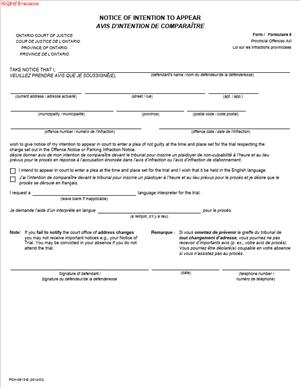
Form 8 (POA-0813-E) – Notice of Intention to Appear
Fill out nowJurisdiction: Country: Canada | Province or State: Ontario
What is a Form 8 (POA-0813-E) – Notice of Intention to Appear?
Form 8 is an Ontario Court of Justice document used under the Provincial Offences Act. You use it to tell the court that you want to appear and dispute a charge. It is most common for parking tickets to be issued under Part II of the Act. The form puts the court on notice that you want a hearing. It also stops a default conviction for ignoring the ticket.
You are not pleading guilty on this form. You are preserving your right to be heard. You are asking the court to schedule a trial date or meeting as the court directs. Filing the form brings your matter into the court process.
Who typically uses this form?
Drivers and vehicle owners who receive a parking ticket. Fleet managers and business owners with company vehicles. Property managers are responsible for vehicles on site. Out-of-province owners who receive a ticket while in Ontario. Paralegals or lawyers acting for any of the above. Any registered owner named on the ticket may file it.
Why would you need this form?
You want to challenge the ticket. You believe the sign was unclear. You could not comply due to a broken meter. You were within the time limit, but the chalk mark was wrong. You have a disability permit that was not visible for a valid reason. You want to question the officer’s observations. You want to negotiate a resolution first, if the court offers that. You want an interpreter. You need a court date that works with your schedule. The form allows you to ask for these process steps.
Typical usage scenarios are straightforward. You find a parking infraction notice on your windshield. You read the back and see the response options. You decide to dispute the ticket. You complete Form 8 and deliver it to the court office on the notice. You then receive a Notice of Trial in the mail. In another case, you receive a mailed notice about a parking ticket you missed. You still want to dispute it. You act quickly, complete Form 8, and file it before a default is entered. In a fleet scenario, your company gets multiple tickets. Your authorized representative files Form 8 for each one. You keep copies and track the future hearing dates.
Form 8 is for provincial offence proceedings in the Ontario Court of Justice. It is not used for all parking matters in Ontario. Some parking matters use an administrative penalty process, not the court. If your ticket refers to the Provincial Offences Act and lists a court location, Form 8 is generally the correct form. If your notice refers to an administrative review or screening process, do not use this form. Follow the steps on your notice instead.
Form 8 is also distinct from the trial request process for speeding and other Part I tickets. Those tickets usually include a built-in “request a trial” option on the back. You would use the ticket itself to request a trial for those. Form 8 focuses on parking and similar Part II provincial offences.
When Would You Use a Form 8 (POA-0813-E) – Notice of Intention to Appear?
You use Form 8 when you intend to appear and dispute a parking charge under the Provincial Offences Act. The most common trigger is a Parking Infraction Notice left on your vehicle. The notice tells you the offence, the set fine, and the last day to respond. You complete Form 8 and deliver it before that deadline. Deadlines are short. They are often 15 days after the date of the ticket. Your actual deadline appears on the ticket.
You also use Form 8 if you receive a mailed notice about the parking infraction. This can happen if the officer did not leave a notice on your car. It can also happen if you have moved and the first notice did not reach you. If the matter is still within the response time, file Form 8 right away. If a default conviction has already been entered, you will need a reopening request. That is a separate step. Do not assume Form 8 alone will cancel a default.
Typical users include individual motorists, students, and visitors. Business owners and fleet managers also use this form to dispute tickets on company vehicles. Property managers and condominium corporations may use it for vehicles under their control. Paralegals and lawyers file it as agents for their clients. Out-of-province owners use it if charged while in Ontario. Corporate owners file it through an authorized employee. The person who signs should have the authority to bind the corporation.
Practical examples help. You parked on a street with temporary signage. You believe the sign was posted after you parked. You want a trial to challenge the officer’s evidence. You file Form 8 to secure a date. You have a mobility permit, but it slid off the dashboard when you shut the door. You still want to present your permit at court. You file Form 8 to prevent a default conviction. You used a pay-and-display machine that was out of service. You kept a photo. You file Form 8 to present your defence. You are a delivery company. The ticket lists your company as the owner. You assign a representative to file Form 8 and attend.
You may also use the form to request an interpreter for your court date. You can indicate your language needs on the form. You can note any accessibility accommodation requests. The court uses your information to set a suitable hearing.
You should not use this form to simply ask for time to pay. You also should not use it to enter a guilty plea. If you want to plead guilty with an explanation, there are other processes for that. For parking tickets, you usually either pay or dispute. Check your notice for available options. If you want an early resolution meeting, you can indicate that if the form allows it. Not all courts offer early resolution for parking. The court will advise what applies in your matter.
Legal Characteristics of the Form 8 (POA-0813-E) – Notice of Intention to Appear
Form 8 is a court form authorized under the Provincial Offences Act. It is a procedural document. It is not your defence. It does not ask the court to decide the charge. It tells the court you want a hearing so your matter can be set on a list. It is legally effective once a court office accepts it. It triggers court scheduling. It prevents the clerk from entering a default conviction during the response period.
The form is binding in the sense that it sets the process in motion. When you file it on time, the court must take steps to set a hearing. The prosecutor must disclose the evidence before the hearing, on request. You then appear on the date set. If you fail to appear, the court can proceed in your absence. The court can convict and impose costs. Filing the form does not guarantee an outcome. It secures your right to be heard.
Enforceability rests on timely, proper filing and proper content. You must complete the form clearly and accurately. Include the offence number and plate details found on your ticket. Provide your correct mailing address. The court uses this address to send your Notice of Trial. If you do not update your address, you risk missing your court date. The court will not excuse a missed appearance because you moved and did not update. Keep your contact information current with the court office.
Deadlines matter. If you miss the response deadline, the clerk may enter a conviction by default. A late Form 8 will not stop that. You may still file it and seek a reopening. A reopening is a separate request to set aside the default. It is time-sensitive and requires reasons for missing the deadline. Do not rely on a reopening if you can avoid it. File on time and keep proof that you filed.
The form can be signed by you or your authorized agent. Agents can be licensed paralegals, lawyers, or another person you authorize. Corporate owners should sign through an officer or employee with authority. The person signing certifies the intention to appear. The form is not sworn or notarized. Even so, you should be accurate and honest. Misleading information can undermine your case and delay the process.
Language and accessibility rights apply. If you request an interpreter on the form, the court will arrange one. You must identify the language you need. If you need disability-related accommodation, note that as well. The court will work with you to ensure access. These requests do not delay or weaken your case. They support a fair process.
Form 8 is part of a larger sequence. After you file it, the court sets a date and sends you a Notice of Trial. The prosecutor then provides disclosure if you ask for it. You attend on the date set. You can negotiate a resolution if permitted. Otherwise, the matter proceeds to trial. The justice of the peace decides the case based on evidence and law. If you lose, the court can impose the set fine and costs. If you win, the charge is dismissed.
How to Fill Out a Form 8 (POA-0813-E) – Notice of Intention to Appear
Set aside 10–15 minutes. Have your ticket in front of you. You will need the offence number, date, and location. You will also need your vehicle plate details and your mailing address.
Step 1: Identify the court location
- Find the court office listed on your ticket. It appears near the bottom or on the reverse side.
- Write the court location on the form exactly as shown. Include the municipality and address if the form asks.
- This ensures your form is filed in the correct court.
Step 2: Enter the offence details
- Copy the parking infraction notice number or offence number from your ticket.
- Enter the date of the alleged offence. Copy it exactly.
- Enter the time of the alleged offence if shown on the ticket.
- Identify the by-law or statute section if the form asks. This appears on the face of the ticket.
- Enter the location of the alleged offence. Use the street address or description from the ticket.
Step 3: Enter vehicle and plate information
- Enter your licence plate number and the province or state of issue.
- If the form asks for vehicle make and model, enter those as well.
- These details link your notice to your vehicle and owner record.
Step 4: Enter your name and contact information
- Write your full legal name. Use the same name as on the ticket.
- For a corporation, write the full corporate name as registered.
- Enter your complete mailing address, including postal code. This is where the Notice of Trial will go.
- Provide a phone number and email if the form allows. The court may use these to contact you about scheduling.
Step 5: Identify the party status
- If you are the individual named on the ticket, check “Defendant/Owner.”
- If you are an agent, check “Agent/Representative” and enter your client’s name.
- If you are authorized for a corporation, state your title (for example, Fleet Manager).
Step 6: Choose the process option if available
- Some versions ask if you want an early resolution meeting. Choose yes only if you want to discuss the resolution before trial.
- If you want to proceed straight to trial, select the trial option. Not all courts offer early resolution for parking. If no option is shown, the court will set a trial date.
Step 7: Ask for an interpreter if needed
- Indicate your language if you need an interpreter. Write the language clearly (for example, Mandarin, Arabic).
- If you are comfortable in English or French, select “No interpreter needed.”
Step 8: Request accessibility accommodations if needed
- If you need accommodation, state the nature of the request briefly. Examples include mobility access or communication supports.
- The court will contact you to confirm details.
Step 9: Appoint a representative if applicable
- If a paralegal or lawyer will appear for you, enter their name and contact information.
- If a company employee will appear for a corporate owner, enter their name and title.
- You can still attend along with your representative if you choose.
Step 10: Sign and date the form
- Sign your name. For a corporation, an authorized person must sign.
- Print your name under the signature if the form provides space.
- Date the form. Use the current date.
Step 11: Keep copies
- Make a copy for your records. Keep it with the ticket.
- If you are filing several forms for a fleet, assign each one a tracking note. Include the offence number and vehicle plate.
Step 12: File the form with the correct court office
- Deliver the form to the court office listed on your ticket. You can file in person or by mail. Some courts accept electronic filing. Follow the filing instructions on your ticket.
- File it before the response deadline on the ticket. Deadlines are strict.
- If you mail it, allow extra time for delivery. Use a method that gives you proof of delivery.
- Ask the clerk to stamp a copy “received” if you file in person. Keep that copy.
Step 13: Confirm your address and watch for the Notice of Trial
- The court will mail you a Notice of Trial after scheduling. This can take weeks or months.
- If you move, update your address with the court office immediately. Include your offence number and plate number in the update.
- If you do not receive a Notice of Trial within a reasonable time, contact the court office to check status.
Step 14: Prepare for the hearing
- After you receive the Notice of Trial, request disclosure from the prosecutor. Ask for the officer’s notes, photos, and any relevant records.
- Organize your evidence. This may include photos, receipts, permits, or witness statements.
- Plan your availability. If you need an adjournment, ask as early as possible. Provide reasons and any supporting documents.
Practical examples of completing the form
- Individual owner: You are named on the ticket. Enter your full name and home address. Check that you are the defendant. Request an interpreter if you need one. Sign and date.
- Corporate owner: The ticket lists “ABC Logistics Inc.” Enter the corporate name. The fleet manager signs and lists their title. Enter the company’s mailing address for notices.
- Agent filing: A licensed paralegal files on behalf of a client. The agent lists the client’s name in the defendant field. The agent lists their own contact in the representative field. The client still receives the Notice of Trial at their address unless the court directs otherwise.
Common Mistakes to Avoid
- Missing the deadline. File before the last day to respond listed on the ticket.
- Using the wrong court office. Always file where the ticket directs.
- Entering an old or incorrect address. You must receive the Notice of Trial by mail.
- Leaving out the offence number. The clerk needs it to find your file.
- Assuming the form includes your defence. It does not. Save your arguments for court or discussions with the prosecutor.
What happens after you file
- The clerk schedules your matter and sends a Notice of Trial.
- If early resolution is available and you opted in, the court sets that meeting first.
- You must attend any scheduled date. If you miss it, the court can proceed without you.
- If you receive a date that you cannot attend, request an adjournment early. Provide reasons and any proof.
- Bring your Notice of Trial, disclosure, and evidence to court. Arrive early and check in.
- If you resolve the matter before the hearing, confirm with the court what, if anything, you still need to attend.
If you are late
- If you miss the response deadline and the clerk has not entered a default, file Form 8 immediately.
- If a default is already entered, ask about a reopening. This is a separate request to set aside the default. Act quickly. You will need to explain why you missed the deadline.
- Keep any proof of circumstances, such as mail delivery issues or address changes.
Form 8 gives you a simple, reliable path to be heard. Fill it out carefully. File it on time with the correct court. Keep your address current. Then prepare your defence and attend your hearing.
Legal Terms You Might Encounter
- You will see “Offence Notice” on your ticket. This is the form you get for many provincial offences. It lists the alleged offence, the fine, and the options you can choose. Form 8 is the document you use when you choose to appear in court instead of paying.
- A “Certificate of Offence” is the document the enforcement officer files with the court. It records the charge laid against you. When you submit Form 8, the court uses the certificate details to schedule your case.
- A “Summons” is a formal notice that orders you to come to court on a date. If you received a summons instead of a ticket, you still use your Form 8 details to confirm your intention to appear and to keep your address current with the court.
- “Defendant” means you. The form asks for your legal name and contact details because you are the person responding to the charge. Use your current mailing address so you receive your next notice.
- A “Prosecutor” is the person who represents the enforcement side in court. After you file Form 8, you will later deal with the prosecutor for disclosure and any discussions about resolution before trial.
- “First Appearance” is the first court event after you file Form 8. It may be a brief hearing to confirm your plea, set a date, or address scheduling. Your Form 8 triggers the court to set this event and mail you the details.
- “Trial” is the hearing where a justice hears evidence and decides the case. Filing Form 8 signals that you want your day in court. Keep your availability in mind. If you cannot attend on the date sent to you, ask for a change as early as possible.
- A “Plea” is your answer to the charge: guilty or not guilty. Filing Form 8 does not enter a plea. It only tells the court you plan to appear. You will enter your plea at your first appearance or at trial.
- “Disclosure” is the evidence the prosecutor must provide to you, such as notes or reports. You can request disclosure after you receive your court date. Filing Form 8 ensures the court and prosecutor know where to send disclosure notices.
- A “Default Conviction” happens if you do nothing by the ticket deadline or you miss your court date. Filing Form 8 on time helps you avoid a default. Always update your address so you do not miss mailed notices that could lead to default.
FAQs
Do you need to file Form 8 to dispute a ticket?
Yes. If you want to challenge the charge or appear in court, file Form 8. This tells the court to set a court date and to mail you the details. If you only want to pay, you do not file this form.
Do you have a deadline to file?
Yes. The back of your ticket shows a deadline, usually short. File before that date. If you miss it, you risk a default conviction. Act quickly if the deadline is close.
Do you pay a fee to file?
No. Filing Form 8 does not involve a filing fee. You may have later costs if you are convicted, but the act of filing itself does not carry a fee.
Do you get a trial date right away?
No. The court will mail you a Notice of First Appearance or Notice of Trial after processing. Timelines vary by court location and volume. Watch your mail and keep your address current.
Do you need to appear in person to file?
Not always. Filing options vary by court office. You can often file in person or by mail. Some offices may accept electronic filing. Use the filing instructions on your ticket. Keep proof of delivery.
Can someone file for you or appear for you?
Yes. You can authorize a representative. If someone other than you signs, they should have written authorization. If a representative plans to appear for you in court, list that person’s details on the form, if space allows, and ensure they have your signed authorization.
Can you ask for an interpreter?
Yes. Form 8 includes a place to request an interpreter and to identify the language. Make the request when you file. If you forget, contact the court office as soon as possible.
What if you moved after filing?
Tell the court office in writing right away. Include your name, offence number, and the new mailing address. If you do not update your address, you may miss your court notice and risk a default.
What if you missed the ticket deadline?
You may still have options, but they are not automatic. Act quickly. Ask the court office about next steps to address a default. Be ready to explain the delay and provide any supporting information.
Can you change your election after filing?
Yes, often. You can still resolve the matter before trial. You might be able to plead guilty to a different offence or make submissions on penalty. Contact the court or attend your first appearance to discuss options.
Checklist: Before, During, and After the Form 8 (POA-0813-E) – Notice of Intention to Appear
Before signing
- Your ticket or summons with the offence number and location code.
- Your full legal name as it appears on your identification.
- Your current mailing address and reliable phone or email.
- The enforcement officer’s name and ticket date (from the ticket).
- Any interpreter needs and the requested language.
- Your availability constraints for the next few months.
- Representative details, if someone will act for you.
- A calendar to note deadlines and to track mail.
During signing
- Confirm the offence number and location code match your ticket.
- Check your name’s spelling and any middle names or initials.
- Use a current, complete mailing address, including postal code.
- Indicate if you need an interpreter and specify the language.
- Identify accessibility needs that affect how you appear.
- Add your representative’s name and contact details, if any.
- Select the correct option that says you intend to appear.
- Sign and date the form. Use ink. Make it legible.
After signing
- File the form with the court office shown on your ticket.
- File before the ticket deadline. Do not wait until the last day.
- If filing by mail, use a trackable method and keep the receipt.
- If filing in person, ask for a stamped copy as proof of filing.
- Mark your calendar for the expected mail about your court date.
- When you receive your date, plan time off and travel if needed.
- Request disclosure from the prosecutor after you get a court date.
- Store copies of the form, proof of filing, and all court notices.
- Update the court immediately if your address changes.
Common Mistakes to Avoid
- Don’t forget to file by the deadline. Missing it can lead to a default conviction, added costs, and enforcement actions. File early to avoid mail delays.
- Don’t use an old or wrong address. If the court mails your date to the wrong address, you may miss it and be convicted in your absence. Double-check your address and update it if you move.
- Don’t leave the interpreter field blank if you need one. Without a request, the court may not provide an interpreter. That can delay your case or force an adjournment.
- Don’t miscopy the offence number or court location. A wrong number can misroute your form. Cross-check the ticket and your form before filing.
- Don’t forget to sign and date. An unsigned form can be rejected or cause delays. Sign in ink and keep a copy.
- Don’t assume the court received your mailed form. Without proof, you have no record. Use a trackable method and keep delivery confirmation.
What to Do After Filling Out the Form 8 (POA-0813-E) – Notice of Intention to Appear
- File your form with the court office listed on your ticket. File before the deadline shown. Keep proof of filing.
- Watch your mail for a Notice of First Appearance or Notice of Trial. Read it carefully. Add the date, time, and location to your calendar. Block travel time and plan your day.
- If you need to change the date, act fast. Request an adjournment as soon as you know about the conflict. Explain the reason and be ready to provide any supporting details the court requests.
- Request disclosure after you receive your court date. Ask for officer notes and any other materials the prosecutor will use. Review disclosure before your appearance so you can prepare.
- Decide your approach. You can maintain a not guilty plea and proceed to trial. You can discuss the resolution with the prosecutor. Or you can plead guilty and make submissions on penalty. Plan your choice before you appear.
- Confirm interpreter arrangements if requested. If you asked for an interpreter and do not see it noted on your notice, contact the court office promptly to confirm.
- Coordinate with your representative. If you have an agent or lawyer, share copies of the form, the court notice, and the disclosure. Align on strategy and attendance.
- Update your address if it changes. Send a written notice to the court office with your name, offence number, and new address. Keep a copy of the update request.
- If you decide to resolve the ticket without a trial, contact the court office or attend your first appearance to change your plea or discuss resolution. If you pay after filing, confirm with the court how that affects any scheduled dates.
- If you discover an error on your filed form, correct it in writing. Provide your name, offence number, and the corrected information. File the update with the same court office and keep proof.
- Keep records organized. Maintain a single folder with your ticket, Form 8, proof of filing, court notices, disclosure, and notes from any discussions. Bring this folder to every court event.
- Prepare for your appearance. Bring your identification, court notice, disclosure, notes, and any documents you plan to rely on. Arrive early. Check in as instructed on your notice.
- If you do not receive a court notice within a reasonable time, contact the court office to confirm the status. Have your offence number ready. Provide your address again to ensure proper delivery.
- After your case concludes, review the outcome. If you are convicted, note any fine payment deadline and methods. If you are acquitted or the charge is withdrawn, keep the final document for your records.
- If you missed your date or received a default conviction, act quickly. Contact the court office to ask about next steps. Be prepared to explain why you missed the date and to provide supporting information.
Disclaimer: This guide is provided for informational purposes only and is not intended as legal advice. You should consult a legal professional.