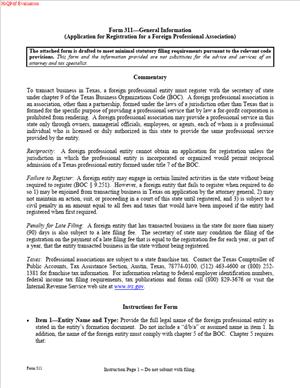
Form 311 – Application for Registration of a Foreign Professional Association
Fill out nowJurisdiction: United States | Texas
What is a Form 311 – Application for Registration of a Foreign Professional Association?
Form 311 is the Texas Secretary of State’s application used by a foreign professional association to register to do business in Texas. “Foreign” means your association was formed under the laws of another state or country. Registration grants your association legal authority to render its professional services in Texas under its own name.
A professional association is a specific entity type for licensed professions. Common examples include medical practices, law firms, engineering groups, architecture firms, and accounting practices. Your entity must be organized as a professional association under its home jurisdiction’s law. If your entity is a different type, this is not the right form.
You use Form 311 when your out‑of‑state professional association plans to carry out its professional services in Texas on a regular, ongoing basis. This includes opening an office, employing Texas staff, holding itself out to the public in Texas, or entering into contracts performed in Texas. It is not limited to physical offices. Routine, repeated client work tied to Texas can trigger the need to register.
Typical usage scenarios
You want to lease Texas office space under the association’s name. A hospital system requests proof of Texas authority before contracting with your specialty group. A municipality requires registration before awarding a professional services contract. A malpractice carrier asks for a Texas registration certificate for coverage. A lender wants to confirm your authority before closing a loan secured by Texas assets.
Registering protects your right to transact business in Texas under your chosen name (if available) and to sue or defend in Texas courts. It also puts the state on notice that you accept service of process through your registered agent. If you skip registration, you risk penalties and limits on your ability to enforce contracts in Texas courts until you cure the failure.
Who typically uses this form? Owners or officers of out‑of‑state professional associations, in‑house legal teams, outside counsel, and operations leaders handling expansion. You might be a managing physician, partner, director, or general counsel. If you manage multi‑state licensing compliance for a firm or practice, this form will be part of your checklist.
When Would You Use a Form 311 – Application for Registration of a Foreign Professional Association?
You use Form 311 before your foreign professional association starts transacting business in Texas. If your team is planning a Texas office launch, you should file early. If you already serve Texas clients remotely and the work has become continuous, you should assess registration now.
Expansion often drives the filing. Your board approves a Texas market entry. You recruit Texas‑licensed professionals. You sign a Texas commercial lease. Before you start services, you file Form 311 so you can operate without delay.
Mergers and acquisitions also trigger the need. Your association acquires a Texas practice and will continue using the existing client contracts. You need registration in place by closing, so billing and employment roll over cleanly.
Contract requirements can force the timing. A hospital, public agency, or corporate client may require proof of Texas registration before awarding work. You file Form 311 to meet that condition. The same applies to large vendor registrations and credentialing processes that call for evidence of Texas authority.
Licensing and credentialing workflows often link to entity registration. You may need your registration documents to complete facility credentials, insurance networks, or professional practice approvals tied to Texas locations. Filing Form 311 early can shorten the lead time to staff deployment.
Sometimes, past activity in Texas triggers a catch‑up filing. Your association has been serving a cluster of Texas clients without a physical office. If the services are recurring and tied to Texas, you likely need to register. You can file Form 311 to cure the gap. You may be asked to address the start date of business and related consequences. The sooner you file, the cleaner the record.
In short, if you plan to provide licensed professional services in Texas under a foreign professional association banner, you should use Form 311. It aligns your entity status with Texas law and avoids disruptions.
Legal Characteristics of the Form 311 – Application for Registration of a Foreign Professional Association
Form 311 is a statutory filing that, once accepted, results in a certificate of registration. That certificate is a legal authority for your foreign professional association to transact business in Texas. The filing is legally binding because it brings your association under Texas law for activities within the state, including service of process and ongoing compliance obligations.
Enforceability comes from several features. First, you must appoint a Texas-registered agent with a physical address. This ensures reliable service of legal documents within Texas. Second, you must state your professional purpose and confirm that the association renders a single professional service or related professional services as allowed for a professional association. Third, you must meet Texas naming and professional designator rules. This usually means your Texas name includes “Professional Association” or “P.A.” If your home‑state name does not comply or is unavailable in Texas, you must adopt a compliant alternate name for use in Texas.
You also must be in good standing in your home jurisdiction. The application requires proof of existence, often a recent certificate from your home jurisdiction. This document shows your entity is active and authorized to operate. If your entity is suspended or dissolved at home, Texas will not register it.
Licensing is a core legal consideration. A professional association may render only the professional services for which its owners are licensed. Texas expects that the individuals who will practice in Texas hold the required Texas professional licenses. You should not use Form 311 to bypass licensing requirements. The association’s authority to operate does not replace individual licensure.
Accurate disclosures are essential. You affirm the truth of the information in the application under penalty of law. Submitting false information can lead to rejection, revocation, or penalties. Texas can also impose consequences if you transact business without registering when required. Common outcomes include the inability to maintain a lawsuit in Texas until you register and pay any fees, along with potential fines.
Your registration is continuous so long as you remain in good standing, maintain a registered agent, and comply with Texas law. You must update the state if your registered agent or registered office changes. If your name changes, you must amend your registration. If you cease Texas operations, you should file a withdrawal to avoid ongoing obligations.
In summary, Form 311 creates a formal legal bridge between your out‑of‑state professional association and Texas law. It is the mechanism that gives your entity legal standing to operate and be held accountable in Texas.
How to Fill Out a Form 311 – Application for Registration of a Foreign Professional Association
Follow these steps to prepare a clean, approvable filing. Keep your answers precise and consistent with your home jurisdiction records.
Step 1: Confirm your entity type and professional scope
Verify that your entity is a professional association under your home jurisdiction’s law. If your entity is a professional corporation, PLLC, or another type, you need the correct Texas form for that entity type. Also confirm your association renders a single professional service, or a permitted combination. Ensure your owners meet the professional association ownership rules under your home law.
Define the exact professional service you will provide in Texas. Keep it specific. For example, “the practice of medicine,” “the practice of law,” or “engineering services.” Do not use a generic catch‑all purpose. Texas expects a professional purpose for this entity type.
Step 2: Check Texas name availability and compliance
List your true legal name as it appears on your home jurisdiction records. Confirm whether that name is available in Texas and meets Texas naming rules for a professional association. Your Texas name must include “Professional Association” or “P.A.” If your true name does not include an acceptable designator, you must adopt a compliant name for Texas use.
If your true name is not available in Texas due to a conflict, select an alternate Texas name that is distinguishable and compliant. You will place that alternate name on the application in the “name to be used in Texas” field. Use the exact spelling, punctuation, and designator you intend to use on signage, contracts, and invoices.
Step 3: Appoint a Texas-registered agent and office
Designate a registered agent with a physical street address in Texas. The registered office cannot be a P.O. Box. Use a consented agent. Get written consent from the agent to serve in this role. Enter the agent’s name and the registered office address exactly as they should appear on the public record.
Do not use your principal office address here unless it is a Texas street address dedicated for agent service. The registered agent and office are critical for service of process and state notices.
Step 4: Provide jurisdiction and formation details
Identify the jurisdiction where your association was formed and the original date of formation. Use the legal name of the jurisdiction. Enter the period of duration. If your association is perpetual, state that. If it has a defined term, enter the expiration date.
Provide the address of your principal office. This is the main business office, which may be outside Texas. Use a full street address.
Step 5: State the professional purpose
Enter a clear, specific professional purpose. Focus on the licensed service your association is authorized to provide. Do not add unrelated commercial activities. Your purpose statement should align with both your governing documents and Texas rules for professional associations.
If your profession has a protected title, use the proper title. Avoid marketing language. This is a legal purpose, not a brand statement.
Step 6: Address ownership and licensing statements
Form 311 includes statements tied to professional ownership and licensure. Be prepared to affirm that owners, members, or managers meet professional eligibility rules under your home law. Be prepared to affirm that individuals who will render services in Texas hold the required Texas licenses before practicing.
If the form requires names of directors, officers, or managers, provide full legal names and business addresses. Use consistent titles. If the form requests license information, provide accurate license details as requested. Do not list individuals who will not practice or govern the association.
Step 7: Add name protection and assumed name details, if applicable
If you are using an alternate name in Texas, confirm that name in the application. If you intend to use an assumed name for branding, determine whether you need to file separate assumed name paperwork. The application itself only establishes your registration name. Plan your naming strategy so your contracts and invoices match your registered or properly filed assumed name.
Step 8: Attach proof of existence from your home jurisdiction
Obtain a recent certificate of existence or good standing from your home jurisdiction. “Recent” generally means dated within the last 90 days. Ensure the name on the certificate matches the name on the application. If your home jurisdiction uses a different language or naming format, provide the official certified document as issued.
Do not submit an outdated or unofficial printout. A stale or informal document is a common reason for rejection.
Step 9: Review tax and professional compliance touchpoints
While Form 311 addresses entity registration, you may have post‑filing obligations. Plan for tax registrations and professional facility approvals that hinge on entity registration. Align your internal timeline so you can staff and bill soon after approval. Your certificate of registration will often be needed to complete those next steps.
Step 10: Execute the application
An authorized individual must sign the form. This is usually an officer, director, manager, or other authorized agent of the association. Print the signer’s name and title. Date the signature. By signing, you certify the truth of the information.
If your registered agent’s consent is included on the form, ensure the agent’s name appears correctly, and that you hold their consent. Some versions include a separate consent line. Others allow a separate consent document. Keep the consent in your records if not filed.
Step 11: File and pay the state fee
Submit the completed Form 311 to the Texas Secretary of State with the filing fee. You can file by mail or through accepted electronic methods. If your launch date is tight, consider expedited processing. Keep the payment method consistent with the submission channel. Double‑check your return email and mailing addresses to receive confirmation promptly.
Retain proof of submission. Track processing and plan your opening tasks around the expected approval date.
Step 12: Receive and store your certificate of registration
Once approved, you will receive a certificate of registration. Store this document with your governing records. Provide copies to your credentialing, contracts, and finance teams. Update your client engagement templates to reflect your Texas-registered name, including the “P.A.” designator if used.
If you filed under an alternate name, ensure your signage, letterhead, and invoices use the registered Texas name or a properly filed assumed name.
Step 13: Maintain good standing and update changes
Keep your registered agent and office current. If either changes, file the appropriate update promptly. If your legal name changes in your home jurisdiction, amend your Texas registration. If your professional purpose changes, evaluate whether a filing is required.
Calendar your renewal and periodic report obligations, if any apply to your profession or entity. Monitor license renewals for the individuals who practice in Texas. Loss of licensure can impact your association’s eligibility to provide services.
Parties, clauses, signatures, and schedules in context
- Parties: The filing involves your foreign professional association and the State of Texas. Your registered agent is the designated in‑state recipient for legal notices.
- Clauses: The application includes statutory statements that your association accepts Texas jurisdiction, maintains a registered agent, and is authorized in its home jurisdiction. It includes a professional purpose clause limiting your activities to the stated licensed service.
- Signatures: An authorized signer executes the application. The signature certifies accuracy. Some versions include an explicit registered agent consent acknowledgment. Keep the agent’s consent even if not filed.
- Schedules/Attachments: Attach the home jurisdiction certificate of existence or good standing. If you need more space for officers or directors, use an additional page labelled to match the item number. If you use an alternate Texas name, ensure the name details are clearly presented.
Practical example
You manage an out‑of‑state cardiology association formed as a P.A. You plan a Houston clinic. You confirm that “HeartCare Associates, P.A.” is available in Texas and meets designator rules. You appoint a Texas-registered agent at a commercial street address. You collect a recent certificate of existence from your home jurisdiction. You complete the form with your formation date, principal office address, and a clear purpose: “the practice of medicine.” Your medical staff applying to practice in Texas holds the proper Texas licenses. Your authorized officer signs and dates the form. You submit the filing with the fee and request expedited review. You receive the certificate of registration and complete your facility and payer onboarding using that certificate.
Common pitfalls to avoid
Do not use a name without the required “P.A.” or “Professional Association” designator. Do not submit a certificate of existence older than 90 days. Do not list a P.O. Box as the registered office. Do not state a broad commercial purpose unrelated to your licensed profession. Do not let a non‑authorized person sign. Do not begin Texas operations under the association’s name before registration, if registration is required.
Final check before filing
- Your entity type is a professional association.
- Your Texas name is compliant and available, or you selected an alternate compliant name.
- Your registered agent and office details are correct and consented.
- Your professional purpose is precise and limited to licensed services.
- Your home jurisdiction certificate of existence is recent and matches your name.
- Your signer has clear authority.
- Your attachments are labeled and legible.
Complete, accurate, and consistent filings get approved faster. Tight coordination across legal, licensing, and operations helps you open your Texas practice on schedule.
Legal Terms You Might Encounter
- A foreign professional association is your professional association formed outside Texas. You use Form 311 to register so you can provide services in Texas.
- Professional service means the licensed service your firm provides, such as medical, legal, or engineering services. On this form, you state that the service is clearly defined and limited to the authorized scope for your profession.
- Jurisdiction of formation is the state or country where you originally formed the association. Form 311 asks for that jurisdiction, plus the original formation date, so Texas can match your record to your home registration.
- Certificate of existence (often called a certificate of good standing) is an official document from your home jurisdiction. It confirms your association exists and is in compliance there. You typically attach a recent certificate to Form 311.
- Registered agent is the individual or company you appoint in Texas to receive legal papers for your association. Form 311 requires the agent’s name and consent. Choose someone who will reliably handle time-sensitive notices.
- Registered office is the Texas street address where the registered agent accepts service of process. It must be a physical address. You enter this on Form 311. A P.O. Box alone does not work for service of process.
- Service of process is the delivery of legal documents, such as lawsuits or official notices. Appointing a registered agent and office ensures you receive service properly. Form 311 records that appointment.
- Assumed name (also called a DBA) is a name your association uses that differs from its legal name. If your home name is not available in Texas or lacks the required professional ending, you may need to register an assumed name in Texas.
- Governing persons are the individuals who own or manage the association, depending on your structure under home law. Form 311 may require you to identify those persons to show professional ownership and control.
- Effective date is when your registration becomes active in Texas. You can choose the filing date or a delayed effective date on Form 311. Use a delay only if you have a planned start date.
FAQs
Do you need to register before seeing clients in Texas?
Yes. If you open an office, hire staff, or provide services in Texas, you must register first. Registration protects your name, clarifies your authority to act, and helps you comply with state rules.
Do you need a Texas-registered agent for this filing?
Yes. You must list a Texas registered agent and a Texas registered office street address. Confirm the agent’s consent before you file.
Do you need a certificate of existence from your home state?
You typically attach a recent certificate of existence from your home state. Make sure it is current when you file. Your filing can be rejected if the certificate is missing or outdated.
Do the owners need to hold Texas professional licenses?
Owners and the professionals who perform services in Texas generally must hold the appropriate Texas licenses. Check your profession’s board rules. Form 311 does not replace professional licensing requirements.
Can you use a P.O. Box for the registered office?
No. The registered office must be a physical street address in Texas where the agent can accept service during business hours. You can include a mailing address separately if needed.
Can you use an assumed name in Texas?
Yes, if your legal name is unavailable or does not meet Texas naming requirements. You still register the legal name on Form 311. You then file the assumed name in Texas for public use.
Who can sign Form 311 for your association?
An authorized officer or governing person with authority under your home jurisdiction can sign. Use a clear title that shows authority, such as president or managing member.
How long does approval take?
Timing varies with workload and the filing method you choose. If you need an exact timeline or faster processing, contact the filing office to discuss options before you submit.
What if your information changes after registration?
File the appropriate update with the filing office. Typical changes include name, registered agent, registered office, or governing persons. Do not wait; update records soon after any change.
Checklist: Before, During, and After the Form 311 – Application for Registration of a Foreign Professional Association
Before signing: Information and documents you need
- Exact legal name of your professional association as it appears in your home jurisdiction.
- Jurisdiction and date of original formation.
- A current certificate of existence from your home jurisdiction.
- Texas-eligible company name, including a professional designator if required.
- Assumed name details if your legal name is unavailable or noncompliant in Texas.
- Clear description of the professional service your association provides.
- Proof that owners and practicing professionals hold the required Texas licenses.
- Texas registered agent’s full name and written consent to serve.
- Texas registered office street address for service of process.
- Principal office address where you manage the association.
- Names and titles of governing persons or officers you will list.
- Authorized signer’s name and title, with authority to bind the association.
- Are any profession-specific approvals or letters required by your licensing board?
- Decision on the effective date: filing date or a delayed effective date.
- Internal corporate records that match Form 311 (so titles and addresses align).
During signing: Sections to verify
- Legal name appears exactly as on your home records and certificate.
- Professional service is accurately and narrowly described.
- Jurisdiction of formation and original formation date are correct.
- Registered agent’s name matches your consent document.
- Registered office is a Texas street address, not a P.O. Box.
- Principal office address is current and complete.
- Governing persons or officers are listed with correct titles and addresses.
- Any assumed name information is consistent across your records.
- Attachments are complete: certificate of existence and any board approvals.
- Effective date selection matches your operational plan.
- The signer’s title clearly shows authority under your home law.
- All pages are legible, signed, and dated in ink by the authorized person.
After signing: Filing, notifying, storing
- File Form 311 with the Texas Secretary of State using your chosen method.
- Include the required state fee and all required attachments.
- Request a file-stamped copy for your records when you submit.
- Track confirmation of acceptance and note the file number in your records.
- Order a certified copy if your bank, insurer, or landlord requests it.
- Register with the state tax office if your association must do so.
- Complete or update any profession-specific registrations or permits.
- File an assumed name in Texas if you plan to use any public DBA.
- Update your website, letterhead, signage, and contracts with the correct name.
- Notify your malpractice insurer and update endorsements if needed.
- Store the approved filing and certificate of existence in your corporate record book.
- Calendar ongoing deadlines: tax filings, annual reports, and license renewals.
- Set reminders to update the filing office if your agent, office, or name changes.
Common Mistakes to Avoid
Using the wrong entity type on the form
- Don’t submit Form 311 if your home entity is not a professional association or its equivalent. Mismatched entity types delay or derail approval. Confirm your home charter before you draft the form.
Forgetting the certificate of existence
- Don’t forget to attach a current certificate from your home jurisdiction. Missing or stale certificates are a common reason for rejection. Request the certificate early, so it is current when you file.
Listing a P.O. Box as the registered office
- Don’t list a P.O. Box for service of process. The registered office must be a Texas street address. If you use a P.O. Box, the filing office will reject your application.
Naming that fails Texas requirements
- Don’t overlook the professional designator rules. If your name lacks the required ending or conflicts with an existing name, the filing office may reject it. Fix naming conflicts before you file.
Vague or overbroad professional purpose
- Don’t submit a generic purpose like “any lawful business.” Professional associations must limit activity to the licensed service. Broad language slows review and can trigger a rejection.
Signature by someone without authority
- Don’t let an unauthorized person sign. The signer must be an officer or governing person with authority under your home law. An improper signature causes delays or rejection.
Failing to secure registered agent consent
- Don’t name an agent who has not agreed to serve. If the agent refuses service, you can miss lawsuits or notices. Get written consent before you file.
What to Do After Filling Out the Form
- File your application with the Texas Secretary of State. Include the filing fee and your certificate of existence. Choose your delivery method based on your timeline and how you prefer to receive confirmation.
- Monitor your submission. Watch for any deficiency notices. Respond promptly if the filing office asks for corrections or additional documents.
- Once approved, record your Texas file number. Save the file-stamped copy and any certificate issued. Store them with your corporate records, board minutes, and license documents.
- Order a certified copy if your bank, landlord, or insurer requests it. Keep a digital copy in your compliance folder and a physical copy in your record book.
- Set up your compliance calendar. Add reminders for renewal deadlines, tax filings, and public information reports, if required. Include license renewal dates for all professionals in your association.
- Confirm your registered agent engagement. Ensure the agent has clear instructions for forwarding legal papers. Test your internal routing so time-sensitive documents reach the right person.
- Align your public-facing materials. Update your website, intake forms, proposals, and email signatures with the exact legal name or approved assumed name. Include the professional designator where required.
- Coordinate with your profession’s licensing board. Confirm any post-approval steps, such as practice location notices or roster updates. Maintain proof of each owner’s and employee’s Texas license.
- Review your contracts and insurance. Update contract party names to match your Texas registration. Verify malpractice or professional liability coverage reflects your Texas presence.
- Open or update your bank account as needed. Your bank may ask for the filed application and a certified copy. Keep consistent signer titles across banking resolutions and your filings.
- If your information changes, file updates promptly. Common changes include the registered agent, registered office, governing persons, or the association’s name. File amendments quickly to keep records accurate.
- If you plan to stop doing business in Texas, file a withdrawal. Close tax accounts and notify your licensing board as required. Keep proof of withdrawal with your permanent records.
- Finally, document internal policies. Assign a compliance owner, list trigger events that require filings, and implement a 30-day change notice rule inside your practice. That simple system prevents missed deadlines.
Disclaimer: This guide is provided for informational purposes only and is not intended as legal advice. You should consult a legal professional.