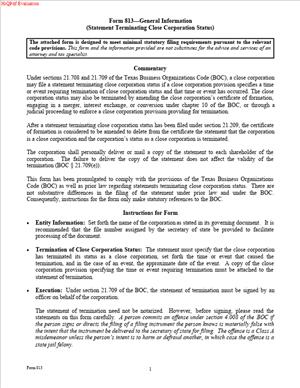
Form 813 – Statement Terminating Close Corporation Status
Fill out nowJurisdiction: United States — Texas
What is a Form 813 – Statement Terminating Close Corporation Status?
Form 813 is a filing you submit to the Texas Secretary of State to end a corporation’s “close corporation” status. A Texas close corporation is a for‑profit corporation that has elected special statutory rules in its certificate of formation. Those rules allow heavy shareholder control, limited transferability of shares, and simplified corporate formalities. Close corporation status is not automatic. It only applies if the certificate of formation includes the close corporation statement.
When your corporation no longer qualifies for those special rules, or you no longer want them, you use Form 813. The filing notifies the state and the public that the corporation has ceased to be a close corporation. After the filing takes effect, the corporation is governed by the general Texas corporate rules for for‑profit corporations.
Who typically uses this form?
Corporate officers, directors, or an authorized corporate representative prepare and sign the filing. In many cases, your outside counsel or corporate secretary will handle it. If you are the business owner or a managing shareholder, you may coordinate the approvals and direct your team to file.
Why would you need this form?
You need it if your corporation’s certificate of formation states it is a close corporation and:
- You voluntarily decide to terminate that status by shareholder vote and amendment, or
- You triggered an automatic termination event, such as increasing the number of shareholders beyond the statutory limit, or
- Your shares became listed or regularly traded on a public securities market.
Typical usage scenarios include growth and financing events. You may be raising capital and adding investors. You may be implementing a more traditional board structure. You may be aligning your governance with lender or investor requirements. Or you may have crossed the shareholder limit that close corporations must observe. In each of these cases, you file Form 813 so the public record matches your new governance status.
In practical terms, Form 813 does two things. It tells the state that your corporation no longer operates under the “close corporation” subchapter. And it sets an effective date for the change so partners, lenders, and regulators can rely on it. If you also removed the close corporation clause from your certificate of formation, Form 813 complements that amendment by memorializing the status change.
When Would You Use a Form 813 – Statement Terminating Close Corporation Status?
You use Form 813 when the corporation has been operating as a close corporation, and that status is ending. You might initiate this yourself. Or the law may require it because a disqualifying event occurred.
A common scenario is growth through investment. Suppose you formed a close corporation to make decisions with a small group of shareholders. Now you are bringing in a dozen angel investors and issuing additional shares. As your cap table expands, you may exceed the statutory shareholder cap. Once you pass that limit, close corporation status no longer fits. You file Form 813 to reflect the change.
Another scenario is financing that requires traditional corporate governance. Lenders or institutional investors often require a board, committees, and standard corporate procedures. If your certificate allows shareholder management instead of a board, you may choose to end close corporation status and adopt a conventional board. Once shareholders approve that change and you amend the certificate to delete the close corporation statement, you file Form 813 to record the termination.
You may also use the form when your shares become publicly traded or regularly quoted on a securities market. Public trading is inconsistent with close corporation rules on shareholder numbers and transfer restrictions. If trading has started, you file Form 813 to confirm that the special status has ended.
Sometimes you use the form to clean up older records. Many Texas corporations elected close corporation status years ago and no longer need it. You may be standardizing your governance across subsidiaries. You may be preparing for a merger where the surviving entity will not be a close corporation. In those cases, you coordinate the internal approvals, remove the statement from your certificate of formation, and then file Form 813.
Typical users include corporate officers, corporate secretaries, general counsel, and managing shareholders. If you own the business, you drive the approvals and have your team file. If you advise the business, you confirm that a terminating event occurred or that voluntary approvals are in place. In every case, the corporation—the entity itself—is the filer. The form is not filed by individual shareholders in their personal capacity.
Legal Characteristics of the Form 813 – Statement Terminating Close Corporation Status
Form 813 is a public filing that has legal effect under Texas corporate law. It is legally binding because the Texas filing statutes treat it as part of the entity’s public record. Once accepted and effective, the filing updates the corporation’s status under the code. From that point forward, the corporation is no longer governed by the close corporation subchapter. The secretary of state indexes the filing and associates it with your entity record. Third parties can rely on it when they assess your governance framework.
What ensures enforceability?
Proper internal authority and accurate content. If you are voluntarily terminating close corporation status, your certificate of formation must be amended to delete the close corporation statement. That amendment must be approved by the required shareholder vote. Many certificates require at least a two‑thirds vote of the outstanding shares. Your certificate may impose a higher threshold. You must satisfy whatever your certificate and bylaws require. You then sign and submit Form 813 to memorialize the termination.
If your close corporation status ended because a disqualifying event occurred, your filing confirms the automatic change. Disqualifying events include having more shareholders than the limit or having your shares publicly traded or regularly quoted. In those cases, you do not need shareholder approval to acknowledge the change. The status already ended under the statute. You still file Form 813 to update the public record and avoid confusion.
The filing becomes effective when accepted by the Secretary of State, unless you select a delayed effective date. You may delay the effective date for a short period to coordinate with internal implementation. For example, you might want your new board to take office on a specific date. You select that date in the filing so your governance and public record line up.
There are several legal considerations to keep in mind:
- Termination of close corporation status does not erase existing obligations. Contracts, guarantees, and liabilities remain in place.
- Share transfer restrictions embedded in shareholder agreements or bylaws may continue to apply. If you want those restrictions removed, you must amend those documents.
- If you were a shareholder‑managed corporation under your certificate, you must install a board once the close status ends. Appoint directors, adopt board‑level bylaws, and elect officers.
- The term “closely held corporation” is different from “close corporation.” You may still be a closely held corporation based on the number of shareholders. That classification affects some procedural rules, but is not the same as the statutory close corporation status you are terminating.
- False statements in a filing can trigger penalties. Ensure your facts are correct and your approvals are documented.
In short, Form 813 is a binding notice that resets your governance under general corporate rules. It works when you pair it with the right internal approvals and, if needed, a certificate amendment.
How to Fill Out a Form 813 – Statement Terminating Close Corporation Status
Follow these steps to prepare and file the form correctly.
1) Confirm you are the right filer
- Make sure your entity is a Texas for‑profit corporation that elected close corporation status in its certificate of formation.
- If your entity is an LLC or a professional corporation, this form is not the right tool.
- Confirm your corporate name and file number as shown on record. You will need both.
2) Identify the basis for termination
- Voluntary termination: You plan to delete the close corporation statement from the certificate of formation. This option requires shareholder approval and a certificate amendment.
- Automatic termination: You crossed the shareholder limit or your shares became listed or regularly traded in a public market. In that case, the close status ended by operation of law. You file the statement to reflect the change.
3) Obtain internal approvals (if voluntary)
- Review your certificate of formation and bylaws for voting thresholds. Many require at least a two‑thirds approval of outstanding shares to delete the close corporation statement. Your documents may require more.
- Prepare a board resolution recommending the amendment, if your corporation has a board. If you are shareholder‑managed, prepare written consents or meeting minutes.
- Hold the shareholder vote or obtain written consents. Keep signed copies in your records.
- Prepare a certificate of amendment removing the close corporation statement. The amendment and Form 813 typically move together.
4) Gather key data for the form
- Entity name exactly as it appears in your formation documents.
- Texas file number for the corporation.
- The reason for termination: deletion of the close corporation statement, or occurrence of an automatic event.
- The date the terminating event occurred. For example, the date your 36th shareholder was issued shares, or the date trading began. If voluntary, the date the amendment becomes effective.
- The effective date of the Form 813 filing. You can choose immediate effectiveness upon filing or a delayed date.
- The name and title of the individual who will sign. An authorized officer or director should sign.
5) Complete the identity section
- Enter the legal name of the corporation without changes or abbreviations not on record.
- Enter the entity’s Texas file number. This ensures your filing links to the correct record.
6) State the termination of the close corporation status
- Use clear language that the corporation terminates its close corporation status.
- Indicate the basis:
- If voluntary, state that the certificate of formation has been amended to delete the close corporation statement. Identify the shareholder approval date if helpful.
- If automatic, state the specific event: the corporation exceeded the shareholder limit, or its shares became publicly traded or regularly quoted. Provide the date of the event.
7) Select the effective date
- Option A: Effective on filing. Use this if you want the status to end as soon as the state accepts the filing.
- Option B: Delayed effective date. Choose a date within a short window if you need time to install a board, update bylaws, or coordinate with financing. Enter the specific date.
8) Execution (signature)
- An authorized officer, director, or other authorized representative signs the form.
- Print the signer’s name and title. Date the signature.
- Confirm that the signer has authority under your bylaws or board resolutions.
9) Prepare the accompanying amendment (if voluntary)
- If you are terminating voluntarily, the certificate of formation must no longer contain the close corporation statement.
- Ensure your certificate amendment removes that statement in full. If your certificate gave shareholders management powers, add or restore board‑management provisions as needed.
- Align the effective date of the amendment with the Form 813 effective date.
10) File the form
- Submit the signed form to the Secretary of State with the required filing fee.
- Choose your filing method based on your timing needs. Keep a copy of the submission for your records.
- If timing is critical, consider expedited processing. Build in processing time for your deal timeline.
11) Obtain and store proof
- Keep the file‑stamped copy of Form 813 and, if applicable, the file‑stamped certificate amendment.
- Place both in your minute book or electronic corporate records.
- Provide copies to your counsel, lenders, and investors as needed.
12) Implement post‑filing governance changes
- If you were shareholder‑managed, appoint a board of directors effective as of the Form 813 date.
- Adopt or update bylaws tailored for board management. Establish meeting procedures and officer roles.
- Elect officers consistent with your bylaws. Update banking resolutions and signature cards.
- Update stock certificates to remove any “close corporation” legends that no longer apply.
- Review shareholder agreements and investor rights agreements. If they rely on close corporation provisions, amend them.
13) Update related registrations and communications
- Notify your registered agent if they maintain governance summaries for your account.
- Inform your accounting team. The filing does not change tax classification by itself, but they should track the effective date for records.
- If you have ongoing transactions, deliver evidence of termination to counterparties who requested it.
14) Avoid common mistakes
- Do not rely on Form 813 alone if you are voluntarily terminating. You must also remove the close corporation statement from the certificate of formation.
- Do not miss the automatic termination timeline if you crossed the shareholder limit or began public trading; file promptly to align the public record.
- Do not use an outdated corporate name or the wrong file number. Verify against your most recent filing.
- Do not leave the effective date blank if you need coordination with other steps.
- Do not forget to install a board if shareholder management ends with the termination.
15) Example walk‑through
- You formed as a close corporation to make decisions with three founders.
- You now have 20 new angel investors. Your cap table shows 38 shareholders.
- Close corporation status ended when you issued the 36th shareholder’s shares.
- You prepare Form 813 stating that the corporation exceeded the shareholder limit on that issuance date. You select immediate effectiveness.
- You also update your bylaws to reflect a board structure. You appoint directors and elect officers on the same date.
- You notify your bank and investors and provide the file‑stamped copy as evidence.
16) Another example of voluntary termination
- You want to adopt a formal board before a financing round.
- Your certificate includes the close corporation statement and gives shareholders management power.
- You secure the required shareholder approval to delete those provisions.
- You file a certificate amendment to remove the close corporation statement.
- You file Form 813 the same day, with a coordinated effective date next Monday.
- Over the weekend, you finalized board charters and officer appointments. On Monday, the new governance is in effect, and your financing closes with clean diligence.
By following these steps, you will complete Form 813 correctly and align your internal governance with your public record. Keep your approvals, minutes, and file‑stamped documents organized. Lenders, investors, and auditors will ask for them.
Legal Terms You Might Encounter
- Close corporation status means your corporation chose a special set of rules that allow tight owner control. Form 813 ends that choice. After filing, your corporation operates under the standard rules for Texas for-profit corporations. This change affects how you govern, vote, and transfer shares.
- Termination of close status is the legal action that removes those special close corporation provisions. It does not dissolve the company or change its name. It only changes which corporate rules apply going forward.
- Board resolution is the formal action your directors take to approve the termination. If you did not have directors under your close corporation structure, you may need to appoint them as part of the transition. Your governing documents guide who approves first.
- Shareholder approval means the owners agreed to end the close corporation status. Your certificate of formation, bylaws, and any shareholder agreements set the voting standard. Form 813 relies on those internal approvals. The state filing office assumes you handled them correctly.
- Unanimous shareholder agreement is a contract often used by close corporations. It can replace or limit board powers. If you file Form 813, you should review and update or terminate any such agreement. Leaving a unanimous agreement in place after termination can create conflicts.
- Certificate of formation is your corporation’s charter on file with the state. Close corporation provisions may appear there. Form 813 removes your close status. You may also need to amend your certificate of formation if it still includes language tied to close corporation rules.
- File number is the unique number the state assigned to your corporation. Form 813 asks for this number and your exact legal name. Using both ensures the filing office matches your form with the right record.
- Authorized officer or director is the person who signs Form 813 for the corporation. You must have authority under your bylaws or resolutions. Sign with your title and print your name clearly. The filing office may reject a form with an unclear or improper signature.
- Effective date is when the change takes effect. You can choose the date allowed by the form. If you do not choose a date, effectiveness occurs upon filing. Pick a date that fits your governance and transaction timeline.
- Corporate law status versus tax status are different things. Form 813 changes your corporate law status only. It does not alter your federal or state tax classification by itself. If you want tax changes, handle those through proper tax filings and notices outside this process.
FAQs
Do you need shareholder approval before filing Form 813?
Yes. Form 813 depends on proper internal approval. Check your certificate of formation, bylaws, and any shareholder agreements. Confirm who must vote and what vote you need. Document the approvals in minutes or written consents. Keep those records with your corporate books.
Do you need to amend your certificate of formation after filing?
Maybe. Form 813 ends your close status, but it does not rewrite your charter. If your certificate includes close corporation provisions, consider an amendment. Remove language that conflicts with standard corporate rules. Align your governing documents with the new status to avoid disputes.
Do you need to update or cancel a unanimous shareholder agreement?
Likely. Many close corporations use unanimous shareholder agreements to replace a board or limit its powers. After termination, those terms may no longer fit. Review the agreement. Decide if you will terminate it, amend it, or adopt new bylaws. Get the required approvals and keep records.
Does filing Form 813 change your tax classification?
No. Ending close corporation status is a corporate law change. Your tax classification does not change automatically. If you want a different tax classification, make the appropriate tax filings. Coordinate timing so governance and tax outcomes work together.
Can you pick a delayed effective date?
Yes, if the form allows it. A delayed date lets you prepare for the transition. Plan your board appointments, bylaws, and notices around that date. Make sure the date meets the state’s timing limits. If you do not choose a date, effectiveness occurs upon filing.
Do you need a new entity number or a name change?
No. Form 813 does not create a new entity. It changes your status only. Your entity name and file number stay the same. If you want to change your name, use the appropriate name change filing. Do not combine changes unless the state allows it.
Can you re-establish close corporation status later?
Possibly. You would need to take the steps the state requires at that time. That may include amending your certificate of formation and getting new approvals. There is no automatic right to return to the closed status. Plan carefully before you terminate.
Do you have to tell banks, investors, or insurers?
Yes. Your contracts may reference close corporation provisions. Notify lenders, investors, insurers, and key partners about the change. Share updated bylaws, resolutions, or board lists as needed. This helps you avoid covenant breaches and operational delays.
Checklist: Before, During, and After the Form 813 – Statement Terminating Close Corporation Status
Before signing
- Confirm you are a Texas for-profit corporation that elected close status.
- Review your certificate of formation, bylaws, and shareholder agreements.
- Identify the vote or consents required to end the close status.
- Draft and approve a board resolution, if you have directors.
- Draft and collect shareholder approvals with the correct voting threshold.
- Decide on your effective date. Align it with board, meeting, and contract timelines.
- List all close corporation provisions in your governing documents. Plan updates.
- Review unanimous shareholder agreements and buy-sell agreements. Plan updates.
- Identify stock transfer restrictions or legends that reference close status.
- Gather your exact entity name and state file number.
- Confirm who will sign the form and their title.
- Prepare your payment method for the filing fee.
- Choose a filing method and plan delivery timing.
During signing
- Verify the exact legal name matches the state’s record.
- Enter the correct state file number with no transposed digits.
- Check the termination statement language for accuracy and completeness.
- Select the effective date option. Add a delayed date only if needed.
- Confirm the signer’s name, title, and authority are accurate.
- Use a consistent signature style. Print the signer’s name clearly.
- Include any required supplemental statements if your form calls for them.
- Do not mix other amendments into this filing. Use separate filings for those.
- Review every field for typos, blanks, or mismatched dates.
After signing
- File the form and pay the fee using your chosen method.
- Track delivery or submission. Note the date and any confirmation numbers.
- Calendar an expected response date. Allow time for processing.
- When accepted, save the stamped or confirmed copy in your records.
- Update bylaws and, if needed, your certificate of formation.
- Terminate or amend any unanimous shareholder agreement, if applicable.
- Update your cap table and stock certificates to remove obsolete legends.
- Appoint or confirm directors if your prior structure did not use a board.
- Notify lenders, investors, insurers, and key partners.
- Provide updated officer and director information to parties who rely on it.
- Update internal policies to reflect standard corporate governance.
- Train your team on new meeting, approval, and recordkeeping practices.
- Monitor your state record to confirm status shows the change.
- If rejected, fix the issues and refile promptly.
Common Mistakes to Avoid
- Don’t forget internal approvals. Filing without proper board or shareholder approvals can trigger disputes. It can lead to challenges to your actions after the filing. Get approvals in writing and keep them in your records.
- Don’t leave close corporation language in your documents. Keeping old provisions in your certificate, bylaws, or agreements creates confusion. It can delay decisions, financing, and deals. Align your documents with your new status right away.
- Don’t confuse corporate status with tax status. Form 813 does not change how you are taxed. Expecting a tax shift can cause planning errors. Coordinate any tax changes through the correct tax filings.
- Don’t misstate your entity name or file number. Errors lead to rejections or misapplied filings. That wastes time and risks missing deadlines. Double-check both against your state record.
- Don’t ignore the effective date. Picking a date without a transition plan can leave gaps. Transactions may straddle two governance regimes. Set a date that avoids meetings or closings falling in the wrong window.
What to Do After Filling Out the Form
- File the form and pay the fee. Choose a filing method that meets your timeline. If you selected a delayed effective date, confirm it meets the state’s rules. Keep a copy of everything you submit.
- Track your filing. Watch for acceptance or rejection. If the filing is accepted, save the stamped or confirmed copy. If the filing is rejected, correct the issues and resubmit quickly. Note any reasons for rejection to avoid repeat errors.
- Update your governing documents. Amend your certificate of formation if it still references close corporation rules. Adopt bylaws that fit standard corporate governance. Decide how directors are elected and how meetings will be held. Document changes with board and shareholder actions.
- Address unanimous shareholder agreements. If you used one, it may no longer fit. Terminate it or amend it to reflect the new governance framework. Make sure the process follows its termination or amendment provisions.
- Adjust share transfer terms. Review stock transfer restrictions that existed only because of the close status. Update buy-sell agreements, rights of first refusal, and legends on stock certificates. Reissue certificates if needed. Update your cap table to reflect any changes.
- Establish or confirm your board if your close corporation structure allowed no board seats for directors now. Approve bylaws, banking changes, and officer appointments. Set an annual meeting schedule and recordkeeping practices.
- Notify key parties. Inform lenders, investors, insurers, and advisors. Update certification forms, opinion letter requests, and diligence packages. Provide updated lists of officers and directors where needed. Review covenants that referenced close corporation status.
- Align your operations. Update internal approval matrices and signature authority. Revise meeting calendars and minute templates. Train your team on notice, quorum, and voting requirements. Confirm who must sign contracts under the new governance rules.
- Review compliance calendars. Your overall reporting rhythm likely remains the same. Still, your governance duties may expand under standard rules. Add reminders for board meetings, annual shareholder meetings, and minutes. Keep your records in good order.
- Plan for future changes. If you want to re-establish a close status later, map the steps now. Keep clean records of the termination. That will simplify future filings and approvals. Revisit your governance setup each year to confirm it still fits your company.
- Maintain a clean document set. Store Form 813, approvals, minutes, bylaws, and any amendments together. Keep signed copies and electronic scans. This helps with audits, financings, and due diligence.
Disclaimer: This guide is provided for informational purposes only and is not intended as legal advice. You should consult a legal professional.