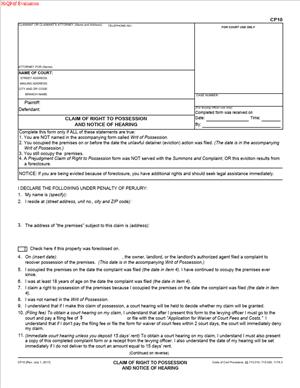
CP10 – Claim of Right to Possession and Notice of Hearing
Fill out nowJurisdiction: United States | California
What is a CP10 – Claim of Right to Possession and Notice of Hearing?
CP10 is a Superior Court of California form used in landlord-tenant eviction cases after the court has already entered a judgment for possession and the sheriff has posted or served a notice to vacate. If you live in, use, or occupy the property but your name was not listed in the unlawful detainer lawsuit or on the eviction judgment, this form lets you tell the court that you claim a legal right to stay. When you file it on time and correctly, the sheriff usually pauses the lockout until the court holds a fast hearing to decide your claim.
Who typically uses this form?
People living at the property who were not named in the eviction case. That includes subtenants, family members, roommates, cohabitants, live-in caregivers, and sometimes business occupants in commercial spaces. It can also apply if you moved in after the case started, or if the landlord sued only the “master tenant” and not you.
Why would you need this form?
Because the writ of possession (the court’s eviction order) authorizes the sheriff to remove occupants listed in the case and anyone whose rights have already been adjudicated. If you were not included and did not have your day in court, CP10 gives you a narrow, fast path to be heard before you’re locked out. It’s your due process safety valve. Without it, the sheriff can proceed with the eviction and you could lose possession without a hearing.
Typical usage scenarios
- You are a subtenant who pays rent to the master tenant, but the landlord sued only the master tenant and won. The sheriff posts a notice to vacate and you first learn of the case. You file CP10 to ask for a hearing and to explain your tenancy.
- You are the master tenant’s spouse, partner, or family member who moved in before the case and has an agreement to live there. Your name is missing from the lawsuit and judgment. CP10 lets you tell the court your connection to the home.
- You are an occupant in a commercial suite under a sublease. The landlord evicted the prime tenant only. You file CP10 to assert your possessory rights.
- You are a caretaker or employee with a right to be there as part of your job. You were not named in the case. CP10 allows you to request a hearing to prove your right to possession.
This form is part of the postjudgment stage of an unlawful detainer. It’s tied to the sheriff’s eviction process. You will see it referenced or served alongside the writ of possession and the sheriff’s notice to vacate.
When Would You Use a CP10 – Claim of Right to Possession and Notice of Hearing?
You use CP10 after a judgment and writ of possession are issued, and after the sheriff posts or serves a notice to vacate at the property. The key condition is that you were not named as a defendant in the unlawful detainer and you claim a legal right to continue occupying the premises. Timing is critical. You must act immediately. The deadline to file is short and is printed on the form and sheriff’s notice. If you miss that deadline, the sheriff can proceed with the lockout.
Here are practical examples. The landlord never knew you lived there and sued only the person on the lease. You see the sheriff’s notice taped to the door. You should prepare CP10 the same day and follow the filing instructions on the notice. Or, you moved in mid-lease with the landlord’s consent but were not added to the lease or the case. You discover the judgment only when the sheriff posts at the property. CP10 is the correct tool to request a hearing and show your approval to occupy. Another common scenario is a subtenancy. You rented a room or a unit from the master tenant. The landlord obtained a judgment against the master tenant. You file CP10 to present your sublease, rent receipts, and communication showing you have a legitimate right to stay.
It’s not only for residential settings. If you operate a business in a portion of a commercial property and the landlord sued the primary tenant, you can use CP10 to assert your possessory interest if you were not named. The same goes for a licensee or concessionaire who has documented permission to occupy a space.
If you were served earlier with a “prejudgment” claim of right to possession as part of the initial eviction paperwork and did not act then, CP10 is usually not available now. In many cases where that earlier procedure was properly used, the court’s judgment already applies to “all occupants,” and the sheriff will not accept a CP10 to delay the lockout. If you’re unsure which papers you were served, read the sheriff’s notice carefully. It will say whether a postjudgment claim is allowed.
Landlords do not file CP10. They receive it and prepare for the hearing. If you are a landlord reading this, expect a brief pause in the lockout and a focused hearing on whether the claimant has a real right to possession. Bring the lease, proof of service from the eviction case, and any documents showing the claimant was served earlier or has no legitimate tenancy.
Legal Characteristics of the CP10 – Claim of Right to Possession and Notice of Hearing
CP10 is a court-approved form that triggers a specific legal process in an unlawful detainer after judgment. It is signed under penalty of perjury. When you submit it properly and on time, it temporarily stops the sheriff from enforcing the writ against you until the court holds a hearing. That pause protects your due process rights as an unnamed occupant and prevents an immediate lockout without a judicial decision about your claim.
Is it legally binding?
Your statements on CP10 are sworn. If you misrepresent facts or file in bad faith, you risk court sanctions, adverse orders, or referral for perjury. The form also usually includes your consent to be added to the eviction case and to accept service of case papers at the address you list. That means you become a party to the unlawful detainer for purposes of deciding possession, and potentially for money claims related to the occupancy period. Once the court rules on your claim after the hearing, that ruling is binding. If the court denies your claim, the writ of possession will be enforceable against you, and the sheriff can proceed with the lockout. If the court sustains your claim, the writ may not be enforced against you, and the landlord may have to pursue separate legal steps to obtain possession of you.
What ensures enforceability?
The sheriff enforces writs of possession and follows court orders in the county where the property is located. CP10 is the mechanism that tells the sheriff to pause and lets the court decide your status quickly. The hearing is set on an expedited basis. The court’s order after the hearing instructs the sheriff what to do next—either continue the eviction or stand down as to you. That chain of court order, writ, and sheriff enforcement is what gives this process legal force.
General legal considerations. CP10 is not a defense to the underlying judgment against named defendants. It’s a narrow path for someone who was not named to assert their rights. If you file CP10, you are telling the court you genuinely claim a right to possession, not simply that you want more time. Judges are looking for credible evidence: a lease, sublease, written permission, rent receipts, communications with the landlord, utility bills, or other documents showing lawful occupancy. If you are just a guest or you moved in after the judgment to avoid eviction, the court will likely deny your claim. If a prejudgment claim procedure was used and you were served earlier, your postjudgment claim may be rejected because your rights have been adjudicated already.
Fees may apply. Some courts charge a filing fee to process your claim. If you cannot afford the fee, you can apply for a fee waiver. The form itself does not require a rent deposit. If you see instructions about depositing rent, that is usually tied to a different, earlier procedure and not this postjudgment claim. Always read the instructions on your papers to confirm how your county handles filing and scheduling.
Finally, timing matters. CP10 has a short deadline. The sheriff will not wait if the deadline passes. If you decide to file, do it the same day you receive the papers.
How to Fill Out a CP10 – Claim of Right to Possession and Notice of Hearing
Follow these steps. Move quickly and be accurate. Keep your sentences short, documents organized, and facts consistent with what you will say at the hearing.
1) Gather your papers and information
- The sheriff’s notice to vacate and the writ of possession posted or served at the property.
- Any eviction case documents you have (summons, complaint, judgment), if available.
- Your proof of occupancy and right to possession: lease or sublease, written permission, rent receipts, bank statements showing rent payments, utility bills, or mail showing you at the address, text or email confirmations with the landlord or property manager, photos of your room or business space, and keys or access badges.
- Identification. You may need it for filing at the sheriff’s office.
- Money for any filing fee, or a fee waiver application if you qualify.
2) Read the instructions on your notice
Your notice will tell you where to file the CP10. Some counties require you to deliver the completed CP10 to the sheriff (levying officer). Others allow or require filing with the court clerk and immediate delivery of a copy to the sheriff. Follow the instructions on your papers. The deadline is short and printed on the notice. Calendar it and act the same day.
3) Complete the caption (top section)
- Court name and branch: Use the same court and branch that issued the unlawful detainer judgment.
- Case number: Copy it exactly from the writ, judgment, or notice.
- Plaintiff/Petitioner and Defendant/Respondent: Copy the names as they appear in the case. This is usually the landlord (plaintiff) and the named tenant(s) (defendants).
- Property address: Enter the full street address of the premises, including unit number if any.
- Sheriff or levying officer file number or writ number: If your notice shows a sheriff’s reference number, include it. This helps the sheriff connect your claim to the lockout.
4) Identify yourself and your claim
- Your full legal name: Use your legal name as on your ID.
- Your relationship to the premises: State you live there, occupy a room, sublet the unit, or conduct business in a specific suite. Be precise. Example: “I sublease Bedroom B from [Master Tenant] and have lived there since March 2023.”
- Basis for your right to possession: Check or state that you have a lease, sublease, written permission, or other right. If your lease is oral, say so, and be ready to describe terms at the hearing.
- Date you began occupying: Month and year at a minimum.
- Monthly rent or license fee (if any): State the amount you pay and to whom you pay it.
- Whether you were named or served in the eviction case: Indicate that your name was not on the complaint, you were not served with the summons and complaint, and you did not receive earlier court papers. If you did receive the initial eviction papers with a prejudgment claim form, state that; it affects the court’s analysis.
5) Accept service and understand party status
The CP10 includes language by which you agree to be joined in the unlawful detainer for the limited purpose of deciding possession and to accept service of papers at the mailing address you list. Make sure the mailing address is accurate and that you can receive mail there. Add a phone number and email to ensure you receive hearing details quickly.
6) Provide your mailing and contact information
- Mailing address: Use a reliable mailing address. If mail at the property is risky due to an imminent lockout, consider a safe alternate address where you can get mail fast.
- Phone and email: Optional but helpful for scheduling and notices.
- Language or accommodation needs: If the form provides a space to note language or access needs, use it.
7) Attach supporting documents
Strong attachments increase your credibility:
- A copy of your lease, sublease, or written permission. If oral, prepare a short declaration describing who offered the tenancy, key terms, and witnesses.
- Rent receipts, bank transfers, or money order stubs.
- Utilities or official mail with your name and the property address.
- Communications with the landlord or manager acknowledging you.
- Photos or diagrams showing your specific room or unit, if relevant, labeled with dates.
- Any page needed to continue explanations. If the form has limited space, add an attachment labeled “Attachment to CP10 – Claim of Right to Possession” and reference the section you’re supplementing.
Do not attach originals. Use clear copies. Bring originals to the hearing.
8) Sign and date under penalty of perjury
Read the declaration carefully. You are swearing that the facts are true. Sign and date. Unsigned claims are rejected. Use black ink, print clearly, and ensure your name matches the name you listed earlier.
9) Make copies
Prepare at least three sets:
- One for the court.
- One for the sheriff or levying officer.
- One for the landlord or the landlord’s attorney.
- One for your records.
Some counties will handle service on the landlord after you file with the sheriff. Others require you to serve the landlord or attorney by personal delivery or mail. Follow the instructions on your notice. If service by mail is allowed, use first-class mail the same day and keep proof of mailing.
10) File the CP10 promptly
- Where to submit: Follow the instruction on the sheriff’s notice. In many counties, you deliver the completed CP10 to the sheriff’s office that posted the notice. The sheriff then sends it to the court and pauses the lockout. In some courts, you file at the clerk’s window and deliver a copy to the sheriff. Ask the clerk or sheriff which applies in your county.
- Deadline: Meet the deadline on your notice. If the notice says “within X days,” do not wait until the last day.
- Fees: Pay any filing fee required. If you cannot afford it, submit a fee waiver application at the same time. If the sheriff collects a processing fee, be prepared to pay that as well.
Get a filed-stamped copy if you file at the court. If you submit to the sheriff, ask for a receipt or stamped copy.
11) Calendar and prepare for the hearing
You will receive a hearing date quickly, often within days. The hearing notice may be returned to you on the same form or as a separate notice. Confirm the date, time, department, and courtroom. Set aside time to attend in person, or follow instructions if remote appearance is allowed.
Prepare your presentation:
- Bring all original documents and two copies.
- Be ready to explain clearly how and when you moved in, what your agreement is, and your payments.
- Be prepared to answer whether the landlord knew about you, whether you were served earlier, and whether you have any written agreements.
- If you have witnesses, bring them or a signed declaration if live testimony is not possible.
12) Attend the hearing
Arrive early. Check in with the clerk. When your case is called, speak clearly and stick to facts. The judge will focus on whether you have a genuine right to possession that was not adjudicated. The landlord or attorney may argue that you are a guest, moved in after the case started to delay eviction, or were served earlier. Respond with documents and specifics.
Possible outcomes:
- Claim granted: The court finds you have a legitimate claim that was not adjudicated. The writ may not be enforced against you. The landlord may need to amend the case or file a new one naming you.
- Claim denied: The court finds you do not have a valid right to possession, or that your rights were already adjudicated. The sheriff can proceed with the lockout, usually on an expedited timeline.
- Conditional orders: The court may issue an order setting further proceedings. Follow the court’s directions closely.
13) After the hearing
Get a copy of the court’s order before you leave. If your claim is denied, plan to move your belongings quickly. If your claim is sustained, keep a copy of the order accessible to show the sheriff if needed. Understand that being added to the case may expose you to claims for rent or damages for the period you occupied the property. If the landlord files further papers, calendar deadlines to respond.
Common Mistakes to Avoid
- Missing the deadline. File immediately on receiving the sheriff’s notice.
- Filing the wrong form. CP10 is postjudgment. Do not use the prejudgment claim form.
- Leaving blanks. Incomplete forms can be rejected or doubted at hearing.
- Not including contact details. You could miss the hearing notice.
- No attachments. Bare statements carry less weight than documents.
- Not serving required parties where your county requires it. Keep proof of service.
- Misstating facts. Inconsistencies harm credibility and can result in sanctions.
Practical tips
- Keep everything in one folder: the sheriff’s notice, your CP10, and all supporting documents.
- Use simple, consistent facts: who, what, when, where, how much.
- Confirm the case number and property address on every page and attachment.
- If you have a language need or disability accommodation, notify the court immediately after you file.
- If the sheriff arrives before your hearing is set, show your filed CP10 and ask them to verify the pause with their office.
What this form is not
- It is not a general request for more time to move. Courts will deny CP10 claims that are only about needing time but do not show a real right to possession.
- It is not a defense for someone already named and served in the eviction case. Named defendants use motions, appeals, or stays, not CP10.
- It is not a rent deposit process. If you see deposit requirements, you’re looking at a different procedure used earlier in the case.
If you’re someone who wants to fill out this form, focus on speed, accuracy, and solid proof. Tell the court clearly why you have a real right to be there and never had your day in court. That is what CP10 is designed to address.
Legal Terms You Might Encounter
- Unlawful detainer is the formal name for an eviction case. If your landlord sued for possession, the case will be labeled as an unlawful detainer. CP10 lets you tell the court you live at the property, but were not named in that case.
- Writ of possession is a court order that lets the sheriff remove occupants. If the sheriff posted a notice about a lockout, a writ of possession has already been issued. CP10 asks the court to hear your claim before the sheriff proceeds.
- Unnamed occupant means you live at the property, but your name does not appear on the eviction papers. CP10 exists for unnamed occupants to request a hearing about their right to stay.
- Stay is a short pause in the lockout process. Filing CP10 usually triggers a brief stay so the court can hold a hearing. The stay lasts only until the hearing and decision.
- Service means delivering legal documents to the other side correctly. With CP10, you must serve your filed claim on the landlord or their lawyer, and often provide a copy to the sheriff listed on the writ.
- Fee waiver is a request to the court to waive filing fees due to financial hardship. If you cannot afford CP10 fees, you can submit a fee waiver with your claim to avoid delays.
- Notice of hearing is the formal notice that tells everyone when and where the court will decide your claim. CP10 includes a notice of hearing section or prompts the court to set one.
- Proof of service is the form or declaration that shows you properly served CP10. The court needs this to confirm that the landlord received your claim.
- Possession means the right to occupy and control the property. In a CP10 hearing, the judge decides whether you have a right to possession that stops the lockout.
- Undertaking is a bond the landlord may post in some situations to proceed despite a claim. If required, the court will explain how any undertaking affects your case after you file CP10.
FAQs
Do you file CP10 if you have already answered the eviction case?
No. If you were named and already filed an answer, CP10 is not for you. CP10 is for occupants who were not named. If you were named, keep using the standard eviction forms for your case.
Do you have to pay a filing fee for CP10?
Often yes, unless the court waives it. If you cannot pay, submit a fee waiver with your claim. File both together so the court can process them at the same time.
Do you deliver CP10 to the sheriff?
You should. The writ lists the sheriff’s office handling the lockout. After you file CP10 with the court, deliver a filed copy to that sheriff so they know a hearing is pending.
Do you serve the landlord or their lawyer?
Yes. Serve the plaintiff’s lawyer if one appears on the eviction papers. If not, serve the landlord. Use a person over 18 who is not you to serve. Complete a proof of service.
Do you get extra time before the lockout once you file?
You get a short pause while the court schedules the hearing. The pause is brief. The sheriff will not wait long beyond the hearing date. Show up prepared, or the lockout may resume.
Do you need evidence to support your right to possession?
Bring it. Useful items include mail showing your name at the address, a lease or sublease, rent receipts, utility bills, or photos of your room and belongings. Bring a government ID, too.
Do you file one CP10 for the whole household?
No. Each adult occupant who was not named should file their own CP10. If only one person files, only their rights get reviewed at the hearing.
Do you still file CP10 if you moved in after the eviction started?
Yes. CP10 is designed for unnamed occupants, including those who moved in after the case began. You still need to show why you have a right to possession.
Checklist: Before, During, and After the CP10 – Claim of Right to Possession and Notice of Hearing
Before signing:
- Identify the eviction case number. Find it on the sheriff’s notice or any court paper posted on your door.
- Confirm the property address matches the writ and the posted notice.
- Write down the sheriff’s file number and contact information from the notice.
- Gather your proof of residence: lease, sublease, rent receipts, mail, utility bills, or declarations from other occupants.
- List all adults in the unit, and note who was named in the eviction and who was not.
- Note key dates: when the sheriff posted the notice and the lockout date, if listed.
- Collect landlord or attorney contact details from the writ or posted papers.
- Prepare your statement of why you have a right to possession. Keep it factual and concise.
- Decide whether you need a fee waiver. Gather pay stubs, benefits letters, or other financial proof if required.
- Arrange a neutral adult (over 18, not you) who can serve documents.
- Make copies of everything you plan to file and serve.
During signing:
- Verify your name and contact information. Use a phone and email you check daily.
- Confirm the case number, court location, and property address are correct.
- Accurately describe how and when you moved in, and your relationship to any tenant.
- State clearly that you were not named in the eviction papers.
- Attach supporting documents. Label them and reference them in your statement.
- Review the notice of hearing section. If the court completes it, make sure it is legible and complete.
- Read the declaration under penalty of perjury. Sign and date in ink. If the form needs multiple signatures, sign each spot.
- Complete any proof of service forms you will need, except for the server’s signature and service details, which come later.
After signing:
- File CP10 with the correct court clerk’s office for the eviction case. Ask for at least two conformed copies.
- If requesting a fee waiver, submit it together with CP10. Wait for the clerk’s instructions.
- Hand-deliver or promptly send a filed copy to the sheriff named on the writ. Ask how they prefer to receive it.
- Arrange service on the landlord or their lawyer. Use a neutral adult. Complete and file the proof of service.
- Calendar the hearing date and time. Build in travel time and security screening.
- Organize your evidence. Bring originals and two sets of copies.
- Plan your brief statement for the judge. Focus on facts showing your right to possession.
- Keep all receipts, stamped copies, and notes together in a folder.
Common Mistakes to Avoid
Filing too late after the sheriff posts a notice.
- Consequence: The court may not hear your claim before the lockout. Don’t wait. File CP10 as soon as you receive the notice.
Not serving the landlord or their lawyer.
- Consequence: The court may refuse to proceed or delay the hearing. Don’t forget proof of service. Serve right after filing.
Using the wrong form or mixing forms.
- Consequence: The court may reject your filing. Don’t submit a general answer or a prejudgment claim by mistake. Use CP10 for unnamed occupants facing a lockout.
Leaving out the case number or sheriff details.
- Consequence: The sheriff may not pause the lockout. Don’t omit the case number, writ information, or sheriff file number if available.
Skipping the hearing.
- Consequence: The court can deny your claim, and the lockout continues. Don’t miss it. Arrive early with your documents and witnesses, if any.
What to Do After Filling Out the Form
- File with the right court. Go to the civil filing window that handles eviction matters. Give the clerk your completed CP10 and any fee waiver. Ask for conformed copies for you, the landlord’s side, and the sheriff.
- Notify the sheriff. Deliver a conformed copy to the sheriff’s office listed on the posted notice. Confirm they received it and note the name of the person you spoke with.
- Serve the landlord or their lawyer. Have a neutral adult deliver or mail a copy of CP10 to the person and address on the eviction papers. Complete a proof of service and file it. Keep a copy with your records.
- Prepare for the hearing. Sort your documents by topic and date. Mark key pages with tabs or sticky notes. Draft a short outline of what you will say. Practice once or twice so you can present clearly in a few minutes.
- Attend and participate. Arrive early and check in. When called, tell the judge you are an unnamed occupant and briefly explain your right to possession. Hand up your exhibits when asked. Answer questions directly.
- Update the sheriff after the hearing. If the court grants your claim, take a copy of the order to the sheriff. If your claim is denied, ask the sheriff about the lockout timeline so you can plan your move.
- Consider next steps if the court denies your claim. You may need to arrange to move, request a brief extension, or discuss a move-out plan with the landlord. If the court allows time, get the time period stated in the order.
- Amend or correct if needed. If the court allowed you to correct an error, do so quickly. File the corrected pages and serve them again. Keep stamped copies.
- Store your records. Keep your filed CP10, proof of service, hearing notice, and any order together. You may need them to update the sheriff, a housing agency, or for any follow-up.
- Communicate any settlement. If you and the landlord reach a written agreement before the hearing, file a copy with the court and notify the sheriff. Make sure the agreement states how the lockout will be handled.
- Monitor deadlines. Watch for any court instructions or dates that affect your rights. Act promptly so the sheriff does not proceed without the court’s decision.
Disclaimer: This guide is provided for informational purposes only and is not intended as legal advice. You should consult a legal professional.