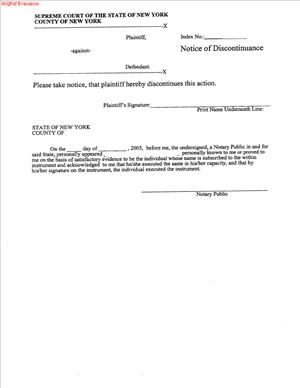
Notice of Discontinuance
Fill out nowJurisdiction: United States | New York
What is a Notice of Discontinuance?
A Notice of Discontinuance is a short court filing that ends your own claims in a New York Supreme Court case. You use it to tell the court and all parties that you are stopping the action or specific claims. It can cover the entire case or only part of it. It can apply to all defendants or only some. It can be with prejudice or without prejudice.
In New York practice, the plaintiff or another party who asserts claims usually uses this form. That includes a petitioner, counterclaimant, cross-claimant, or third-party plaintiff. If you asserted a claim and want to end it, this is your tool. The caption will say “SUPREME COURT OF THE STATE OF NEW YORK”, followed by the county.
You would need this form when you want to end the lawsuit or a part of it. Common reasons include early withdrawal, settlement, or refilling elsewhere. You may also use it to narrow the case and drop a claim that no longer makes sense.
Here is how the mechanics work in broad terms:
- Early in the case, you can often discontinue without a court order. You do so by serving and filing a Notice of Discontinuance. This is available before any defendant serves a responsive pleading, or shortly after you served your complaint. The timing is strict. If you miss it, you will need consent or a court order.
- Later in the case, you can discontinue by written stipulation signed by all parties who appeared. That document is often titled “Stipulation of Discontinuance.” You file it with the County Clerk and serve it on the parties.
- If you cannot get consent, you can ask the court for an order to discontinue. You do that by motion. The court may grant it on terms and conditions, including costs.
A Notice of Discontinuance is a routine document in Supreme Court practice. It is short. It uses the case caption. It states what you are discontinuing and whether it is with prejudice. It includes your signature and service on all parties.
Typical usage scenarios
- You resolve the case by settlement and want to close the file.
- You want to refile in another forum or after correcting a defect.
- You sued the wrong defendant and want to dismiss as to that party.
- You decide to drop only certain causes of action.
- Your claim is better handled in arbitration or an administrative forum.
- You need to end a third-party claim you asserted for contribution.
- You want to withdraw a counterclaim to streamline the trial.
You may also need to file a Notice of Discontinuance to clear the record if you filed a notice of pendency (lis pendens) in a real estate dispute. In that situation, you will usually also file a separate cancellation of the notice of pendency.
When Would You Use a Notice of Discontinuance?
- Use this form whenever you need to stop your own claims in the Supreme Court of the State of New York. The timing and method depend on where the case stands.
- If you are a personal injury plaintiff, you might discontinue after a settlement pays your claim. You file a notice (or a stipulation with defense counsel) to end the action with prejudice. That closes the case and prevents refiling. If you settled with only one defendant, you can discontinue as to that defendant only and continue against others.
- If you are a small business that filed a contract case, you might realize the contract has an arbitration clause. You can discontinue the court case and proceed with arbitration. You may do this early by notice. If an answer has already been served, you will likely use a stipulation or a motion.
- If you are a landlord or tenant in a Supreme Court property dispute, you might settle possession with a side letter for repairs. You file a discontinuance to reflect the settlement. If you recorded a notice of pendency to cloud title, you should cancel it once the action ends.
- If you are a corporate defendant who asserted counterclaims, you might decide those claims are not worth the cost. You can discontinue your counterclaims while the main claim continues. You use a Notice of Discontinuance for your own counterclaims. Your discontinuance does not touch the plaintiff’s claims.
- If you are a healthcare provider or insurer, you may narrow causes of action to reduce discovery issues. For example, you might discontinue a fraud claim but keep a breach of contract. That can simplify expert issues and shorten depositions.
- If you filed in the wrong county, you might discontinue and refile in the proper venue. You might also discontinue to refile in federal court if diversity jurisdiction exists. Be careful with timing. You need to track the statute of limitations and any tolling rules that may apply.
- If a defendant files for bankruptcy, an automatic stay may halt claims against that party. You might discontinue claims against the bankrupt defendant to proceed against others. Consider whether you need bankruptcy court relief. Coordinate with the stay before you file.
- If your case has become moot, discontinuance closes it cleanly. For example, you sought an injunction, and the event already occurred. Or a government decision resolved your dispute. You end the action by notice or stipulation.
- Certain case types may require court approval before you discontinue. That includes class actions, shareholder derivative suits, and cases involving infants or incapacitated persons. Some matrimonial matters also require court approval to discontinue. In those situations, a simple notice is not enough. You should seek an order or follow the specific procedural rules for that case type.
Legal Characteristics of the Notice of Discontinuance
A properly used Notice of Discontinuance is legally binding. It ends the claims you identify once you serve it and file it with the County Clerk. It is self-executing if you use it at the time the rules allow. The court does not need to sign anything for an early unilateral discontinuance. The case (or the claims) end upon service and filing of the notice.
Enforceability turns on three things:
- Your authority to discontinue at that stage of the case.
- Clear description of what you are discontinuing.
- Proper service and filing.
Authority depends on the case posture. Before a defendant serves a responsive pleading, you can discontinue your claims by notice. After that, you need either a stipulation signed by all appearing parties or a court order. If you assert a counterclaim, the same concept applies to you as counterclaimant.
Clarity matters. Your notice should state whether the discontinuance is with prejudice or without prejudice. It should name the parties and claims it covers. If you intend to discontinue the entire action as to all defendants, say so. If you intend to discontinue only some claims or as to some defendants, list them precisely.
Service and filing complete the discontinuance. You must serve all parties who have appeared. You must file in the County Clerk’s office. If the case is in the New York State Courts Electronic Filing system, e-file the notice and serve through that system. If a party is not e-filing, serve that party by an approved method and upload proof.
What is the legal effect?
- A discontinuance with prejudice ends the claims for good. You cannot refile those same claims.
- A discontinuance without prejudice preserves your right to refile, subject to time limits and other defenses. New filing deadlines may apply.
- The discontinuance ends your claims only. It does not end a co-party’s counterclaims or cross-claims, unless the stipulation or order says otherwise.
- Pending sanctions, cost awards, or discovery obligations can survive. The court can allocate costs or impose terms when granting a discontinuance by order.
- Prior orders in the case remain on the record unless vacated. A discontinuance does not erase the docket.
Some discontinuities require court oversight. When the case involves a class, a derivative claim, or a claim by or against an infant or incapacitated person, the court may need to approve the discontinuance. The court may review settlement terms and ensure protection of those interests. In matrimonial matters, you may need court leave as well.
If you filed a notice of pendency in a real property action, the discontinuance does not automatically cancel it. You should file a cancellation so the title record is clear. This protects you and the defendant from ongoing title complications.
Finally, mind the timing and re-filing risks. If you discontinue without prejudice with plans to refile, check the limitation periods. Some rules may give you a short window to recommence after a non-merit end. That window can be brief. Do not assume an automatic extension. Plan the timetable before you file your notice.
4. How to Fill Out a Notice of Discontinuance
Follow these steps to prepare, serve, and file a Notice of Discontinuance in the Supreme Court of the State of New York.
Step 1: Confirm you can use a unilateral notice
- Check whether any defendant has served a responsive pleading to your claim. If no responsive pleading has been served, you can usually discontinue by notice. If a responsive pleading was served, you need a stipulation signed by all appearing parties or a court order.
- If your case falls into a special category (class action, derivative suit, infant or incapacitated party, or certain matrimonial matters), plan for court approval. In those cases, prepare a stipulation or motion rather than a unilateral notice.
Step 2: Decide the scope and prejudice status
- Decide if you will discontinue the entire action or only certain claims. If partial, list specific causes of action.
- Decide if the discontinuance is with prejudice or without prejudice. With prejudice, it permanently ends those claims. Without prejudice allows refilling, subject to deadlines.
- If you are discontinuing as to only some defendants, identify those defendants by full name as they appear in the caption.
Step 3: Prepare the caption
- Use the exact case caption format. At the top, list: “SUPREME COURT OF THE STATE OF NEW YORK, COUNTY OF [County Name].”
- Include the case title with all parties, exactly as on prior filings. List the Index Number and the filing year.
- Add the IAS Part and the name of the assigned Justice if the case has one.
- Title the document “NOTICE OF DISCONTINUANCE.”
Step 4: Draft the body text
Write a short, clear statement that covers:
- Who is discontinuing: “Plaintiff [Your Name], by [Counsel Name], hereby discontinues…”
- What you are discontinuing: “the above-captioned action” or “the following causes of action…”
- Against whom: “as against all defendants” or “as against Defendant [Name] only.”
- With or without prejudice: “with prejudice” or “without prejudice.”
- Any reservations or clarifications: Note that counterclaims or cross-claims by other parties are unaffected, unless the stipulation or order says otherwise.
- Example language:
- “PLEASE TAKE NOTICE that Plaintiff ABC LLC hereby discontinues this action in its entirety, with prejudice, as against all defendants.”
- “PLEASE TAKE NOTICE that Plaintiff Jane Doe hereby discontinues the Second and Third Causes of Action, without prejudice, as against Defendant XYZ Corp. only.”
Step 5: Add ancillary provisions if relevant
- If you previously filed a notice of pendency, include a line stating you will submit a cancellation of the notice of pendency contemporaneously. Then file that cancellation separately.
- If the court required a bond or undertaking, address its release in a stipulation or proposed order. A unilateral notice cannot release an undertaking by itself.
- If you are discontinuing after settlement, and the settlement requires confidentiality, avoid disclosing settlement terms in the notice.
Step 6: Signature block
- If represented, your attorney signs. Include the attorney’s name, firm, address, phone, and email. Add “Attorneys for Plaintiff” or the correct role.
- If you are self-represented, you sign above your typed name. Include your address, phone, and email.
- Add the date and city.
Step 7: Schedules and attachments (use when the scope is detailed)
- If you are discontinuing only some claims in a complex complaint, attach a Schedule A listing the exact causes of action by number and title. Refer to “Schedule A” in the body.
- If you are discontinuing as to specific defendants among many, attach a Schedule B listing those parties as they appear in the caption.
- If discontinuance is by stipulation, attach the executed stipulation signed by all appearing parties. Make sure each signature block lists the party represented.
Step 8: Proof of service
- Prepare a proof of service for all parties who have appeared. State the date and method of service. List names and addresses.
- If you serve by mail or by hand, use an Affidavit of Service. The server signs before a notary.
- If the case is e-filed, serve through the electronic filing system on consenting parties. Serve any non-participating parties by an approved method and upload proof.
- Keep a copy of the served notice and the proof of service.
Step 9: File with the County Clerk
- File the Notice of Discontinuance and proof of service with the County Clerk for the county where the case is pending. If the case is e-filed, upload the document to the electronic filing system.
- If discontinuance is by stipulation, file the fully executed stipulation. If you need a court order, file your motion with a proposed order.
Step 10: Follow-up actions
- If you filed a notice of pendency, file the cancellation and serve it. Confirm that the County Clerk cancels the record.
- If settlement requires payment or performance, confirm all conditions are met. Your discontinuance does not enforce the settlement. Use a stipulation or order that addresses performance if needed.
- If you discontinued without prejudice to refile, diary the new filing deadline. Track any tolling period closely.
Common drafting tips and pitfalls to avoid
- Use the exact names of parties as shown in the caption. Do not shorten or alter them.
- State “with prejudice” or “without prejudice.” Do not leave it unstated. If you omit it, other parties may argue about intent.
- Specify whether the discontinuance is entire or partial. If partial, list the claims by cause of action number and name.
- Serve all appearing parties, including intervenors and third-party defendants, if your notice affects claims against them.
- Do not try to discontinue someone else’s claims. You can only discontinue the claims you asserted.
- Do not assume a discontinuance ends counterclaims or cross-claims. It does not, unless the stipulation or order says so.
- If an answer has been served and you cannot get consent, move for leave to discontinue. Explain why discontinuance will not prejudice the other side. Offer to pay reasonable costs if appropriate.
- If infants or incapacitated persons are involved, seek court approval. Submit any required affidavits and proposed orders.
- If the case is trial-ready, the court may impose conditions. Be ready to accept terms such as costs or witness fees.
- Keep your notice short. Clarity helps the clerk and the court close the file.
Sample structure you can follow
- Caption: Supreme Court of the State of New York, County of [X]; Index No.; Case Title; IAS Part; Justice.
- Title: Notice of Discontinuance.
- Intro: “Please take notice that [Party] discontinues…”
- Scope: Entire action or specific claims; list parties affected.
- Prejudice: State “with prejudice” or “without prejudice.”
- Reservation: “All counterclaims and cross-claims are unaffected unless otherwise stipulated or ordered.”
- Date and Signature: Include full contact details.
- Proof of Service: Affidavit or electronic service confirmation.
By following these steps, you will file a clean, effective Notice of Discontinuance in the Supreme Court of the State of New York. You will also avoid delays, protect your rights, and close the matter on the record.
Legal Terms You Might Encounter
Notice of Discontinuance
- This is the document you file to end your case, or part of it. In this court, it tells the clerk and all parties that you are stopping the action. It must use the exact case caption and index number so it lines up with the court’s file. You usually serve it on the other parties after filing, so everyone has the same record.
Stipulation of Discontinuance
- This is a written agreement to discontinue, signed by the appearing parties or their attorneys. You use it when consent is required or as part of a settlement. It should state whether the case ends with or without prejudice. It also should make clear which parties and which claims are covered.
With Prejudice
- A discontinuance “with prejudice” closes the claim for good. You cannot bring the same claim again. You might choose this to finalize a settlement and buy full peace. If you write “with prejudice” on your notice or stipulation, you close that door by design.
Without Prejudice
- A discontinuance “without prejudice” ends the current case but leaves the claim open. You can start a new case later if allowed by law. This is useful if you want to regroup, correct defects, or pursue talks. Your form should say “without prejudice” if that is your intent.
Caption
- This is the block at the top that lists the court, county, index number, and all party names. The caption must match the court file exactly to avoid rejection or confusion. If you are discontinuing only as to some parties, keep the full caption but clearly name who is affected. Accuracy in spelling and roles (plaintiff/defendant) matters.
Index Number
- This is the unique number the court gave your case. It appears on every filing, including your notice or stipulation. Mistyping it can misdirect your filing or delay processing. Confirm it from a recent court document before you submit your notice.
Party Appearing
- An “appearing party” has participated in the case, commonly by filing a response or having counsel file a notice of appearance. Their consent may be needed in some situations. When you draft a stipulation, make sure each appearing party who must consent signs it. If someone has not appeared, different service or consent rules can apply.
Counterclaim
- A counterclaim is a claim the defendant brought against you in the same case. A simple notice from you will not end a live counterclaim unless that defendant agrees. If the other side keeps the counterclaim, your case is not fully over. Your form should say whether the discontinuance covers counterclaims.
So-Ordered
- “So-ordered” means a judge has signed and adopted your stipulation as a court order. You might seek this when the court needs to supervise terms or to settle specific issues. If your agreement is “so-ordered,” it has the force of a court directive. Not every discontinuance needs this, but if you want it, present the stipulation for signature.
Proof of Service
- This is a document that shows how and when you served your notice or stipulation. It identifies what you served, who received it, and the method used. It closes the loop after filing, so the court and parties know everyone was notified. Keep it with your file in case the court asks for it.
FAQs
Do you need the other side’s consent to discontinue?
It depends on the stage of your case and whether any party has appeared or asserted claims against you. Early in a case, you can often discontinue without consent. Once the other side has appeared, consent is commonly required, especially if you want to stop the entire case. If there is a counterclaim, you usually need the counterclaimant’s consent, or you must carve the counterclaim out. Use a stipulation when consent is required, and have each necessary party sign.
Can you discontinue only some defendants or some claims?
Yes. You can stop the case against one defendant but keep the case against the others. You can also drop specific claims and leave others active. Your notice or stipulation must state exactly who and what you are discontinuing. Precision avoids arguments about what remains in the case. After filing, serve all parties so the docket reflects the change cleanly.
What is the difference between a Notice of Discontinuance and a Stipulation of Discontinuance?
A notice is a one-sided document that you file to stop your case or part of it. It can be effective at certain times without consent. A stipulation is a signed agreement by the appearing parties to discontinue. You use it when consent is required or when settlement terms are involved. Both need the correct caption, index number, and clear language on prejudice and scope.
Should you discontinue with or without prejudice?
Choose with prejudice if you have resolved the dispute fully and want to end it permanently. Choose without prejudice if you may refile or if you need to preserve your ability to pursue claims later. Think about deadlines that may apply to any future case. Your form should say which applies. If you stay silent, you risk a fight over what you intended.
Do you get your filing fees back if you discontinue?
No. Filing fees are usually not refunded when you end your case. The court has already opened and handled your file. If your settlement addresses costs, put that in the stipulation between you and the other party. The court does not refund fees just because you stopped the action.
Can you discontinue after a motion has been filed or argued?
You can, but you may need consent or court involvement. The more the case has progressed, the less likely a one-sided notice will work. A stipulation is often the cleanest path because it resolves pending motions as well. If a judge has under advisement a motion that affects the merits, plan your approach so the record is clear. File and serve your discontinuance promptly to avoid confusion.
What if the defendant filed a counterclaim—can you still discontinue?
You can discontinue your claims, but you cannot wipe out the counterclaim without that party’s agreement or a separate resolution. If they keep the counterclaim, the case stays open for that claim. If they agree to end it too, include that in a joint stipulation so the entire case closes. Make sure your form states the status of any counterclaim.
Do you need to notify third parties, like insurers or lienholders, before you discontinue?
It is smart to coordinate with anyone who has an interest in the outcome. Insurers may need to approve settlements. Lienholders may expect payment terms. If your settlement depends on outside approvals, secure them before filing. Your discontinuance should align with those obligations so you do not create disputes after the case is closed.
Can you fix a mistake after filing your Notice of Discontinuance?
Yes, but act quickly. If you misstated the prejudice status or left out a party, file a corrected notice or a stipulation clarifying the error. Serve all parties again to keep the record straight. If the court has already taken action or closed the case, you may need a motion to correct the docket. The sooner you address it, the simpler the fix.
How do you prove service of the discontinuance?
Prepare a proof of service that lists the document served, the names and addresses of recipients, the date, and the method used. If your case uses electronic filing, serve through the system, and save the confirmation. For paper cases, mail or hand delivery is common, and you should keep receipts. File the proof if the court requires it, and always keep a copy in your file.
Checklist: Before, During, and After the Notice of Discontinuance
Before signing
- Confirm the exact caption and index number from a recent court paper.
- List all parties, including any added or dropped parties during the case.
- Decide the scope: entire action, certain claims, or certain parties only.
- Decide on “with prejudice” or “without prejudice” and why.
- Check for counterclaims, cross-claims, or third-party claims.
- Identify whether any party has appeared and whether consent is needed.
- Gather signatures from all parties who must consent, if required.
- Align settlement terms with the discontinuance language.
- Confirm insurer or lienholder approvals if the settlement depends on them.
- Check for pending motions or orders that your discontinuance should address.
- Verify service requirements for each party, including non-appearing parties.
- Confirm whether you will e-file or file in person and the correct location.
- Prepare a proof of service template to complete after the service.
During signing
- Verify the caption matches the court’s docket exactly.
- Check the index number on each page if your format uses a footer.
- State clearly which claims and which parties are discontinued.
- Specify “with prejudice” or “without prejudice.” Do not leave it implied.
- Confirm the date and place of signing for each signature.
- Ensure name, title, and party role appear under each signature.
- Include attorney information, including addresses and phone numbers.
- If a stipulation is used, make sure every required party signs.
- Remove stray terms that conflict with your settlement or intent.
- If you plan to seek “so-ordered” status, prepare a clean signature page for the judge.
After signing
- File the notice or stipulation with the court using the proper system.
- Serve all parties who have appeared, and any others required.
- Complete and save proof of service, and file it if needed.
- Request “so-ordered” treatment if your case calls for it.
- Calendar follow-up dates to confirm the docket reflects closure.
- Withdraw pending motions or hearings if they are rendered moot.
- Notify insurers, brokers, or lienholders that the case is discontinued.
- Cancel subpoenas and depositions that are no longer needed.
- Secure and store the final signed documents and service proofs.
- Close your file internally and update your records retention plan.
Common Mistakes to Avoid
- Don’t forget to say whether it’s with or without prejudice.
- Leaving this out invites disputes later. You may think you can refile, while the other side claims you cannot. State it plainly on the form.
- Don’t discontinue only your claims while ignoring a counterclaim.
- If a counterclaim remains, the case stays open. You could face ongoing deadlines. Address counterclaims in your stipulation or clarify what remains.
- Don’t misname a party or use the wrong index number.
- Clerks often reject filings with mismatched case information. Even if accepted, you risk confusion about who is actually dismissed. Match the docket exactly.
- Don’t skip required signatures or consents.
- If the other side has appeared, a solo notice may not work. You could end up with an ineffective discontinuance. Get signatures from those who need to agree.
- Don’t serve the wrong people or fail to provide service.
- Service errors cause delays and disputes about notice. Use the correct method for each party and save your proof. It protects your record.
What to Do After Filling Out the Form
File it with the court.
- Submit your signed notice or stipulation to the clerk through the proper channel. Confirm that the court received it. If the system provides a receipt, save it. You want a clear filing trail for your records.
Serve all parties.
- Send a copy to every party that has appeared, using the approved method. If a party has not appeared, follow the service approach that applies to them. Keep confirmations and mail receipts. If you e-file, download and store the service acknowledgments.
Address any remaining claims.
- If your discontinuance does not end the whole case, clarify what continues. For example, a counterclaim may still be active. Coordinate schedules and update the court if needed. Avoid missed deadlines by confirming what remains on the docket.
Seek a judge’s signature if needed.
- If you want the stipulation to be “so-ordered,” submit it to the judge. Include a short request and a clean signature page. Track the status until the signed order issues. Once signed, serve the order on all parties.
Update pending events.
- Withdraw motions that no longer matter. Cancel hearings and depositions that the discontinuance moots. File a short letter advising the court that the matter has been resolved. This prevents wasted time and duplicate appearances.
Finalize settlement tasks.
- If your discontinuance is part of a settlement, complete closing actions. Exchange any promised payments, releases, or dismissals. Make sure lienholders or insurers receive what they need. Keep copies of all settlement documents with your file.
Fix errors quickly.
- If you spot a mistake, file a corrected notice or a clarifying stipulation. Serve it at all parties. If the court has already closed the case, ask the clerk about the best way to correct the docket. The sooner you act, the easier it is.
Close and store your file.
- Mark the matter closed in your system. Store the signed discontinuance, proof of service, and any signed order. Keep settlement documents as required by your retention policy. That record protects you if questions arise later.
Confirm docket closure.
- Check the docket to ensure the case reflects your discontinuance. If something looks off, contact the clerk. Provide your filing receipt and proof of service. Keep a screenshot or printout of the updated docket for your records.
Disclaimer: This guide is provided for informational purposes only and is not intended as legal advice. You should consult a legal professional.