Subpoena Ad Testificandum – New Jersey
Fill out nowJurisdiction: Country: United States | Province/State: New Jersey
What is a Subpoena Ad Testificandum?
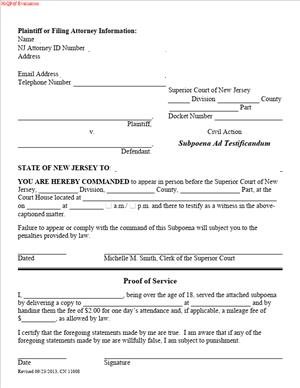
A subpoena ad testificandum is a court order that requires a person to appear and testify. In New Jersey, this form comes from the Superior Court of New Jersey. You use it to compel a witness to attend a trial, hearing, or deposition and give testimony under oath. It does not ask for documents. If you also need records, that is a different form.
Who typically uses the Subpoena Ad Testificandum Form?
Attorneys use it in civil, family, probate, and criminal matters within the Superior Court. Self‑represented litigants use it too. You might be a tenant, landlord, business owner, medical provider, accident witness, accountant, or custodian of records who is asked to testify. If you are prosecuting or defending a claim and need a non‑party witness to appear, you will likely use this subpoena.
Why would you need the Subpoena Ad Testificandum Form?
Voluntary witness commitments are not always reliable. Work conflicts, travel, or reluctance can derail your case. A subpoena turns a request into a legal requirement. It ensures the witness appears at the exact time and place. It also protects the witness with a formal court directive, so employers will excuse the absence.
Typical usage scenarios
- Trial testimony. You need an eyewitness to an accident to identify the scene and sequence of events. You also need a treating physician to explain injuries and prognosis.
- Motion or evidentiary hearing. You need a bank employee to confirm account ownership or a contractor to explain an estimate.
- Family or probate matter. You need a childcare provider to testify about pickup times. You need a financial advisor to explain account transfers in an estate dispute.
- Deposition testimony. You need a third‑party accountant to answer questions under oath before trial. A subpoena fixes a date and compels attendance at the deposition location.
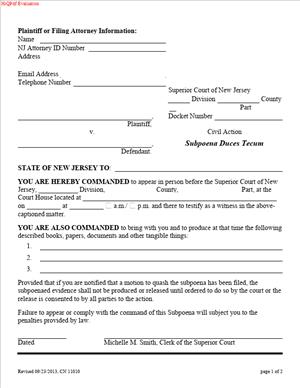
This form is limited to testimony. It commands a person to appear and speak under oath. If you want the same person to bring documents too, use a subpoena duces tecum, or combine testimony with a separate request for records.
When Would You Use a Subpoena Ad Testificandum?
Use this form when you must secure a witness’s live testimony and cannot rely on voluntary attendance. If the witness is not a party to the case, you generally need a subpoena. Parties are already under the court’s authority and usually can be compelled through other orders. Non‑parties are not. Without a subpoena, they may not appear.
Consider a few practical examples. You are a tenant suing for a security deposit. The building superintendent saw the condition of the unit at move‑out. You serve a subpoena so the superintendent appears in court on the hearing date and explains what he saw. You are a small business owner defending a breach of contract claim. You need a former employee to testify about customer approvals. She moved and is hesitant. You issue a subpoena for her deposition to preserve her testimony. You are a personal injury plaintiff. A passerby witnessed the collision but did not want to get involved. You subpoena him for trial so the jury hears a neutral account.
Attorneys use this form daily in the Superior Court. Self‑represented litigants use it as well, especially in the Special Civil Part and Family Part. Landlords and tenants use it for witnesses, like property managers and neighbors. Insurers use it for adjusters or medical providers. Health care offices receive these to produce a treating nurse or billing manager to explain notes. Employers receive them when an employee’s presence is necessary in court.
You also use this form when scheduling constraints matter. Trials often run on tight calendars. The court sets strict start times. A subpoena ensures the witness knows where to go and when. It also allows the court to enforce attendance if needed. If the witness fails to appear, you can ask the court to take action. Without the subpoena, you lack that leverage.
Use it only within New Jersey. A New Jersey subpoena is valid inside the state. It does not compel out‑of‑state witnesses. If your witness lives outside New Jersey, you must use that state’s process to compel attendance. For remote testimony, you still need either consent or a court order. A subpoena alone does not give a right to remote appearance unless the court approves it or the rules allow it for that event.
Legal Characteristics of the Subpoena Ad Testificandum
This subpoena is legally binding because it is issued under the authority of the court. In New Jersey, an attorney of record may issue and sign a subpoena on the court’s behalf. A self‑represented party can ask the Clerk to issue it. Once issued and properly served, the subpoena carries the court’s command. The witness must comply or face possible sanctions.
Enforceability depends on correct issuance and service. The subpoena must list the court, county, docket number, case title, and the witness’s full name and address. It must state the exact date, time, and place of appearance. It must bear the signature of the issuing attorney or the Clerk. The server must deliver it properly. In most cases, that means personal delivery to the witness by an adult who is not a party. Include the statutory witness fee and mileage with service for civil matters. If you skip any of these steps, enforcement becomes difficult.
The court can impose penalties for non‑compliance. Those may include fines or, in serious cases, a warrant to compel attendance. But the court looks at fairness. It will ask whether the subpoena gave reasonable notice. It will check whether you tendered the required witness fee and mileage. It will also consider hardship. If your subpoena gave a doctor only 24 hours to appear during clinic hours, the court may grant relief or reschedule.
A subpoena ad testificandum has limits. It cannot override privileges. A witness may refuse to answer certain questions protected by privilege, such as attorney‑client communications or certain medical information, without proper consent or order. It cannot impose an undue burden. If the time or location is unreasonable, the court can modify the subpoena. The witness may move to quash or ask to reschedule. The court balances your need for testimony against the burden.
A subpoena ad testificandum compels testimony only. Do not use it to demand records. If you need documents and testimony, you must add a document request using the correct form or schedule. Keep the scope clear to avoid confusion and objections at the outset.
Geography matters. The subpoena is effective within New Jersey. It cannot be enforced against a witness outside the state without using the other state’s mechanism. If your witness is in New Jersey, you can compel attendance at any Superior Court location in the state, subject to reasonableness. Choose a location that minimizes burden when possible, especially for depositions.
Timing matters. Serve the subpoena with enough lead time for the witness to plan. For depositions, give ample notice so counsel can attend and arrange a court reporter. For trial, coordinate with the court’s schedule. If the trial spans several days, consider a “time certain” notice. That reduces idle time for the witness.
Finally, remember decorum. A subpoena is a serious directive. Use it only when necessary. Be respectful in communication. Work in good faith to address scheduling issues. Courts expect you to be reasonable while protecting your client’s rights.
How to Fill Out a Subpoena Ad Testificandum
You can complete this form in a few clear steps. Work from the top down. Keep your entries neat and exact. Use full names and complete addresses. Avoid abbreviations that can cause confusion.
1) Confirm your case details
- Gather your docket number. Confirm the exact case caption, including the names of all parties.
- Identify the county where the case is pending. Use that county’s Superior Court listing on the form.
- Know the specific event. Is this for trial, a motion hearing, or a deposition? You will need the date, time, location, and any room or suite number.
2) Choose the appearance type and location
- Trial or hearing: Use the courthouse address, floor, and courtroom number. Include the judge’s name if known.
- Deposition: Use the address where the deposition will occur. That could be your office, the court reporter’s office, or another agreed-upon site. Confirm accessibility and parking.
- Remote appearance: Only if you have consent or a court order. If approved, specify the platform and connection instructions in an attachment.
3) Complete the caption
- Court: “Superior Court of New Jersey.”
- County: Name the vicinage county where your case is filed.
- Division/Part: Civil Part, Special Civil Part, Family Part, Law Division, or Chancery as applicable.
- Docket number: Copy it exactly.
- Case title: List the plaintiff(s) v. defendant(s) as they appear on the complaint.
4) Identify the witness
- Use the witness’s full legal name. Avoid nicknames.
- Add a complete service address. Include apartment or suite number if any. This address is where the server will hand‑deliver the subpoena.
- If the witness is a professional (e.g., doctor), include the practice or facility name as a reference. Still list the individual’s name prominently.
5) State the command to appear
- Write the exact date and time. Avoid vague time ranges. Choose a realistic window.
- Provide the full location. For a courthouse, include street address, floor, and courtroom number. For a deposition, include the company name and suite number.
- Describe the event. “Trial testimony,” “Evidentiary hearing,” or “Deposition upon oral examination.” For a deposition, attach a notice of deposition with topics, if required, and the court reporter’s details.
6) Add any special instructions
- If the witness should check in with a specific clerk or receptionist, note that.
- If you expect the appearance to last a limited time, state the estimated duration. This helps the witness and the court manage time.
- If an interpreter is needed, note that in your communications with the court in advance. The subpoena itself does not secure an interpreter for depositions; you must arrange one for private settings.
7) Identify the issuing party
- If you are an attorney, include your name, firm, address, phone, and email. Add your New Jersey attorney identifier if the form provides a space.
- If you are self‑represented, list your name, mailing address, phone, and email. The Clerk will issue and sign the subpoena for you if you are not authorized to sign.
8) Signature and issuance
- Attorneys may sign and issue the subpoena. Your signature certifies that the subpoena is proper and not unduly burdensome.
- Self‑represented parties must take the form to the Superior Court Clerk for issuance. Bring your case docket information and identification. Be ready to pay any required issuance fee.
- Date the subpoena on the day of issuance. Do not predate or backdate.
9) Prepare the witness fee and mileage
- Civil subpoenas require tendering the statutory witness fee and mileage at the time of service. Use a check or money order payable to the witness.
- Calculate mileage from the witness’s address to the appearance site and back. Use a reasonable route.
- For professionals with set appearance fees, confirm if the court expects a higher tender or a negotiated fee. Some courts handle disputes later, but an upfront tender is still required.
10) Arrange service
- Use personal service in most cases. A subpoena is best served by hand to the witness.
- The server must be an adult who is not a party. You may use a process server, sheriff, or any qualified individual.
- Hand the witness a copy and the fee/mileage tender. Be polite and clear. Do not argue the case.
- Keep track of service attempts, dates, and times. If the witness evades service, note details for the court.
11) Proof of service
- Complete the proof of service page or affidavit of service. Include the server’s name, age, relationship to the case (none), date and time of service, exact location, and the items served (the subpoena and fee).
- Sign and notarize the proof if the form requires it. Many process servers provide notarized affidavits.
- Keep the original proof. File it with the court if requested or attach it to any enforcement motion, if needed. Provide a copy to other parties if appropriate.
12) Serve other parties
- Provide a copy of the subpoena or the deposition notice to all other parties. Do this before or at the time of service on the witness. This avoids surprise and gives parties a chance to object or coordinate scheduling.
- For depositions, serve the notice of deposition on all parties well in advance.
13) Coordinate scheduling and follow‑up
- Call or email the witness after the service to confirm receipt and answer logistics questions. Keep the conversation neutral.
- Provide directions, parking details, security screening times, and check‑in instructions. Make attendance as simple as possible.
- If the court changes the hearing date, notify the witness immediately. If the date shifts materially, issue an amended subpoena and re‑serve with the fee for the new date.
14) Day of appearance
- Bring a copy of the subpoena and the proof of service. Have the witness wait nearby until called.
- Manage time respectfully. If the court delays, update the witness and the judge’s staff.
- If testimony continues to another day, tender the additional daily fee and mileage before the next appearance.
15) If the witness does not appear
- Inform the court on the record that you served a subpoena and tendered fees. Offer the proof of service.
- Ask for appropriate relief. The court may issue a new date, an order to show cause, or, in rare cases, a warrant.
- Consider whether re‑service, a different date, or a deposition would be more effective. The court often prefers practical solutions first.
Real‑world tips
- Choose a “time certain” for professionals like doctors, police officers, and teachers. Coordinate with chambers if possible. This reduces waiting and avoids unnecessary disruption.
- Use neutral locations for depositions to minimize burden. A court reporter’s office with free parking is ideal.
- Keep your requests narrow. Do not plan for a full day if you need only 30 minutes. Overreach invites pushback and motions to quash.
- Respect privilege boundaries. Prepare to rephrase or pivot if the witness raises a legitimate privilege. The judge will expect you to try to resolve disputes efficiently.
- If the witness is out of state, plan early. You will need to use that state’s process. Do not rely on a New Jersey subpoena alone.
Common mistakes to avoid
- Missing or incorrect docket numbers. The clerk may refuse issuance, and enforcement will suffer.
- Vague times or locations. “Morning” is not enough. Use a specific time and full address.
- Failure to tender the fee and mileage for civil subpoenas. Courts often refuse to enforce such subpoenas.
- Last‑minute service. Give reasonable notice so the court will back you up if there is non‑compliance.
- Serving the wrong person. For an individual witness, serve the person directly. For an entity representative, name and serve the specific individual you need to testify.
By following these steps, you create a clear, enforceable command that respects the witness and the court’s process. You lock in attendance, reduce the risk of delay, and protect your record. Fill out the form carefully, serve it the right way, and be ready to show the court you did everything by the book.
Legal Terms You Might Encounter
- Subpoena ad testificandum. This is the full name of the form you’re using. It orders a person to appear and testify as a witness. On the form, you name the witness and state when and where they must appear.
- Subpoena duces tecum. This is a related but different subpoena. It requires a person to bring documents or things. Your form is for testimony only. If you also need records, you would use or add the correct command for documents.
- Service. Service means delivering the subpoena to the witness the right way. Your plan for service should match what the court accepts. List the witness’s complete address on the form so service is possible.
- Personal service. This is a hand delivery to the named witness. Many courts expect hand delivery for a witness subpoena. If you use a process server, keep their proof of service with your case file.
- Return of service or proof of service. This is a signed statement showing when and how you served the witness. It often lists who served it and where. Keep this proof attached to your copy of the subpoena.
- Tender of fees. Some subpoenas must include the witness fee and mileage when served. If you must tender fees, prepare a check with the correct amounts. Note the fee tendered in your file.
- Contempt. If a witness ignores a valid subpoena, the court may act. The court can issue penalties for noncompliance. Your job is to issue and serve the form correctly before seeking any court help.
- Motion to quash or modify. A witness or party can ask the court to cancel or change the subpoena. They may claim it’s unreasonable, late, or improper. Track the service date and be ready to respond if you receive an objection.
- Deposition. This is sworn testimony before trial, outside the court, with a court reporter. A subpoena ad testificandum can require a witness to appear at a deposition. Your form must list the deposition address and start time.
- Protective order. A person can ask the court to limit or control the subpoena’s impact. This may affect timing, scope, or location. If you receive a protective order, follow it and update your plan to secure testimony.
- Mileage and witness fee. Witnesses may receive a fee and mileage for travel. Build these costs into your case plan. If required, include the fee with the service and keep a record of the amount.
- Out-of-state witness. Bringing a witness from another state usually needs extra steps. Those steps depend on where the witness lives. If your witness is outside New Jersey, confirm how to proceed before issuing the subpoena.
FAQs
Do you have to appear if you receive this subpoena?
Yes. A subpoena ad testificandum is a court order. If you are served correctly, you must appear and testify. Contact the issuer at once if you have a serious conflict.
Do you have to bring documents with this subpoena?
Not unless the subpoena says so. A standard subpoena ad testificandum orders testimony only. If it also lists documents to bring, read that section closely and prepare.
Do you get paid for appearing as a witness?
You may receive a witness fee and mileage. The issuer may tender it with service. Ask the issuer about payment if none was provided when you were served.
Do you have to take time off work to appear?
Yes, if the subpoena is valid and you were properly served. Give the subpoena to your employer right away. Ask the issuer for scheduling help if the date conflicts with critical duties.
Do you need a lawyer to respond to a subpoena?
Not always. Many witnesses appear without a lawyer. If you have confidentiality concerns or legal risk, consider speaking with counsel. Tell the issuer about any specific concerns in advance.
Do you have to appear in person, or can you testify remotely?
Follow the instructions on the subpoena. Some proceedings allow remote testimony. If you need a remote option, ask the issuer as early as possible.
Do you need an interpreter or accommodation?
If you need language help or disability accommodation, notify the issuer promptly. Early notice allows time to arrange interpreters or access support.
Do you have to reschedule if the case date changes?
If the hearing or deposition is moved, the issuer should notify you. You may get an amended subpoena with the new date. Do not appear for a canceled or rescheduled session unless told to do so.
Do you have to respond if you were not personally served?
Service must meet court rules. If you did not receive the subpoena directly, contact the issuer to confirm service. Do not ignore a subpoena you know about; ask for clarification.
Do you risk contempt if you cannot attend?
Courts expect good-faith compliance. If you cannot attend for a serious reason, notify the issuer at once. Offer documentation and propose an alternative time.
Checklist: Before, During, and After the Subpoena Ad Testificandum
Before signing
- Confirm the correct court: Superior Court of New Jersey.
- Verify the case caption and full docket number.
- Confirm the correct county and court location for the appearance.
- Fix the date and start time with your team and the court schedule.
- Choose the right appearance type: trial, hearing, or deposition.
- Identify the witness’s full legal name and service address.
- Confirm the witness’s availability or any known conflicts.
- Decide if you will request in-person or remote testimony.
- Determine if you must tender witness fees and mileage at service.
- Arrange a process server or an eligible server not involved in the case.
- Prepare logistics: room number, conference link, or reporter details.
- Note accessibility and interpreter needs, if any.
- Create a service plan with deadlines and backup options.
- Set calendar reminders for serve-by dates and follow-up calls.
- Prepare an internal copy with your file stamp and version date.
During signing
- Review the caption and docket for accuracy and spelling.
- Check that the appearance address is complete and precise.
- Confirm the date, start time, and time zone if remote.
- Ensure the witness’s name matches any ID or record you hold.
- Verify any listed documents if you added a production request.
- Add the issuer’s contact info for questions and confirmations.
- Sign the subpoena with the correct title and date.
- If required, include your attorney ID or firm information.
- Attach any required notices or instructions for remote testimony.
- Prepare a check for fees and mileage, if applicable.
- Make copies before service: one for you, one for service, one spare.
After signing
- Assign service to a qualified server with clear instructions.
- Track service attempts and dates in your case calendar.
- Obtain a signed proof of service and store it with the case file.
- Confirm fee tender, if required, and record the amount and check number.
- Notify your team that the witness is secured and when to expect them.
- Contact the witness to confirm receipt and attendance details.
- Share remote links, entry procedures, or parking information.
- Reconfirm interpreter or accommodation arrangements.
- Monitor for objections, motions, or requests to reschedule.
- If the event changes, issue an amended subpoena promptly.
- Prepare testimony outlines and exhibit lists to streamline the appearance.
- Keep all documents in a secure, organized repository.
Common Mistakes to Avoid
- Serving too late. Don’t wait until the last minute. Late service risks nonappearance and a wasted court date. Build in time for multiple attempts.
- Using the wrong address or name. Don’t guess. A misspelled name or a bad address blocks proper service. Verify identity and service location before you issue.
- Leaving out the appearance details. Don’t forget the room, suite, or link. A vague location or a missing time causes confusion. The witness may show up late or not at all.
- Failing to tender the required fees. Don’t ignore fee rules. Missing fees can make the subpoena unenforceable. The witness may refuse to appear.
- Assuming the witness knows what to do. Don’t stay silent. Confirm receipt and explain logistics. Share any remote instructions and timing expectations.
- Issuing for the wrong event type. Don’t mix up hearing, trial, and deposition. The wrong selection can misdirect the witness. You may have to reissue and lose time.
What to Do After Filling Out the Form
- Serve the witness. Use a qualified server who understands delivery requirements. Give them clear instructions, deadlines, and fee checks if needed. Ask for updates after each attempt.
- Document service. Secure a signed proof of service as soon as delivery is done. File it in your case system. Note any fee tendered and mileage paid.
- Confirm attendance. Call or email the witness to confirm the date, time, and place. Share parking or building entry details. For remote appearances, send a test link and dial-in backup.
- Plan for testimony. Draft a short outline of topics. Identify exhibits you may show and who will handle them. Coordinate with the court reporter if it’s a deposition.
- Handle conflicts or objections. If the witness raises a legitimate conflict, consider rescheduling. If you receive a challenge, review your options to narrow, modify, or reset the subpoena.
- Amend when needed. If the date, time, or location changes, issue an amended subpoena. Serve it promptly and confirm receipt. Replace calendar holds and notify your team.
- Prepare day-of logistics. Assign someone to greet or text the witness on arrival. Reserve a waiting area. Have copies of the subpoena and proof of service on hand.
- Address special needs. Confirm any interpreter or accommodation before the appearance. Test remote platforms. Share clear instructions for joining and muting.
- Follow through after testimony. Note the witness’s actual arrival and departure times. If you owe additional mileage, process it. Update your case notes with key testimony details.
- Store your records. Keep the signed subpoena, proof of service, and correspondence in your file. Save emails and call notes with dates and times. You may need them for enforcement or costs.
- Plan for contingencies. If the witness misses the appearance, document the impact and next steps. Decide whether to reschedule, seek court relief, or adjust your proof plan.
- Close the loop. When the proceeding ends, notify the witness if further attendance is not needed. Thank them. Archive all materials with your final case documents.
Disclaimer: This guide is provided for informational purposes only and is not intended as legal advice. You should consult a legal professional.