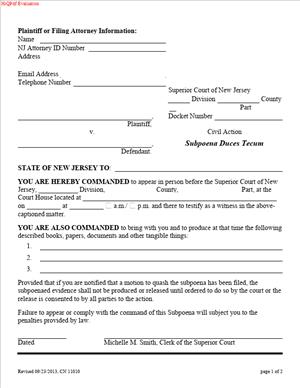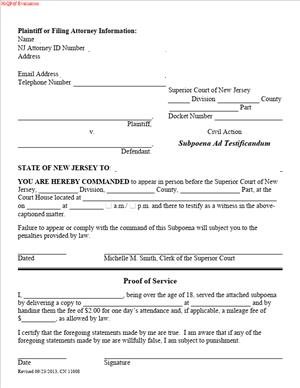
Subpoena Duces Tecum – New Jersey
Fill out nowJurisdiction: United States | New Jersey
What is a Subpoena Duces Tecum?
A subpoena duces tecum orders a person or business to produce records. It demands documents, electronically stored information, or physical items. It is part of a court case and tied to a specific docket. It comes from the Superior Court of New Jersey. Attorneys use it to collect evidence from third parties. Self-represented litigants can use it as well, with court issuance.
Think of it as a command with a deadline. It tells a records custodian what to provide and where to send it. It does not always require testimony. You can ask for records only. Or you can require records and a witness at a set time and place. Your choice depends on your case needs.
Who typically uses the Subpoena Duces Tecum form?
Civil litigants use it a lot. That includes personal injury plaintiffs and defendants. Landlords and tenants use it in housing disputes. Employers and employees use it in wage or discrimination cases. Family litigants use it for financial records or healthcare records. Debt collection parties use it for bank and payroll records. Businesses use it in contract cases. Government records custodians can receive it. Insurers receive it often.
Why would you need the Subpoena Duces Tecum form?
You need records you do not have. The other side may not control them. A hospital may hold the records. A bank may hold statements. A store may hold security video. A city may hold inspection logs. You need proof, not just claims. This form gets that proof. It locks in the evidence for trial or motions.
Typical usage scenarios
You represent an injured driver. You subpoena emergency room records and radiology images. You seek the store video of a fall. You ask an employer for payroll data in a wage case. You request a landlord’s work orders for mold claims. You obtain a contractor’s permits and inspection reports. You seek Uber trip data. You get phone records for call timing. You request a therapist’s chart with a signed release. You obtain an insurance claim file and photos. You ask a school for attendance records with consent. The form fits all these needs when used correctly.
This form belongs to the Superior Court of New Jersey. You use it only in an active case. You must list the correct county and docket. You must target a real custodian. You must describe the records with precision. The court enforces it when it meets these basics.
When Would You Use a New Jersey Subpoena Duces Tecum?
You use this form when normal discovery falls short. You serve it when a third party holds key records. You do not need it to get documents from an opposing party. You use party discovery tools for that. Reserve subpoenas for non-parties or mixed requests.
You might use it early in discovery. You need facts to build other requests. You might also use it near a trial. You need certified records or chain-of-custody proof. You can use it for a motion hearing. You can set a return date before a hearing, if time allows.
A tenant may use it for landlord work orders, invoices, and leases. A landlord may use it for tenant payment records from a rent portal. A small business owner may use it for vendor contracts and delivery logs. An employee may use it for payroll journals and badge swipe logs. An employer may use it for social media posts that reflect work conduct. A personal injury litigant may use it for EMS run sheets and imaging. A divorce litigant may use it for bank statements and 401(k) records. A creditor may use it for employer wage records for a post-judgment inquiry.
You also use it to secure video before it is lost. Many systems auto-delete in 30 days. A prompt subpoena can preserve that data. You can also demand email or text data from a company. Be specific about dates and accounts. You can request native files with metadata. That helps with authenticity.
You might pair the subpoena with a deposition. That is a deposition duces tecum. You set a date for testimony and document production. The witness brings the records and testifies about them. This helps with foundation and completeness. Use it when you expect disputes on authenticity.
Out-of-state custodians add steps. You may need to follow that state’s process. You may also need a commission or a domesticating filing. Plan ahead in those cases. Build in more time for return and objections.
Use this form only for case-related needs. Do not use it to fish or harass. Keep the scope tied to claims and defenses. Keep the date range modest. Tailor the request by subject and source. Judges expect proportional requests. Tight drafting gets better results and faster compliance.
Legal Characteristics of the Subpoena Duces Tecum
A subpoena duces tecum is legally binding. It carries the authority of the court. An attorney issues it under that authority. A self-represented party needs the clerk to issue it. Once issued and served, the recipient must comply. They must produce records as commanded or object.
Enforceability rests on several points. The case must be active in the Superior Court. The subpoena must show the correct caption and docket. It must state what to produce with reasonable detail. It must set a clear return date and delivery location. It must be served properly. You must allow a reasonable time to respond. You must include any required fees if you also demand testimony.
The recipient has rights. They can object if the subpoena is improper. They can seek to quash or modify it. Common grounds include undue burden, overbreadth, and privilege. Trade secrets and proprietary data may need a protective order. Personal privacy is a valid concern. Health records involve federal privacy rules. School records involve student privacy rules. Financial records may require consent or notice. Respect these limits in your ask.
Privilege controls what you can get. Attorney-client communications are protected. Work product often is protected. Medical records need patient consent or a court order. Mental health and substance use records have extra rules. You must address these issues before service. Attach consents when needed. Propose a protective order for sensitive material.
You must also notify other parties. You should serve a copy of any non-party subpoena on all parties. Do this before service or at service. This prevents surprise. It allows timely objections. It keeps the process fair. Courts expect this notice step in civil cases.
ESI is now routine. You can specify a format for ESI. Ask for native files when you need metadata. Otherwise, request a practical format like PDF. Avoid requests for “any and all” without limits. Narrow by custodian, keywords, and date range. This reduces the burden and motion practice.
If the witness does not comply, you can seek court help. You can file a motion to enforce. The court can order production. The court can shift costs or award fees. The court can hold a non-compliant witness in contempt. Judges prefer that you try to resolve issues first. Send a meet-and-confer letter. Offer reasonable extensions. Be professional and precise.
You cannot demand privileged documents. You can ask for a privilege log. It lists documents withheld and the reasons. This helps you test the claim. The court can review disputed items if needed. Keep your requests clean to avoid privilege traps.
Finally, protect confidential information. Use a protective order when needed. Limit use to the case. Limit who can see it. Require secure transmission and storage. Return or destroy the data after the case. These terms make custodians more willing to comply. They also avoid spill risk for you.
How to Fill Out a Subpoena Duces Tecum
Follow these steps to complete the form correctly.
1) Identify the correct court and division.
- Confirm your case is in the Superior Court of New Jersey.
- Identify the division: Law, Chancery, Family, or Special Civil Part.
- Confirm the county venue shown on your filings.
2) Copy the caption exactly.
- Use the same plaintiff and defendant names as in the complaint.
- Enter the docket number exactly. Match letters and numbers.
- Accuracy here is essential for validity.
3) Title the document.
- Use the title “Subpoena Duces Tecum.”
- If you also need testimony, write “Subpoena for Records and Testimony.”
- Keep the title clear and consistent with your purpose.
4) Name the person or entity to be subpoenaed.
- Use the full legal name of the business or agency.
- For a company, direct it to the “Custodian of Records.”
- Include the complete service address.
- For corporations, use the registered agent if known.
5) Describe the documents with precision.
- Be specific on date ranges and topics.
- Name the folders, systems, and accounts if known.
- Avoid “any and all” unless truly necessary.
- Examples:
- “All ER records, imaging, and billing for John Doe, DOB 1/2/80, for 5/5/23 visit.”
- “Video from cameras covering Aisle 3, 8:00–10:00 a.m., 4/10/23.”
- “Payroll registers and timecards for Jane Smith, 1/1/22 to 6/30/22.”
- “Work orders and invoices for unit 3B at 123 Main St., 1/1/21 to 12/31/21.”
6) Define ESI formats and delivery methods.
- Say if you want native files, TIFF+Text, or PDF.
- Specify media: secure link, encrypted email, or USB.
- Request a data map if the scope is unclear.
- Include instructions for Bates numbering.
7) Set the return date and place.
- Allow a reasonable time for compliance.
- Provide your office address or a secure upload link.
- If you want records sent to the court, state that.
- If you require in-person delivery, give a date and time.
8) State whether attendance is required.
- If records only, write “Appearance not required if documents are produced.”
- If you need testimony, set a deposition date, time, and location.
- Include remote options if allowed and needed.
9) Address privacy and consent.
- Attach a signed HIPAA authorization for medical records.
- Include patient name, DOB, and date range on the release.
- For mental health or substance use records, confirm proper consent.
- For school records, include parent or student consent as needed.
- For bank or payroll records, include the account holder’s consent if required.
10) Include a protective order if needed.
- Attach a proposed order for confidential records.
- Limit use to this case and bar public disclosure.
- Offer to mark records as “Confidential.”
11) Include instructions and definitions.
- Define “document” and “ESI” in a short schedule.
- List examples: emails, texts, databases, logs, and photos.
- State that duplicates are not required if identical.
12) Provide options to reduce the burden.
- Allow electronic production where possible.
- Accept rolling productions with dates.
- Ask for a custodian declaration if they have no records.
13) Include a notice of rights and objections.
- State that the recipient may object by a set date.
- Ask for a written basis for each objection.
- Request a privilege log for withheld items.
14) List costs and contact details.
- Note that reasonable copying costs are allowed.
- Ask for an estimate if costs exceed a set amount.
- Provide your phone and email for coordination.
15) Sign and issue the subpoena.
- If you are an attorney, sign and include your firm’s info.
- Include your New Jersey attorney ID and contact details.
- If you are self-represented, bring the completed form to the clerk.
- The clerk will issue and seal it if proper.
16) Prepare a Schedule A.
- List each document category as a numbered item.
- Keep each item clear and narrow.
- Add defined terms and the date range at the top.
17) Serve the subpoena properly.
- Use a process server or any adult not a party.
- Personal service is standard for third parties.
- For a company, serve the registered agent or an authorized person.
- Obtain a signed proof of service.
18) Serve all parties with notice.
- Send a copy to all other parties in the case.
- Do this before or at the time of service on the witness.
- Keep proof of that service for your records.
19) Tender any required witness fee.
- If you demand testimony, include the fee and mileage.
- If you seek records only, fees may not be required.
- Confirm what applies to your request type.
20) Track the deadline and follow up.
- Calendar the return date and a buffer date.
- Send a polite reminder five days before the deadline.
- Offer help with secure transmission if needed.
21) Review the production on arrival.
- Check completeness against Schedule A.
- Verify date range coverage and formats.
- Confirm file integrity and metadata if requested.
- Ask for a certification of business records if needed.
22) Handle objections or non-compliance.
- Meet and confer by phone or email.
- Narrow requests to reduce the burden where possible.
- Offer a protective order if that resolves concerns.
- If needed, move to enforce with a clear record.
23) Preserve the chain of custody for key items.
- Keep logs for physical items or original media.
- Avoid altering native files.
- Use read-only copies for review.
- Store sensitive data securely.
24) Use the records effectively.
- Bates labels the production.
- Extract key exhibits for depositions and motions.
- Prepare a summary chart for complex data.
- Disclose to other parties as discovery rules require.
Practical drafting tips
- Use short, focused requests tied to claims.
- State exact locations and systems, if known.
- Limit timeframes to what you truly need.
- Ask for a point of contact at the custodian.
- Invite them to propose a reasonable search method.
- Offer keyword lists when seeking emails.
- Avoid asking for legal holds or counsel notes.
- Request a declaration if no responsive records exist.
Examples of well-phrased requests
- “Produce native Excel payroll registers for Jane Smith, 1/1/23–3/31/23.”
- “Produce all invoices and checks for HVAC repairs at 456 Oak St., 2022.”
- “Produce native MP4 files for Camera #5, 3:00–4:00 p.m., 7/12/23.”
- “Produce a complete claim file for loss #12345, including photos and logs.”
Common mistakes to avoid
- Using the wrong county or docket format.
- Failing to give a reasonable time to respond.
- Serving the wrong entity or address.
- Demanding “any and all” without limits.
- Forgetting to notify other parties.
- Leaving out a HIPAA release for medical records.
- Omitting your contact info for delivery questions.
- Setting an in-person return without confirming access.
If you follow these steps, your subpoena will be clear and enforceable. You will set fair timelines. You will respect privacy and burden. You will improve your odds of fast and complete compliance. That reduces motion practice and saves costs. It also strengthens your position for trial or settlement.
Legal Terms You Might Encounter
- Subpoena duces tecum means “bring the documents.” It commands a person or business to produce records or things. On this form, you specify exactly what you need and where to send it. You may also require a personal appearance if you check that option.
- Issuing party is the person who signs and sends the subpoena. If you have an attorney, your attorney signs as an officer of the court. If you are self-represented, you may need the clerk to issue the subpoena. The signature block on the form identifies who is issuing it.
- Caption is the top section that names the court, parties, and docket number. Use the exact case title and number from your filing. This form belongs to the Superior Court of New Jersey, so the caption must match your case there.
- Docket number is your case’s unique ID. You enter it in the caption so the clerk and recipient know the subpoena ties to your case. If you enter the wrong number, you risk delay or rejection.
- Return date is the deadline for producing the records. You list this on the form. Choose a date that allows the recipient a reasonable time to search and produce. Avoid dates that conflict with court orders or discovery schedules.
- Custodian of records is the person or department that keeps the requested documents. You address the subpoena to that custodian when possible. On the form, you list the recipient’s legal name and service address to reach the right custodian.
- Service means delivering the subpoena to the recipient in a legally valid way. The form includes a section to identify the person served and the method. You also complete or attach a proof of service to show when and how you served it.
- Proof of service (or affidavit/certification of service) is a signed statement by the server. It confirms who was served, when, and where. You attach or file this after delivery. Your form packet is incomplete without it.
- Motion to quash is a request asking the court to cancel or limit the subpoena. A recipient or party can file one if the subpoena is improper. If that happens, you may need to negotiate, narrow the requests, or seek a court order.
- Objection is a written response refusing some or all requests. The recipient may object for burden, privilege, scope, or privacy reasons. If you receive an objection, the subpoena does not enforce itself. You must resolve it or seek an order.
- Protective order is a court order that limits discovery or protects sensitive information. If your subpoena seeks confidential data, you may need a protective order in place. You can reference any protective order in the instructions section of the form.
- Privilege refers to information the law protects from disclosure, like attorney–client or doctor–patient communications. Your form should not demand privileged material. If privilege is claimed, the recipient should provide a privilege log instead of the documents.
- Business records certification is a signed statement authenticating records as kept in the ordinary course of business. You can request this with the subpoena to avoid a live witness. The form’s description area can ask for a certification with the records.
- HIPAA authorization is a signed permission from the patient to release medical records. If you seek health information, plan to include an authorization or obtain an appropriate court order. Note this in your document request to avoid delays.
- Reasonable time means a fair period to respond. It depends on scope, volume, and availability. Your return date should allow the recipient to search, review, and produce without undue burden. The court will consider reasonableness if there is a dispute.
FAQs
Do you need an open case to issue this subpoena?
Yes. A subpoena duces tecum enforces discovery in a pending case. You include the correct caption and docket number from your Superior Court of New Jersey matter. If you do not have a case number, you generally cannot use this form. Rare pre-suit discovery requires special court procedures, which are different from this form.
Do you have to notify other parties before you serve a nonparty?
Yes. You should give all parties advance notice of the requests. Include the exact categories and the return date. Many disputes arise from lack of notice. Serve notice far enough ahead so parties can object or seek relief if needed. Keep proof that you sent notice.
Do you need to tender fees with the subpoena?
It depends on what you demand. If you require a personal appearance, you typically tender the standard witness fee and travel mileage. If you only ask for records by mail or delivery, you usually cover reasonable copying and postage costs. Include clear payment instructions, so the recipient knows how to invoice or charge for copies.
Can you serve a subpoena by email?
Personal service is the default. Email or mail is valid only if the recipient agrees or a rule or order allows it. Ask the records department how they accept subpoenas. If they agree in writing to email or portal upload, keep that agreement with your file. When in doubt, arrange personal service by a qualified server.
Do you need a HIPAA authorization to request medical records?
Yes, if you seek protected health information. Include a signed authorization or obtain the necessary court approval. Clarify in the subpoena that you attached the authorization. If the provider needs a more specific form, contact them early. Without proper authorization, they will not release records.
Can the recipient object to your requests?
Yes. The recipient can send written objections before the return date. You then meet and confer to narrow the scope or adjust deadlines. If you cannot resolve it, you may file a motion to compel or ask the court for guidance. Do not ignore objections; the court expects you to engage in good faith.
What if the subpoena is too broad or burdensome?
You should narrow it. Overbroad requests invite objections and delays. Limit by date range, custodians, and document types. Ask for the most critical categories first. You can always serve a follow-up subpoena if needed. Clarity helps recipients comply faster and reduces disputes.
Can you withdraw or amend a subpoena after serving it?
Yes. You can withdraw it by written notice to the recipient and all parties. To amend, issue a revised subpoena with a new description or return date. Mark it “Amended” and serve it like the original. Send a brief cover note explaining the changes. Keep all versions and proofs of service in your file.
Checklist: Before, During, and After the Subpoena Duces Tecum
Before signing
- Confirm you have a pending Superior Court of New Jersey case.
- Gather the full caption and exact docket number.
- Identify the correct division (Law, Chancery, Family, or Special Civil).
- Confirm the custodian of records’ legal name and service address.
- Draft precise categories of documents or things.
- Limit by date range, location, or custodian where possible.
- Decide if you require a personal appearance or records only.
- Set a reasonable return date based on scope and volume.
- Choose the production method: mail, secure electronic delivery, or inspection.
- Prepare any needed HIPAA authorization or consent.
- Note any protective or confidentiality orders that apply.
- Decide whether to request a business records certification.
- Prepare a check for witness fees if you demand in-person testimony.
- Plan for copying costs and how to reimburse the recipient.
- Coordinate advance notice to all parties with the full request list.
- Confirm no other discovery deadlines conflict with your return date.
- Create a tracking sheet for service, deadlines, and follow-up.
- If documents include trade secrets, plan for handling and storage.
During signing
- Verify the caption matches your case exactly.
- Check the docket number for accuracy.
- Confirm the court name reads “Superior Court of New Jersey.”
- Confirm the division and county venue are correct.
- Enter the recipient’s complete name and physical service address.
- Select the correct subpoena type: documents only or appearance plus documents.
- List each document category clearly and specifically.
- Include a date range and any limits by custodian or format.
- Add production instructions (where and how to deliver).
- Add the return date and time to provide a reasonable response time.
- Reference any protective order for confidential handling.
- Add payment instructions for copying, search, and postage.
- Attach any HIPAA authorization or consent if seeking medical records.
- Request a business records certification, if needed.
- Review for privilege: do not demand privileged communications.
- Add your contact details for questions and meet-and-confer.
- Sign the subpoena in the correct signature block.
- Prepare the proof of service form or certification for the server.
After signing
- Make a complete copy set: subpoena, attachments, and authorizations.
- Serve advance notice and a copy on all parties.
- Arrange proper service for the recipient by a qualified server.
- If required, tender witness fees or include payment details.
- Calendar the return date and set a reminder a week before.
- File or retain proof of service according to court practice.
- Confirm receipt with the recipient and address questions early.
- If you get objections, schedule a quick meet-and-confer.
- If unresolved, consider a motion to compel or to modify the scope.
- On receipt, log documents and note any missing categories.
- Request a privilege log for withheld items, if applicable.
- Securely store and label produced records by request number.
- Update your discovery plan and deposition outlines.
- Produce responsive documents of your own if you owe them.
- Close the loop: send confirmations or withdrawal notices if needed.
Common Mistakes to Avoid
Don’t forget to limit the scope.
- Mistake: Asking for “all documents” without limits.
- Consequence: Objection for burden, delay, or a quash order.
- Fix: Narrow by date range, subject, custodian, and document type.
Don’t use the wrong custodian or address.
- Mistake: Serving a parent company or generic address.
- Consequence: No response or a compliance dispute.
- Fix: Call the records department and confirm the exact service details.
Don’t skip fees or authorizations.
- Mistake: Demanding appearance without tendering witness fees, or requesting medical records without authorization.
- Consequence: Lawful refusal, delay, or sanctions risk.
- Fix: Include the correct fee and any required consent or orders.
Don’t set an unrealistic return date.
- Mistake: Demanding complex data in a few days.
- Consequence: Objection for unreasonable time or noncompliance.
- Fix: Provide a reasonable period based on scope and volume.
Don’t forget the party notice.
- Mistake: Serving a nonparty without notifying all parties first.
- Consequence: Motion practice, sanctions, or invalid service.
- Fix: Send an advance notice with the full request list and keep proof.
What to Do After Filling Out the Form
Finalize and issue
- Review the form for accuracy, clarity, and completeness.
- Confirm the caption, docket number, and division are correct.
- Sign in the proper signature block. If required, have the clerk issue the subpoena.
- Attach any authorizations, protective order references, or instructions.
Notify parties
- Send advance notice to all parties with the full request.
- Include the return date and production method.
- Keep proof of notice in your file.
Serve the recipient
- Arrange proper service for the custodian of records.
- If you require attendance, tender the standard witness fee and mileage.
- For records-only requests, provide copying cost instructions.
- Complete and keep the proof of service or certification.
Manage compliance
- Track the return date and follow up proactively.
- Answer recipient questions to avoid confusion.
- If production is rolling, agree on a schedule by email and save it.
Handle objections and issues
- If you receive objections, meet and confer promptly.
- Narrow scope, extend time, or adjust formats as needed.
- If unresolved, prepare to seek court relief to compel or modify.
- Document all communications to show good faith.
Receive and process records
- Log what you receive and note any categories not produced.
- Verify you received any business records certification requested.
- Check for privilege designations and a privilege log, if items are withheld.
- Store records securely and label them by request number.
Amendments or withdrawal
- If you need to change the scope or dates, issue an amended subpoena.
- Mark it “Amended,” explain changes, and serve all parties and the recipient.
- If the request is no longer needed, send a written withdrawal to all recipients and parties.
Follow-on steps
- Use the records to plan depositions or motions.
- Supplement your own discovery responses if new facts emerge.
- Calendar any related deadlines tied to the production.
- Keep a clean audit trail for admissibility and later court use.
Disclaimer: This guide is provided for informational purposes only and is not intended as legal advice. You should consult a legal professional.