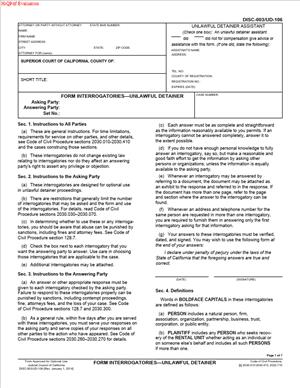
UD-106 – Form Interrogatories – Unlawful Detainer
Fill out nowJurisdiction: Country: US | Province or State: California
What is a UD-106 – Form Interrogatories – Unlawful Detainer?
UD-106 is a standardized discovery tool for eviction cases. You use it to send written questions to the other side. Those questions target facts in a California unlawful detainer case. The other party must answer in writing under oath. UD-106 helps you learn key facts fast. It uses plain checkboxes and numbered questions. You choose the questions that fit your case.
You use UD-106 in the Superior Court in California. It applies to residential and commercial evictions. It works whether you are a landlord or a tenant. Property owners, property managers, and corporate tenants use it as well. Subtenants and occupants named in the case can use it too.
You might need UD-106 to confirm notice details. You might need it to lock down dates, amounts, and people. You can also use it to test the other side’s claims. It is especially useful before a quick UD trial. Eviction cases move fast. You do not have weeks to investigate. Form interrogatories let you focus the issues with speed.
Common usage scenarios
A landlord wants a tenant to admit nonpayment of rent. A tenant wants proof that the notice was served correctly. A landlord wants the names of all occupants. A tenant wants rent figures and late fee details. A landlord wants admissions about lease breaches. A tenant wants repair facts to support defenses. UD-106 covers all these topics and more.
This is not a form for your answers. UD-106 is the form for your questions. You serve it to the other party. They send back verified answers. You do not file UD-106 with the court. You keep it for your case file. You may file it later with a motion or at trial.
The form uses plain definitions and instructions. It covers terms like “agreement,” “premises,” and “notice.” It lists sets of standard questions. You select the questions by checking boxes. Each checked question becomes a formal interrogatory. The numbers matter and must be tracked. The responding party answers by matching those numbers. This ensures clarity and reduces disputes.
In short, UD-106 is a ready-to-use question set. It is tailored to landlord-tenant cases. It saves you time. It reduces drafting mistakes. It produces sworn answers you can use in court.
When Would You Use a UD-106 – Form Interrogatories – Unlawful Detainer?
You use UD-106 after the case begins. Usually, that means after you serve or file your pleading. Landlords often serve UD-106 soon after the tenant answers. Tenants often serve UD-106 right after appearing in the case. Both sides want facts before the first trial date. The timeline is short. You should act early.
Imagine you are a landlord in a non-payment case. You served a three-day notice to pay rent. The tenant claims they paid in cash. You serve UD-106 to request payment details. You ask for dates, amounts, and witnesses. You ask for documents that support payment. If the tenant’s story changes, you can impeach them at trial.
Now imagine you are a tenant facing a holdover claim. The landlord says the lease ended. You think they accepted rent after the end date. You serve UD-106 to ask when the rent was accepted. You ask who accepted it and in what amount. You ask for copies of checks and receipts. You test whether the landlord waived lease termination.
Consider a commercial tenant accused of a lease breach. The alleged breach is a use restriction. You want the landlord’s facts and witnesses. You want the precise lease section they rely on. You want their damage computations. UD-106 covers those points with preprinted questions. You check the right boxes and serve it.
A landlord may also use UD-106 to identify all occupants. This matters for writs of possession. You ask for the names and contact information of all residents. You also ask about subleases and assignments. The answers help when planning enforcement steps.
A tenant may use UD-106 to pursue habitability defenses. You ask about repairs, inspections, and maintenance. You ask who performed the work and when. You ask about notices to government agencies. You also ask for rent calculations with any offsets. These answers frame your defense and settlement options.
You may also use UD-106 to support a motion. For example, a motion to compel compliance with the lease. Or to oppose a motion in limine at trial. The answers help you streamline your witness list. They help you identify evidence holes to fix fast. The goal is clarity before the trial starts.
Use UD-106 whenever you need admissions and facts. Use it when timing is tight. Use it to force the other side to commit. Use it to expose weak claims or defenses. It is one of the fastest discovery tools in a UD case.
Legal Characteristics of the UD-106 – Form Interrogatories – Unlawful Detainer
UD-106 is legally enforceable. It is part of civil discovery in California. When served correctly, it triggers a duty to respond. The responding party must answer under oath. They must answer each checked interrogatory. They must state facts and identify documents. They must also identify witnesses. They may assert valid objections, if any.
Eviction cases have accelerated discovery timelines. Response deadlines are much shorter than in general civil cases. Courts expect quick, complete, and verified answers. The service method affects the due date. Check the proof of service for the exact date. Count carefully to avoid missing the deadline. Short deadlines mean you must calendar it right away.
Verification is critical. The responding party verifies their answers under penalty of perjury. An unverified response is treated as no response. That exposes the responding party to a motion to compel. It also opens the door to sanctions. Courts can order cost and fee sanctions for misuse of discovery. Courts can also exclude evidence if a party withholds facts.
The scope of questions must be reasonable. Interrogatories must seek relevant information. They cannot be oppressive or harassing. UD-106 helps you stay within scope. The questions are standardized for UD issues. Even so, you should pick only what you need. Do not check every box without purpose. A narrow, focused set is more effective and defensible.
Enforceability comes from several factors. First, the form’s standardized structure. Second, the sworn nature of responses. Third, the court’s power to compel and sanction. Together, these ensure compliance. If the other side does not respond, you can seek relief. You can request orders requiring answers. You can ask the court to shift fees. In severe cases, courts may limit claims or defenses.
Some protections apply to the responding party. They can object to privileged information. They can object to vague or overbroad questions. They can object to burdensome demands. They must state those objections in writing. They should also answer any unobjected parts. The duty is to respond as fully as possible.
Form interrogatories do not need a fixed number limit. But volume still matters in UD cases. Too many questions can look abusive. It can also backfire under tight deadlines. Courts prefer proportional discovery. Keep it proportional to the issues and stakes.
Finally, you do not file UD-106 with the court. You serve it on the other side. You keep the original in your file. You only submit it if you need it for a motion or trial. The proof of service becomes crucial. It is your evidence of the deadline and method of service.
How to Fill Out a UD-106 – Form Interrogatories – Unlawful Detainer
Follow these steps to complete and use UD-106.
Step 1: Identify the case and court.
- Enter the court name and branch. Use the same address as your case.
- List the case number exactly as assigned.
- Enter the full case caption. Include all parties as shown on pleadings.
Step 2: Identify yourself and the other side.
- List your name as the propounding party. This is who asks the questions.
- List the opposing party as the responding party.
- If there are multiple parties, be precise. Name the exact party you are addressing.
Step 3: Mark the set number.
- Most parties start with “Set One.”
- Use “Set Two” or higher for later rounds.
- Keep your set numbers consistent across the case.
Step 4: Review the definitions and instructions on the form.
- The form includes standard definitions. They keep terms consistent.
- Read those definitions before selecting questions.
- They control how the questions should be understood.
Step 5: Select the interrogatories that fit your claims or defenses.
- Check the box next to each interrogatory you want to ask.
- Each checked item becomes part of your request.
- Do not check questions that do not apply.
Here is how to choose, based on common UD types:
- Nonpayment of rent case. Select questions on the rental agreement, rent amount, due dates, and payments. Ask for ledgers, receipts, and credits. Ask for facts supporting any payment defense. Ask for rent calculation details and late fees.
- Holdover after lease end. Select questions on lease expiration, renewal options, and acceptance of rent after expiration. Ask about notices to quit and any waiver facts. Ask for written extensions and the people who negotiated them.
- Breach of covenant. Select questions on the specific lease section at issue. Ask for facts showing the breach. Ask about cure notices and cure actions. Ask for witness identities and all supporting documents.
- Nuisance or illegal activity. Select questions on dates, acts, witnesses, and reports. Ask about police reports and incident logs. Ask for security camera footage locations and custodians.
- Owner move-in or withdrawal cases. Select questions on ownership, intent, and move-in timing. Ask for facts showing compliance with local requirements, if any. Ask for all persons with knowledge.
- Habitability or repair defenses. If you are a tenant, select questions on repair history and inspections. Ask who performed repairs and when. Ask about landlord responses to notices of defects. Ask for cost records and maintenance logs.
Step 6: Avoid overbroad or duplicative questions.
- Keep the list tight. Choose only what matters for trial.
- Do not check every box in every category.
- Use the form to target the core disputes.
Step 7: Prepare the service packet.
- Print or save the completed UD-106.
- Do not sign the interrogatories themselves. No signature is required on the questions.
- Prepare a separate proof of service form. Your server signs that, not you.
Step 8: Choose a valid service method.
- You can serve by personal delivery.
- You can serve by mail or another permitted method.
- If the party has an attorney, serve the attorney.
Step 9: Use a neutral adult to serve.
- The server must be at least 18.
- The server cannot be a party to the case.
- The server completes and signs the proof of service.
Step 10: Calendar the response deadline.
- Eviction discovery deadlines are short.
- Count from the date of service.
- Add any extra days allowed for the service method, if applicable.
- Set reminders a few days before the due date.
Step 11: Track and review the responses.
- The other side must answer under oath.
- Compare answers to your documents and timeline.
- Flag any evasive or incomplete answers.
- Note any objections that block key facts.
Step 12: Meet and confer if responses are deficient.
- Write a clear, specific letter. List each problem by number.
- Request full, verified answers. Give a short deadline due to UD timing.
- Offer to discuss by phone for speed.
Step 13: Move to compel if needed.
- If you get no response or bad responses, you can ask the court to compel.
- Attach your UD-106, the proof of service, and the deficient responses.
- Ask for sanctions if appropriate. Eviction courts expect compliance.
Step 14: Use the answers at trial or for settlement.
- Use admissions to streamline your witness list.
- Use rent computations to fix your damages claim.
- Use contradictions for impeachment.
Practical drafting tips
- Match questions to your trial burden. Ask only what advances that burden.
- Coordinate with document requests. Interrogatories identify documents and custodians. Then your document demand gets the records.
- Use identification questions to lock in witnesses. Names, roles, and contact details matter.
- Use “facts and contentions” questions sparingly. They can be broad. Focus them on each claim or defense.
- Sequence your sets. Start narrow. Send a second set only if needed.
- Avoid compound questions. The form already avoids subparts. Do not add any.
- Keep your own ledger and timeline nearby. Use them to spot gaps and inconsistencies.
What to include in each part of the form
- Parties section. Enter the court, case number, and party names exactly. Consistency prevents confusion and delays.
- Clauses/definitions. Accept the preprinted definitions. They control the meaning of terms in your case.
- Interrogatory selection. Check only the boxes you intend to serve. Review each checked item for relevance.
- Attachments or schedules. If your court requires a separate caption page, include it. If you reference exhibits in your questions, keep those references clear. The form itself does not rely on exhibits.
- Signatures. The interrogatories require no signature. The proof of service must be signed by the server. Responses from the other side must be verified.
Examples of targeted sets
Example 1: Landlord in a nonpayment case.
- Ask for facts about any claimed rent payment. Ask for dates, amounts, and methods. Ask for all documents showing payment. Ask for the names of witnesses to the payment. Ask for any claims of rent abatement and why.
Example 2: Tenant asserting improper notice.
- Ask who drafted and served the notice. Ask how and when the service occurred. Ask for all documents proving the service. Ask for corrections or re-service attempts. Ask for people with knowledge of the service.
Example 3: Landlord alleging unauthorized occupants.
- Ask for names and contact info of all occupants. Ask when each moved in. Ask for any sublease agreements. Ask for rent taken from subtenants. Ask for communications about occupants.
Example 4: Tenant asserting habitability.
- Ask for all repair records during your tenancy. Ask for maintenance logs, invoices, and vendor names. Ask for inspections and reports. Ask for rent credit computations, if any. Ask for policies on maintenance response times.
Filing and record keeping
- Do not file UD-106 with the court at service. Keep your original and a copy in your file. Store the proof of service with it. You will need them for any motion or for a trial. If you use responses at trial, bring the verification page. It proves the answers are sworn.
Timing reminders
- Serve UD-106 as early as possible. Eviction trials often occur quickly. Build in time for follow-up and motions. Plan your discovery like a sprint, not a marathon. You want usable answers before the first trial call.
Final check before service
- Confirm the case number and party names. Confirm the responding party is correct. Confirm each checked interrogatory is relevant. Confirm the service address is current. Confirm the server is eligible and available.
If you receive UD-106 instead of sending it
- Calendar your five-day response period right away. Check if extra days apply based on the service method. Draft complete, truthful, and verified responses. State objections narrowly and only when valid. Answer the remainder fully. Sign the verification. Serve your responses on time. Late or unverified responses risk sanctions and evidence limits.
Use UD-106 to get the facts you need. Keep it focused. Serve it early. Follow the rules. The answers can decide your UD case.
Legal Terms You Might Encounter
- Unlawful detainer means an eviction lawsuit. UD-106 supports that case by gathering facts. The questions aim at possession, rent, notices, and timelines.
- Interrogatories are written questions you send to the other side. UD-106 is a standard set for these cases. You check the questions you want answered.
- Propounding party is the person sending UD-106. If you are the landlord or tenant sending questions, you are the propounding party.
- Responding party is the person who must answer UD-106. The responding party must answer each checked question. Answers must follow the form’s instructions.
- Service means delivering UD-106 to the other side. You do not hand it to the court. You serve the party or their lawyer and keep a proof of service.
- Verification is a signed statement under oath. The responding party verifies that their answers are true. This makes the responses evidence-ready.
- Objection is a formal reason not to answer a question. The responding party may claim an objection, such as burden or scope. You can address objections later if needed.
- Privilege protects certain information from disclosure. Common privileges include attorney-client and work product. The responding party must state if a privilege applies to a question.
- Notice to quit means a notice that ends the tenancy unless the tenant acts. Common notices include pay or quit and cure or quit. UD-106 asks about notices, service, and dates.
- Possession refers to the right to live in the property. Some questions test who has possession and why. Others ask about keys, access, and turnover dates.
- Rent and damages are amounts claimed due under the lease or law. UD-106 asks about rent, fees, costs, and calculations. It also seeks payment histories and credits.
FAQs
Do you file UD-106 with the court?
No. You serve it to the other party. Keep it and the proof of service in your file. You may attach it to motions or use it at hearings if needed.
Do you have to check every question on UD-106?
No. Check only the questions you need. Keep it targeted to your claims or defenses. Irrelevant questions invite objections and delays.
Do you need to attach the lease or notices to UD-106?
You do not attach them to UD-106. You may ask about them in the questions. Keep copies ready if you need to use them later.
Do you need a proof of service for UD-106?
Yes. Prepare a proof of service for the set. It shows who was served, how, and when. Keep the original with your records.
Do you have to verify UD-106 when sending it?
No. The responding party verifies the answers. You sign UD-106 if you are represented or self-represented, but you do not verify the questions.
Do you serve UD-106 on the other party or their lawyer?
Serve the lawyer if one has appeared. If no lawyer has appeared, serve the party. Use the best address of record for service.
Do unlawful detainer cases have shorter discovery timelines?
Yes. Discovery timelines are shorter than in other cases. Plan early. Serve UD-106 promptly. Calendar all response deadlines.
Can you amend or withdraw your UD-106 after serving it?
You can send an amended set if needed. Label it clearly as amended. Notify the other side in writing if you withdraw a set. Manage deadlines carefully.
What if the other side refuses to answer or sends objections only?
Review the objections. Send a meet-and-confer letter to resolve disputes. If that fails, consider court help. Keep communications professional and clear.
Can you send UD-106 to multiple tenants or owners?
Yes. Serve each party you want to answer. Track each proof of service. Use separate sets to avoid confusion.
Can you add your own custom questions to UD-106?
No. UD-106 is a preprinted set. If you need custom questions, use other discovery tools. Keep UD-106 intact and unaltered.
Checklist: Before, During, and After the UD-106 – Form Interrogatories – Unlawful Detainer
Before signing
- Confirm case caption matches the complaint.
- Confirm party names, roles, and spelling.
- Confirm the property address in dispute.
- Gather the lease or rental agreement.
- Gather notices served and proof of service for notices.
- Gather payment records, ledgers, and credits.
- Gather communications about rent, breaches, or move-out.
- List dates you need to test through the questions.
- Decide which UD-106 questions address your issues.
- Check if an attorney has appeared for the other side.
- Confirm the correct service address.
- Calendar expected response deadlines.
- Prepare a proof of service form.
During signing
- Verify the case number on each page.
- Verify the court location on the caption.
- Verify your name and contact information.
- Mark the correct party boxes (plaintiff or defendant).
- Label the set number (e.g., Set One).
- Check only the interrogatories you need.
- Do not rewrite or alter the printed questions.
- Keep the pages in order and complete.
- Confirm all checked boxes are clear and legible.
- Add any definitions only if the form allows.
- Complete the signature block for the propounding party.
- Date the form on the day you will serve it.
- Prepare the proof of service with the same date.
- Attach any required addenda if the form instructs.
After signing
- Make a clean copy for your records.
- Serve UD-106 on the party or their lawyer.
- Complete and sign the proof of service.
- Do not file UD-106 with the court in routine practice.
- Calendar the response deadline once service occurs.
- Note any weekend or holiday impacts on timing.
- Track delivery time if served by mail or other methods.
- Follow up with a polite confirmation of receipt if needed.
- When answers arrive, review each response.
- Note any objections, incomplete answers, or ambiguities.
- Request clarifications or supplemental responses as needed.
- Store UD-106, proof of service, and responses together.
- Keep a discovery log with dates and actions taken.
- Prepare for trial or motions using the responses.
Common Mistakes to Avoid UD-106 – Form Interrogatories – Unlawful Detainer
- Don’t forget the set number. Missing “Set One” creates confusion. You risk disputes over what you served and when.
- Don’t check irrelevant questions. Unfocused requests draw objections. You may lose time and weaken your position.
- Don’t alter the preprinted questions. Changes can invalidate the request. The other side may refuse to answer.
- Don’t serve the wrong address. Service errors derail timelines. You may face delays and extra costs.
- Don’t skip the proof of service. Without it, you cannot prove proper service. Enforcement becomes harder.
- Don’t misname the parties. Wrong names cause defects. The other side can challenge your discovery.
- Don’t ignore short deadlines. Unlawful detainer moves fast. Late action can cost you key facts.
- Don’t overlook verification needs. Answers must be verified by the responder. Unverified answers may not be usable.
What to Do After Filling Out the Form UD-106 – Form Interrogatories – Unlawful Detainer
- Review for accuracy. Confirm the caption, case number, and roles. Confirm you checked the right questions. Ensure all pages are present.
- Sign and date UD-106. Complete the proof of service. Use the same service date if possible. Ensure names and addresses match the case file.
- Choose your service method. Serve the party or their lawyer. Use a reliable method that tracks dates. Record the details for your file.
- Calendar the response deadline. Add a reminder a few days before it expires. Note any expected mail time if applicable. Keep your calendar updated.
- Organize your file. Save the signed UD-106 and proof of service. Keep a clean working copy. Store everything by date.
- Monitor for responses. Log when they arrive. Check if all checked questions are answered. Check if each answer is verified.
- Analyze the answers. Compare them to your records. Flag gaps and contradictions. Note helpful admissions and timelines.
- Address objections and gaps. Write a concise meet-and-confer letter. Quote the specific question at issue. Explain why the answer is needed.
- Decide on the next discovery. Consider requests for production or admissions. Use follow-up questions if new issues arise. Keep each request focused.
- Amend or supplement if needed. If you discover an error in UD-106, send an amended set. Label it clearly and explain the change. Track new deadlines.
- Prepare for hearings or trial. Outline facts proven by the answers. Create timelines from dates admitted. Organize exhibits that match the responses.
- Manage confidential issues. Respect privileges claimed. If a privilege log is provided, review it. Consider targeted follow-up where appropriate.
- Keep communications professional. Stay clear and courteous in letters and emails. Document all attempts to resolve disputes. This helps if court help is needed.
- Do not file UD-106 routinely. Discovery requests are usually not filed. File only if required for a motion or hearing. Attach relevant pages as exhibits when needed.
- Maintain a discovery index. Track each set served and received. Note dates and key outcomes. This reduces mistakes and missed deadlines.
- Reassess your goals. Use responses to refine your case plan. Decide if settlement talks make sense. Focus on facts you can prove.
Disclaimer: This guide is provided for informational purposes only and is not intended as legal advice. You should consult a legal professional.