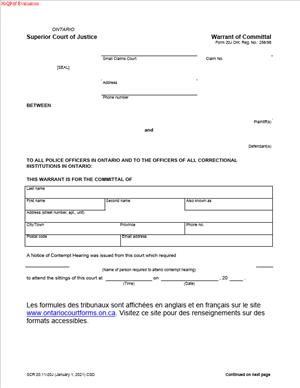
Form 20J – Warrant of Committal
Fill out nowJurisdiction: Country: Canada | Province or State: Ontario
What is a Form 20J – Warrant of Committal?
Form 20J is the Small Claims Court warrant that authorizes the Sheriff or a police officer to arrest and detain someone who has been found in contempt of a Small Claims Court order. In plain terms, it is the court’s written authority to take a person into custody for disobeying a Small Claims Court order, usually after the court has held a hearing and decided that contempt has occurred.
This is not a form you use to collect your judgment, like a writ of seizure or a garnishment. It is used only after the court has already made an order and the person has willfully disobeyed it, or has failed to attend a required hearing (like a judgment debtor examination or a default hearing), or has refused to answer questions, produce documents, or otherwise comply with a court direction. A judge must first make an order authorizing committal. The Form 20J puts that order into action.
Who typically uses this form?
Judgment creditors, landlords, contractors, small business owners, and individuals who have already obtained a Small Claims Court order and have gone through enforcement steps that led to a contempt finding. Court staff issue the warrant based on a judge’s endorsement. You, as the party seeking enforcement, prepare and submit the draft warrant for the court to issue.
Why would you need this form?
You need it to enforce a judge’s committal order made in Small Claims Court. If the debtor failed to attend an ordered examination, refused to comply with a payment plan without a reasonable excuse, or disobeyed another enforceable direction from the court, and the judge has ordered committal, you use Form 20J to have the Sheriff carry out the arrest and, where directed, bring the person before the court or detain them for a set period. It is a last-resort enforcement tool to uphold the authority of the court, not a shortcut for collecting money.
Typical usage scenarios
- A judgment debtor ignored a court order to attend a judgment debtor examination after being properly served, and the judge has ordered committal for failing to attend.
- The debtor attended a default hearing, but the court found willful default of an instalment order, no reasonable excuse, and ordered committal for a short term to enforce compliance.
- The debtor attended an examination but refused to answer questions or produce documents despite the court’s directions, and the judge made a committal order for contempt.
- A corporate officer who was ordered to appear to answer for a corporate judgment failed to appear, and the judge authorized the committal of that officer.
In each scenario, the judge’s order comes first. The warrant follows to execute that order.
When Would You Use a Form 20J – Warrant of Committal?
You use Form 20J only after a judge has made a committal order as part of enforcement in Small Claims Court. The court can make that order in narrow situations focused on contempt of court, not simple non-payment. If a person cannot pay a debt, the court will not imprison them for being poor. Committal targets disobedience of court orders and wilful default.
Imagine you are a contractor who won a judgment for unpaid invoices. You served a Notice of Examination and an order requiring the debtor to attend and bring financial records. The debtor did not show up. You returned to court, showed proof of service, and the judge made a committal order for failing to attend. You then complete and file Form 20J so the Sheriff can arrest the debtor and bring them before the court. That is a proper use.
Or you are a landlord who obtained a Small Claims judgment for damages and later secured an instalment order based on the tenant’s sworn evidence. The tenant then refused to pay without any change in circumstances or reasonable excuse. At a default hearing, the judge found willful default and made an order for committal. You would then request issuance of Form 20J to carry out the judge’s direction.
A small business owner may use the form after a corporate officer disobeyed an order to attend an examination about the corporation’s finances. If the court ordered committal for non-attendance, the business owner would file Form 20J so that enforcement officials can arrest the officer and bring them before the court.
Individuals representing themselves may also use the form, provided they first obtain the underlying committal order and can show compliance with all service and notice requirements. Without that underlying order, the clerk cannot issue a warrant of committal.
In short, you use Form 20J when the court has already found contempt or has ordered committal, and you now need the Sheriff to enforce that order by arresting and detaining the person named.
Legal Characteristics of the Form 20J – Warrant of Committal
Form 20J is legally binding because it is issued by the Small Claims Court under a judge’s authority following the Rules of the Small Claims Court. It is an instrument of the court that directs enforcement officers to act. It is not a private letter or a demand. The warrant is enforceable across the jurisdiction stated on its face and must be executed by those legally authorized, typically the Sheriff of the region or, in some cases, a police officer.
Enforceability rests on several safeguards. First, a judge must decide that committal is appropriate, generally after giving the person a chance to be heard. This protects against improper detention for mere non-payment. Second, the warrant must clearly identify the person, the file number, the court location, the order breached, and the terms of committal. Third, it carries the court’s seal and is signed by the clerk at the judge’s direction. Fourth, it must be correctly delivered to the enforcement office that has territorial jurisdiction to execute it.
The warrant may direct the enforcement officer to do one of two things: arrest and bring the person before the court on a specified date or “forthwith,” or detain the person for a defined period (often a short term) unless release conditions are met. Release conditions often include appearing before the court, paying specified arrears, or complying with document production. The conditions must reflect the judge’s order. You cannot create your own conditions.
The court uses committal sparingly. It is not a debt-collection hammer. It responds to contempt, such as failing to attend court after proper service, refusing to answer questions under oath, or ignoring a payment order without excuse. The court will not approve a warrant if due process was not followed. If the debtor was not properly served with the underlying order, you must fix service first. If the evidence shows an inability to pay rather than willful default, the court will focus on payment arrangements, not committal.
The warrant’s legal effect is time-limited by its terms and practical execution. If the warrant directs that the person be brought before the court, the enforcement officer will coordinate with the court for a prompt appearance. If the warrant sets a detention period, it will specify the duration. The Sheriff records execution details and returns the warrant to the court with an endorsement stating what happened, such as “arrested on [date], brought before the court,” or “not found after diligent search.”
Because committal affects liberty, the details on the form must be precise. Errors in identity, file number, or the terms of committal can delay or prevent enforcement. You must take care to complete the draft accurately and attach any schedules the court requires.
How to Fill Out a Form 20J – Warrant of Committal
Before you start, confirm you have a judge’s committal order or endorsement that authorizes issuance of the warrant. Without that, the clerk cannot issue Form 20J. Gather your court file number, copies of the relevant orders, proof of service for the steps that led to committal, and accurate identification details for the person to be arrested.
Follow these steps:
1) Identify the correct court and file
- At the top of the form, enter the Small Claims Court location where your case is filed. Use the same address that appears on your existing court documents.
- Fill in the court file number exactly as it appears on your case.
- Confirm that the file caption (plaintiff and defendant names) matches previous filings. Use full legal names.
2) Complete the style of cause
- On the lines for Plaintiff(s) and Defendant(s), write the parties as they appear on the judgment.
- If the warrant targets an individual officer of a corporation (for example, for a judgment debtor examination), ensure the person’s name is clearly set out as the person to be committed. Do not substitute the name of a company when the warrant is directed at a person.
3) Identify the person to be committed
- Provide the full legal name of the person the warrant covers. If known, include any aliases. Precision here reduces the risk of mistaken identity.
- Include the last known residential address, phone number if available, and any workplace information that helps the Sheriff locate the person.
- If you know the person’s date of birth or a physical description, prepare that information as a schedule. Many enforcement offices ask for these details to assist with execution.
4) State the authority for committal
- The form includes space to reference the order or endorsement authorizing committal. Enter the date of the judge’s order, the name of the judge if recorded, and a brief description of the breach (for example, “failure to attend judgment debtor examination on [date] after proper service” or “willful default of instalment order made on [date] without reasonable excuse”).
- If the judge made a written endorsement, attach a copy. If the order was made in court and later typed, use the order’s date and attach it.
5) Specify the terms of committal exactly as ordered
- The warrant must mirror the judge’s direction. If the order states “arrest and bring before the court forthwith,” copy that language.
- If the order sets a detention period (for example, “commit for up to five days”), write the period exactly. Do not change or add a duration.
- If there are release conditions, set them out precisely as the judge stated them. Common examples: “Release upon appearance before the court,” “Release upon payment of $[amount] toward arrears,” or “Release upon delivery of the specified documents.” Do not invent new conditions.
6) Add the amounts and costs if the order directs payment conditions
- If the judge ordered that the person may be released upon payment of a stated amount (for example, arrears and costs), specify the amount. Ensure it matches the order.
- If execution costs are to be added, state them only if the order authorizes it. Otherwise, leave blank or write “N/A.”
7) Provide execution details for the enforcement officer
- Enter the name of the region where the warrant will be executed. The Sheriff’s office for that region will handle it. If you expect the person to be in a different region, speak with court staff about where to file and how to transmit the warrant for execution.
- If the order requires the person to be brought to court on a specific date, time, and courtroom, include those details. Coordinate with the court in advance to avoid a clash with court availability.
8) Complete the issuance section for the court
- Leave the signature and seal lines for the clerk. Do not sign for the court. The warrant is issued by the court, not by you.
- Confirm the date of issuance. The clerk completes this when the warrant is issued.
- If the form has a line for “Issued at [location] this [date],” enter the court location, then allow the clerk to date and seal.
9) Attach helpful schedules
- Schedule A: Identification details (date of birth, aliases, physical description, and photos if available and appropriate).
- Schedule B: Copy of the judge’s order or endorsement authorizing committal.
- Schedule C: Proof of service of the notices and orders that led to committal, if the court asks for it.
- Label each schedule clearly. Refer to them in the body of the form where relevant (for example, “See Schedule A for identification details”).
10) Prepare the package for filing
- Include the draft Form 20J with all details completed except the court’s signature and seal.
- Attach the underlying committal order or judge’s endorsement.
- Add any schedules and evidence the clerk requests.
- Bring payment for the issuance fee. Fees can change, so confirm with the court office.
11) File and request issuance
- File the package with the Small Claims Court where the order was made. Ask the clerk to place it before a judge if required, or to issue based on the existing order.
- If the judge must review the warrant before issuance, the clerk will advise you about timing.
- Once issued, obtain certified copies as instructed by the clerk. You will need a copy for the Sheriff.
12) Deliver the warrant to the enforcement officer
- Take the issued warrant to the Sheriff’s office for the region where you expect to find the person. Some offices accept filings by courier or electronically; confirm their process.
- Be ready to pay any enforcement deposits the Sheriff requires. Ask what information they need for execution, such as hours when the person is at home or work.
- Provide a contact number for updates and urgent questions during execution.
13) Coordinate for court appearance if required
- If the warrant directs that the person be brought before the court, contact the trial coordinator or clerk to confirm a time slot and courtroom. The Sheriff will also coordinate, but your proactive call avoids delays.
- Plan to attend. Be prepared to explain the history of the file and what relief you are seeking, such as a new payment order or directions for document production.
14) After execution and return
- The Sheriff will endorse the warrant with execution details and return it to the court. Ask for a copy of the return so you know what happened.
- If the person was not found, consider the next steps, such as updating addresses or seeking further directions.
- If the person appears and complies, the court may suspend or discharge the committal. If not, the court may enforce the detention period set by the order.
Practical tips
- Accuracy is critical. Double-check the person’s name, the date of the committal order, and the execution region.
- Keep your tone factual and your requests aligned with the judge’s order. The warrant cannot go beyond what the judge authorized.
- If the order is conditional, spell out those conditions in clear, simple language so the Sheriff knows when release is allowed.
- Keep copies of everything you file and deliver. Record the date and method of delivery to the Sheriff.
- If the situation changes (for example, the debtor contacts you, pays, or offers to attend voluntarily), inform the Sheriff and the court immediately so enforcement can be adjusted safely.
Common mistakes to avoid
- Seeking a warrant without a committal order. The court cannot issue Form 20J unless a judge has already authorized committal.
- Using the warrant to try to collect money you are not entitled to collect under the order. Only include amounts set out by the court.
- Vague identification. If the enforcement officer cannot identify the person with confidence, execution may fail or be delayed.
- Wrong court location or file number. Mismatches create delays and can lead to a refusal to issue.
Real-world example
You won a Small Claims judgment for $8,500 against a former client. The court later ordered monthly instalments based on their sworn financial statement. After paying twice, the debtor stopped. You requested a default hearing. The debtor attended and admitted no change in circumstances. The judge found willful default and ordered committal for up to three days unless the debtor paid $1,200 toward arrears or attended a follow-up examination with documents by a set date. The debtor ignored the order. You prepared Form 20J, attached the judge’s endorsement, specified the conditional release terms exactly as ordered, and filed it. The court issued the warrant. You delivered it to the Sheriff with identification details. The Sheriff arrested the debtor and brought them to court the next morning. The debtor provided the documents, paid $1,200, and the judge suspended the committal. You left with an updated payment plan and stronger compliance.
That is how Form 20J functions in practice: it enforces the court’s authority when someone chooses to ignore clear orders. Use it carefully, complete it accurately, and align every detail with what the judge already decided.
Legal Terms You Might Encounter
- A warrant of committal is the court’s written authorization to have a person arrested and held for breaching a Small Claims Court order. With this form, you ask the court to direct the sheriff to arrest the judgment debtor because they disobeyed a clear court order connected to your case. It’s not a tool to collect money. It addresses non‑compliance with the court’s process.
- A judgment is the court’s formal decision that says who owes what. The warrant of committal does not re‑decide the debt. It responds to the debtor’s failure to obey a specific order made during enforcement, such as attending an examination or providing a financial disclosure.
- A judgment creditor is you, the person owed money under the judgment. On this form, you confirm your identity and the case details so the court can see you have standing to request the warrant. You also take responsibility for filing accurate information about the debtor’s default.
- A judgment debtor is the person or business ordered to pay. The warrant targets this person’s failure to do what the court required beyond payment, such as appearing at a hearing, producing documents, or following a payment schedule in an order.
- Contempt or default refers to disobeying a Small Claims Court order. The warrant of committal addresses that disobedience, such as not attending a judgment debtor examination after proper notice, or ignoring a specific compliance order. Your form needs to tie the warrant to a concrete breach that the court already recorded.
- A judgment debtor examination is a hearing where the debtor must answer questions about income, assets, and expenses, and may have to produce documents. If the debtor skips this hearing or refuses to answer as ordered, the court may issue a warrant of committal, and Form 20J is the document that activates arrest and detention for that breach.
- The sheriff is the enforcement officer who executes court warrants. When you submit Form 20J, the sheriff uses it to arrest the debtor and carry out any instructions the court included, such as bringing the debtor before a judge or committing them to custody for a set time. The sheriff will later return the executed warrant to the court with a note of what happened.
- Affidavit of service is a sworn statement proving you served documents, such as a notice of examination or a compliance order, on the debtor. It matters because a warrant of committal hinges on proof that the debtor knew about the order and still failed to comply. Courts are strict about proper service before they restrain someone’s liberty.
- Purge terms are the conditions the debtor must meet to avoid or end custody. The form can reflect what the court ordered, such as attending a rescheduled examination, producing documents, or complying with payment terms already set. If the debtor satisfies those conditions, the sheriff may release them, or the court may cancel the warrant.
- A stay or suspension means the court has paused enforcement. If a stay is in place (for example, because the debtor appealed or obtained time to comply), the warrant of committal cannot be acted on. You should confirm there is no stay before you file or ask the sheriff to proceed.
- Vacate or set aside means the court cancels a warrant or the underlying order. The debtor might apply to set aside if they were not properly served, had a valid reason for missing court, or have now complied. If a warrant is vacated, the sheriff cannot enforce it, and you may need a new order if non‑compliance continues.
- Return of warrant is the sheriff’s written report back to the court after executing, attempting to execute, or being unable to execute the warrant. It shows whether the debtor was arrested, released on conditions, brought to court, or not found. You can use this return to plan next steps if the debtor wasn’t located.
FAQs
Do you go to jail for not paying a Small Claims Court judgment?
No. Jail is not used for unpaid civil debt. A warrant of committal addresses disobeying court orders related to enforcement, like failing to attend a debtor examination or ignoring a compliance order. The focus is the breach, not the money itself. If the debtor follows the court’s process, the court does not commit them to jail.
Do you need a separate order before requesting a warrant of committal?
Yes. The court must have already made and recorded the order that the debtor breached, such as an order to attend, answer questions, produce records, or comply with set terms. Form 20J relies on that existing order and the proof the debtor had notice and did not comply. Without that, the court will not authorize committal.
How long can a warrant of committal last, and what is the detention period?
The warrant remains valid until executed, stayed, or set aside, unless the court sets an expiry. Detention periods are limited and tied to the specific breach and the court’s directions. Some warrants require the sheriff to bring the debtor before a judge promptly; others specify a short custody period or release on meeting purge terms. The form must mirror the court’s directions.
Can the debtor avoid arrest if they finally comply?
Often, yes. If the court sets purge terms, the debtor can satisfy them to avoid or end custody. For example, they may attend a rescheduled examination, produce missing documents, or meet compliance terms in full. If they comply before the sheriff executes the warrant, you may notify the sheriff to hold off, or the debtor can seek a cancellation order from the court.
Do you have to serve the debtor with Form 20J?
No. The warrant of committal is directed to the sheriff, not served on the debtor like other documents. What you must be able to prove is that the debtor was properly served with the earlier order they breached. That proof goes into your supporting materials. The sheriff gives the debtor a copy of the warrant when executing it.
What if the debtor lives or works in another county?
The sheriff enforces in defined geographic areas. If the debtor is outside the local area, the sheriff may need a transfer or a request to another sheriff’s office to execute the warrant. On your end, provide the best location details you have, including any cross‑county addresses or workplaces, so the enforcement office can coordinate as needed.
Can you change the warrant after you file it if you spot an error?
You cannot alter a court‑issued warrant on your own. If you discover an error in names, addresses, or file numbers, ask the court for corrected documents. Small mistakes can stall enforcement or cause the sheriff to refuse the warrant. Act quickly when you notice a problem so the court can issue a corrected version.
What happens if the debtor is arrested outside business hours?
Sheriffs often execute warrants when they can locate the debtor, including evenings. If the warrant directs the sheriff to bring the debtor to court, and the court is closed, the sheriff follows the instructions on the warrant, which may include holding the debtor for the next available court appearance or releasing them if purge terms are met. You do not need to be present unless the court later requires you.
Checklist: Before, During, and After the Form 20J – Warrant of Committal
Before signing
- Court file details: File number, court location, and correct names of parties as they appear on the judgment.
- Underlying order: Certified or clear copy of the order the debtor breached (e.g., order to attend an examination, order to produce documents, or compliance order).
- Proof of service: Affidavit(s) of service showing the debtor was properly served with the order and any related notices.
- Proof of default: Transcript, endorsement, clerk’s note, or affidavit setting out the breach (missed appearance, failed production, refusal to answer).
- Status check: Confirm no stay, payment plan, or set‑aside motion is pending that would block committal.
- Debtor identifiers: Full legal name, aliases, date of birth if known, last known address, workplace, phone, email, and physical description if available.
- Safety and timing: Any known risks to enforcement officers, preferred times or places where the debtor can be found, and vehicle details if known.
During signing
- Names and file number: Confirm exact spelling and format match the court record.
- Court location: Ensure the issuing court is the correct Small Claims Court office for your file.
- Legal basis: Confirm the form cites or is accompanied by the order that authorizes committal for this specific breach.
- Sheriff instructions: Check the warrant text has the right directions (bring before a judge, commit for a period, release on conditions).
- Purge terms: If the court included conditions for release, verify they are clear and match what the court ordered (attend on a set date, produce specific documents).
- Addresses: Review debtor’s addresses and locations for accuracy. Add any recent updates you hold.
- Signatures and dates: Ensure the issuing official’s signature, seal, and date are present, and your materials are signed where required.
After signing
- Court issuance: File the form with the court for issuance. Do not handwrite changes after issuance.
- Coordinate with the sheriff: Deliver the issued warrant to the sheriff’s office that covers the debtor’s location. Provide copies of the underlying order, service proofs, and any safety notes.
- Track execution: Ask for a file or reference number and a point of contact. Offer updated debtor location info as you learn it.
- Monitor returns: Watch for the sheriff’s return indicating arrest, release on purge, appearance before a judge, or no‑find. Keep copies in your file.
- Respond to developments: If the debtor complies, inform the sheriff. If the court vacates or stays the warrant, notify the sheriff immediately.
- Store records: Keep stamped copies of the issued warrant, the underlying order, affidavits of service, and the sheriff’s return in a safe, organized file.
- Calendar follow‑ups: Note hearing dates if the debtor will be brought before a judge, and diary the warrant’s status for review.
Common Mistakes to Avoid Form 20J – Warrant of Committal
- Relying on the warrant to collect money directly. A warrant of committal addresses disobedience, not non‑payment of a judgment. If you skip the required compliance steps and jump to committal, the court may refuse your request. Don’t forget: tie your warrant to a clear, documented breach of a specific order.
- Weak or missing proof of service. If you cannot prove the debtor knew about the order they breached, the warrant can be denied or later set aside. The consequence is delay and extra cost. Make sure your affidavits of service are complete, signed, and match the details in the court record.
- Incorrect or incomplete debtor information. Errors in names, dates, or addresses can stop enforcement. The sheriff may refuse to act or arrest the wrong person. Verify all identifiers and include any aliases the debtor uses. If you find a mistake after issuance, seek a corrected warrant right away.
- Ignoring a stay, pending motion, or compliance update. If the debtor secures a stay or now complies, and you press ahead, the court may view your enforcement as improper. Always confirm status with the court and the sheriff before asking for execution. Keep communications dated and in writing where possible.
- Vague or inconsistent purge terms. If release conditions are unclear or contradict the court’s order, the sheriff can’t apply them. That causes confusion or an unlawful detention risk. Cross‑check the purge terms against the court’s endorsement and ensure they are specific and measurable.
What to Do After Filling Out the Form 20J – Warrant of Committal
- File the form with the Small Claims Court for issuance. Bring the underlying order and your supporting materials so the clerk can confirm the basis for committal. Once issued, the court will seal and date the warrant. Do not alter the document after issuance.
- Deliver the issued warrant to the sheriff’s office responsible for the debtor’s location. Include a copy of the breached order, affidavits of service, the judgment debtor’s details, and any purge terms the court set. Provide the best contact and location information you have, including work hours and typical whereabouts.
- Stay in touch with the sheriff. Ask how the office prefers updates. Share any new addresses or sightings—small details help. If the debtor contacts you to comply, tell the sheriff before the arrest occurs. If the court suspends or cancels the warrant, notify the sheriff immediately in writing.
- Prepare for a court appearance if directed. Some warrants instruct the sheriff to bring the debtor before a judge. Be ready with your file, the history of the breach, and clear proposals for next steps, such as a new examination date, document deadlines, or a compliance plan.
- Manage outcomes promptly. If the debtor purges the default, records should show it. If the debtor does not, the sheriff will make a return. Use that return to decide your next move: request a new examination date, pursue other enforcement methods, update addresses, or seek further directions from the court if non‑compliance continues.
- Handle amendments and corrections through the court. If you find errors on the warrant, ask for a corrected version. Do not mark up the issued document. If circumstances change, you may request updated directions or a fresh warrant if the court agrees.
- Keep a complete paper trail. Store the issued warrant, all supporting documents, communications with the sheriff, and the return in one place. Update your internal checklist so you can prove what was done, when, and why. Good records save time if questions arise later.
- Close the loop with stakeholders. If you act for a client or a business unit, provide a concise status report: when the warrant was issued, what the sheriff did, whether the debtor complied, and recommended next steps. Set a review date to reassess enforcement based on new information.
Disclaimer: This guide is provided for informational purposes only and is not intended as legal advice. You should consult a legal professional.