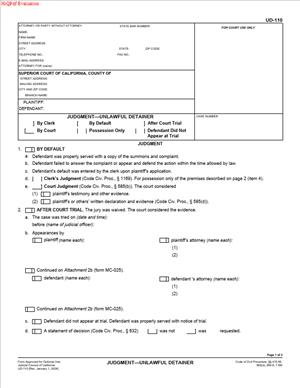
UD-110 – Judgment – Unlawful Detainer
Fill out nowJurisdiction: United States | State: California
What is a UD-110 – Judgment – Unlawful Detainer?
UD-110 is the California Superior Court’s standard judgment form for eviction cases. It is the document the court uses to state the final decision in an unlawful detainer case. The form tells everyone who gets possession of the property. It also lists any monetary awards, fees, costs, and other orders tied to the eviction. It becomes the official judgment once the judge signs it and the clerk enters it.
You will see UD-110 at the end of an eviction case. The court may reach judgment after a trial, a default, a settlement, or another ruling that decides the case. The form records all essential outcomes. That includes possession of the property, lease forfeiture, rent and damages, attorney’s fees, and daily damages after judgment. It also notes whether a stay applies before enforcement, and whether the judgment reaches all occupants.
Who typically uses this form?
Landlords and property managers use it when they win possession or a money award. Tenants use it when they win and want the court to enter judgment in their favor. Attorneys for either side prepare the proposed judgment for the court to sign. Self-represented parties also use it. The judge signs it. The clerk enters it. The sheriff uses it to enforce a writ of possession later.
You would need this form to turn a court decision into a formal, enforceable judgment. A verbal ruling in court is not enough for the sheriff to act. The sheriff requires a judgment and a writ of possession. UD-110 is the judgment step. It is also the record that starts post-judgment deadlines and interest. Without a completed UD-110, you will not move forward with eviction or collection.
Typical usage scenarios include a default after the tenant fails to respond. The landlord submits a proposed UD-110 with the default package. The court enters judgment based on that. It also applies after a bench or jury trial. The prevailing party submits the form to mirror the court’s ruling. The court can also use UD-110 for a stipulated judgment. That happens when both sides settle and agree to terms. Less often, a tenant uses UD-110 after they win at trial. The form then reflects that the landlord takes nothing. It may include the tenant’s costs or other relief the court grants.
UD-110 works for both residential and commercial properties. It covers judgments for possession only and judgments for possession plus money. It also has language to reach unnamed occupants if a claim of right to possession was served before judgment. The form is specific to unlawful detainer, so do not use it for other civil cases.
When Would You Use a UD-110 – Judgment – Unlawful Detainer?
You use UD-110 when your unlawful detainer case is ready for judgment. For a landlord, this often follows a default. The tenant did not file a response or did not appear at trial. You prepare UD-110 to capture possession of the property and any amounts the court awards. You also include the daily rate for damages after judgment, if allowed.
You also use UD-110 after a trial. The judge or jury decides who gets possession and what money is owed. You prepare the form to match the court’s ruling line by line. If the court orders a short stay before eviction, you put that on the form. If the court declares forfeiture of the lease, you mark that too. If the court awards attorney’s fees and costs, you state those amounts.
If you resolved the case by a stipulated judgment, you attach or reflect the settlement terms that need to be in the judgment. Many settlements have a conditional stay. They also set move-out dates, payment plans, or a waiver of forfeiture if payments are made. UD-110 records the parts that function as a judgment. That includes possession, any stay, and money awards. Do not include private terms that are not enforceable through a judgment unless the court approves them.
Tenants use UD-110 if they prevail. If the court rules that the landlord is not entitled to possession, the tenant prepares a proposed judgment for the judge. The form shows judgment for the defendant. It may award costs or fees if the lease or statute allows it. A prevailing tenant may need the judgment entered to close the case, stop enforcement, and start appeal deadlines.
You also use UD-110 for a possession-only judgment. That happens when the service allows possession to be decided but not money. For example, the complaint was served by posting and mailing. The court can award possession, but money claims must be brought later. UD-110 has options to reflect that. The form then shows possession is awarded, and money issues are reserved.
Commercial landlords also use UD-110. The structure is the same. You list possession and any commercial rent or damages. You can include forfeiture of the lease. If the court orders a stay, it often requires daily rent payments during the stay. You capture those conditions on the form.
Legal Characteristics of the UD-110 – Judgment – Unlawful Detainer
UD-110 is a court judgment. It is legally binding once the judge signs it and the clerk enters it. It states the rights of the parties as to possession and any awarded amounts. It also controls post-judgment enforcement. The sheriff relies on the judgment to carry out a lockout once a writ of possession issues. Creditors rely on it to collect money through lawful means.
Enforceability comes from the court’s authority and the form’s content. The form identifies the parties, the property, and the relief granted. It shows who gets possession and when. It declares lease forfeiture when requested and granted. It lists specific money amounts for rent, damages, fees, and costs. It can include a per-day rate for holdover damages after judgment. Those elements give the sheriff and clerk clear instructions.
The judgment may include a stay of enforcement. A court can grant a short hardship stay. The judgment must state the stay period and any conditions. Common conditions include daily rent payments during the stay. If the tenant fails to pay during a stay, the landlord may move to lift the stay. If no stay appears on the judgment, the landlord can move forward as allowed by law after the writ issues.
A UD judgment can bind unnamed occupants if the required notice was served. If a prejudgment claim of right to possession was properly served, the court can enter judgment against all occupants. The form has language to reflect that coverage. That ensures the sheriff can remove occupants who were not named in the complaint.
The judgment must match what the plaintiff properly requested. You cannot get more than what you pleaded and proved. You cannot get attorney’s fees unless a contract or statute supports them and the court awards them. Costs require a request and a proper basis. Per-day damages must reflect the fair rental value and the court’s ruling.
Once entered, the judgment accrues interest on the money amounts at the legal rate. Appeals and post-judgment motions run on strict timelines. Those timelines usually start when the court serves notice of entry of judgment. The clerk may mail that notice with the form’s certificate of mailing. Some courts require the prevailing party to provide envelopes or to serve the notice. Check your local practice before you file.
In limited situations, a UD judgment can award possession only. In that case, you may need a separate action to recover rent or damages. The judgment should say which issues are reserved. That clarity prevents confusion when you later seek money relief.
How to Fill Out a UD-110 – Judgment – Unlawful Detainer
Follow these steps to complete the form accurately. Bring enough copies for filing and service.
1) Complete the caption at the top.
- If you have a lawyer, enter the attorney’s name, bar number, firm, address, phone, and email. If you are self-represented, fill in your contact details and mark “In Pro Per” or “Self-Represented.”
- Enter the court’s name and branch address. Use the same court listed on your complaint.
- Enter the case number. Copy it exactly from your case.
- List the plaintiff(s) and defendant(s) exactly as they appear in the case.
2) Identify how judgment is entered.
- Mark the box that fits the court’s decision path. Common options include “After court trial,” “By default,” “On stipulation,” or “On clerk’s judgment.”
- If it is a default judgment, make sure your default paperwork is on file. The court compares the amounts on UD-110 to your declarations.
- If it is after trial, mirror the judge’s pronouncement. If the judge reads from notes, use those terms.
3) State for whom the judgment is.
- If the landlord wins possession, check “Judgment for plaintiff” and continue through the possession and money sections.
- If the tenant wins, check “Judgment for defendant.” List any costs or fees the court awarded. Do not complete the possession or forfeiture sections unless the court ordered relief in favor of the tenant.
4) Identify the property with precision.
- Enter the full street address, unit number, city, and zip code. The sheriff needs the exact address.
- If the property is a space number or lot in a park, include that identifier.
- If the premises are commercial, the form may include a “commercial” or “residential” indicator. Mark the correct one if present.
5) Address possession and restitution.
- If the landlord is awarded possession, check the box for restitution of the premises to the plaintiff.
- If the court sets a move-out date or a stay, reflect the date. Write the date clearly. If the stay has conditions, list them in the stay section, not here.
6) Address lease forfeiture.
- Check “Forfeiture of the lease” only if you requested it in your complaint and the court granted it. Forfeiture ends the lease and supports removal of all occupants.
- Do not mark forfeiture if the court denied it or if a settlement keeps the lease in effect on conditions.
7) Complete the money sections awarded through the judgment date.
- Past-due rent: Enter the total rent awarded through the judgment date if the court granted it. If the court awarded rent only through a specific date, use that date.
- Holdover damages through judgment: Enter the total fair rental value for the holdover period up to judgment, if awarded. Calculate days times the daily rental value approved by the court.
- Other damages: Use this only if the court awarded specific amounts like utilities or repair costs pleaded and proved. Do not add costs that the court did not approve.
- Attorney’s fees: Enter the amount the court awarded. You need a contractual or statutory basis and court approval.
- Costs: Enter the amount on your filed memorandum of costs, if allowed. Some courts set costs later. If the court has not set the amount, leave it blank or use “to be determined” if the form allows.
8) Add post-judgment daily damages, if granted.
- If the court awards per-day damages from the judgment date until possession is returned, write the daily rate. Include the start date. You can write “until plaintiff recovers possession.” The sheriff will not compute money for you. The amount continues to accrue until you regain possession.
- Do not include a per-day rate unless the court awarded it.
9) Address “possession only” judgments.
- If the court awarded possession only and reserved money issues, check the box that limits judgment to possession. Leave money amounts blank. The judgment should note that money claims are reserved.
- This is common when service was by posting and mailing, or when the plaintiff chose to reserve damages.
10) Address unnamed occupants, if applicable.
- If you served a prejudgment claim of right to possession and the court allows judgment against all occupants, mark the box indicating coverage. This helps the sheriff remove occupants not named in the complaint.
- Do not mark this box if you did not complete that service.
11) Include any stay of enforcement.
- If the court ordered a hardship stay, write the end date of the stay. Include conditions such as daily payments. The judgment should clearly state the payment amount and where payments are made.
- If no stay was ordered, leave this section blank.
12) Compute and confirm totals.
- Add awarded amounts carefully. Make sure the totals match what the court granted.
- Do not combine pre-judgment amounts with per-day post-judgment damages. Keep them separate as the form directs.
13) Interest and credits.
- You do not usually write interest rates on UD-110. Post-judgment interest applies by law. The clerk tracks that in enforcement.
- If the court ordered credits or offsets, reflect the net amounts. If the form lacks a clear field, use the “other” or “as ordered” space and state the net award.
14) Attachments and stipulations.
- If the judgment is by stipulation and the court requires the stipulation attached, include it. Ensure the judgment mirrors the enforceable terms.
- If the court requested an attachment for detailed terms, label and attach it. Reference it in the designated section.
15) Signatures and entry.
- Do not sign the judge’s line. The judge will sign and date the judgment.
- The clerk will enter the judgment. The bottom section often includes a clerk’s certificate of mailing. The clerk completes that after mailing the conformed copy.
- If your court requires self-addressed stamped envelopes, provide them with enough postage.
16) Copies and filing.
- Bring the original and at least two copies. Some courts require more copies. One copy is for you. One is for each other’s party. The court keeps the original.
- Ask the clerk to confirm your copies. Keep a conformed copy for your records. You will need it to request a writ of possession.
17) After entry, next steps.
- Once judgment is entered, request a writ of possession if you were awarded possession. You file that request with the court. The sheriff uses the writ, not the judgment alone, to schedule the lockout.
- If you were awarded money, consider collection options. You may need to locate assets and follow the required collection procedures.
18) Quality checks before submitting.
- Compare every dollar amount to your complaint and the court’s ruling. Do not exceed what you asked for or what the court awarded.
- Confirm names, addresses, and the case number. Errors slow enforcement.
- Make sure any stay dates and conditions are clear and complete.
- Ensure boxes for “possession only,” “lease forfeiture,” and “all occupants” reflect the actual ruling. The sheriff looks for those terms.
Real-world example: You won a default on a nonpayment case. Your complaint requested possession, lease forfeiture, $3,000 rent, $25 per day holdover, attorney’s fees per lease, and costs. On UD-110, you check the judgment for the plaintiff. You list the property address. You mark lease forfeiture. You write rent $3,000 through the date claimed. You list the attorney’s fees of the amount the court approves based on your declaration. You list costs from your memorandum. You add per-day damages of $25 from the judgment date until you recover possession. You leave the stay blank because none was ordered. You give the court envelopes. The judge signs. The clerk mails notice of entry. You then request a writ of possession.
Another example: You settled with a move-out in 14 days, no money if keys are returned on time, but with a judgment for possession that is stayed for 14 days. On UD-110, you mark judgment for the plaintiff and possession granted. You add a stay through the agreed date and state the conditions. You do not list money amounts because they are waived if the tenant performs. You attach the stipulation if required. The judge signs. If the tenant fails to move out, you request a writ after the stay ends.
Tenant example: You prevailed at trial because the notice was defective. On UD-110, you check the judgment for the defendant. You list costs if awarded. You do not include possession or forfeiture terms. The judge signs. The clerk mails a notice. The landlord cannot get a writ based on that case.
Approach UD-110 as a final, exact record of the court’s ruling. Keep it clear. Keep it accurate. Fill only what the court granted. This helps you move to enforcement without delay and reduces the risk of rejection or confusion.
Legal Terms You Might Encounter
- Judgment means the court’s final decision in your case. On UD-110 – Judgment – Unlawful Detainer, you record what the court decided about possession, money, and any other relief. You also state how the judgment was reached, such as by default or trial.
- Unlawful detainer is the legal name for an eviction case. The UD-110 closes out that case. It shows who wins and what the court awarded.
- Plaintiff is the party who filed the eviction. If you are the landlord or owner, you are the plaintiff on UD-110. You list your name exactly as it appears on the complaint.
- Defendant is the person being evicted. This includes tenants and sometimes subtenants or occupants. On UD-110, you must list every defendant covered by the judgment.
- Default means the defendant did not respond in time or did not appear. In that case, the court can enter judgment without a trial. UD-110 lets you mark that the judgment is by default. It also states what you get by default.
- Restitution of premises means the court awards possession back to you. On UD-110, you check that box to confirm you can recover the property. This is the key part of any eviction judgment.
- Forfeiture of the lease means the tenancy ends by court order. If you seek termination, UD-110 has space to reflect that. You should only request what you asked for in your complaint.
- Damages are monetary awards. They can include unpaid rent, holdover damages, costs, and attorney fees. UD-110 has lines to enter each category and totals. You need accurate calculations and support.
- Daily rental value is the per-day amount for holdover damages. The court may award a daily rate for each day the defendant remains. UD-110 lets you state that daily figure. It helps law enforcement calculate amounts until the move-out.
- Costs are your case expenses, like filing and service fees. Attorney fees are what your lawyer charges if allowed. On UD-110, you can request both if permitted. You often need to state the amounts clearly.
- Writ of possession is a court order for law enforcement to remove occupants. UD-110 supports issuing the writ. You will request the writ after judgment to enforce the move-out.
- Stay of enforcement is a delay before the judgment can be enforced. UD-110 can reflect if the court stayed enforcement for a set time. If there is a stay, you cannot proceed with removal until it expires.
- Clerk’s judgment versus court judgment identifies who enters it. A clerk’s judgment is entered by the clerk, usually after default. A court judgment is entered by a judge after a hearing or trial. UD-110 has boxes for both paths.
- Service means giving legal notice to the other side. After judgment, you may need to serve a copy or notice. UD-110 does not serve itself, but it records the result that you may need to share.
FAQs
Do you need UD-110 if the tenant has already moved out?
Yes, if you want a court judgment. You may still need possession to be restored on paper. You may also seek money, costs, or fees. UD-110 closes the case and confirms the result.
Do you complete UD-110 for a default?
Yes. You prepare UD-110 when the tenant fails to respond or appear. The clerk or court uses it to enter the default judgment. Make sure your amounts match your supporting documents.
Do you list subtenants or unnamed occupants on UD-110?
You list every defendant named in your case. If you have a judgment that covers unnamed occupants, reflect the coverage as the court ordered. Enter the parties exactly as they appear in the file.
Do you have to ask for forfeiture of the lease on UD-110?
Only if you asked for it in your complaint and the court allows it. If you did not request termination earlier, do not add it now. UD-110 must match the relief allowed in your case.
Do you need to include a daily rate for holdover damages?
Yes, if you requested holdover damages. The daily rate lets the court and sheriff calculate continuing amounts. Use the correct figure as proven in your case. Round and format it clearly.
Do you need to attach proof for costs and attorney fees?
Yes, if you claim them. Bring your cost memo, fee basis, and any required declarations. UD-110 captures the totals. Your file must include support so the court can verify.
Do you send the tenant a copy of the judgment?
Usually, yes. Some courts mail the judgment. Others expect you to serve it. Ask the clerk how your court handles notice. If you serve it, keep proof of service in your file.
Do you change the locks after judgment is entered?
No, not yet. You need a writ of possession and the sheriff’s help. The sheriff schedules the lockout and oversees the move-out. Do not self-evict. Follow the enforcement process.
Checklist: Before, During, and After the UD-110 – Judgment – Unlawful Detainer
Before signing
- Case caption details: court location, case number, party names.
- Property address for possession, including unit number.
- Judgment type: default, trial, or clerk’s entry.
- Relief requested in the complaint: possession, forfeiture, money, costs, and fees.
- Unpaid rent totals with dates covered.
- Holdover damages and the daily rental value.
- Credits received, such as payments after filing.
- Cost receipts and filing fees paid.
- Attorney fee basis, if allowed by law or agreement.
- Any court orders on stays or move-out dates.
- Any partial settlements or stipulations on record.
- Calculations checked for accuracy and rounding.
- Draft language that matches what the court allowed.
- Copies for filing and for each party.
During signing
- Verify that the plaintiff and defendant names match the complaint.
- Confirm the property address is exact and complete.
- Check the judgment path: default, clerk’s judgment, or court judgment.
- Mark restitution of premises if you seek possession.
- Mark’s forfeiture of the lease is only if requested and allowed.
- Enter rent, damages, costs, and fees in the correct lines.
- State the daily rate for holdover damages, if awarded.
- Confirm the totals add up across all money lines.
- Include dates for any stay of enforcement.
- Note who appeared at trial, if applicable.
- Ensure the form leaves signature lines for the right signer.
- Use legible printing if handwritten.
- Avoid blank critical fields; write “0” where none.
- Review for consistency with the court’s minute order.
- Sign and date where required.
After signing
- File UD-110 with the court clerk.
- Ask for conformed copies for your records.
- Confirm who will mail or serve the judgment.
- Calendar any stay expiration and move-out dates.
- Request a writ of possession from the clerk.
- Deliver the writ to the sheriff with all required fees.
- Track the sheriff’s posting and lockout schedule.
- Keep copies of all filings, fees, and proofs of service.
- If you have a money judgment, plan collection steps.
- Update your accounting to reflect credits from possession.
- Store the judgment and writ details in the case file.
Common Mistakes to Avoid UD-110 – Judgment – Unlawful Detainer
Don’t forget to match the complaint.
- If you ask for relief not pleaded, the court can deny it. This can delay judgment or reduce your award.
Don’t use the wrong daily rate.
- An incorrect per-day figure skews holdover damages. That can cause rejection or require correction later.
Don’t misidentify parties or the property.
- Wrong names or addresses can invalidate the writ. Fixing this after entry wastes time and costs more.
Don’t omit costs or fees you can claim.
- If you forget them, you may lose recovery. Amending a judgment later is harder than doing it now.
Don’t ignore court notes or stays.
- If the judge stayed enforcement, you must honor it. Acting early risks sanctions or voided enforcement.
What to Do After Filling Out the Form UD-110 – Judgment – Unlawful Detainer
- File the signed UD-110 with the clerk. Bring at least one copy for stamping. Ask for conformed copies for all parties.
- Confirm how the notice will go out. Some courts mail the judgment. Others expect you to serve it. If you must serve, use a reliable method and keep proof.
- Request a writ of possession once judgment is entered. The writ authorizes the sheriff to enforce possession. Submit the writ request, pay fees, and monitor issuance.
- Deliver the writ to the sheriff. Follow the sheriff’s process for scheduling. Provide contact information for access and coordination.
- Prepare for the lockout. Plan for keys, locksmith access, and property inventory if needed. Follow all procedures given by the sheriff.
- Handle money portions of the judgment. If you have damages, costs, or fees, plan for collection. You may use collection tools after possession is restored.
- Track stays and deadlines. If the judgment includes a stay, calendar the date it ends. Do not request enforcement until the stay expires.
- Correct errors promptly. If you spot a clerical mistake, ask the clerk how to correct it. You may need a corrected judgment or minute order.
- Keep records organized. Store the judgment, writ, proofs, and any sheriff paperwork. Good records support future collection and compliance.
- If something changes, seek guidance. If payment cures the debt or parties agree on timing, document it. Update the court or sheriff as needed to avoid issues.
- Distribute copies to those who need them. Share the judgment with property management, accounting, or counsel. Ensure everyone uses the same terms and dates.
- Consider the next steps after recovery. If you plan to relist or relet, confirm possession and key transfer. Inspect the unit once the sheriff completes the lockout.
Disclaimer: This guide is provided for informational purposes only and is not intended as legal advice. You should consult a legal professional.