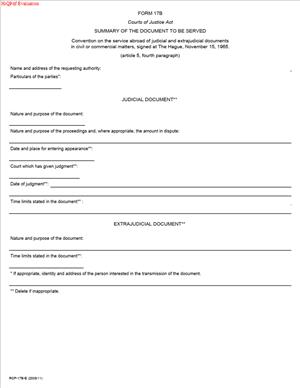
Form 17B – Summary of the Document to be Served
Fill out nowJurisdiction: Country: Canada | Province or State: Ontario
What is a Form 17B – Summary of the Document to be Served?
Form 17B is a standard cover summary you include when arranging official service of Ontario civil court documents outside Ontario. It gives the person being served a clear, plain-language snapshot of what the document is, what it asks for, and what they need to do next. Think of it as the one-page guide that helps a foreign recipient understand an Ontario lawsuit or motion at a glance.
You use this form when you pursue service outside Ontario through an official channel. In practice, Form 17B travels with the documents you want served. It explains the nature of the case, identifies the court and parties, tells the recipient if there is a deadline to respond, and flags what may happen if they do nothing. If the receiving country expects documents in a certain language, this summary is typically translated so the recipient can read it.
Who typically uses this form?
Litigants and their counsel use it when they must serve an originating process or other court document abroad. Law clerks and litigation support staff complete it as part of an international service package. Process servers and central authorities rely on it to understand what needs to be served and why.
Why might you need it?
If your defendant, respondent, or witness is outside Ontario, you often can’t just mail or email the documents and call it a day. Many jurisdictions require formal service through a designated authority. Form 17B is part of that formal process. It shows foreign authorities and the recipient that you are following proper procedures and giving fair notice. If you later seek a default judgment or enforce the Ontario judgment abroad, having used the correct form can make that easier.
Typical scenarios
- You sue a supplier headquartered in another country for breach of contract and need to serve a statement of claim at its head office abroad.
- You start an application against a foreign parent company and must serve the notice of application outside Ontario.
- You bring a motion for injunction relief, and the respondent is temporarily resident in another country, so you need to arrange service there.
- You serve third-party claims, crossclaims, or notices of garnishment on entities outside Ontario.
- You serve a judgment debtor examination notice on a director who has moved outside Canada.
In all these cases, Form 17B provides a plain-language summary that accompanies the actual documents, so the foreign recipient understands what the Ontario court requires of them.
When Would You Use a Form 17B – Summary of the Document to be Served?
You use Form 17B when you arrange official service of an Ontario civil proceeding outside Ontario, and the method you’re using calls for a standardized summary. This most often arises when you need to route service through an authority in another country or jurisdiction, rather than having a local process server handle it informally. It is also used where the receiving jurisdiction expects a summary in its own language. In those cases, you prepare Form 17B, translate it if required, and include it with the service package.
Consider a few practical examples:
- You are a business owner who issued a statement of claim in Ontario against a distributor incorporated abroad. You need formal service at the foreign corporation’s registered office. You prepare Form 17B, setting out the nature of the claim and the time to defend, and send it with the claim and any translations.
- You are counsel for a landlord suing a guarantor who now resides outside Canada. You are serving an amended statement of claim. You include Form 17B to flag that the pleading has changed, what the changes are about, and what the recipient must do.
- You are an in-house lawyer serving a notice of application on a foreign respondent bank. The application is returnable on a set date. Your Form 17B highlights the hearing date, how to participate, and the consequences if the respondent does not attend.
- You are a plaintiff adding a third party to a construction lien action, and that party is based in another country. You include Form 17B to explain the third-party claim and list the response deadline.
Typical users include self-represented litigants, small and mid-sized businesses, larger enterprises with in-house legal teams, government bodies, and law firms of all sizes. The common thread is the need to serve outside Ontario using an official channel that expects this standardized summary. If you anticipate seeking a default judgment or enforcing an Ontario order abroad, using Form 17B is a prudent step because it helps demonstrate that service complied with proper process.
Legal Characteristics of the Form 17B – Summary of the Document to be Served
Form 17B is not a pleading or an affidavit. It does not, by itself, create or change legal rights. It is an informational summary that accompanies the document being served. Its legal importance lies in notice and procedure. Proper service is a gateway to the court’s ability to proceed, especially against defendants who do not respond. Many jurisdictions also look at whether the recipient was given a clear explanation of what they were being served and what deadlines applied. Form 17B satisfies that expectation.
Is it legally binding?
Not in the sense that a contract or court order is. But it is part of a service package that, taken together, triggers legal consequences. If the recipient ignores the package after proper service, the court may permit you to proceed to default. If the recipient challenges service, an accurate and complete Form 17B helps demonstrate that they received fair, comprehensible notice.
What ensures enforceability?
Accuracy and consistency. The content of Form 17B should align with the documents served. The parties’ names must match. The court file number, court location, and hearing details (if any) must be correct. The response deadline must reflect what the Rules and the served document require. If a translation is needed, it must be faithful and complete. If these fundamentals are wrong, a court may set aside service or decline to enforce a default judgment.
General legal considerations:
- Jurisdiction and method of service: Your choice of service method must comply with Ontario rules and the receiving jurisdiction’s requirements. Form 17B supports that compliance by giving the recipient a readable summary.
- Language: If the recipient does not read English or if the receiving authority requires a translation, you should provide one. A translated summary helps prevent challenges to service based on comprehension.
- Deadlines: Make sure the response deadline stated in the summary matches the applicable rule for the type of document and place of service. For a statement of claim, the time to deliver a defence typically depends on where service occurs. Always confirm the correct period and reflect it in the summary.
- Consequences of default: The summary should state plainly that the court may proceed without further notice if the recipient does not respond. That mirrors the reality of default practice and supports later enforcement.
- Neutral tone: The summary explains; it does not argue your case. Avoid advocacy or new allegations. Stick to what the document is, what it asks the court to do, and what the recipient must do.
Used correctly, Form 17B strengthens the procedural foundation of your service. That helps you move your matter forward confidently, whether the recipient responds or not.
How to Fill Out a Form 17B – Summary of the Document to be Served
Below is a practical, step-by-step guide to complete Form 17B. Adjust details to match the document you are serving and the service method you are using.
1) Gather the information you will need
- Court file number and court location.
- Full names of all parties, exactly as they appear on the document.
- The recipient’s legal name and service address abroad.
- The type of document you are serving (for example, statement of claim, notice of application, motion record).
- A short, neutral summary of the document’s purpose.
- Any hearing date, time, location, and how to attend (in person or virtual).
- The time the recipient has to respond and how to do so.
- The consequences if the recipient does not respond.
- The language(s) of the documents and whether translations are included.
- Your contact details or your lawyer’s contact details.
2) Complete the header details
- Court: Insert the court name and location that appear on the document you are serving.
- Court file number: Copy it exactly.
- Title of proceeding: List the parties as they appear on your documents (for example, ABC Inc. v. XYZ GmbH). Keep formatting consistent.
Tip: Consistency matters. If your claim spells “XYZ G.m.b.H.” with punctuation, use the same form in the summary.
3) Identify the document to be served
- State the exact name of the document (for example, Statement of Claim, Fresh as Amended Statement of Claim, Notice of Application, Notice of Motion).
- Include the date of the document and, if relevant, the return date of any motion or application.
- If you are serving multiple documents, list each one. Keep the list short and clear.
Example: “This summary accompanies a Statement of Claim issued on March 3, 2025, and a Notice of Action issued on February 28, 2025.”
4) Describe the nature and purpose of the document
- Provide a two to four-sentence description in plain language. Be neutral. Do not argue your case here.
- Mention the area of dispute (for example, breach of contract, unpaid invoices, professional negligence, debt recovery, wrongful termination).
- If money is claimed, state the amount claimed and the currency. If non-monetary relief is sought, state what order is requested.
Example: “You are being sued for breach of a distribution agreement. The plaintiff alleges unpaid invoices and lost profits. The plaintiff seeks CAD 275,000 in damages and interest.”
5) Identify the court, parties, and recipient clearly
- Court: Confirm the court name and address. Include the courthouse street address.
- Parties: Identify the plaintiff(s)/applicant(s) and defendant(s)/respondent(s) using full legal names, including corporate designators (Inc., Ltd., LLC).
- Recipient: Provide the full legal name of the person or entity to be served and their full service address abroad. If serving a corporation, identify the role of the recipient (for example, registered office, director, authorized agent).
Example: “Recipient: XYZ GmbH, Registered Office: Kaiserstraße 12, 60311 Frankfurt am Main, Germany.”
6) State what the recipient must do, and by when
- Set out the response steps in simple, precise terms. Tailor them to the document type.
- For a statement of claim, the usual step is to serve and file a statement of defence within the period that applies to where service occurs. Reflect the correct period for your case.
- For an application, explain that the respondent should serve and file a notice of appearance or responding record before the hearing, within the timelines that apply to your proceeding.
- For a motion, state the return date and any deadline to serve and file responding materials.
Example: “If you wish to defend this lawsuit, you must prepare, serve, and file a Statement of Defence. You must do so within the time that applies to where you were served. If served in Ontario: 20 days. If served elsewhere in Canada or the United States: 40 days. If served outside Canada and the United States: 60 days. The deadline runs from the date of service.”
If your document sets a different timetable (for example, a case management order or a fixed return date), use those times instead.
7) Explain how to respond and where to file
- Provide the court office address where filings are to be made.
- Identify the method of filing if the court directs electronic filing. If you are unsure, give the courthouse address and your contact details so the recipient can request instructions.
- Tell the recipient to serve copies on the other parties, with names and addresses for service from your documents.
Example: “File your materials with the court at 393 University Avenue, Toronto, Ontario. Serve a copy on the plaintiff’s lawyer at the address on this summary.”
8) State the consequences of not responding
- Use direct language. Explain that the court may proceed without further notice and may grant judgment or orders requested, including costs.
- For a claim, reference the default judgment and the possibility of enforcement.
- For an application or motion, remind that the court may hear and decide the matter in the recipient’s absence.
Example: “If you do not respond within the time allowed, the court may proceed without further notice and may grant judgment or make the orders requested, including orders for costs.”
9) Include any scheduled hearing details
- If your document has a hearing date, state the date, time, time zone, courthouse or virtual hearing link details (if available), and how to attend.
- Note whether the recipient must attend in person or may attend by telephone or video, if that is clear from your notice or court direction.
Example: “The application will be heard on May 30, 2025, at 10:00 a.m. (Toronto time) at 393 University Avenue, Toronto. Attendance by video is available if arranged in advance.”
10) Address language and translation
- Indicate the language of the documents included (for example, English) and whether a translation is enclosed.
- If the recipient’s country expects documents in its official language, include a translation of the summary and of the core documents being served, as required.
- If you include a translation, note the language and that the translation accompanies the documents.
Example: “Documents enclosed are in English. A French translation of this summary and the Statement of Claim is enclosed.”
11) List the documents enclosed
- Provide a brief list so the recipient can confirm they received everything. For example:
- Statement of Claim (dated March 3, 2025)
- This Form 17B Summary
- Translation (French) of Statement of Claim and Summary
- Blank Defence form or instructions (if applicable)
- Any court order fixing a hearing or timetable
12) Provide contact information for questions
- Add the name, address, phone, and email of the person the recipient may contact with procedural questions (usually counsel of record).
- Include office hours if relevant. Do not give legal advice in the summary; keep it procedural.
13) Sign and date where the form requires
- Follow the signature block on the form. Sign, print your name, and include your title (for example, Lawyer for the Plaintiff).
- Insert the date you complete the form.
- If the form is to be used by an authority for transmission, leave any “official use” parts blank unless instructed otherwise.
14) Quality-check for accuracy and consistency
- Names: Match party names exactly across all documents.
- Addresses: Confirm the international address format and postal codes.
- Deadlines: Verify that the response time stated matches your document and the applicable rule for the place of service.
- Hearing details: Confirm date, time, and time zone.
- Translation: Ensure translations are complete and consistent with the originals.
- Attachments: Confirm that all listed documents are enclosed.
15) Assemble and submit for service
- Place Form 17B directly behind the main document (for example, the statement of claim). Put translations together with the documents they translate.
- Prepare the number of copies required by the service channel you are using.
- If an official authority or registrar will transmit the package, provide everything in the format and number of sets they require, and pay any fees.
16) Track service and follow up
- Keep a copy of everything you sent.
- Diarize the expected service date based on the method used.
- When you receive proof of service, file it promptly and update your response deadline diary.
- If the recipient does not respond, be ready to move for default as permitted. If they do respond, proceed under the normal timetable.
Practical drafting tips
- Keep it literal and neutral. Avoid adjectives and arguments.
- Use short sentences and simple words. The recipient may read it in translation.
- Avoid internal jargon. Spell out acronyms on first use.
- Align all dates with the originating document and any scheduling order.
- Use the recipient’s local date format only if you also include the month in words (for example, 05 June 2025) to avoid confusion.
Common pitfalls to avoid
- Stating the wrong response deadline. Confirm it before you finalize.
- Missing hearing details or time zone information.
- Using a corporate trade name instead of the legal name.
- Omitting the currency of the amount claimed.
- Failing to include required translations or listing translations that are not enclosed.
- Inconsistent party listings across the form and the served documents.
If you approach Form 17B as a clear, factual guide for the recipient, you will produce a summary that supports valid service and reduces the risk of a challenge. It is a small investment of time that pays off in smoother progress of your case, both in Ontario and abroad.
Legal Terms You Might Encounter
You will see the term party or parties on this form. The party that serves documents is often called the plaintiff, applicant, or moving party. The party who receives them is the defendant, respondent, or responding party. Use the actual titles from your case. They must match the titles on your court documents.
- Service means delivering legal documents to another party in a way the law accepts. This form summarizes what you are serving. It travels with the documents so the receiving party knows what they are and why they matter.
- Originating process is the first document that starts a case. Examples include a statement of claim or notice of application. If you serve an originating process, note that clearly on the form. It signals that a new case has begun against the receiving party.
- Subsequent document refers to anything served after the case starts. Examples include a defence, motion record, or affidavit. The form should state whether your documents are originating or subsequent. This affects response timelines and expectations.
- Jurisdiction refers to the court’s legal authority. The summary helps the receiving party understand which court issued the documents. It also shows where the case will be heard and why the service is happening in their location.
- Method of service is how you deliver the documents. Examples include service through a central authority, personal service, or mail. Some countries require service through an official channel. The form signals the route taken and why it is valid.
- Hague Service Convention is a treaty about serving documents abroad. Many countries follow it. If you serve in a country that uses it, you often must include this summary. The form helps the foreign authority process the service request.
- Central Authority is the official body in a foreign country that handles service requests under the treaty. If you use a central authority, the summary accompanies your documents. It helps them understand the case and what to do next.
- Translation means rendering the documents into another language. Some countries require translation of the summary and the documents served. The form includes simple descriptions meant to translate well and reduce confusion.
- Proof of service is evidence that the service happened properly. You usually complete an affidavit of service after the documents are delivered. The form itself is not proof of service. It supports service by explaining the packet, but you still need proof.
FAQs
Do you need to attach a copy of the documents to this form?
No. You do not attach copies to the summary. The documents must be served alongside the form. The form is a cover summary that travels with the documents. It should list each document by title and date. It should describe the purpose in plain language.
Do you need a translation of the form?
Maybe. It depends on where you are serving. Some countries require translation of the summary and the underlying documents. Check language requirements before sending. If translation is needed, keep your descriptions simple and consistent. Avoid idioms and complex phrasing. This makes accurate translation easier.
Do you use one form per person served?
Yes. Prepare a separate summary for each individual or entity you serve. Each form should reflect that person’s name and address. If serving multiple parties, tailor each summary to that party. This helps the receiver and the authority process service without confusion.
Do you list every item in the service package?
Yes. List every document by full title and date. Include schedules and exhibits. If you include a notice or a blank reply form, list those too. Do not bundle items into vague categories. The receiver should see an exact inventory of what they are getting.
Do you include deadlines and response instructions on the form?
Yes. Summarize key response timelines if they apply. Keep them short and clear. Say who the person should contact and where. If the document is only for information, state that clearly. Do not overstate consequences. Only include timelines that appear in the served documents.
Do you sign the form?
Yes. Sign and date the form. Print your name and role. If you act for a party, include your firm or office address. If you file electronically, follow the signature format accepted by the court. Make sure the name on the form matches your signature block on the served documents.
Do you need to file this form with the court?
Often, you keep it with your service materials. Some processes require filing a copy with the proof of service. If a central authority returns a certificate, keep the summary with your proof. If the court requests it, file it. Always store a duplicate with your records.
Do you use this form for service inside your province?
No. This form is used for cross-border services or other services outside the usual area. When serving outside the province, the receiver may not know your court system. The summary explains the documents in plain terms. It also helps foreign authorities process the package.
Checklist: Before, During, and After the Form 17B – Summary of the Document to be Served
Before signing
- Confirm the exact titles of all documents to be served.
- Check that names match the court documents exactly.
- Verify the court file number and court location.
- Confirm party roles (plaintiff, defendant, applicant, respondent).
- Identify whether documents are originating or subsequent.
- Confirm the correct service address for each recipient.
- Determine if translation is required in the destination country.
- Confirm the required service method for the destination country.
- Note all response deadlines shown in the served documents.
- Obtain the contact details you will include on the form.
- Prepare a short, plain-language summary for each document.
- Ensure dates on the form match dates on the documents.
- Confirm that any attachments mentioned actually exist in the package.
During signing
- Review spelling of party names and addresses.
- Double-check the court file number and style of cause.
- Verify each listed document appears in the package.
- Confirm you stated whether the case is new or ongoing.
- Check that response timelines are accurate and necessary.
- Ensure your contact information is current and complete.
- Sign and date the form. Print your name and role.
- If translating, sign both language versions if required.
After signing
- Place the form at the front of the service package.
- Include translations as required by the destination.
- Send the package using the permitted service route.
- Keep a full duplicate set of everything sent.
- Track delivery with dates and reference numbers.
- When service completes, prepare proof of service.
- Store the proof, any certificates, and the summary together.
- Calendar the recipient’s response deadline.
- If service fails, correct issues and re-serve promptly.
Common Mistakes to Avoid
Listing incomplete or wrong document titles
- Don’t forget to list the full, exact titles and dates. Incomplete titles confuse the receiver. This can lead to rejection by the authority or disputes about what was served.
Using vague or technical descriptions
- Avoid jargon and long explanations. Use short, clear phrases. Vague language can cause translation errors and delay acceptance by foreign authorities.
Mismatched names or file numbers
- Check that party names and the court file number match your documents. Mismatches suggest the wrong case. The recipient may ignore or challenge the service.
Leaving out response timelines
- Include clear response timelines when they apply. Missing timelines can prejudice the receiver and lead to procedural challenges.
Skipping translation where required
- Confirm translation rules before sending. Missing translations often cause rejection or delay. You may need to re-serve and lose time.
What to Do After Filling Out the Form
- Assemble the package with the summary on top. Include each listed document in the order shown on the form. If translation is required, include the translated summary and translated documents. Keep the summary language simple to reduce translation risk.
- Choose the permitted service route. If the service goes through an official authority, provide all required copies and translations. If you are serving by another permitted method, follow those rules exactly. Record the date the package leaves your hands.
- Track the package. Note tracking numbers, courier references, and processing dates. If you use an authority, note their internal file number. Save all receipts and confirmations.
- When you receive confirmation of service, prepare proof. Complete the affidavit of service or other proof required. Attach the certificate or proof returned by the authority if one is issued. Make sure the dates and names match your summary and the underlying documents.
- File proof as required. If the court expects the proof on the record, file it by the deadline. If not required immediately, keep it ready. Courts may request it later to validate steps in the case.
- Calendar the recipient’s response deadline. Use the timeline stated in the served documents. Adjust for delivery method and location rules if they apply. Build in a reminder a few days before the deadline to check for a response.
- Handle returned or failed service quickly. If the package is returned, find out why. Common reasons include address errors, missing translations, or wrong service routes. Correct the issue. Prepare a fresh summary if details change. Re-serve without delay.
- Amend the form if needed. If you discover an error after sending, assess its impact. Minor typos may not matter. Errors in names, file numbers, or document lists may need correction. If re-service is required, issue a clean summary with the corrected package.
- Store records securely. Keep copies of the summary, all served documents, translations, proofs, and certificates. Keep delivery receipts and correspondence with authorities. Organize them by party served. You may need them to prove proper service later.
- Communicate with the recipient if appropriate. The summary includes your contact details. If the recipient reaches out, respond professionally. Do not give advice to the opposing party. Keep the discussion to logistics, deadlines, and how to obtain copies.
- Monitor the case docket. After service, check if the recipient files a response. If no response appears by the deadline, consider the next steps available in your case. Those steps depend on your documents and the court’s rules.
- Coordinate with any agents or process servers. Confirm that they used the exact form you prepared. Ensure they followed the method stated. Collect their confirmations and any official certificates.
- Prepare for possible challenges. The recipient may dispute the service. Have your summary, proofs, and translations ready. Clear, consistent documentation supports the court’s review if a challenge arises.
- Review future service plans. If more documents must be served abroad, reuse the structure that worked. Keep your language consistent across summaries. Update dates, titles, and deadlines each time.
- Keep stakeholders informed. If you act for a client, report when the service is sent, accepted, or delayed. Share key dates and expected next steps. Provide copies of the summary and proofs for their records.
- Refine your template language. After completion, note any terms that caused translation issues. Replace them with plainer alternatives next time. Your goal is clarity for non-lawyers in another country.
- Document the chain of custody. Keep a clear trail from preparation to delivery. Note who handled the package and when. This helps if timing or authenticity is questioned.
- Evaluate timing against limitation periods. If the case involves deadlines, confirm that service time did not cause issues. If delays occurred, consider whether you need further steps in the case.
- Confirm compliance at the destination. If you used an authority, check whether their certificate reflects the documents listed on your summary. If something is missing, clarify promptly.
- Retain for the life of the case. Keep the summary and proofs until final disposition. Some matters require retention after the case ends. Follow your record policy.
Disclaimer: This guide is provided for informational purposes only and is not intended as legal advice. You should consult a legal professional.