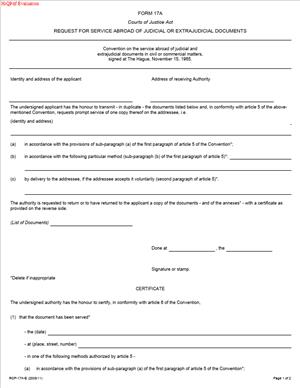
Form 17A – Request for Service Abroad of Judicial or Extrajudicial Documents
Fill out nowJurisdiction: Country: Canada | Province or State: Ontario
What is a Form 17A – Request for Service Abroad of Judicial or Extrajudicial Documents?
Form 17A is the Ontario Superior Court of Justice form you use to request official service of court documents in another country. It is the standard request used when you need a foreign public authority to serve your documents on someone outside Canada. It covers both judicial documents (like a statement of claim, notice of action, notice of application, or motion materials) and extrajudicial documents (like a demand letter or a notice required by contract or statute).
The form follows an internationally recognized model. It tells the foreign authority who you are, what documents you need to serve, who the recipient is, and the method of service you request. It also includes a “Summary of the document to be served” and a “Notice to the addressee,” which help the recipient understand what the documents are about and what they must do next. The form also anticipates a “Certificate” section that the foreign authority completes and returns. That certificate is your proof of service for filing in Ontario.
Who typically uses this form?
Lawyers acting for plaintiffs often complete and sign it. Corporate counsel use it as well when their company sues or is involved in a proceeding that requires cross‑border service. Government lawyers use it in regulatory or civil enforcement matters. You can also use it if you are self‑represented. In that case, you may ask the court registrar to sign and seal the request as the forwarding authority. Many foreign authorities accept requests signed by counsel. Some prefer a court signature and seal. Using the registrar’s signature and court seal helps avoid refusal.
You would need this form when the recipient is outside Canada and you cannot serve them using domestic methods alone. Ontario’s Rules of Civil Procedure allow service outside Ontario in specified cases. But the service must still be valid where the person is located. Rather than hire a private agent abroad, you can use the formal cross‑border service channel. Form 17A is the gateway to that channel.
Typical usage scenarios include a plaintiff serving a statement of claim on a supplier located outside Canada; a lender serving an application record on a guarantor who moved abroad; a family-owned business serving an originating process on an overseas shareholder; or a judgment creditor serving a motion to enforce a domestic judgment against assets abroad. It also covers non-court documents when you must deliver a formal notice in a civil or commercial matter and want proof that meets court standards.
In short, Form 17A makes your request official. It packages your documents, translation (if required), and instructions for service in a format foreign authorities expect. When service is complete, you receive a certificate that Ontario courts recognize as reliable proof.
When Would You Use a Form 17A – Request for Service Abroad of Judicial or Extrajudicial Documents?
You use Form 17A when your defendant, respondent, or notice recipient is physically outside Canada. If you issued a statement of claim in Ontario and the defendant resides elsewhere, you cannot simply mail it and hope for the best. You need a method that the foreign country will recognize as valid. Form 17A requests that the country’s designated authority serve your documents in a manner that fits local law.
For example, say your Ontario company sues a distributor who operates abroad. You have a valid Ontario claim. The distributor has no agent for service here. Using Form 17A, you ask the foreign authority to serve the distributor at its foreign business address. You can request formal service, which means service done in a way recognized under that country’s law. The authority then returns a certificate stating if, when, and how service was made.
If you are a landlord and your former tenant moved abroad, but you need to serve a claim for damages, Form 17A gives you a reliable channel to reach the tenant. If you are a franchisor serving a notice of default on a franchisee who relocated outside Canada, you can use Form 17A for an extrajudicial document so you can later prove delivery. If you are an estate trustee serving a notice to an heir who lives abroad, the same tool applies.
Law firms use Form 17A regularly for commercial disputes, product liability claims, class proceedings, and shareholder litigation when defendants or witnesses are outside Canada. Insurers use it in subrogated actions with foreign insureds or third parties. Individuals use it in civil claims such as defamation or negligence where the defendant resides abroad. Government bodies use it for civil enforcement or cost recovery when a party is outside Canada.
You also use Form 17A when a treaty or local law in the destination country restricts private service. In some countries, private process servers cannot serve court documents, or service by mail is not accepted. The safest approach is to request formal service through the public authority. Form 17A is designed for that.
Finally, you use Form 17A when you want a certificate of service that Ontario courts will accept without a fight. The certificate comes from a foreign authority. It is clear, standardized, and reliable. It removes guesswork and avoids later challenges to service.
Legal Characteristics of the Form 17A – Request for Service Abroad of Judicial or Extrajudicial Documents
Form 17A itself is not a pleading or a court order. It is a prescribed request form under Ontario’s Rules of Civil Procedure. Its legal weight comes from two places. First, Ontario’s rules recognize this channel for service abroad. Second, the receiving country treats the request as a formal call to serve documents in accordance with local law. The result is a service that is both recognized in that country and accepted by the Ontario court.
Is it legally binding? The request compels no action by itself. But when the foreign authority carries out service, the process becomes legally significant. The authority returns a certificate that states whether the service occurred, the date, the method used, and any reasons for failure. Ontario courts rely on that certificate as proof of service or attempted service. That makes your proof of service clear and difficult to challenge.
What ensures enforceability is compliance with both systems. Your request must meet Ontario requirements and fit the destination country’s service rules. That is why the form asks for the address in the foreign country, the exact identity of the recipient, and the method of service requested. It also anticipates translation needs. Many countries require a translation of the documents into the official language of that country. If you do not provide the translation when required, the authority may refuse service, or the recipient may validly refuse to accept the documents. The notice in the form advises the recipient of their right to refuse documents not in a language they understand. Supplying proper translations avoids that problem.
Another legal point is method selection. The form allows you to request formal service under the foreign law, informal delivery if allowed, or delivery by mail where accepted. Some countries restrict service by mail or informal delivery. If you pick a method that the destination country does not allow, the service may be refused or declared invalid. To protect your case, request formal service unless you have firm reasons to do otherwise.
Timelines also matter. Serving an originating process abroad can take time. Ontario has service deadlines for originating processes. Courts understand that international service can be slow. You should move quickly, track the request, and seek an extension from the court if needed. When the certificate returns, file it promptly. It will start or confirm litigation timelines such as defence deadlines.
Privacy and data rules apply. You should include only the necessary personal data. Ensure the address is complete and accurate. Providing more than one address can confuse the authority. If you have multiple possible addresses, consider separate requests or a court order for substituted service if appropriate.
Finally, cost is a legal consideration. Some countries charge fees for service. Payment must meet the destination authority’s requirements. If you fail to provide payment in the required form or currency, the authority may decline the request. Ontario courts will expect you to have followed the destination country’s procedures, including fees.
How to Fill Out a Form 17A – Request for Service Abroad of Judicial or Extrajudicial Documents
Follow these steps to prepare, submit, and complete Form 17A correctly.
1) Confirm you need cross‑border service
Decide whether the recipient is outside Canada and needs formal service for your Ontario case. Check your claim or application. Confirm that the Ontario Rules allow service outside Ontario for your claim. If the recipient is outside Canada, you should use Form 17A unless you have a court order for an alternate method or a valid contractual agent for service.
2) Identify the forwarding authority and signer
Decide who will sign the request. If you are a lawyer licensed in Ontario and acting for a party, you can sign. Include your full firm address, phone, and email. If you are self‑represented, ask the court registrar to sign and affix the court seal as the forwarding authority. This helps avoid refusal by foreign authorities that require a court seal.
3) Gather the documents to be served
Prepare the exact documents to be served. For a statement of claim, include the issued claim with court seal, any schedules, and any required notices. For a notice of application, include the issued notice and supporting materials if you want them served. For an extrajudicial document, include the notice letter and any attachments. Assemble clean, legible copies. Some authorities require two complete sets. Plan to include two sets to avoid delay.
4) Determine translation needs
Check whether the destination country requires translation of judicial documents into the official language used there. If you are not certain, assume a translation is required. Use a qualified translator. Obtain a translator’s declaration that states their name, qualifications, the language pair, and a statement that the translation is true. Attach the translation to each set. Include the translation of the Form 17A “Summary” and “Notice to the addressee” sections in the language used for service.
5) Complete the “Request” section
Fill in your name and address as the requesting authority. Provide your file reference for tracking. Include the name and address of the authority to whom the request is addressed if known. If not, leave that line for the central authority of the destination country. Identify the court proceeding in Ontario. State the court name (Ontario Superior Court of Justice), the court file number, and the nature of the document (for example, Statement of Claim). Identify whether the document is judicial or extrajudicial. Provide the full name and address of the party requesting service (your client). Provide the full name and address of the person to be served. Use a complete residential or business address. Do not use a post office box unless that is the only known address and local law permits it.
6) Choose the method of service
Tick the option for formal service under the destination country’s law, unless you have a clear reason to choose informal delivery or mail. Formal service is the safest default. If you select mail or informal delivery, ensure that the destination country accepts it. If you request a specific method (such as personal service by an officer), describe it in the request.
7) Add details for service and costs
Provide any special instructions, such as office hours when the recipient is present, gate codes, or multilingual issues. If the destination country charges a fee, state that you will pay the costs and include the payment form required. Some authorities require a bank draft in local currency or a service voucher. If you do not include fees in the correct form, your request may be returned.
8) Complete the “Summary of the document to be served”
This summary is for the recipient. Write a clear summary in plain language. Identify the parties, the court, the nature of the proceedings, and what the recipient must do. Include deadlines. Keep it brief but specific. If you are serving an originating process, state how many days the recipient has to deliver a defence or to respond under Ontario rules. If you provide a translation, make sure the summary and the notice are translated too.
9) Complete the “Notice to the addressee”
This notice tells the recipient about their rights. It explains that they can refuse to accept documents if they are not in a language they understand. It also warns that if they do accept the documents, timelines may begin to run. Use the standard wording in the form. Ensure the notice is in a language the recipient understands, or in an official language of the destination country if required.
10) Prepare exhibits and schedules
Attach the documents to be served as numbered schedules. For example, Schedule A: Statement of Claim; Schedule B: Translation; Schedule C: List of Exhibits. If serving an application, list the notice of application as one schedule and the supporting affidavit as another. Keep your package organized. Use tabs or clear separators. If you include a translator’s declaration, mark it as a schedule.
11) Sign and seal the form
Sign the request in ink. Print your name and role below your signature. If possible, have the Ontario court registrar sign and affix the court seal on the request. A court seal increases acceptance abroad. Date the form. Keep a copy for your records. If you are a lawyer, include your firm’s stamp if you use one. The form anticipates a seal or stamp of the forwarding authority.
12) Assemble the service package
Include the following in your package:
- The original signed Form 17A.
- Two sets of the documents to be served, each with translations if required.
- The “Summary” and “Notice” are in the appropriate language.
- The required fee in the correct form and currency, if applicable.
- A prepaid return envelope to your office for the certificate.
- Your contact information for questions.
13) Send the request to the destination authority
Send the request directly to the foreign service authority for the destination country. Use a reliable courier that allows tracking. Do not email or fax unless the destination authority explicitly accepts it. Keep proof of delivery. Record the courier tracking number, delivery date, and recipient.
14) Track progress and follow up
International service takes time. Typical ranges are several weeks to a few months. Check the status after a reasonable period. If you provided a reference number, use it when you inquire. If the authority needs more information, respond quickly. If the authority requests additional fees or an updated address, provide them promptly.
15) Receive and review the certificate of service
When service is completed, the authority issues a certificate. It states the date, place, method, and person served. It also states reasons for any failure. Review the certificate carefully. Confirm the details match your request and the recipient. If the service failed, decide on your next step. You can correct the issue and resend, or seek a court order for substituted service if justified.
16) File proof of service in Ontario
File the certificate with the Ontario Superior Court of Justice. The certificate serves as proof of service. Attach it to an affidavit if your local practice requires it. Update your litigation calendar. Defence deadlines generally run from the date of service. If the recipient is abroad, consider whether extended response times apply under Ontario rules. Serve the certificate on other parties if needed.
17) Manage deadlines and next steps
Once service is proven, move your case. If the defendant does not respond in time, you may seek default judgment where available. If the defendant appears, proceed under the timetable set by the rules or the court. Maintain your file copy of the Form 17A, the courier proof, and the certificate. These documents will be important if the service is contested.
18) Avoid common pitfalls
Use a full, accurate foreign address. Inaccurate addresses cause the most failures. Include translations when needed. If in doubt, translate. Choose formal service unless you are sure a lighter method is allowed. Include the correct fee in the required form. Do not rely on email or private delivery unless the destination country expressly allows it. Ensure the “Summary” and “Notice” are clear and in the right language. Get the court seal on the request if possible.
19) Special notes on extrajudicial documents
If you are serving a non‑court notice, explain its purpose in the “Summary.” State any deadline for response or cure if the notice is a condition precedent to starting a claim, service proof matters. Using Form 17A for extrajudicial service gives you a certificate you can use later to show you complied with the notice requirement.
20) Costs and budgeting
Budget for translation, courier, and foreign service fees. Translation can be a major cost if your materials are extensive. Consider whether you must serve supporting affidavits now, or whether serving the originating process alone is enough. Serving fewer documents can reduce translation cost while meeting minimum service requirements. Confirm that any later documents can be served domestically or electronically once the defendant appears.
Practical example: You issued a statement of claim against a manufacturer located outside Canada for breach of contract. You complete Form 17A, select formal service, and attach two sets of the claim and translation. You request the court registrar to sign and seal the form. You courier the package to the foreign authority with the fee in the required currency. Two months later, you receive a certificate stating personal service was made at the manufacturer’s registered office. You file the certificate. The defence deadline runs from the date of service set out in the certificate. You proceed with your case, confident that the service is valid.
Another example: You need to serve a notice of intention to arbitrate as required by contract, and the counterparty has relocated abroad. You complete Form 17A for an extrajudicial document. You provide a clear summary and deadline for response. You include translations. The authority serves the notice and returns a certificate. If the counterparty later disputes the notice, you have reliable proof.
If service fails because the address is unknown, consider a court motion for substituted service. The certificate’s “reason for failure” will help you show the court you tried diligently. The court can order service by another method, such as email or service on counsel, where appropriate.
Handled correctly, Form 17A gives you a reliable, court‑recognized path to serve documents abroad. It aligns your Ontario case with foreign service rules, produces a clean certificate of service, and reduces the risk of a successful challenge.
Legal Terms You Might Encounter
- Requesting party means you, the person asking for service abroad. On Form 17A, you identify yourself and your role in the case. Make sure your contact details are complete, since the foreign authority may contact you about costs or questions.
- Party to be served is the person or organization abroad who must receive the documents. You must provide a complete physical address for this party. Form 17A requires exact names and addresses, so confirm spelling and legal names.
- Judicial documents are court-issued materials, like a claim, motion, order, or judgment. You use Form 17A to send these documents abroad for formal service. Include the document titles and dates in the form.
- Extrajudicial documents are non-court papers that still relate to a legal matter. Examples include a demand letter or a settlement offer. Form 17A can request the service of these, if allowed by the receiving country.
- Method of service describes how the documents will be delivered. Options can include personal delivery, official service by a public officer, or another accepted method. Form 17A asks you to select or describe the requested method. The final method used depends on the receiving country’s rules.
- Forwarding authority refers to the Ontario court office that transmits your request abroad. You file Form 17A there with your documents and translations. The court office then sends the package to the appropriate authority in the receiving country.
- Receiving authority means the designated authority in the foreign country that handles incoming requests. It arranges service under its domestic rules. It will issue proof of service or explain why service failed.
- Certificate of service is the official proof that service occurred. The foreign authority issues it and returns it to Ontario. You file the certificate in your case to prove proper service.
- Translation refers to converting the documents into the language required by the receiving country. Form 17A has a field to confirm if you attached translations. If you skip needed translations, the foreign authority may refuse service.
- Costs of service are the fees charged by the receiving country. These can include process server fees or administrative fees. On Form 17A, you agree to pay those costs. You may need to pay in advance or upon invoicing.
FAQs
Do you need Form 17A for every document served abroad?
Use Form 17A when you need formal service of documents in another country. If you only need to send documents for information, consider regular delivery methods. Check your procedural rules if you are unsure. When in doubt, use formal service to protect your case.
Do you need a full address for the person abroad?
Yes. You must provide a complete street address. P.O. boxes are rarely acceptable for service. If you have only partial details, pause and investigate. Confirm the address through reliable sources before filing Form 17A.
Do you need translations?
Often, yes. Many countries will not serve documents unless they are in the official language of that country. Even if English or French is widely understood, translation may still be required. Include a translator’s name and a translator’s certificate if available.
How long does service abroad take?
Expect several weeks to several months. It depends on the receiving country’s workload, local rules, and the method used. Build extra time into your litigation schedule. Track the date you filed Form 17A and follow up if you hear nothing for a while.
Who pays the service costs?
You do. Form 17A includes an undertaking to pay the foreign authority’s fees. Ask the court office about local fees and confirm any foreign costs. Be ready to provide a payment method acceptable to the receiving country.
Can you serve by email or mail instead?
Sometimes. Some countries accept alternative channels for certain documents. Others do not recognize them as a valid service. Using an unapproved method can invalidate the service. If you need speed, ask the court for directions before choosing email or mail.
Where do you file Form 17A?
File it with the Ontario court office where your case is filed. Bring all required copies, translations, and the fee. The court office will forward the materials under the accepted international channel to the receiving country.
What happens if the address is wrong or the person has moved?
Service will likely fail. The foreign authority may return the package or report non-service. Find the correct address and submit a new Form 17A. If time is tight, consider asking the court to extend deadlines for service.
Checklist: Before, During, and After the Form 17A – Request for Service Abroad of Judicial or Extrajudicial Documents
Before signing
- Confirm the court file number and court location.
- Gather full legal names for all parties.
- Verify the complete foreign address, including postal code.
- Confirm the country and province/state of service.
- List each document to be served with exact titles and dates.
- Obtain certified copies if required by the receiving country.
- Arrange translations by a qualified translator if needed.
- Prepare a translator’s certificate or affidavit, if available.
- Confirm the number of document sets required.
- Identify any local service preferences or restrictions abroad.
- Prepare a payment method for foreign costs.
- Create a cover sheet with your contact details for questions.
- Calendar estimated timelines and follow-up dates.
During signing
- Check that the court file number matches your case.
- Confirm that the requesting party’s name and address are accurate.
- Verify the party-to-be-served name and full address.
- Ensure the selected service method is allowed, if requested.
- List each document clearly in the form’s description fields.
- Confirm languages used and note attached translations.
- Include the translator’s details if you attach translations.
- Complete the undertaking to pay foreign costs.
- Add any special instructions needed for local law.
- Sign and date the form. Print your name clearly.
- Ensure any required court seal or endorsement is applied.
- Attach all documents and translations in the correct order.
- Make copies of everything for your records.
After signing
- File the package with the Ontario court office handling your case.
- Pay any court transmission fees.
- Ask the clerk how tracking will work for the request.
- Record the date of filing and any reference numbers.
- Note the expected timeframe for the foreign authority’s response.
- Monitor for updates, returned mail, or inquiries.
- If costs are requested by the foreign authority, pay promptly.
- When you receive the certificate of service, file it in your case.
- Serve the certificate on other parties if your rules require it.
- Update your litigation timeline based on the service date.
- Store copies of the form, documents, and proof of service.
- If service fails, correct the issue and resubmit a new request.
Common Mistakes to Avoid
- Don’t forget the full address. An incomplete or inaccurate foreign address almost always leads to failure. Consequence: delay, extra cost, and a possible need to re-serve from scratch.
- Don’t skip translations. If the receiving country requires them, your request may be refused. Consequence: the entire package returns unserved, and deadlines may be missed.
- Don’t list the documents vaguely. “Court papers” are not enough. Consequence: the authority may not understand what to serve, causing delay or rejection.
- Don’t ignore cost undertakings. If you fail to cover fees, the service can stall. Consequence: the foreign authority may hold the request or return it unexecuted.
- Don’t mismatch names and file numbers. Inconsistent names or wrong file numbers create confusion. Consequence: misfiled documents, delay, or proof of service that does not match your case.
What to Do After Filling Out the Form
- File the package with the Ontario court office where your action is pending. Include Form 17A, the documents to be served, translations, and any supporting translator certificate. Ask the clerk to confirm the forwarding process and any local fees.
- Record the filing date and any reference numbers. Place a follow-up date on your calendar based on the estimated turnaround. Service abroad can be slow. Build flexibility into your schedule.
- Respond to any requests from the receiving country. They may ask for extra copies, proof of translation, or additional fees. Provide what is requested promptly to avoid further delay.
- If your address for the party to be served was uncertain, monitor closely. If the package returns unserved, investigate quickly and refile with an updated address. Consider asking the court for more time to serve if needed.
- When the certificate of service arrives, review it carefully. Confirm the name and address match the party. Confirm the date and method of service. File the certificate with the court. Keep certified copies for your records.
- If the certificate reports failure, fix the issue identified. This could be an incorrect address, a missing translation, or a local restriction on the requested method. Prepare a revised Form 17A and refile the package after correcting the problem.
- If you need to amend your request, prepare a new Form 17A. Note the changes in a short cover letter. Attach corrected documents or translations. File again with the court office and request forwarding.
- Notify other parties in your case as required. Update your litigation plan based on the service date shown on the certificate. Adjust deadlines for responding to documents or next steps.
- Store everything securely. Keep a clean copy of Form 17A, the documents served, translations, the certificate of service, and proof of payment of costs. These records may be needed to prove proper service later.
- If timelines are at risk, consider asking the court for directions or more time. Provide a short explanation of what has been done and why extra time is needed. Courts understand that service abroad depends on foreign processes.
- Finally, align your next procedural steps with the service date. For example, calculate response deadlines and hearing dates based on when the service was completed abroad. Note any country-specific response periods if relevant to your case strategy.
Disclaimer: This guide is provided for informational purposes only and is not intended as legal advice. You should consult a legal professional.