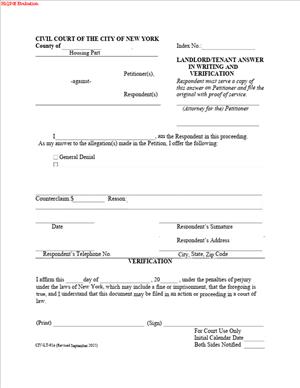
CIV-LT-91a – Landlord/Tenant Answer in Writing and Verification
Fill out nowJurisdiction: Country: United States | Province or State: New York
What is a CIV-LT-91a – Landlord/Tenant Answer in Writing and Verification?
The CIV-LT-91a is the Civil Court of the City of New York’s written answer form for landlord-tenant cases. You use it to respond to a Notice of Petition and Petition in Housing Court. In plain terms, it is your side of the story, in writing, filed with the court. It lists your defenses, any counterclaims, and the relief you want. It also includes a verification. The verification is your sworn statement that the facts in your answer are true.
In Housing Court, the landlord is the petitioner. The tenant or occupant is the respondent. The petition starts the case. Your answer meets it. If you do not answer, you risk a default. A default can lead to a judgment and an eviction warrant. The form helps you avoid that outcome. It organizes your defenses in a way the court accepts.
Who typically uses this form?
Most often, tenants and lawful occupants. That includes named tenants, subtenants, family members with succession claims, and other occupants named in the case. Attorneys use it for clients. Some small businesses also use it when they are named respondents and allowed to appear. Corporate entities usually need a lawyer. Landlords do not use this form to start a case. They file the petition. You file this form to answer it.
You may need this form if you receive court papers about rent or possession. That includes nonpayment cases, where rent is claimed to be owed. It also includes holdover cases, where the landlord seeks possession for other reasons. Examples include lease expiration, alleged violations, or owner occupancy claims. The form is the standard way to respond in writing before or on your court date. It lets you preserve defenses that you might otherwise waive. Some defenses must be raised in your first response, or they are lost. The form ensures you check the right boxes and add facts for context.
Typical usage scenarios
You get served with a Notice of Petition and Petition. The papers tell you when to come to court. You decide to answer in writing rather than only orally at the clerk’s window. You complete the CIV-LT-91a. You list defenses like “I paid,” “the rent is wrong,” or “I need repairs.” You add counterclaims, such as a claim for a rent abatement due to bad conditions. You demand a jury trial, if you want one. You sign the verification. You file the answer with the court. You bring copies and proof to your court date. The judge and the other side can then review your defenses in an organized way.
In practice, the form does three things. First, it notifies the court and the landlord of your defenses and counterclaims. Second, it preserves issues that must be raised early, like improper service. Third, it helps steer the case toward settlement, dismissal, or a hearing. Because it is verified, the court treats it as a sworn pleading.
When Would You Use a CIV-LT-91a – Landlord/Tenant Answer in Writing and Verification?
You use this form any time you are a respondent in a New York City Housing Court summary proceeding and you want to answer in writing. The most common moment is after you receive a Notice of Petition and Petition in a non-payment case. The landlord claims you owe rent. The papers tell you the hearing date. You prepare your written answer on this form before that date. You file it and bring copies to court.
You also use it in a holdover case. For example, your lease expired, and the landlord seeks possession. Or the landlord claims lease violations. Or they allege you are an unauthorized occupant. Or they say they need the apartment for personal use. You can use the form to deny the claims, raise defenses, and present counterclaims. If you assert succession rights or a regulatory status, state those facts here. If the landlord served a termination notice that you believe is defective, say so. You can ask for dismissal on that ground.
Small businesses sometimes receive nonpayment or holdover petitions for commercial spaces. If you are allowed to appear, you would answer with this form. You would state payment disputes, service issues, or lease defenses. If you are a corporation or LLC, plan to have counsel. The court may not accept a pro se filing for an entity. You can still use the form as a guide to gather facts for your attorney.
Use this form if you want a jury trial in a case where a jury is allowed. You must demand a jury in your answer, or you may waive it. Use this form to request repairs or a rent abatement. You can ask the court to reduce rent due to poor conditions. You can ask for a stay of eviction while you pay or while the landlord makes repairs. You can request a hearing on service if you were not served correctly. The form gives you a place to ask for these outcomes.
You may prefer a written answer if your case involves details. Written answers help when you have complex rent calculations, subsidy issues, or many conditions. They help when many people live in the apartment and have different claims. They help if you want to attach documents, like receipts or photos. The court can read your answer before you appear. That speeds up discussions on your court date.
You also use this form when you cannot appear before a clerk to answer orally. For example, you travel for work and can only submit papers in advance. Or you wish to consult with a tenant advocate and then file. The form gives you structure. It reduces the chance that you forget a key defense on the spot.
Legal Characteristics of the CIV-LT-91a – Landlord/Tenant Answer in Writing and Verification
This form is a pleading in a court case. It is legally binding because you file it with the Civil Court in a pending proceeding. Filing it places your defenses and counterclaims on the record. The court relies on it to frame what issues will be decided. The verification makes it more than a casual statement. You swear to the truth of the facts. A false statement can have serious consequences.
What ensures enforceability is proper filing and signature under oath. You must complete the caption and case number correctly. You must identify yourself as a respondent. You must date and sign the verification. If a notary is required, you sign in front of a notary or a court clerk. The notary completes the notary block. If the form permits an unsworn declaration, follow that text exactly. The court then treats your answer as a verified response. The other side can rely on your statements, and the judge can rule based on them.
Your answer preserves defenses that you must raise early. Those include improper service of the Notice of Petition and Petition. They also include challenges to the predicate notice in holdover cases. If you do not raise them now, you may waive them. By using the form, you can check the right box and add facts. For example, you can state that you never received the papers. You can request a hearing on service. The judge can then set that hearing.
Your answer also confirms or disputes the core claims. You can admit that some rent is due but dispute the amount. You can deny that the lease ended. You can claim protected status or succession rights. You can explain that you pay a portion of the rent because of a subsidy. You can show that the landlord misapplied payments. The court needs these facts to evaluate the case. The form is designed to capture them plainly.
You may assert counterclaims in the same case. Common counterclaims include breach of the warranty of habitability and rent overcharge. You can claim the landlord failed to provide heat or hot water. You can claim severe leaks, mold, pests, or unsafe conditions. You can ask for a rent abatement or damages. You can ask for an order to correct the conditions. Counterclaims must be specific. You should state what happened, when, and the impact on you. You should bring proof to court, like photos, HPD printouts, or receipts. The written answer helps you organize that proof.
Some cases are not eligible for a jury. If your case is eligible and you want a jury, request it in the answer. If you do not ask for a jury now, you may lose that option. The form often provides a checkbox or a line to demand a jury. This is another reason to answer in writing.
Finally, the form is part of the court record. It is governed by court rules and statutes. It must be respectful and clear. It should avoid speculation. Stick to facts you know or can prove. If you do not understand a claim, you can deny it and ask for proof. The court expects candor and accuracy in a verified answer.
How to Fill Out a CIV-LT-91a – Landlord/Tenant Answer in Writing and Verification
The goal is a complete, accurate, and timely answer. Work line by line. Use clear facts. Keep copies of everything you file. Bring one set of copies to court. Follow these steps.
Step 1: Gather your case papers and evidence
Collect the Notice of Petition and Petition. Note the return date and courtroom, if listed. Confirm the borough and Housing Court address. Find your index or LT case number if assigned. Gather your lease, rent receipts, payment records, money order stubs, and bank statements. Gather photos of conditions, HPD violation printouts, and inspector reports, if any. Collect any notices from the landlord, such as a rent demand or termination notice. Bring subsidy records if you have a voucher or public housing.
Having these documents will help you answer with specifics. You can refer to dates, amounts, and events. You can attach a short exhibit list if the form allows it. If not, still bring the documents to court.
Step 2: Complete the caption
At the top, fill in the court name: Civil Court of the City of New York. Select the correct county: Bronx, Kings, New York, Queens, or Richmond. Enter the full case title exactly as on the petition. The landlord or building entity is the petitioner. You and other named occupants are respondents. Copy names exactly, including “a/k/a” or “d/b/a” if listed. Enter the LT index number, if available. Enter the apartment address. Add the full ZIP code.
Accuracy in the caption avoids confusion and delays. If your name is misspelled on the petition, you can note the correct spelling in your answer. Still match the caption so the clerk files it under the right case.
Step 3: Identify the type of case
Confirm whether it is a nonpayment or a holdover. The petition will say. Check the correct box or write it in. This frames your defenses. In a nonpayment case, the focus is rent due. In a holdover, the focus is on possession and the predicate notice.
Step 4: State your defenses
The form lists common defenses. Check all that apply and add brief facts.
- If payment is the issue, state what you paid and when. List amounts and dates if possible. If you paid by money order, include the stub numbers. If the landlord refused payment, say so. If the rent amount is wrong, explain the error. For example, “Rent is $1,500, not $1,800. Lease attached.”
- If you did not receive a proper rent demand in a nonpayment case, state that. If you received no notice of termination or a defective notice in a holdover, say that. If you were not served with the court papers, check for improper service. Add facts about where you were when they claim service occurred. Ask for a hearing on the service.
- If the apartment has bad conditions, state them. List heat, hot water, leaks, mold, pests, broken windows, or unsafe wiring. State when the issues began. State if you notified the landlord and how. Connect conditions to your rent claim. For example, “Seek abatement of 40% from November to February due to no heat.”
- If you have a subsidy, explain it. State your share and the subsidy portion. If the landlord did not credit the subsidy, say so if the landlord changed the rent without proper paperwork, state that.
- If you claim regulated status, state whether the apartment is rent-stabilized or controlled, if you know. If you believe the landlord failed to register or overcharged, say that. Ask for a rent history review and an abatement.
- If you claim succession rights, state your relationship to the prior tenant. State how long you lived there before they left or passed away. Give dates and supporting facts.
- If you are a small business in a commercial case, state lease defenses. For example, “Landlord failed to provide required services,” or “Rent billed contrary to the ease escalation clause.”
- Keep each defense short and factual. The form has limited space. You can attach a rider if allowed. Label each paragraph clearly, such as “Defense 1: Payment,” “Defense 2: Conditions.”
Step 5: Add counterclaims, if any
Use this section to request money or other relief from the landlord. Common counterclaims include breach of warranty of habitability. State the conditions and time period. State the abatement you seek. You can also claim harassment or overcharge, if supported. In commercial cases, you might claim setoff for landlord breaches.
Be specific. “From October through January, no heat on most days. Seek 50% abatement.” “Mold in the bedroom since the leak in August. The landlord failed to repair. Seek 30% abatement for five months.” Specifics show the court you are organized and credible.
Step 6: Request relief
Say what you want the court to do. You can ask for dismissal of the case. You can ask for a hearing on the service. You can ask for repairs and an abatement. You can ask for a payment schedule based on your income. You can ask for time to move if you plan to vacate. You can ask for sealing of the case after settlement, if appropriate. You can ask for a jury trial if the case allows one. If you want a jury, request it here in clear terms. If you do not request it now, you may waive it.
Step 7: Confirm your contact details and any special needs
Fill in your phone and email if the form requests them. Provide a mailing address where you receive mail. If you need an interpreter, note your language. If you need a disability accommodation, state that you will request one. The court can arrange help when it knows your needs.
Step 8: Sign the verification
Read your answer again. Make sure it is true and complete. The verification is your sworn statement. If the form has a notary block, do not sign until a notary or clerk is present. Bring identification. The notary will confirm your identity and watch you sign. The notary will then sign and stamp. If the form provides a specific unsworn statement under penalty of perjury, follow the exact language. Date the verification. Print your name clearly. Each respondent should sign their own verification. If more than one person answers, each should sign and verify. If a minor is involved, consult with the clerk or an attorney about how to proceed.
Step 9: Attach exhibits, if allowed
Some forms allow attachments. If space permits, attach key documents. Number them. Use short labels. Examples include “Exhibit A: Lease,” “Exhibit B: Money order stubs,” “Exhibit C: Photos of ceiling leak,” “Exhibit D: Heat logs.” Keep it organized. Do not staple cash or originals. Bring originals to court and file copies. If the form does not accept attachments, bring your documents to your court date.
Step 10: File and serve as directed
File the answer with the Housing Court clerk for the correct county. File before or on your first court date. Ask the clerk if you must serve a copy on the landlord or their attorney. Some courts serve the answer when you file. Others ask you to mail or hand-deliver it. If you serve it, use first-class mail unless the judge orders another method. Keep proof of mailing. Keep a stamped copy as your file copy.
If you need more time to complete your answer, appear on the return date and ask for an adjournment. Bring a draft and your documents. Judges often allow short adjournments to complete filings, especially for pro se litigants.
Step 11: Prepare for your court appearance
Bring your filed answer and all supporting documents. Arrive early. Check in with the court officer or clerk. When you meet the landlord’s attorney, hand them a copy of your answer and exhibits if they do not have them. Be ready to discuss the settlement. You can propose a payment plan, repairs, or both. If you requested a hearing on service, remind the court. If you demanded a jury, state that on the record.
Your written answer will guide the discussion. It shows the judge what issues to address. It can help you reach a fair resolution or set the case for a hearing.
Practical examples
- If the landlord sued for $6,000 in rent but you paid $2,500, you should say so. List the payments and dates. Attach stubs or bank statements. Ask for dismissal of the excess claim and an accounting.
- If you had no heat for weeks, state that clearly. Note the dates and the impact. Ask for an abatement and an order to restore heat. Bring photos or logs showing indoor temperatures.
- If you never received the petition, raise improper service. Describe where you were when the service allegedly occurred. Ask for a hearing on the service. If the court finds bad service, the case may be dismissed.
- If your lease ended but the landlord accepted rent, state that. Acceptance after termination can be a defense in some cases. Attach proof of payment. Ask for dismissal or a finding that the tenancy continues.
- If you want a jury, demand it in the answer. If you do not demand it here, you may lose that right. Confirm with the clerk that your demand is recorded.
Common mistakes to avoid
Do not leave the verification unsigned. An unsigned answer can be rejected. Do not skip defenses you intend to rely on later. Raise service and notice defects now. Do not guess at facts. If you do not know, say so. Do not attach originals. File copies and keep your originals safe. Do not miss your court date. Filing the answer does not replace your obligation to appear.
After you file
Expect to discuss your answer on the return date. The judge may refer you to a court attorney for a settlement conference. Be open to solutions. If you settle, the agreement will be written and signed. Read it carefully. Make sure it reflects your understanding. If repairs are part of the deal, include dates and access terms. If payments are due, list amounts and deadlines. If you reserved a jury, ensure the stipulation does not waive it unless you agree.
If the case goes forward, your verified answer frames the trial. The court will consider the defenses and counterclaims you raised. If you requested a service hearing, the court will schedule it. Bring witnesses and documents. Your preparation now supports your position later.
By completing the CIV-LT-91a carefully, you protect your rights. You put key facts in front of the court. You set up your case for settlement or trial. And you avoid waiving defenses that matter.
Legal Terms You Might Encounter
- Petitioner means the party who started the case. On this form, the petitioner is usually your landlord or the owner. You will list the petitioner’s name exactly as it appears on the Notice of Petition.
- Respondent means the party that answers the case. That is you. On this form, you identify yourself and any other occupants named in the case.
- Notice of Petition is the paper that tells you when and where to appear. It also tells you how to answer. When you complete this form, copy the case number and courthouse details from the Notice of Petition.
- A petition is a paper that states the claims against you. It says why the landlord brought the case. You respond to those claims in this form by admitting, denying, or explaining.
- Predicate Notice is a notice served before the case began. It might be a rent demand or a termination notice. If the predicate notice was wrong or missing, you can raise that as a defense on this form.
- Answer is your written response to the petition. This form is your Answer. You list defenses, any counterclaims, and what relief you want the court to grant.
- Affirmative Defense is a legal reason the petitioner should not win, even if some facts are true. On this form, you check or write in defenses that fit your situation. Common defenses include improper service, overcharge, or conditions in the apartment.
- Counterclaim is a claim you make against the petitioner. You can ask for money or other relief. On this form, you state your counterclaims clearly and note the amount, if any.
- Jurisdiction means the court’s power over the case and the parties. If the papers were not served correctly, the court may lack personal jurisdiction over you. You can raise that defense on this form.
- Verification is your sworn statement that the Answer is true. The form includes a verification section. You must sign it in front of a notary public or a court clerk who can administer an oath.
FAQs
Do you need to notarize this form?
Yes. The form includes a verification that must be sworn to. Sign in front of a notary or a court clerk. Bring a valid ID. Do not sign in advance. The notary or clerk must watch you sign.
Do you have to list every defense now?
List every defense you know now. If you leave out a defense, you may not be able to add it later without permission. If you are unsure, include the defenses that may apply and explain briefly.
Do you need to attach documents?
You can attach documents that support your Answer. Useful items include your lease, rent receipts, photos, repair requests, and notices. Label each attachment and refer to it in your Answer. Keep originals and file copies.
Do you have to serve the petitioner after you file?
Follow the clerk’s instructions for service. In some parts, the clerk serves the filed Answer. In others, you must serve a copy and provide proof of service. Ask the clerk what your part requires when you file.
Do you still have to appear in court if you file this form?
Yes. Filing the Answer does not replace your court date. You must appear on the return date listed on your Notice of Petition. Bring your stamped copy and your documents.
Do you need to pay a fee to file an Answer?
You generally do not pay a fee to file this Answer. Fees may apply for some counterclaims that ask for money above certain amounts. Ask the clerk before you file.
Do you have to admit or deny each allegation?
You should respond to the petition’s key points. If something is true, you can admit it. If you disagree or lack enough information, say so. Avoid broad admissions that suggest you agree to all claims.
Do you need a lawyer to file this form?
You can file this form without a lawyer, but if you cannot, get legal help. A lawyer can help you pick the right defenses and prepare for court. If you represent yourself, read the form carefully and follow court instructions.
Checklist: Before, During, and After the CIV-LT-91a – Landlord/Tenant Answer in Writing and Verification
Before signing:
- Notice of Petition and Petition with the case number.
- Any predicate notice served before the case.
- Your lease, riders, and renewals.
- Rent receipts, ledgers, or bank statements.
- Photos or videos of apartment conditions.
- Repair requests, emails, or texts with management.
- HPD or inspection records you possess.
- Utility bills if they relate to charges claimed.
- Prior stipulations or orders for this case or unit.
- Names and contact info of witnesses.
- A timeline of key dates and events.
- Amounts you believe are wrong and why.
- ID for notarization or clerk verification.
- Interpreter or accommodation needs to be shared with the clerk.
- A pen with black or blue ink and extra copies.
During signing:
- Confirm the caption exactly matches the Petition.
- Check the borough, courthouse address, and room.
- Verify the index or L&T case number.
- Confirm your name and address are correct.
- List all respondents named in the Petition.
- Identify the type of case (nonpayment or holdover).
- State your defenses clearly and check all that apply.
- Explain facts under each defense in plain language.
- List any counterclaims and the amounts sought.
- Ask for relief, such as repairs or a rent adjustment.
- Review any attachments and label them clearly.
- Cross out blank spaces that should not be filled later.
- Review for legibility, spelling, and complete dates.
- Sign only in front of a notary or authorized clerk.
- Ensure the notary completes the full verification.
- Make at least two copies after notarization.
After signing:
- File the original with the Landlord-Tenant Clerk in the correct borough.
- Ask the clerk about service requirements for your part.
- If you must serve, serve the petitioner or their attorney as directed.
- Complete any proof of service if you served the Answer.
- Get a stamped copy for your records. Keep it clean and legible.
- Calendar the court date and set reminders.
- Prepare your documents in a folder by issue.
- Bring the stamped Answer and attachments to court.
- Plan your travel time to arrive early.
- Organize witnesses and arrange for them to appear.
- Request an interpreter or accommodations in advance if needed.
- Keep contact information for the court and opposing counsel.
- Store copies of everything in a safe place.
Common Mistakes to Avoid
- Don’t forget to notarize the verification. If you skip notarization or the oath, the court may reject your Answer. You may lose defenses if it is not accepted.
- Don’t leave the defenses section blank. If you fail to assert defenses now, you may need permission to add them later. That can cause delay or denial.
- Don’t use the wrong case number or borough. A mismatched caption can lead to misfiling. Your Answer may not reach the right file in time.
- Don’t attach originals without making copies. If the court keeps an original, you may lose it. Always file copies and keep the original safe.
- Don’t admit facts you dispute. Broad admissions can harm your case. Respond narrowly and explain your position with facts.
What to Do After Filling Out the Form
- File the Answer promptly at the Landlord-Tenant Clerk’s Office for the borough on your Notice of Petition. Bring your signed and notarized original and copies. Ask the clerk to stamp your copy and to explain local practices for service and scheduling.
- Confirm the return date and where to appear. Write down the part, room, and time. If the clerk gives you a calendar printout, attach it to your copy of the Answer. Set alerts for the date and a day before.
- If service by you is required, complete it as directed. Typical methods include personal delivery or mail to the petitioner’s attorney. Complete any required proof of service form. File it with the clerk if the part requires it. Keep a copy of your Answer.
- Organize your evidence for the hearing date. Group documents by topic: rent, conditions, notices, and communications. Number your pages. Bring at least two sets of copies. Mark attachments to match the references in your Answer.
- Plan your presentation. Prepare a short timeline. List key points you will make and the documents that support each point. Note any witnesses and what they will say. Bring contact details in case the court needs them.
- Consider settlement options on the return date. If you discuss a settlement, read any proposed agreement carefully. Make sure the dates, amounts, and conditions are clear. Do not sign if you do not understand a term. Ask the court attorney or the judge for time to read.
- If you need to amend your Answer, ask the court. You may request permission to add defenses or counterclaims. Explain why the change is needed and what it adds. Bring a revised draft if you have one.
- Follow any orders the court issues. If the court orders repairs, access dates, or payments, note each deadline. Keep proof that you complied. Save photos, receipts, and messages.
- If you receive a marshal’s notice, act quickly. Go to court right away and bring your stamped Answer and any proof of compliance. Tell the clerk about the notice and ask for guidance on your next steps.
- After court, update your file. Add the stamped Answer, proof of service, and any orders or stipulations. Write notes on what happened and what you must do next. Calendar all dates.
- If your contact information changes, notify the court and the other side in writing. Keep proof that you sent the update. Missed notices can lead to default outcomes.
- If the case is discontinued or settled, get a copy of the dismissal or stipulation. Confirm any payments or repairs in writing. Keep these records for your files.
- If you move, keep copies of everything. Future questions about charges or claims can arise. Your Answer and attachments show what you submitted and when.
Disclaimer: This guide is provided for informational purposes only and is not intended as legal advice. You should consult a legal professional.